
Applying real market trading tactics means treating every trade as a structured, rule-based decision with defined entries, exits, and risk controls tested before a single dollar goes live. Most traders lose not because their signals are wrong, but because they skip the execution layer entirely. They read about price action, watch a few setups, and jump in. The gap between knowing a tactic and deploying it profitably in live markets is where accounts go to zero. This guide closes that gap with a practical workflow covering rule definition, slippage modeling, journaling, and disciplined review.
What are the essential components of real market trading tactics?
Every tactic that survives live market contact shares the same structural DNA. Investopedia recommends writing down testable entry conditions, explicit risk limits, stop-loss logic, and paper trading 50 to 100 trades before going live. That is not a suggestion. It is the minimum viable process for knowing whether your edge is real.
Here is what every documented tactic must include:
- Entry conditions: Specific, testable triggers. Not “price looks strong” but “price closes above the 20-period EMA on a 15-minute chart with volume 20% above average.”
- Exit rules: Both profit targets and stop-loss levels defined before entry. No adjusting stops mid-trade because the position is underwater.
- Position sizing: Risk per trade expressed as a fixed percentage of account equity, typically 1% to 2%.
- Stop-loss placement: Based on market structure, not on how much you are willing to lose emotionally.
- Order types: Knowing when to use limit orders versus market orders matters. Limit orders control entry price. Market orders guarantee execution but not price.
TradeZella’s four-layer defense adds daily and weekly loss limits on top of per-trade controls, plus drawdown thresholds that trigger a mandatory pause. That layered approach prevents one bad session from becoming an unrecoverable drawdown. Think of it as a circuit breaker for your account.
Pro Tip: Write your rules in plain language first, then convert them into specific conditions. If you cannot explain the entry to someone else in two sentences, the rule is not specific enough to trade.
The Opening Range Breakout strategy is a clean example of how classic tactics become executable rules. One version tested over 25 years produced a net profit of $192,390 with a 45.61% win rate and a 1.39 profit factor, spending only 2.91% of the time in the market. The key was strict rule adherence: daily filters, intraday confirmation, one trade per day maximum, and flat positions by the close. Simplicity plus discipline beat complexity every time.
How do slippage and transaction costs affect your real results?
Real-world tactics fail more often due to execution friction than flawed signals. Slippage is the difference between the price you expected and the price you actually got. It is not random noise. It is a predictable cost you must model.

| Slippage Type | Typical Range | Primary Cause |
|---|---|---|
| Latency slippage | 0.01% to 0.05% | Delay between signal and order submission |
| Liquidity slippage | 0.05% to 0.15% | Order size exceeds available volume at best price |
| Volatility slippage | 0.1% to 0.5%+ | Fast-moving markets during news or open |
Slippage can reduce net returns by over 40% if ignored during backtesting. That number should stop you cold. A strategy that looks profitable on paper can be a net loser in live execution once you account for spread, commission, and fill quality.
Liquidity slippage is especially dangerous when scaling up. When your order size exceeds the available volume at the best price, the remaining volume fills at progressively worse prices. What works with a $10,000 account may not work with $100,000 if the instrument lacks depth.
To reduce execution cost risk, apply these tactics directly:
- Trade instruments with tight spreads and deep order books, such as EUR/USD or major equity index futures.
- Use limit orders on entries where possible to control fill price.
- Model at least 0.05% slippage per side in every backtest, even for liquid instruments.
- Avoid trading during the first and last five minutes of a session when volatility spikes and fills degrade.
Pro Tip: Run your backtest twice: once with zero slippage and once with 0.1% per side. If the strategy only works with zero slippage, it is not ready for live trading.
How to implement trading tactics from paper trading to live execution
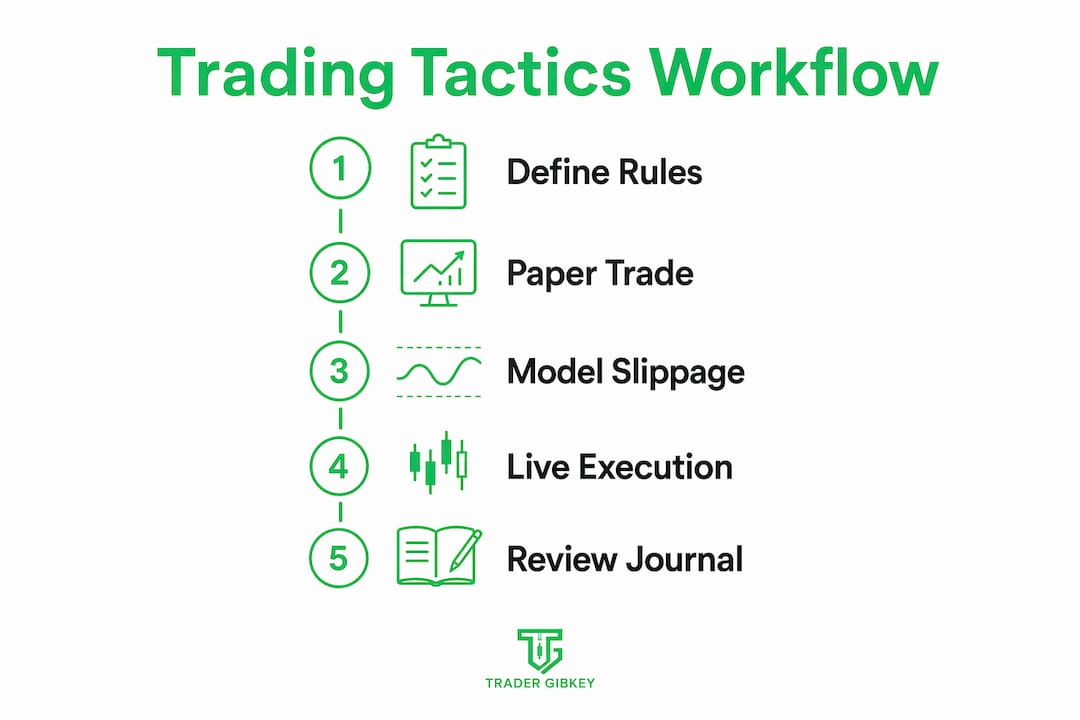
This is the process that separates traders who survive from those who blow up. It is not glamorous, but it works. Follow these steps in order and do not skip ahead.
-
Write your rules in a strategy document. Include entry conditions, exit rules, position sizing formula, stop-loss logic, and maximum daily loss limit. Date the document. Version control matters when you revise later.
-
Paper trade 50 to 100 setups. Paper trading after defining rules is the safest way to validate your plan before risking capital. Use a platform that simulates realistic fills, not best-case fills. TradingView’s paper trading mode or ThinkOrSwim’s paperMoney both work for this purpose.
-
Model realistic execution costs. Include spread, commission, and slippage in every simulated trade. Robust backtesting platforms transition from historical analysis to paper trading to live execution with realistic fills, including commissions, spreads, and slippage reconciliation. If your paper trading tool does not support this, add the costs manually to your journal.
-
Calculate your edge after 50 trades. Compute win rate, average win versus average loss, and profit factor. A profit factor above 1.3 with consistent rule adherence suggests a real edge worth pursuing live.
-
Go live with minimum position size. Start at 25% to 50% of your intended position size for the first 20 live trades. This is not about being timid. It is about confirming that live fills match your paper trading assumptions before full commitment.
-
Scale up only after confirming execution quality. Compare live fill prices to expected prices over 20 trades. If slippage is within your modeled range, increase to full size.
The workflow above is not optional. Skipping paper trading because you are confident in your signal is exactly how traders discover that confidence and edge are not the same thing.
What role does journaling play in applying trading strategies effectively?
A trading journal is not a diary. It is a performance database. Tracking planned versus actual risk using R-multiples and running weekly post-mortems gives better insight into execution quality than daily profit and loss alone. That distinction matters because daily P&L includes luck. Rule adherence does not.
Every journal entry should capture:
- Entry rationale: Which specific rule triggered the trade? Write it out, not just the ticker.
- Rule adherence score: Did you follow every rule exactly? Score it 1 to 10.
- Emotional state: Were you calm, frustrated, or overconfident before entry? This field predicts future failure modes.
- Planned versus actual risk: What was your planned stop distance versus where price actually stopped you out?
- Outcome in R-multiples: Express the result as a multiple of your initial risk, not in dollars.
Discipline scoring based on rule adherence rather than profit outcomes is the only way to distinguish true edge from luck. If you only evaluate performance on winning trades, you are measuring outcomes, not process. A trade can be profitable and still be a bad trade if it violated your rules.
The weekly post-mortem is where the real learning happens. Pull all trades from the week and compute two numbers: your overall win rate, and your win rate only on trades where you scored 8 or higher on rule adherence. If the second number is significantly higher, your edge is real and your problem is discipline, not signal quality. That is actually good news. Discipline is fixable. A broken signal is not.
Effective trading rule systems integrate audit trails that record what triggered each entry and exit, requiring traders to log rationale and outcomes systematically. That level of documentation feels excessive until the day you need to diagnose why a three-week losing streak happened. Then it becomes the most valuable thing you own.
Key takeaways
Applying real market trading tactics requires explicit written rules, realistic execution modeling, disciplined paper trading, and structured weekly review to separate genuine edge from emotional noise.
| Point | Details |
|---|---|
| Write explicit rules first | Document entry, exit, sizing, and stop-loss rules before placing any trade. |
| Model slippage in every test | Add at least 0.05% slippage per side to backtests or paper trades to reflect real fills. |
| Paper trade 50 to 100 setups | Validate your edge with simulated trades before committing real capital. |
| Journal rule adherence, not just P&L | Score every trade on rule compliance to separate process quality from luck. |
| Run weekly post-mortems | Compare rule-adherent trades to all trades to confirm whether your edge is real. |
Why execution reality beats signal theory every time
Here is what 18 years of live market experience has taught me. Most traders spend 90% of their time refining their signal and 10% on execution. The market rewards the opposite ratio.
I have watched traders with genuinely good setups blow up because they never modeled slippage, never paper traded, and never kept a journal. Their signal was fine. Their process was not. The brain stops trading the chart and starts trading the pain the moment a live position moves against you. That is when rules get abandoned and revenge trades happen.
The traders I have seen succeed long-term share one trait: they treat their strategy like a business process, not a creative act. They write things down. They review weekly. They measure rule adherence before they measure profit. Simple, rule-based approaches with consistent execution outperform complex discretionary systems almost every time. Not because the simple system has a better signal, but because it is easier to follow without deviation.
For real: the edge is in the execution, not the idea. You can have a mediocre signal and a great process and still be profitable. You cannot have a great signal and a broken process and survive long-term.
— Gabriel
How Tradergibkey helps you apply tactics in real markets

Tradergibkey was built for traders who are tired of theory that falls apart the moment the market opens. With over 18 years of live market experience, the Tradergibkey courses and mentorship program walks you through defining your own rule-based strategy, paper trading it properly, modeling execution costs, and building a journaling habit that actually improves your edge. You get structured learning, direct mentorship, and a community of traders who hold each other accountable. If you are ready to stop guessing and start applying tactics that hold up under real market conditions, Tradergibkey is where that process begins.
FAQ
What does it mean to apply real market trading tactics?
Applying real market trading tactics means executing a documented, rule-based strategy with defined entries, exits, and risk controls tested over at least 50 paper trades before going live.
How much does slippage actually affect trading performance?
Slippage can reduce net returns by over 40% if not modeled in backtests. Always include at least 0.05% slippage per side when testing any strategy.
Why is a trading journal more important than tracking profit and loss?
A journal tracks rule adherence, which separates genuine edge from luck. Weekly post-mortems comparing rule-compliant trades to all trades reveal whether your process or your signal needs fixing.