
The fastest way to collaborate on trade analysis is a process-first setup: assign roles, work off a shared chart with live annotation, keep one shared journal, and run a short review on a fixed schedule. Skip the group chat that just trades opinions back and forth. That’s not collaboration, it’s noise with extra steps.
Here’s the minimum stack to get moving today:
- One shared charting workspace with annotation tools everyone can access
- A shared spreadsheet or journal tool (Google Sheets works fine to start)
- A voice or chat channel for live commentary and questions
Your first move: book a 30-minute demo session this week. Assign an analyst, a scribe, and a reviewer, walk through one setup on the shared chart, log it in the journal, and debrief for five minutes. That single rep will teach you more about your group’s dynamics than a month of scattered chat messages.
Pro Tip: Run your first session on a demo account or with no real money at all. You want to test the process, not your nerve.
Key Takeaways
Collaborative trade analysis works best when defined roles, a shared chart and journal, and a fixed review cadence replace loose signal-sharing.
| Point | Details |
|---|---|
| Assign roles before your first session | Analyst, scribe, reviewer, and executor should be separate people to avoid single-person bias. |
| Standardize your chart setup | Export one team template, align timestamps to UTC, and use role-based permissions. |
| Log 10 to 25 journal fields | Track R-multiple, expectancy, and execution drag separately to see what’s actually working. |
| Run reviews on a fixed cadence | Daily pre-trade checks, weekly reviews, and monthly metrics meetings catch problems early. |
| Get mentor-led practice | Trader Gibkey’s guided sessions and annotated templates help groups build this process correctly from day one. |
Why Process Beats Signal-Chasing
I’ve spent more than 18 years in live markets, and the groups that last aren’t the ones with the sharpest signal caller. They’re the ones who built a boring, repeatable process and stuck to it. Chasing whoever’s hottest this month is how groups blow up their accounts together instead of growing together. Run the demo checklist above with your group this week. If you want a guided walkthrough, that’s exactly what a mentor-led session is for.
Get Hands-On Mentorship for Your Trading Group
Reading about collaboration only gets a group so far. Tradergibkey gives you what a chat group alone can’t: structured mentorship, live trading sessions, and annotated price-action examples built specifically around the roles and review cadence covered in this guide.
Inside the community, you get downloadable journal templates already formatted for R-multiple and expectancy tracking, mentor-led review sessions where an experienced trader runs the forced-challenge round for you, and access to a group of traders already running this exact process. You can also review real testimonials and case studies from traders who’ve gone through the program before committing. If your group is ready to stop guessing and start running structured reviews, visit the Trader Gibkey landing page to book a demo session or download the example templates.
Table of Contents
- Define Roles, Decision Rules, and Meeting Cadence
- Which Tools Actually Matter for Team Chart Analysis?
- What Should a Shared Trading Journal Actually Track?
- How Do You Run a Mentor-Led Review Session?
- Copyable Checklists for Your First Sessions
- Mentor-Guided Examples From Trader Gibkey
- Bringing New Members Into the Process
- Protecting Your Trade Data With Version Control and Backups
- Sources
- FAQ
Define Roles, Decision Rules, and Meeting Cadence
Most trading groups fall apart not because the analysis is bad, but because nobody agreed on who does what. Fix that first.
- Analyst prepares the annotated chart before the session, marking structure, key levels, and the setup thesis.
- Scribe updates the shared journal in real time, capturing entries, rationale, and any disagreement.
- Reviewer(s) challenge the setup, checking risk, invalidation points, and whether the thesis actually holds up.
- Risk manager or executor confirms position size and pulls the trigger, separate from the person who found the idea.
Splitting these roles matters because the person who falls in love with a setup should never be the only one deciding whether to take it. Groups that skip this step tend to drift toward groupthink, where everyone nods along instead of stress-testing the idea.
Set decision rules before you need them:
- Require at least one dissenting comment before any trade gets approved
- Use a simple majority vote, with the risk manager holding tie-break authority
- New members vote on demo trades only until they’ve logged 20 sessions
For cadence, keep it realistic. A 10 to 15 minute pre-trade check each morning, a 30 to 60 minute weekly review, and a 60 to 90 minute monthly metrics meeting cover most retail schedules without burning anyone out.
Which Tools Actually Matter for Team Chart Analysis?
Not every charting platform is built for group work, and the wrong one will quietly sabotage your process. Look for shared real-time charting with these specific features:
- Live annotation layers everyone in the group can draw on simultaneously
- Synchronized templates so indicators and timeframes match across every screen
- Role-based permissions, so only the analyst or executor can move key lines
- Audit logs that timestamp who drew what and when
- Alert-to-chat integration that pushes price triggers straight into your group channel
Configuration takes about 20 minutes and saves hours of confusion later. Export your team’s chart template once everyone agrees on indicator defaults, then have every member import it rather than rebuilding their own version. Align every timestamp to UTC. A trader in one time zone reading “the London open” differently than a mentor three zones away is a quiet, recurring source of misread setups. Set alert cool-downs so the channel doesn’t flood during volatile sessions.
For communication, match the channel to the moment: voice or video for live trade execution, threaded text chat for recorded commentary and post-trade notes, and pinned threads per chart so historical context doesn’t get buried.
Pro Tip: If your group uses Discord, Slack, or Telegram, create a dedicated channel per currency pair rather than one firehose feed. It makes the audit trail searchable months later.
What Should a Shared Trading Journal Actually Track?
A journal with 10 fields will get a new group off the ground. A serious mentor-led group eventually needs closer to 25. The 25-field professional template groups fields into setup context, execution details, and outcome metrics, then reviews them on a daily, weekly, and monthly rhythm to reveal whether a losing streak is a system problem or a discipline problem.
At minimum, log these fields for every trade:
| Field Category | What to Record |
|---|---|
| Date and session | Entry date, session (London, New York, Asian) |
| Pair and setup tag | Currency pair, named setup type |
| Entry, stop, target | Exact prices for each |
| Planned risk | Position size and dollar or percentage risk |
| Result and R-multiple | Actual outcome expressed as a multiple of risk |
| Execution notes | Slippage, hesitation, deviation from plan |
Calculate R-multiple by dividing your actual profit or loss by your initial risk amount. Expectancy is the average R-multiple across a batch of trades for one setup. Don’t fold spread and slippage into the same number you use to judge the setup’s edge. Execution drag deserves its own column so you can tell whether a strategy is broken or whether someone is just entering late.
Weekly reviews should produce per-setup expectancy. Monthly reviews should compile that into comparison tables across setups. Quarterly, run a full strategic audit and decide what to keep, retire, or refine.
How Do You Run a Mentor-Led Review Session?
A review session without structure turns into either a blame session or a group hug. Neither improves decision quality. Use this flow instead.
- Before the session, select one to three focal trades, export the relevant journal rows, tag them by session and setup, and prepare annotated screenshots of the entry and exit.
- During the session, the trader who took the trade presents their rationale first, unedited. Reviewers then run a forced-challenge round, questioning the entry trigger, stop placement, and whether the setup matched its own rules.
- The scribe records every action item in real time, tied to a timestamped chart annotation so nobody has to reconstruct context later.
- After the session, assign an owner to each action item, update journal tags to reflect what was learned, and schedule a follow-up date to check whether the correction stuck.
Keep a short, visible audit log of past sessions. It stops the same mistake from resurfacing every few months under a different excuse.
Pro Tip: Have reviewers write their critique before hearing anyone else’s. It cuts down on people just agreeing with whoever spoke first.
Copyable Checklists for Your First Sessions
Paste these into your group’s shared doc and start using them this week.
5-item demo session checklist:
- Assign roles (analyst, scribe, reviewer, executor)
- Export the chart and journal entries from the prior session
- Annotate the current setup on the shared chart
- Vote using your decision rule before any entry
- Record the outcome and lesson in the shared journal
Minimal 10-field journal: date, pair, session, setup tag, entry, stop, target, planned risk, result, execution notes. Graduate to the 25-field version once your group is logging consistently.
Anti-groupthink checklist:
- Require at least one dissenting voice before approving a trade
- Rotate who acts as analyst each week
- Time-box agreement discussions to five minutes to avoid endless debate
Groups that start with demo accounts, keep strict, attributed records, and only scale capital once the process shows positive expectancy tend to survive their first drawdown instead of dissolving over it.
Mentor-Guided Examples From Trader Gibkey
Two short cases show how the process plays out in practice. In one, an analyst flagged a bullish flag on a major pair, the reviewer challenged the stop placement as too tight given recent volatility, the group widened it by a few pips, and the trade closed at +1.8R instead of stopping out on noise. The lesson logged: stop distance needs a volatility filter, not just a fixed pip count.
In another, a trader wanted to skip the forced-challenge round because “the setup was obvious.” The reviewer insisted anyway and caught a conflicting higher-timeframe trend. The trade was skipped, and the pair reversed hard within the hour.
Students who go through this process consistently describe the same shift: less anxiety around entries, more confidence in why a trade was taken. You’ll find full annotated mentor-led examples and downloadable journal templates on Trader Gibkey’s site.
Bringing New Members Into the Process
Every group eventually adds someone new, and how you onboard them determines whether they strengthen the process or quietly undermine it.

Start new members as observers for their first two to three sessions. They watch the analyst present, see how the forced-challenge round works, and read back through recent journal entries before they’re allowed to vote. This isn’t gatekeeping, it’s calibration. Someone who hasn’t seen your group’s decision rules in action will either stay silent when they should challenge something, or push back on a rule they don’t yet understand.
Give every new member a short onboarding packet: your role definitions, your decision rules, your journal template, and two or three annotated past sessions to review on their own time. Walk them through how to share trade ideas constructively so their first contributions land as useful challenges rather than vague opinions.
Limit new members to demo-account votes for their first 20 logged trades, the same rule that applies to any first-time participant. It protects the group’s capital while the new person learns the rhythm, and it gives them a low-stakes way to build a track record inside the group before their vote carries full weight.
Rotate a mentor or senior member into a brief check-in with each new addition after their first month. Ask what’s unclear, what feels slow, and what they’d change. Groups that skip this step tend to lose new members quietly around week three, right when they’d otherwise start contributing real value.
Protecting Your Trade Data With Version Control and Backups
A shared journal that lives in one person’s local spreadsheet is a single point of failure waiting to happen. Treat your trade data with the same seriousness you’d give a trade itself.
Use a cloud-based journal tool or a shared Google Sheet with version history turned on, so every edit is timestamped and attributed to whoever made it. This does double duty: it’s your backup, and it’s an audit trail if a dispute ever comes up about who changed what.
Export a full copy of the journal weekly, not just monthly. A weekly cadence matches your review schedule anyway, so it costs nothing extra and gives you a recovery point if the shared file gets corrupted or someone accidentally deletes a quarter’s worth of rows.
Assign one person, usually the scribe, as the backup owner. Their job isn’t to guard the data jealously, it’s to make sure a second copy exists somewhere outside the primary tool, whether that’s a downloaded CSV in shared cloud storage or a duplicate sheet updated on a fixed schedule.
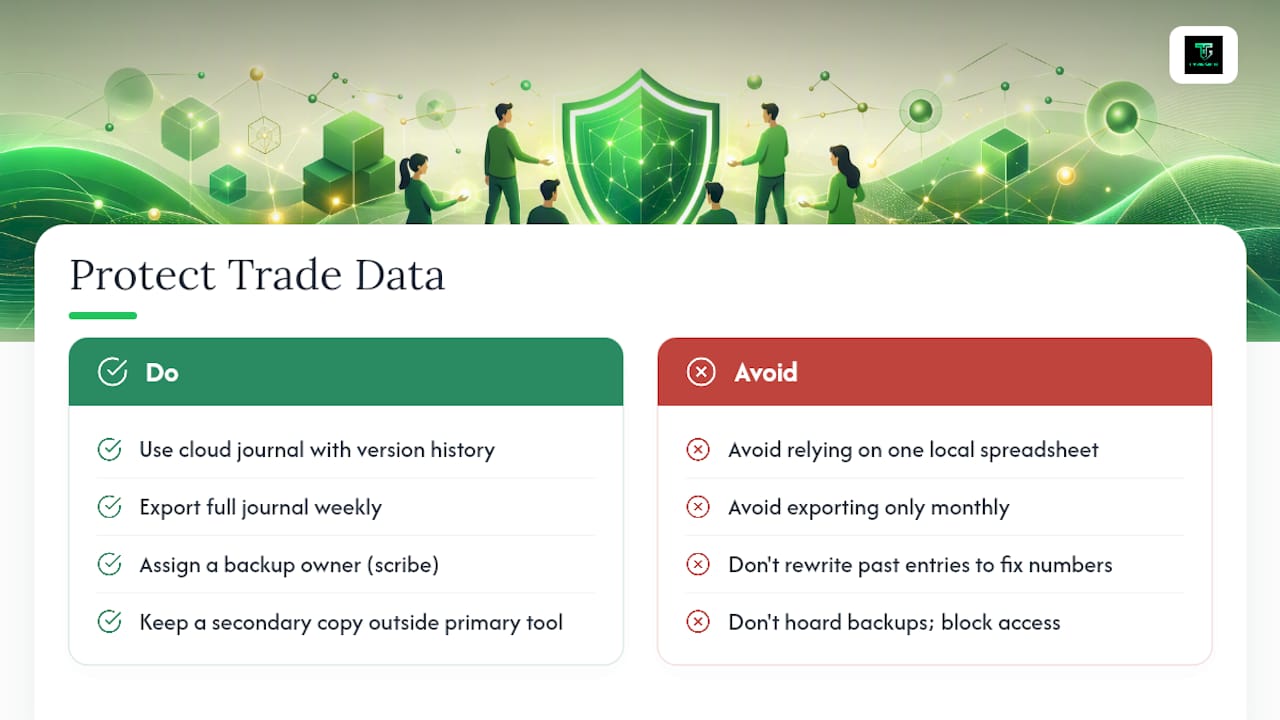
Lock historical rows once a month closes. Editing last month’s entries to “fix” a number after the fact defeats the purpose of tracking expectancy honestly. If a correction is genuinely needed, log it as a new annotated entry rather than quietly rewriting history.
Sources
- TurtleTrader — bias and groupthink
- Trade journal & metrics – R-multiple, expectancy, MAE/MFE | Forex course
- Collaborative trading strategies — FXCC blog
FAQ
How many people should a trade analysis group have? Three to six works best. Fewer than three means no real challenge round; more than six slows decisions down.
Can we collaborate without a paid charting platform? Yes, many free platforms support shared annotation, but check for role permissions and audit logs before committing your group’s workflow to one.
How often should we review our trade journal together? Weekly for per-setup performance, monthly for comparison across setups, and quarterly for a full strategic audit.