
A beginner forex trading plan is a written set of rules that guides every trading decision you make, from entry and exit criteria to how much capital you risk per trade. Without one, you are not trading. You are guessing. Most new traders lose money not because the market is impossible to read, but because they have no structure holding their decisions together. Learning to create a beginner forex trading plan is the single most important step you can take before placing your first real trade. This guide walks you through every component, every common mistake, and the exact process to build yours from scratch.
What are the key elements of a beginner forex trading plan?
A trading plan is the industry term for what many beginners call a “strategy document.” The two are not the same thing. A strategy tells you when to enter. A trading plan tells you everything else, including how much to risk, when to stop trading, and how to review your performance afterward.
Here are the core components every beginner plan must include:
- Trader profile and goals. Define whether you are trading to learn or to generate income. These require different expectations. A learning goal might be “execute 30 trades with 100% rule adherence.” An income goal without a learning foundation is a fast path to blown accounts.
- Currency pairs and sessions. Pick one or two pairs to start. EUR/USD and GBP/USD are the most liquid and widely analyzed. Choose a session that fits your schedule. The London and New York overlap (8:00 a.m. to 12:00 p.m. EST) offers the highest volume for most major pairs.
- Entry and exit rules. Clear, objective entry rules are non-negotiable. Vague intentions like “buy when it looks bullish” will fail under pressure. Write exact criteria: a specific candlestick pattern at a key level, a moving average crossover, or a price action signal at support.
- Risk management rules. Risking no more than 1–2% per trade protects your account from a losing streak wiping you out. This is not optional. It is the foundation everything else sits on.
- Position sizing. Calculate your lot size based on your account balance, the distance to your stop loss, and your risk percentage. Do this before every trade, not after.
- Stop loss and take profit placement. Stop losses must be placed at logical market structure levels, not arbitrary pip counts. Your take profit should give you at least a 1:2 risk-to-reward ratio on every trade.
Pro Tip: Write your plan in a physical document and sign it. Treat it as a contract with yourself. Research confirms that signing your plan and reviewing it before each session significantly reduces emotional override.
Simple, rule-based plans that you can execute mechanically under stress outperform complex systems every time for beginners. Complexity is not sophistication. For new traders, it is a liability.

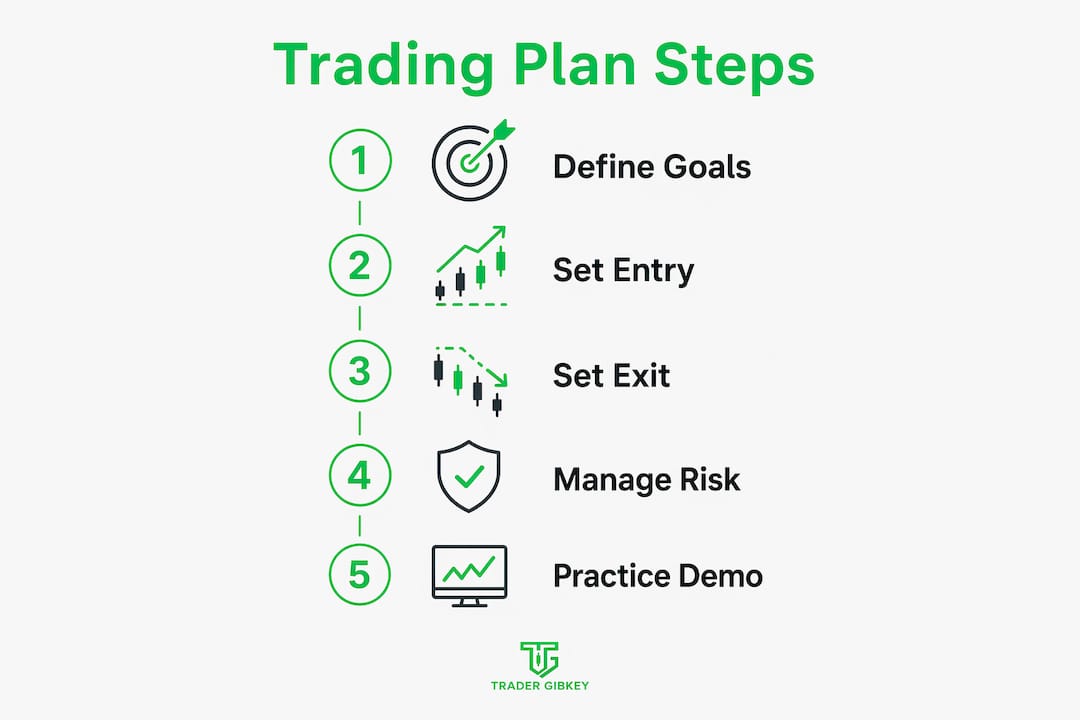
How to develop your trading plan step by step
Building a plan is a process, not a one-time event. Follow these steps in order. Skipping ahead costs you more time in the long run.
-
Start with education and demo practice. Before you write a single rule, spend time learning forex trading basics. Then open a demo account and practice for at least 2–3 months before touching real capital. This is not a suggestion. It is the minimum required to understand how the market moves and how your emotions respond to it.
-
Build a trade journal from day one. Record every demo trade: the pair, the setup, the entry price, the stop loss, the take profit, and the outcome. Add a note on your emotional state. A trade journal transforms emotional trades into data you can actually learn from.
-
Draft your formal plan document. After two to three weeks of demo trading, write your plan. Include every component from the section above. Be specific. “I will enter a long trade on EUR/USD when price forms a bullish engulfing candle at a daily support level during the London session” is a rule. “I will buy when it looks good” is not.
-
Run a 30-trade demo campaign. Execute exactly 30 trades focused on 100% adherence to your plan rules. Profit and loss do not matter here. Following your rules matters. This campaign builds the habit of discipline before money is on the line.
-
Evaluate your results honestly. After 30 trades, review your journal. Where did you deviate from the plan? What setups worked? What did you avoid? This review tells you whether your strategy has an edge or needs adjustment.
-
Transition to live trading with micro-lots. Start with the smallest position sizes your broker allows. The goal is to experience real money emotions while keeping risk minimal. Many brokers allow micro-lot trading starting at 0.01 lots.
-
Review and refine on a schedule. Set a weekly review appointment with yourself. Treat it like a meeting you cannot skip.
Pro Tip: Do not move to live trading until you complete the full 30-trade demo campaign with consistent rule adherence. Validating your strategy on demo first is what separates disciplined traders from gamblers.
What mistakes should beginners avoid in their trading plan?
Most beginner plans fail not because the strategy is wrong, but because the trader abandons the plan the moment it gets uncomfortable. Here are the mistakes that kill beginner plans fastest:
- Risking too much per trade. Going above 2–3% account risk on a single trade turns a normal losing streak into a blown account. A string of five losses at 10% risk each destroys nearly half your capital.
- Overtrading. Taking trades outside your defined setups because you are bored or feel like you are “missing out” is one of the most common ways beginners lose money. If the setup is not there, you do not trade.
- Placing stop losses arbitrarily. Putting a stop 20 pips away because it “feels right” is not a rule. Stop losses belong at market structure levels: below support, above resistance, or beyond a recent swing high or low.
- Skipping exit rules. Many beginners define entries carefully and ignore exits completely. Exit strategies must define exact invalidation points before you enter the trade, not while you are watching the position move against you.
- Not keeping a journal. Without a journal, you cannot tell whether your losses come from a flawed strategy or poor discipline. Those are two very different problems with two very different solutions.
- Chasing profits before mastering consistency. The goal in your first three to six months is not to make money. The goal is to execute your plan correctly. Profits follow consistency. Consistency does not follow profits.
- Using overly complex strategies. A plan with 12 conditions before entry will break down under stress. Keep your rules simple enough to recite from memory.
How to maintain and evolve your trading plan over time
A trading plan is a living document. It should change as your skills grow and as you gather real performance data. Here is how to keep it working for you long term.
-
Conduct weekly journal reviews. Every week, go through your trades and score your rule adherence. Did you follow your entry criteria? Did you honor your stop loss? Did you exit at your target or move the goalposts?
-
Adjust risk parameters as experience grows. After 100 consistent trades with documented results, you may consider adjusting your risk per trade or adding a second currency pair. Do not make changes based on emotion. Make them based on data.
-
Use a pre-trade checklist. Before every trade, run through a short checklist: Is this setup in my plan? Is the session correct? Have I calculated my position size? Is my stop at a logical level? This takes 60 seconds and prevents most impulsive entries.
-
Add complexity only when simplicity is mastered. New strategies, indicators, or timeframes belong in demo testing first. Never add them to your live plan until they have passed a 30-trade demo evaluation.
Here is a simple framework for your weekly review:
| Review Area | What to Check |
|---|---|
| Rule adherence | Did you follow entry and exit rules on every trade? |
| Risk management | Did you stay within your defined risk per trade? |
| Emotional state | Did you revenge trade or overtrade after a loss? |
| Strategy performance | What is your win rate and average risk-to-reward ratio? |
| Plan updates needed | Are any rules unclear or consistently broken? |
Staying disciplined to your plan under stress is the hardest part of trading. The brain stops trading the chart and starts trading the pain after a losing streak. A pre-trade checklist and a weekly review are the two tools that keep you anchored to your rules when emotions run hot. For a deeper look at performance review practices, Tradergibkey has a dedicated resource that walks through this process in detail.
Key takeaways
A beginner forex trading plan works because it replaces emotional, random decisions with clear, repeatable rules that protect your capital and build consistent habits over time.
| Point | Details |
|---|---|
| Start with a written plan | Define entry rules, exit rules, and risk limits before placing any trade. |
| Risk no more than 1–2% per trade | Keeping risk small protects your account through losing streaks. |
| Demo trade for 2–3 months first | Practice on a demo account before risking real capital to build discipline. |
| Run a 30-trade adherence campaign | Focus on following your rules perfectly, not on profits, to build habits. |
| Review your journal weekly | Objective data from your journal shows whether losses come from strategy or discipline. |
Why simple plans beat complex ones every time
Here is something I have seen proven over and over in 18 years of live market trading: the traders who blow up fastest are almost never the ones with the simplest plans. They are the ones who built elaborate systems with 10 conditions per entry and then froze when the market moved fast.
For real, simplicity is not a beginner’s compromise. It is a professional’s choice. When you are under pressure, your brain runs a different operating system. Complex rules collapse. Simple rules hold. A plan you can execute in 30 seconds under stress is worth more than a perfect plan you abandon the moment you are down two trades.
The other thing beginners consistently underestimate is exit rules. Everyone obsesses over entries. “What is the best setup?” “What indicator should I use?” But the exit is where the money is actually made or lost. I have seen traders with a 40% win rate outperform traders with a 70% win rate purely because their exits were disciplined. Define your invalidation point before you enter. Not while you are watching the trade.
Journaling is the part most people skip because it feels tedious. That is a mistake. Your journal is the only objective record of whether you are actually following your plan or just telling yourself you are. Emotion rewrites memory. Data does not. Start your journal on day one of demo trading and never stop.
The traders I have watched grow fastest at Tradergibkey are not the ones who found the best strategy first. They are the ones who committed to a structured learning roadmap and treated their plan like a contract. Small, consistent progress compounds. That is true in trading and in everything else.
— Gabriel
Build your plan with tradergibkey’s structured mentorship
If you are ready to stop trading without a plan and start building real, repeatable skills, Tradergibkey’s courses and mentorship programs are built exactly for this stage of your development.

Tradergibkey brings over 18 years of live market experience to a structured curriculum designed for beginners who want to trade with discipline, not guesswork. You will learn price action strategies, risk management frameworks, and how to build and stick to a trading plan that actually works. The community gives you accountability and feedback from traders at every level. Whether you are on demo or just moving to live trading, start your structured education at Tradergibkey and build the foundation your trading career needs.
FAQ
What is a forex trading plan?
A forex trading plan is a written document that defines your entry and exit rules, risk management limits, and trading goals. It removes emotional decision-making by giving you a clear set of rules to follow on every trade.
How long should i practice on demo before going live?
Practice on a demo account for at least 2–3 months and complete a 30-trade adherence campaign before trading real capital. This builds discipline and validates your strategy before real money is at risk.
How much should i risk per trade as a beginner?
Beginners should risk no more than 1–2% of their total account equity on any single trade. This limit protects your capital through losing streaks and keeps you in the game long enough to improve.