Yes, private forex profits get taxed in Germany, and the standard rate runs to roughly 26.375% once you include the solidarity surcharge. That figure comes from the Abgeltungsteuer at 25% plus a 5.5% surcharge on the tax itself, before any church tax. Domestic brokers usually withhold this automatically; foreign brokers typically don’t, which means self-reporting. A 2024 reform also changed how derivative losses get offset, and it matters for anyone who’s had a rough trading year.
TL;DR:
- German forex profits are taxed at a flat rate of approximately 26.375%, including the 25% Abgeltungsteuer and solidarity surcharge, with an additional church tax if applicable.
- Foreign brokers do not withhold taxes automatically, requiring traders to self-report and provide documents like trade logs and P&L statements for accurate filing.
- The €1,000 saver’s allowance for individual filers and €2,000 for couples offsets capital gains, reducing taxable income after proper accounting.
- The 2024 reform eliminated the €20,000 annual cap on offsetting derivative losses, allowing full loss deductions without limits for the first time.
- Maintaining detailed records, including trade logs, currency conversions, and broker statements, is essential for compliance and can prevent costly audits or penalties.
Table of Contents
- How Forex Gains Are Taxed in Germany: Abgeltungsteuer Explained
- Withholding, Foreign Brokers, and CRS: When You Must Self-Report
- Loss Offset Rules and the 2024 Reform: What Actually Changed
- Filling Anlage KAP: Currency Conversion and Recordkeeping
- When Your Trading Looks Like a Business: Gewerbebetrieb Criteria
- Common Pitfalls and How to Avoid Costly Compliance Mistakes
- Tradergibkey’s Practical Checklist for Recordkeeping and Filing
- Author Perspective: Why Tidy Tax Routines Help Your Trading
- Get Structured Support for Tax-Aware Trading
- Sources
- FAQ
How Forex Gains Are Taxed in Germany: Abgeltungsteuer Explained
The Abgeltungsteuer is Germany’s flat withholding tax on private capital income, and it covers forex CFDs, futures, options, and most spot forex profits traded through a broker. It doesn’t matter whether you held a position for three minutes or three months. Once you’re classified as a private investor rather than a business, this flat rate applies uniformly.
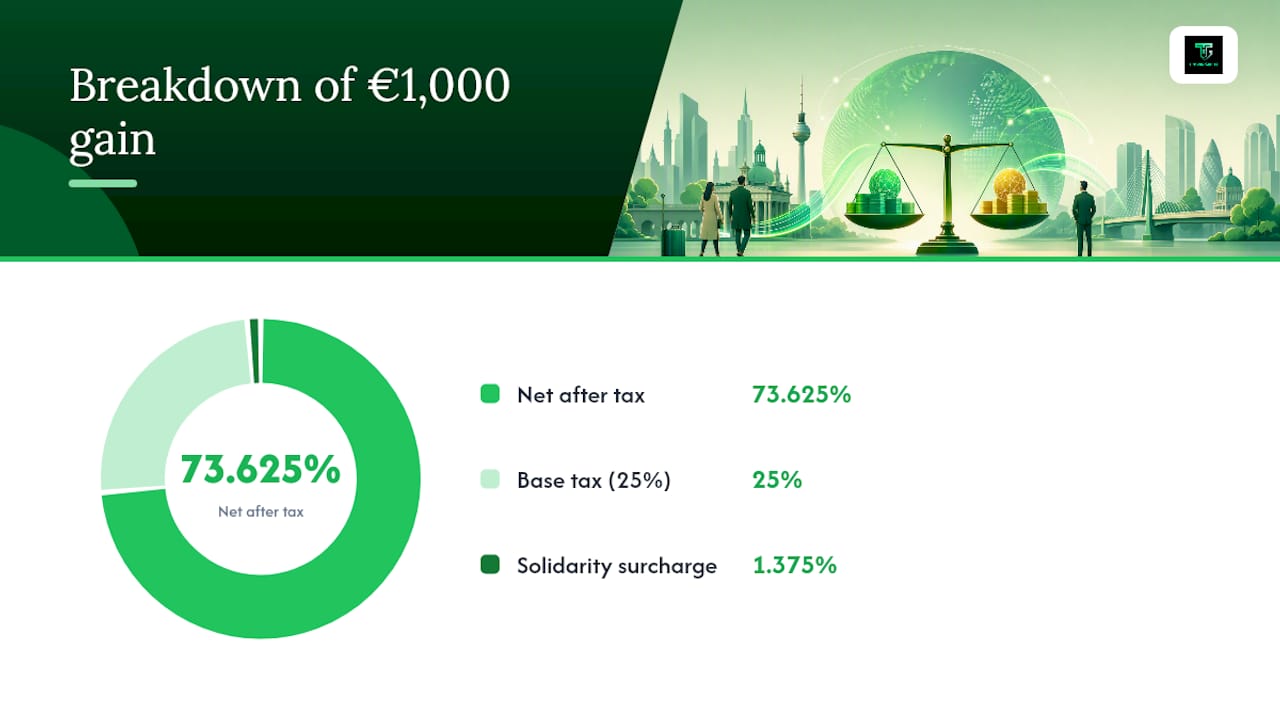
The math works like this: the base rate is 25%, and the solidarity surcharge adds 5.5% on top of that tax amount, not on your total profit. So a €1,000 gain gets taxed at €250, and the surcharge adds €13.75 (5.5% of €250), bringing your total to €263.75. That’s an effective rate of about 26.375% for someone with no church affiliation.
Church tax changes the picture if you’re a registered member of a recognized church.
Pro Tip: Ask your broker’s year-end tax statement whether church tax was already factored in. If you registered your religious affiliation with your bank, withholding usually happens automatically. If not, you’ll settle the difference through your return.
Every German taxpayer also gets a Sparerpauschbetrag, the saver’s allowance that shields a slice of capital income from tax entirely.
- Individual filers: the first €1,000 of combined capital income (forex gains, dividends, interest) is tax-free.
- Married couples filing jointly: the allowance doubles to €2,000.
- Coverage: this allowance applies across all capital income sources, not just forex, so if you also hold dividend stocks, they share the same pool.
Here’s the full picture with numbers: say you made €5,000 in forex profits and have no other capital income. Subtract the €1,000 allowance, leaving €4,000 taxable.
Withholding, Foreign Brokers, and CRS: When You Must Self-Report
Where your broker is based decides who does the paperwork. Domestic German brokers withhold Abgeltungsteuer automatically at the moment you realize a gain, and they send the money straight to the tax office on your behalf. Foreign brokers, including many popular international CFD platforms, generally don’t withhold German tax at all, which shifts the entire reporting burden onto you.
This isn’t a loophole. Germany participates in the Common Reporting Standard, so foreign broker accounts in CRS jurisdictions get automatically reported to the Finanzamt each year. Assuming a foreign account stays invisible is one of the more expensive mistakes a trader can make, since the mismatch between what you declared and what the CRS data shows can trigger a formal inquiry years later.
Before filing, gather these three documents from every broker you used:
- Year-end profit and loss statement, ideally itemized by instrument type.
- Full trade list showing entry and exit prices, dates, and position sizes.
- Executed order confirmations, which back up the P&L figures if the Finanzamt asks questions.
Once you have those, take these steps: set up a Freistellungsauftrag with your domestic broker so the €1,000 (or €2,000 joint) allowance gets applied before withholding kicks in. Then check your year-end statement against your own trade log for accuracy. Finally, enter your figures on Anlage KAP, the capital income supplement to your main tax return, in the lines for capital gains and any withheld tax already paid.
Loss Offset Rules and the 2024 Reform: What Actually Changed
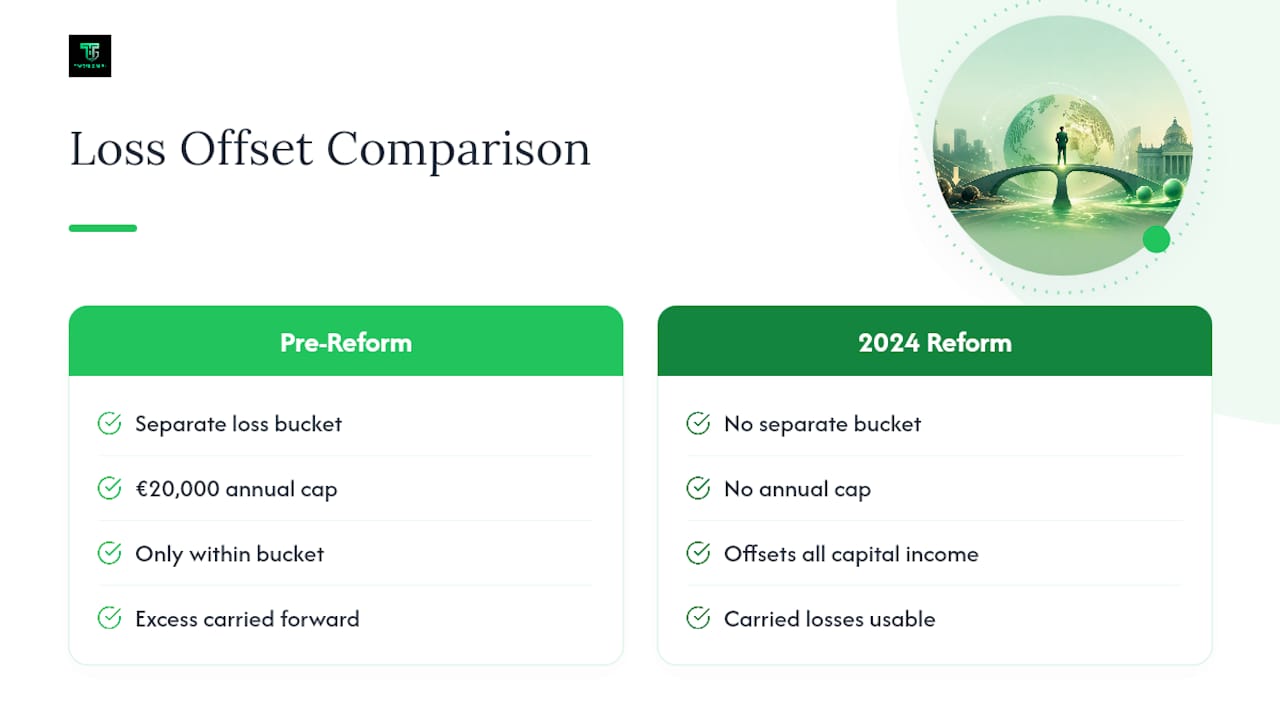
For years, German tax law capped how much you could offset in derivative losses. Under the old §20 Abs. 6 EStG rule, termingeschäft losses (CFDs, options, futures) went into a separate bucket, and you could only offset up to €20,000 per year against gains in that same bucket. Anything above that got carried forward indefinitely, which sounds fine until you consider that most retail traders don’t generate enough matching gains fast enough to use those carried losses.
The Jahressteuergesetz 2024 changed that. Lawmakers abolished the €20,000 cap and the separate loss bucket entirely, and derivative losses can now offset capital income in full, without a ceiling. The reform applies retroactively for 2024 and to open cases still under review, which matters if you had a loss year sitting in limbo.
Pro Tip: If you filed a return for 2024 or earlier years under the old cap and your assessment is still open, ask your Steuerberater whether you qualify for a correction. Traders with large swing losses stand to benefit the most from applying carried losses without an annual ceiling.
If your prior assessment already closed, a formal objection (Einspruch) within the standard one-month window after the notice is usually the only path to a correction, so timing matters more than the size of the loss itself.
Filling Anlage KAP: Currency Conversion and Recordkeeping
Anlage KAP is where all of this lands on paper. Line entries separate domestic capital income already taxed at source from foreign income you’re declaring yourself, plus a dedicated section for derivative losses and any carryforward from prior years. Get this wrong and you either overpay or invite a correction notice.
Here’s the practical sequence for preparing your filing:
- Convert every non-euro gain using the ECB’s daily reference rate for the date the trade closed, not the date you opened it. Most brokers report in your account currency already, but if you’re trading US-dollar pairs through a euro-denominated account, verify the conversion basis.
- Log the exchange rate used for each closed position, or at minimum keep an annual summary if you’re trading dozens of positions and the amounts are modest.
- Enter net gains after allowance on the appropriate Anlage KAP line, matching the categorization your broker used on its year-end statement.
Your recordkeeping checklist should cover:
- Trade-by-trade logs with entry, exit, size, and instrument type.
- Broker year-end reports (P&L and tax withholding summaries).
- Screenshots or CSV exports of ECB exchange rates used for conversions.
- Any invoices or fee statements tied to trading costs.
Keep everything for at least six years, since that’s the standard retention window the Finanzamt can look back on. If your trading volume or complexity has grown, book time with a Steuerberater before the filing deadline rather than during it. A broker’s technical systems are still adapting to the 2024 reform, and some year-end statements from 2026 onward may reflect updated loss-offset categorization, so cross-check rather than assume.
When Your Trading Looks Like a Business: Gewerbebetrieb Criteria
Trade often enough, with enough structure, and the Finanzamt may decide you’re not a private investor anymore. The Abgeltungsteuer applies to private investors; professional traders fall under a different regime entirely.
Authorities weigh several factors together, not any single one in isolation:
- Frequency and volume of trades, especially daily or near-daily activity.
- Organizational structure, like dedicated office equipment, staff, or formal systems.
- Intention to earn a primary living from trading rather than treating it as supplemental income.
- Scale of capital deployed relative to your other income sources.
VAT questions can also surface depending on how the activity is structured.
Pro Tip: If you’re trading daily, living off the proceeds, and treating it like a full-time job, get ahead of a reclassification by talking to a Steuerberater before the Finanzamt raises the question first.
Common Pitfalls and How to Avoid Costly Compliance Mistakes
Most tax problems in forex trading aren’t about dishonesty. They’re about sloppy tracking that catches up months later.
The recurring mistakes look like this:
- Forgetting to declare gains from a foreign broker because “nobody’s watching.”
- Using the wrong exchange rate date for currency conversion, which skews your taxable base.
- Never setting up a Freistellungsauftrag, so tax gets withheld even on income the allowance should have covered.
- Assuming the old €20,000 loss cap still applies and underclaiming eligible offsets.
The cost of getting this wrong isn’t trivial. Missed declarations can trigger interest charges, formal audits, and in serious cases, criminal tax proceedings. CRS reporting has made foreign accounts far more visible than traders assume, which means the “they’ll never know” approach carries real risk now, not theoretical risk.
The fix is boring but effective: keep consistent trade logs, review your positions against broker statements annually, and if you discover a past return was incomplete, file a voluntary correction (Selbstanzeige) before the Finanzamt finds it first.
Tradergibkey’s Practical Checklist for Recordkeeping and Filing
Good tax outcomes start with good habits at the trade level, not scrambling every March. A minimal weekly routine: log the instrument, entry and exit price, position size, date, and realized P&L for every closed trade. That’s five fields, and it takes under a minute per trade.
When it’s time to file, hand your Steuerberater these three items:
- Your broker’s year-end P&L statement.
- A trade-level CSV export, if your broker offers one.
- Any fee or commission invoices tied to trading costs.
Pro Tip: A structured trading program that builds journaling into your daily routine, like the frameworks taught in Trader Gibkey’s courses, makes tax season faster because the records already exist. A Steuerberater adds the most value once your trade count or foreign broker exposure grows complex enough that manual tracking starts slipping.
Author Perspective: Why Tidy Tax Routines Help Your Trading
Traders who track every position for tax purposes almost always trade better, too. The discipline of logging entries, exits, and outcomes forces you to confront your actual results instead of your memory of them. If you want templates for this kind of tracking, or a comparison against UK forex tax rules if you trade across borders, that structure pays off twice.
— Gabriel
Get Structured Support for Tax-Aware Trading
Understanding the tax mechanics is one thing. Building the habits that make filing painless every year is another, and that’s where a structured program earns its place. Structured trading programs build recordkeeping and trade review directly into the learning process, so documentation for the Steuerberater exists by tax season, instead of getting reconstructed from memory in March.
Whether you’re just starting to trade price action or you’re managing enough volume that a foreign broker’s lack of withholding has become a real filing burden, the Price Action (Core) plan at £149 per month gives you the systematic approach that makes trade logging second nature. For traders wanting direct, personalized feedback on both strategy and process, a Single Session Mentorship at €149 one-off is a practical way to get specific answers before your next filing deadline. Review the full course lineup and mentorship options on the Tradergibkey site and pick the format that fits how you trade.
Sources
- German Forex Tax Calculator 2026 | Abgeltungsteuer + Loss Offset | FX-Brokers.info
- Forex-basics
- ESMA (European Securities and Markets Authority)
This article is general information, not a substitute for advice from a qualified financial advisor. Consult a qualified financial professional about your own circumstances before acting on anything here.
FAQ
Is forex trading legal in Germany?
Yes, forex trading is fully legal in Germany, and it’s regulated under the same capital income tax framework as other financial instruments. Retail protections and leverage limits come from ESMA rules applied across the EU.
Do I have to pay tax on forex profits in Germany?
Domestic brokers usually withhold this automatically, while foreign brokers typically require self-reporting on Anlage KAP.
Who pays 45% tax in Germany?
It becomes relevant only if your trading gets reclassified as a Gewerbebetrieb, since business income falls under progressive rates instead of the flat Abgeltungsteuer.