
Yes, forex trading gains for Italian tax residents are generally taxable, and where the 26% substitute tax applies, you owe it on realized profit. Whether you actually pay depends on three things: what instrument you traded, whether your broker withholds tax for you (amministrato) or leaves it to you (dichiarativo), and whether your foreign-currency balance ever crossed the €51,645.69 threshold for seven straight working days. Get those three variables right and the rest of your tax picture falls into place.
TL;DR:
- The default self-declared regime requires traders to calculate net gains, report in Quadro RT, and pay the 26% substitute tax via F24, with losses deductible and carryforward for up to four years.
- Foreign-currency account balances exceeding the threshold trigger both capital gains tax and IVAFE reporting obligations, while balances below do not.
- Brands’ regulatory status does not determine withholding tax obligations; traders must verify if their broker is an Italian withholding agent.
- Proper recordkeeping, including daily balance snapshots and broker statements, is essential to avoid penalties, with five-year retention recommended for potential audits.
Table of Contents
- Forex Tax Italy: Which Instruments Trigger the 26% Rate
- Amministrato Vs Dichiarativo: Who Files Your Taxes
- The €51,645.69 Threshold and IVAFE on Foreign Accounts
- Calculating Net Gains and Filing Through Quadro RT
- Common Mistakes That Cause Forex Tax Problems
- Trader Gibkey’s Practical Workflow for Tax-Ready Records
- Leverage and Margin Trading: What Changes for Tax Purposes
- Transaction Taxes and the Tobin Tax Question for Forex
- Documentation Italian Tax Authorities Expect From Forex Traders
- Penalties for Misreporting Forex Income in Italy
- How Forex Gains Fit Into Your Overall Italian Tax Return
- Why Compliance Is Part of Professional Trading
- Build Disciplined Trading Habits With Trader Gibkey
- Official Rulings and Definitive Guides
- Sources
- FAQ
Forex Tax Italy: Which Instruments Trigger the 26% Rate
Italian tax law groups forex profits under redditi diversi di natura finanziaria, a catch-all category for capital gains that aren’t ordinary business income. This is the classification Agenzia delle Entrate confirmed in its 2021 ruling on forex gains, and it’s the anchor for everything else in this article. No brackets, no scaling with your other income.
But “forex” isn’t one instrument for tax purposes. How you traded it changes when the tax bites:
- CFDs on currency pairs are treated as derivatives and taxed from the first euro of gain, no threshold exemption.
- Spot forex held in a foreign-currency account only becomes taxable once that account’s balance crosses the €51,645.69 threshold for seven consecutive working days.
- Futures and options on currency pairs follow the same derivative treatment as CFDs.
- Rollover and swap adjustments get folded into your net gain calculation rather than taxed separately.
Most retail traders using leveraged CFD platforms never touch the threshold question at all, because CFDs skip that exemption entirely. The threshold mostly matters if you’re holding actual foreign currency in a bank or brokerage account rather than trading margined contracts.
Amministrato Vs Dichiarativo: Who Files Your Taxes
Your broker’s regime decides whether you or someone else does the paperwork. Under the amministrato (managed) regime, an Italian bank or authorized intermediary acts as your withholding agent. You get a certificate at year end and generally don’t need to touch Quadro RT.
The dichiarativo (self-declared) regime puts the entire burden on you. This is what happens by default when you trade through a foreign broker not registered as an Italian withholding agent, which describes the vast majority of retail forex platforms. Tax professionals consistently point to broker status as the single biggest factor in how complicated your filing becomes, and that assessment lines up with how the two regimes actually work in practice.
Practical consequences of dichiarativo:
- You calculate your own net gain from broker statements.
- You report it yourself in Quadro RT of Modello Redditi.
- You pay via F24 rather than having it withheld automatically.
- You keep documentation because no certificate substitutes for it.
Pro Tip: Check your broker’s regulatory status before assuming anything about withholding. A broker regulated by CONSOB or passported under ESMA rules for EU access isn’t automatically an Italian tax withholding agent. Regulatory authorization and tax withholding status are two separate questions, and conflating them is one of the most common mistakes Italian traders make.
The €51,645.69 Threshold and IVAFE on Foreign Accounts
The threshold test only matters for spot foreign-currency holdings, not CFDs or derivatives. If your foreign-currency account balance exceeds €51,645.69 for seven consecutive working days at any point in the year, any gains become taxable and you trigger Quadro RW reporting obligations. Stay under that line the whole year, and those specific balances are exempt from both the capital gains tax and IVAFE.
IVAFE (Imposta sul Valore delle Attività Finanziarie all’Estero) is a separate patrimonial tax on the value of foreign financial assets held by Italian residents, distinct from the capital gains tax on trading profit. It applies regardless of whether you made money, because it taxes the asset’s presence, not its performance.
To check where you stand:
- Pull daily closing balances from your foreign account or broker statement for the full tax year.
- Convert each balance to euros using the official exchange rate for that date, not a rate you pick after the fact. Guidance from tax practitioners recommends using ECB or MEF published rates for consistency with how the tax authority checks your numbers.
- Scan for any run of seven or more consecutive working days above €51,645.69.
- If you find one, both capital gains tax and IVAFE reporting kick in for that account, and Quadro RW becomes mandatory.
Calculating Net Gains and Filing Through Quadro RT
Start with your broker’s annual statement, not your own memory of trades. Extract total realized profit and loss, then subtract commissions, financing or swap charges, and any performance fees your platform charged. What’s left is your net taxable gain, and it’s the only number that belongs on your tax return.
That figure goes into Quadro RT, Section II-B of Modello Redditi PF for most independent traders. If you qualify for the simplified 730 form and have a qualifying intermediary, the equivalent entries fall under Quadro T instead, though most forex traders using foreign brokers end up filing the full Modello Redditi.
Losses aren’t wasted. Italian rules allow a four-year carryforward, meaning a losing year can offset gains in any of the following four tax periods, as long as you declare the loss in the year it happened.
- Total your net gain or loss per broker account.
- Combine across accounts if you hold more than one.
- Apply any carried-forward losses from the prior four years before calculating tax owed.
- Pay the resulting 26% via F24, using the substitute tax code specified for financial capital gains, by the standard Modello Redditi deadline.
A single missed carryforward claim can mean paying tax on a gain that a prior year’s loss should have offset entirely, since Agenzia delle Entrate won’t apply it retroactively without your declaration.
Common Mistakes That Cause Forex Tax Problems
Most compliance headaches trace back to a handful of repeat mistakes: misclassifying CFDs as exempt spot trades, skipping Quadro RW because “the broker is foreign, not Italian,” using an inconsistent FX conversion rate across the year, or simply forgetting IVAFE exists because no one withheld it.
Keep four categories of records, ideally for at least five years:
- Daily or monthly realized P&L exports from every broker.
- Annual broker tax summaries or certificates, if issued.
- Bank statements showing deposits, withdrawals, and currency conversions.
- A note of which official exchange rate source you used for threshold testing.
Pro Tip: Build an audit folder as you go, not after a notice arrives. A broker report plus your own daily balance snapshots is the clearest evidence you can hand an auditor.
Trader Gibkey’s Practical Workflow for Tax-Ready Records
Every trader we work with gets the same advice: export realized P&L, commissions, and swap charges from your platform weekly, not once a year. Keep a running snapshot of foreign-currency balances so the seven-day threshold never sneaks up on you. At year end, hand your accountant one clean summary sheet, not twelve months of scattered screenshots.
Leverage and Margin Trading: What Changes for Tax Purposes
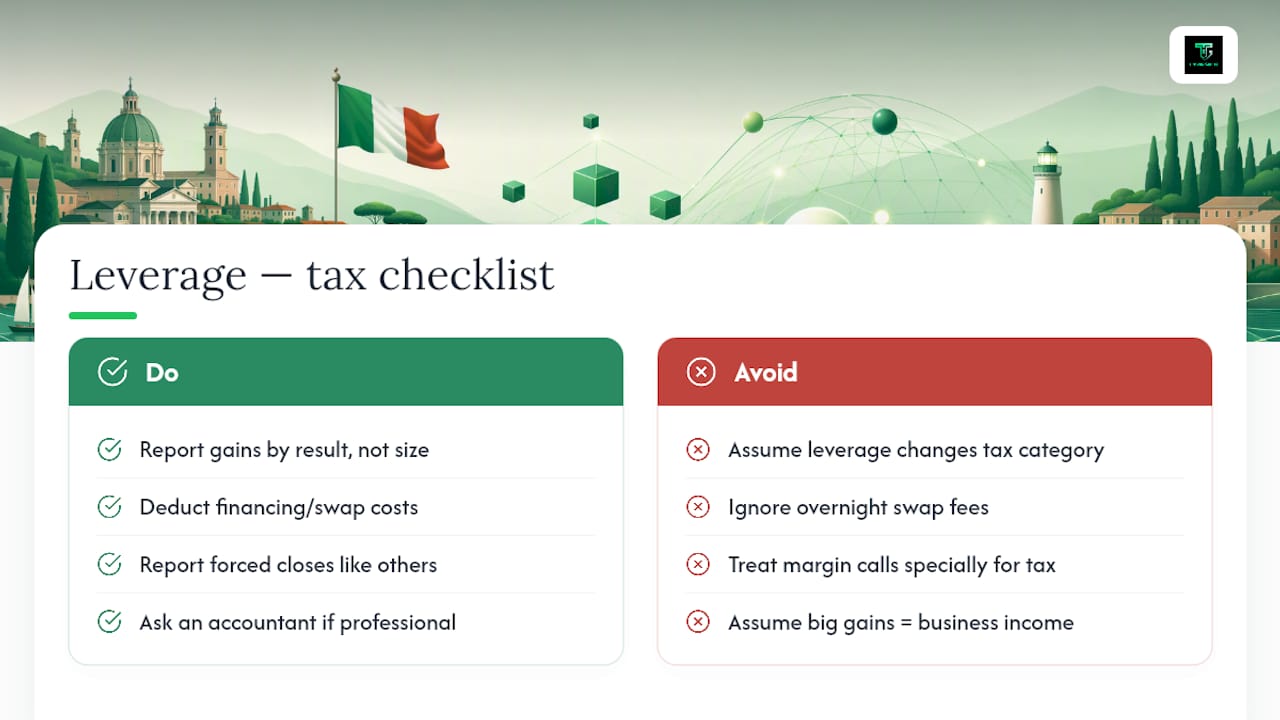
Leverage changes your exposure, not your tax category. A CFD traded at 1:30 margin and one traded at 1:5 margin get identical tax treatment under Italian rules, because the 26% substitute tax applies to the realized gain, not the notional position size or the margin used to open it.
Where leverage does matter is in your net gain calculation. Financing charges on leveraged positions, sometimes called overnight swap fees or rollover costs, are deductible against your gross trading profit before you arrive at the taxable net figure. Ignore these deductions and you overstate your tax bill; miscount them and you understate it, which creates its own audit risk.
Margin calls and forced liquidations don’t get special tax treatment either. A losing position closed by your broker’s margin system is reported the same way as one you closed voluntarily. What matters for Quadro RT is the realized result, not why the position closed.
One area worth flagging: some traders assume high leverage somehow pushes them into a different tax bracket or business-income classification, since the profits can be large relative to deposited capital. That’s not how redditi diversi works. The classification depends on the nature of the activity (occasional trading versus a structured business), not the size of the gain or the leverage ratio used to generate it. If your trading looks more like a professional, continuous business activity rather than personal investment, that’s a different conversation entirely, and one worth raising with an accountant rather than assuming based on leverage alone.
Transaction Taxes and the Tobin Tax Question for Forex
Currency pair trading itself, spot or CFD, doesn’t trigger Italy’s financial transaction tax (commonly called the Tobin tax). That tax targets transfers of shares and certain derivatives tied to Italian-listed equities and equity-linked instruments, not currency pairs. If your trading is purely forex, this tax generally does not apply to your positions.
Where it becomes relevant is if your broader portfolio includes derivatives on Italian equities alongside your forex activity. Index or single-stock derivatives referencing Italian underlyings can fall within scope of the transaction tax, and that’s a separate cost layer from your 26% substitute tax on gains. The two taxes don’t overlap or offset each other. One is a transaction cost charged regardless of profit or loss; the other is a tax on realized gain.
Practical costs that do affect every forex trader’s net position, tax-relevant or not, include spread costs, commissions, and financing charges. None of these are government taxes, but all of them reduce the net gain you eventually report. Overview guidance on Italian trading tax treatment groups the 26% capital gains rate, IVAFE, and the transaction tax together as the three cost layers a serious trader needs to track, even though only the first two typically touch pure forex activity.
Bottom line: don’t let Tobin tax anxiety distract from where the real forex tax exposure sits, which is the 26% rate on your net trading gain and IVAFE on qualifying foreign account balances.
Documentation Italian Tax Authorities Expect From Forex Traders
Agenzia delle Entrate doesn’t require you to submit broker statements alongside your tax return, but it can request them during a review, and the burden of proof sits with you. Practical guides on Quadro RT and RW mechanics consistently point to the same core document set as the baseline every trader should maintain.
At minimum, keep:
- Annual broker statements showing realized profit, loss, commissions, and financing charges per account.
- Daily or periodic balance snapshots for any foreign-currency holdings, converted at official rates.
- Bank records showing transfers in and out of trading accounts, since these help substantiate the source and destination of funds.
- A copy of every Modello Redditi and Quadro RT/RW filing you submit, along with F24 payment confirmations.
If you use more than one broker, keep records separated by account rather than merged into one file. Auditors reconstructing your tax year will want to trace gains back to a specific platform and time period, and a jumbled combined ledger slows that process down and raises unnecessary questions.
Retention period matters too. Italian tax authorities can generally go back several years to review a filing, so treating five years of retained records as a working minimum protects you better than assuming a shorter window is safe. Digital copies are fine; what matters is that they’re complete, dated, and organized by account and tax year, not that they’re on paper.
Penalties for Misreporting Forex Income in Italy
Getting your forex tax wrong isn’t a minor paperwork slip. Underreporting capital gains or skipping Quadro RW when required can trigger penalties calculated as a percentage of the unpaid tax or undeclared asset value, on top of the tax itself plus interest for late payment.
Quadro RW omissions carry their own separate penalty track from the income tax omission, because IVAFE and the monitoring obligation are treated as distinct requirements from the capital gains tax itself.
Voluntary disclosure before an audit notice arrives generally reduces the penalty exposure compared to being caught first by the tax authority. If you realize partway through the year that you’ve misclassified an instrument or missed a threshold crossing in a prior filing, correcting it proactively, through a supplementary declaration, tends to produce a materially better outcome than waiting.
The safest posture is treating every foreign broker relationship as a reporting obligation from day one, rather than assuming smaller accounts or occasional trading fly under the radar. Threshold and Quadro RW rules don’t scale down for casual traders. A retail trader holding a modest foreign-currency balance that happens to cross €51,645.69 for a week faces the same reporting duty as someone trading full time.
How Forex Gains Fit Into Your Overall Italian Tax Return
This separation is actually good news for most traders: a strong trading year doesn’t push your salary or business income into a higher bracket, because the two income streams are calculated independently.
That said, the separation cuts both ways. Trading losses can’t offset employment income or pension income, since redditi diversi losses only carry forward against future capital gains, not against other income categories. If you had a rough trading year alongside a strong year at your day job, the two don’t net against each other on your tax return.
Where the interaction does matter is administrative. If you’re already filing Modello Redditi for business income, rental income, or foreign asset holdings unrelated to trading, your forex gains and Quadro RW entries simply become additional sections within that same annual return rather than a separate filing process. There’s no advantage to trying to isolate trading income into its own submission.
One overlooked detail: if your forex activity is substantial enough and structured enough to look like a professional trading business rather than personal investment, tax treatment can shift toward business income categories with different rules entirely. That threshold isn’t about volume or profit size alone. It’s about whether the activity is organized, continuous, and structured like a business. Most retail traders remain comfortably within the redditi diversi category, but it’s worth a conversation with an accountant if trading has become your primary income source.
Why Compliance Is Part of Professional Trading
Good tax hygiene isn’t separate from good trading. The traders who last years, not months, treat recordkeeping the same way they treat risk management: as a discipline that protects the account, not a chore that gets skipped when markets get busy. Keep your broker exports current, track your foreign balances weekly, and talk to a tax professional the moment something looks ambiguous. That habit is what separates a hobby from a sustainable practice.
— Gabriel
Build Disciplined Trading Habits With Trader Gibkey
Clean tax records start with clean trading habits, and that’s exactly what Tradergibkey was built to teach. Instead of theory-heavy courses that leave you guessing under real market pressure, Tradergibkey draws on 18 years of live trading experience to teach price action strategies you can actually track, review, and report with confidence.

If you want direct feedback on your trade journal and bookkeeping habits, the Single Session Mentorship at €149 gives you one-on-one time to review your setups and recordkeeping approach. Traders looking for a structured foundation often start with the Price Action (Core) plan at £149 per month, which builds the disciplined trade review habits that make tax season painless instead of chaotic. For serious long-term traders, the Diamond (Lifetime Access) package at €3,499 one-off includes ongoing community support so you’re never rebuilding your process from scratch. Visit Tradergibkey to compare mentorship options and pick the format that fits how you trade.
Official Rulings and Definitive Guides
For readers who want to verify the details covered here, these are the primary sources worth bookmarking:
- Agenzia delle Entrate — Risposta 490 (20 July 2021), the official ruling on forex classification and reporting.
- Fiscomania’s threshold and Quadro RT/RW guide, for the €51,645.69 mechanics and conversion method.
- Io Faccio Soldi’s amministrato vs dichiarativo breakdown, for F24 payment procedure.
- MoneyViz’s worked Quadro RT examples, for filing walkthroughs and loss carryforward mechanics.
This article is general information, not a substitute for advice from a qualified financial advisor. Consult a qualified financial professional about your own circumstances before acting on anything here.
Sources
- Agenzia delle Entrate — Risposta 490 (20 July 2021)
- Tassazione Forex Trading 2026: aliquota 26% e soglia € 51.645 - Fiscomania
- Trading Taxes in Italy: What Traders Need to Know
FAQ
Is Forex Trading Allowed in Italy?
Yes. Forex trading is legal for Italian residents, and brokers offering services to Italian clients must operate under authorization recognized through ESMA passporting rules or direct CONSOB authorization. Being legal doesn’t exempt gains from tax.
Do I Have to Pay Tax on Forex Trading?
In most cases, yes. Gains from CFDs and derivatives on currency pairs are taxed from the first euro at the flat 26% substitute tax rate, while spot forex gains depend on whether your account balance crossed the €51,645 threshold.
What Is the 7% Tax Rule in Italy?
That figure typically refers to a flat 7% tax regime available to certain foreign pensioners relocating to specific southern Italian municipalities, which is unrelated to trading income or the 26% capital gains rate covered here.
Do I Have to Pay Tax on Forex if My Broker Is Foreign?
Yes, and it often means more work for you. Foreign brokers generally can’t act as your Italian withholding agent, which places you in the dichiarativo regime, requiring you to calculate and self-report your gains through Quadro RT and pay via F24.