Spread betting profits are generally tax-free, but you get no relief if you lose. Trade often enough, with enough organization and intent, and HMRC’s “badges of trade” test can reclassify you as running a business, meaning Income Tax and National Insurance instead. Your first move: identify your instrument, then check your record-keeping against that classification.
TL;DR:
- Spread betting profits are tax-free only if activity is casual; turning it into a business may lead HMRC to tax profits as income and NI contributions.
- CFD losses can offset gains and be carried forward, but only if traders keep detailed records of each disposal; spread-bet losses offer no relief.
- Spot forex trading’s tax classification depends on trading behavior, with frequent, organized, or profit-driven activity risking classification as a trade subject to income tax.
- HMRC’s “badges of trade” test considers trading frequency, organization, motive, duration, and supplementary work to determine if trading is business activity.
- Report gains through Self Assessment, track every trade meticulously, and be aware that the lower annual CGT exemption will likely require more traders to file, especially high-turnover ones.
Table of Contents
- How Spread Bets, CFDs, and Spot Forex Are Taxed
- When HMRC Treats Forex Trading as a Trade
- Capital Gains Tax Mechanics You Need to Know
- Record-Keeping, Currency Conversion, and Filing
- Losses, Offsets, and Practical Planning
- Three Worked Examples of Forex Tax Outcomes
- Trader Gibkey’s Practical Checklist for Staying Compliant
- A Trader’s View on Tax and Discipline
- Build Better Trading Habits With Trader Gibkey
- Sources
How Spread Bets, CFDs, and Spot Forex Are Taxed
The instrument you trade decides which tax rulebook applies to you, and the differences are bigger than most new traders assume.
Spread betting sits in a category of its own. HMRC treats it as gambling rather than investing, so profits are generally free from both Income Tax and Capital Gains Tax. Sounds like a gift, but there’s a catch that trips up a lot of traders after a rough quarter: you cannot offset spread-bet losses against gains elsewhere. Win big and pay nothing. Lose big and there’s no consolation on your tax bill.
CFDs work differently. HMRC’s Capital Gains Manual classifies contracts for difference as chargeable assets, which puts them squarely in the Capital Gains Tax regime rather than the gambling one. Every closed position is a disposal. That’s actually useful, because it means losses can offset gains elsewhere and carry forward into future years if you don’t use them immediately.
Spot forex usually gets CGT treatment too, but it’s the least settled of the three. If the facts point toward trading as a business rather than casual speculation, HMRC can tax it as income instead.
Here’s the trap: don’t pick an instrument purely to chase a tax outcome.
- Spread betting’s tax-free status assumes casual, non-trade activity, not a full-time operation.
- CFD loss relief only helps if you’re disciplined about recording every disposal.
- Spot forex sits in a genuine gray zone depending on your trading pattern.
Tax treatment follows behavior, not the label on your account.
When HMRC Treats Forex Trading as a Trade
This is the classification that changes everything, and it’s worth understanding before you scale up your activity. HMRC uses what’s called the “badges of trade” test to decide whether what looks like investing is actually running a business. There’s no single trigger. It’s a pattern of factors weighed together.
- Frequency — How many trades you place and how regularly.
- Organization — Whether you run it like a business, with systems, targets, and dedicated hours.
- Motive — Whether profit-seeking, rather than hedging or occasional speculation, drives your activity.
- Duration — How long you’ve been trading this way.
- Supplementary work — Whether you’ve built tools, taken courses, or treat trading as a primary occupation.
Tip the balance far enough toward “trade,” and HMRC taxes your profits as income at your marginal rate, plus Class 4 National Insurance contributions, rather than under CGT. That can mean a meaningfully higher tax bill on the same profits.
Red flags that increase your risk of a trade finding: trading daily as your main source of income, running multiple accounts or strategies simultaneously, and treating trading capital like working capital for a business rather than personal savings.
Pro Tip: If you’ve quit a job to trade full-time, or you’re pulling consistent monthly income from it, get a tax adviser to review your classification before HMRC does it for you. A voluntary conversation with a professional beats a compliance letter every time.
Capital Gains Tax Mechanics You Need to Know
CGT is where most CFD and spot forex traders live, and the mechanics got tighter recently. The annual exempt amount now sits at just £3,000 for the 2025/26 and 2026/27 tax years, down sharply from historical levels.
That drop matters more than it sounds. Accountants have flagged that casual and part-time CFD traders who once stayed comfortably under the old allowance now find themselves with a filing obligation on gains they’d never have needed to report before.
Your existing salary or self-employment income determines where that line falls.
Two reporting triggers to watch:
- Total gains before losses exceed £3,000.
- Total disposal proceeds exceed £50,000, even if your net gain sits below the allowance entirely.
That second trigger catches high-frequency traders off guard constantly. Small profits per trade, but huge cumulative turnover, and suddenly you’re required to report even though you “didn’t make much.”
To calculate your gain, subtract your allowable costs (spreads, commissions, financing charges on the position) from your closed-position proceeds, for each disposal. Report the total through Self Assessment.
Record-Keeping, Currency Conversion, and Filing
Good records aren’t optional paperwork. They’re what protects you if HMRC ever asks how you calculated a gain, or worse, questions your classification.
- Log every trade in detail. Trade ID, open and close timestamps, entry and exit price, notional value, GBP value at disposal, plus fees, swaps, and commissions.
- Convert to GBP using the spot rate on the disposal date. HMRC’s corporate finance manual sets out how exchange differences are treated, and the principle carries over for individual traders converting closed positions.
- Register for Self Assessment if you haven’t already, and file by the January 31 deadline. Use SA108 for capital gains disclosures, and SA103 if your activity has been classified as trading income instead.
- Budget for payments on account if your tax bill crosses the relevant threshold, since HMRC may ask for advance payment toward next year’s liability.
Most brokers export CSV statements with timestamps and trade identifiers built in. Pull them monthly rather than scrambling in January.
Losses, Offsets, and Practical Planning
Losses behave very differently depending on your regime, and mixing them up is a common, costly mistake. CFD and spot forex losses under CGT offset your capital gains and carry forward indefinitely if unused. Spread-bet losses get no such relief since they sit outside the tax system entirely.
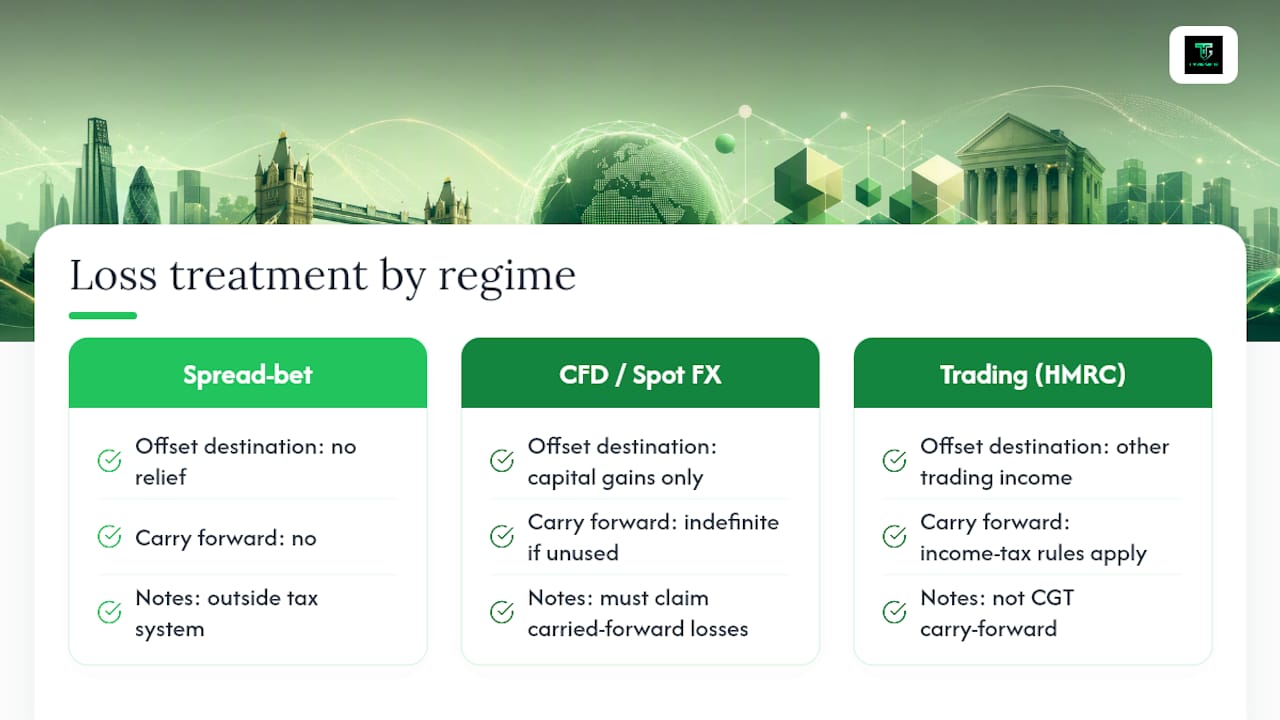
If HMRC has classified your activity as a trade, losses may offset other trading income under different income tax rules, not the CGT carry-forward mechanism.
The pitfalls that trip up otherwise careful traders: missing the £50,000 disposal-proceeds trigger, forgetting to formally claim carried-forward losses on a prior return, and blending personal and trading records so neither is defensible. Claim every allowable cost, keep segregated records, and talk to an adviser before your volume grows past what your current setup can track.
Three Worked Examples of Forex Tax Outcomes
Numbers make this concrete faster than rules alone.
- Example A: A trader nets £8,000 spread betting for the year. Owes nothing in tax, but if a bad month had produced an £8,000 loss instead, none of it would be deductible.
- Example B: A casual CFD trader nets £9,000 in gains. Subtract the £3,000 allowance, leaving £6,000 taxable. If that trader’s income keeps them in the basic rate band, they owe 18% on that £6,000; in the higher band, it’s 24%.
- Example C: A full-time, highly organized trader hits HMRC’s badges of trade threshold. Their profits get taxed as income at marginal rates, plus Class 4 NICs, and the CGT allowance no longer applies at all. This is illustrative only. Actual liability depends heavily on individual facts.
Trader Gibkey’s Practical Checklist for Staying Compliant
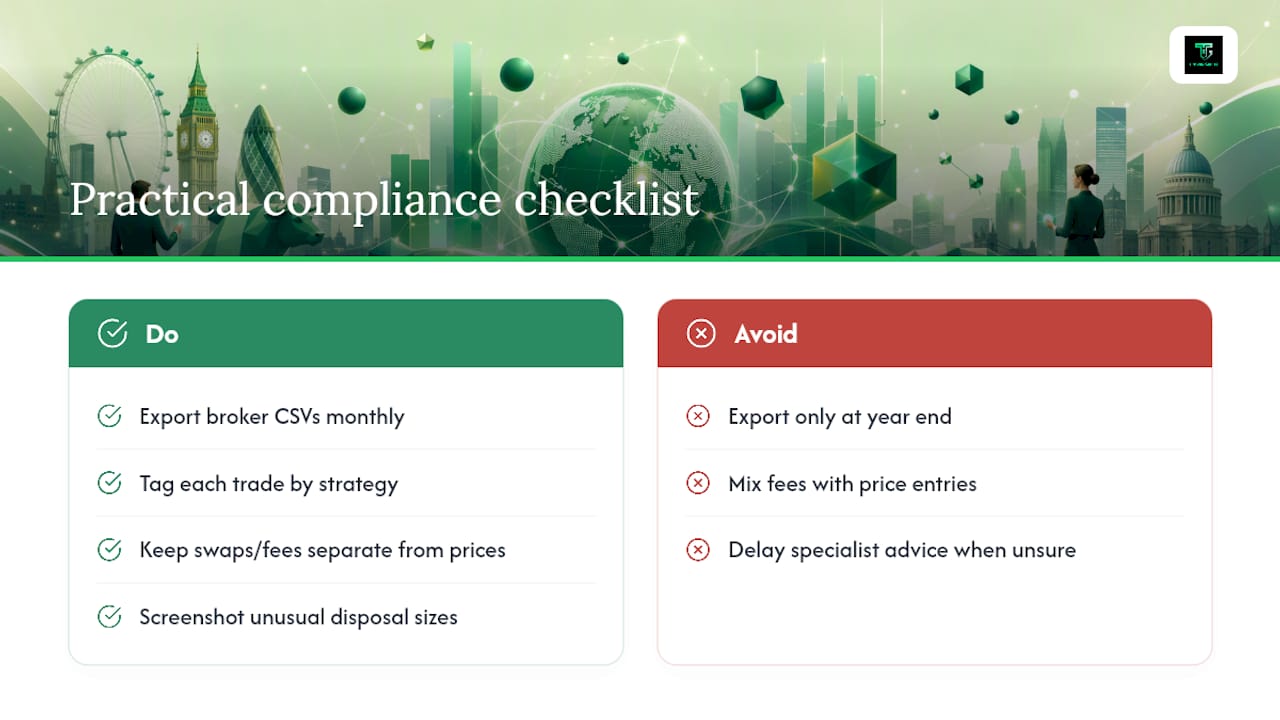
You don’t need complicated software to stay on top of this. Export your broker’s CSV statements every month rather than at year end. Tag each trade by strategy so you can explain your pattern of activity if HMRC ever asks. Keep a running log of swaps, fees, and commissions separate from your price entries. Screenshot your platform at the moment of disposal when the trade size is unusual.
Consider talking to a specialist adviser once your trading volume grows past what a spreadsheet can track, once monthly profits become a meaningful part of your income, or once you’re genuinely unsure whether your activity reads as investing or trading. Our breakdown of how HMRC classifies forex profits covers the record formats we recommend to students in more depth.
A Trader’s View on Tax and Discipline
Treat tax as a trading cost, the same way you treat spread and slippage. Traders who lose money to HMRC rarely lose it to bad tax rules. They lose it to sloppy records and guesswork filed in January. Structured mentorship won’t file your return, but it builds the discipline that keeps your trade log clean enough that filing becomes routine rather than a fire drill. Good habits at the trade level prevent expensive surprises at the tax level. That connection is easy to underestimate until you’re staring at a shoebox of statements in week three of tax season.
— Gabriel
Build Better Trading Habits With Trader Gibkey
Tax compliance starts long before your tax return. It starts with how consistently you record what you actually do in the market, and that’s where most self-taught traders fall short. Structured trading programs often emphasize the discipline of tracking every setup, entry, and result, so records are prepared for tax season.

Some trading approaches lean on price action strategies developed through extensive market experience and provide workflows for logging trades that can serve as an audit trail. This is education and process support, not tax or legal advice. Always confirm your specific filing position with a qualified UK tax adviser. If you want a structured way to build that discipline, explore Trader Gibkey’s trading programs and see which course or mentorship track fits where you are right now.
Sources
- Spread Betting, CFDs and Forex: How HMRC Taxes Each One in 2026/27 - Stewart Accounting
- CFD Capital Gains Tax: UK Rates, Allowances and Reporting - LegalClarity
- Gov
This article is general information, not a substitute for advice from a qualified financial advisor. Consult a qualified financial professional about your own circumstances before acting on anything here.