
Most traders put in the work but still repeat the same mistakes month after month. They review their charts, they journal occasionally, and they try harder. Yet nothing sticks. The reason is almost always the same: they don’t have a structured way to give useful trading feedback to themselves. Without a repeatable system, experience alone doesn’t build skill. It just builds habit. This guide gives you a practical, level-by-level framework to evaluate your trading with clarity, cut through emotional noise, and turn every trade into a real learning opportunity.
Table of Contents
- Key takeaways
- What to prepare before giving useful trading feedback
- How to execute feedback at four key levels
- Common mistakes that break your feedback process
- Turning feedback into real improvements
- My honest take on feedback systems
- Take your feedback system further with Tradergibkey
- FAQ
Key takeaways
| Point | Details |
|---|---|
| Separate process from outcome | A losing trade that follows your rules is a good trade. Judge execution, not just P&L. |
| Use a four-level review cadence | Immediate, daily, weekly, and monthly reviews each serve a distinct purpose in your feedback system. |
| Track the right metrics | Focus on R-multiples, rule adherence, and setup quality rather than raw profit numbers. |
| Fix one thing at a time | Testing one constraint per review period produces clearer results than trying to fix everything at once. |
| Speed matters in feedback | Delayed reviews cause memory distortion. Capture trade notes within minutes of closing a position. |
What to prepare before giving useful trading feedback
Before you review a single trade, you need to get two things right: your mindset and your data. Skip either one and your feedback will be distorted before it even starts.
The mindset shift that changes everything
The most common mistake traders make is judging trades purely by profit or loss. A trade that made money because the market moved in your favor despite a sloppy entry is not a good trade. A trade that lost because you followed every rule and got stopped out by a wick is not a bad trade. Separating process from outcome is the single most important mindset shift in effective trading feedback. It moves your focus onto controllable behaviors instead of results that are partly random.
This sounds simple. It is not easy. Your brain is wired to associate loss with error. You have to consciously override that wiring every time you sit down to review.
What your trading journal must capture
Your journal is the raw data your feedback system runs on. If the data is incomplete or inconsistent, your feedback will be too. A complete trading journal should record the following for every trade:
- Date and session (London, New York, overlap)
- Instrument and direction (long or short)
- Entry price, exit price, and stop loss level
- Position size
- R-multiple (how much you gained or lost relative to your defined risk)
- Setup tag (the specific pattern or condition that triggered the trade)
- Rule adherence score (did you follow your criteria or deviate?)
- Emotional state at entry (calm, anxious, revenge-trading, bored)
- Brief notes on what you saw and what you did
The R-multiple is worth highlighting. It normalizes every trade to your risk unit, which means you can compare a micro-lot Forex trade to a full-size futures position on equal terms. Without it, your performance data is distorted by position size variation.
Pro Tip: Set up your journal template before you start trading for the day, not after. Pre-filled fields for date, session, and instrument reduce friction and make post-trade capture faster and more consistent.
The other non-negotiable is having written rules for your setups. You cannot evaluate execution quality without a clear standard to measure against. If your criteria for a valid entry are vague, your feedback will be vague too.
| Metric | What it measures | Why it matters |
|---|---|---|
| R-multiple | Gain or loss relative to defined risk | Normalizes trades for fair comparison |
| Rule adherence score | Whether you followed your entry/exit criteria | Separates execution error from strategy failure |
| Setup quality rating | How well the setup matched your criteria | Identifies if you are taking low-quality trades |
| Emotional state tag | Your psychological condition at entry | Links behavior patterns to performance outcomes |
How to execute feedback at four key levels
A trading feedback system works best as a four-level loop. Each level has a different time horizon and a different purpose. Together they cover everything from in-the-moment capture to big-picture strategy assessment.
Here is how to run each level effectively:
-
Immediate feedback (2 to 3 minutes per trade). Right after you close a position, write three things: what you saw, what you did, and whether you followed your rules. That’s it. Don’t analyze yet. Just capture. Memory fades fast, and a delayed review is a distorted review. This is your raw data entry point.
-
Daily session review (10 to 15 minutes). At the end of each trading session, read through your trade notes and ask: Did I follow my rules today? Was my emotional state consistent? Did I take trades outside my defined setups? This is not a deep analysis. It’s a pattern check. You’re looking for drift before it becomes a habit.
-
Weekly pattern analysis (30 to 60 minutes). This is where you go deeper. Pull your trade data for the week and look at your discipline percentage and conditional R to see how rule adherence actually affected your performance. Group trades by setup tag. Which setups performed well? Which ones did you take that weren’t in your playbook? This is where qualitative frustration turns into quantitative clarity.
-
Monthly strategic assessment (1 to 2 hours). Zoom out. Are you progressing toward your goals? Is your edge holding up across different market conditions? Are there recurring psychological patterns that keep showing up in your weekly reviews? This is the level where you make strategic decisions about what to change, what to keep, and what to cut entirely.
Pro Tip: Write one focused question at the start of each review level before you look at any data. For example: “Did I size correctly this week?” or “How many trades this month were genuine setups vs. impulse entries?” A single guiding question keeps your review objective and prevents you from drifting into storytelling.
The key to making this system work is consistency, not perfection. Even a 10-minute daily review done every day beats a three-hour deep dive done once a month.

Common mistakes that break your feedback process
Most traders who try to build a feedback system make at least one of these errors. Knowing them in advance saves you weeks of wasted effort.
-
Delayed data capture. If you wait until the evening to log trades you took at 8 a.m., your memory has already edited the story. You’ll remember the trade as more intentional than it was. Capture immediately, every time.
-
Focusing only on P&L. Profit is an outcome. It tells you what happened, not why. Scoring trades on repeatable criteria like entry quality, stop placement, and rule adherence gives you data you can actually act on.
-
Tracking too many metrics. More data feels like more insight. It rarely is. Overfitting feedback to too many metrics dilutes your focus and leads to analysis paralysis. Pick a small set of decision-driving KPIs and stick to them.
-
Emotional storytelling instead of objective review. “I took that trade because the setup was almost there and I had a feeling” is not feedback. It’s a story. Feedback requires you to compare what you did against a written standard.
-
Trying to fix everything at once. You find five problems in your weekly review and decide to address all five next week. You end up addressing none of them properly. This is one of the most common ways feedback systems collapse.
“The brain stops trading the chart and starts trading the pain.” When you’re reviewing trades from a place of frustration or ego, you’re not analyzing. You’re rationalizing. Build the habit of reviewing when you’re calm, not when you’re reactive.
Psychological distortions like overestimation are directly linked to excessive trading and poor decision discipline. A structured, measurable feedback process is one of the most effective tools for keeping those distortions in check.
Turning feedback into real improvements
Identifying a problem is not the same as fixing it. This is where most feedback processes stall. You know you’re overtrading on Fridays. You know you’re moving your stop loss. But knowing and changing are two different things.
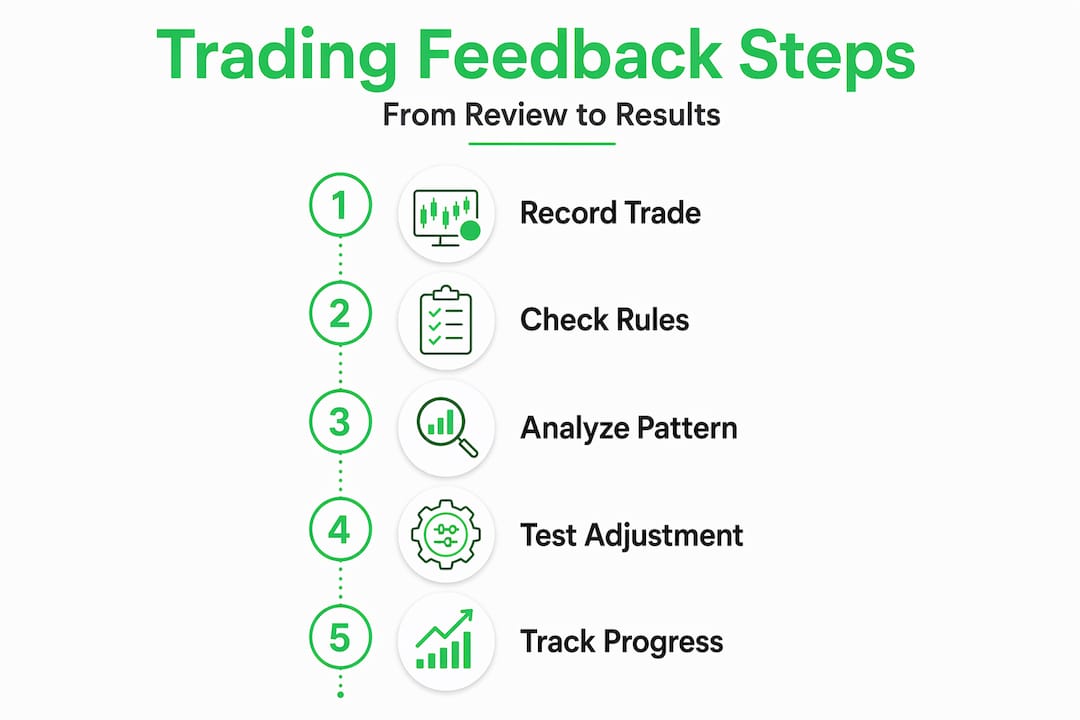
Here is a process that actually works:
-
Identify one repeatable leak. Look at your weekly data and find the single behavior that cost you the most. Not the most money necessarily, but the most frequently repeated error. Common examples: taking trades outside your defined session, sizing up after a loss, exiting early on winners.
-
Set one constraint to test. Turn the leak into a hard rule for the next one to two weeks. “No trades in the last 30 minutes of the session.” “Position size stays fixed regardless of conviction.” Make it specific and binary so you can measure it clearly.
-
Define what success looks like. Before the test period starts, write down what you’re measuring. For example: “I will take zero trades outside my defined setup criteria this week.” That’s a measurable target, not a vague intention.
-
Review and confirm or pivot. At the end of the test period, check your data. Did the constraint improve your rule adherence score? Did it affect your R-multiple distribution? If yes, keep it. If the constraint created new problems, adjust and test again.
Pro Tip: Write your current constraint on a sticky note and put it next to your monitor. Not as motivation. As a reminder of the one thing you’re testing this week. It keeps your focus narrow when the market tries to pull it wide.
Structured feedback transforms trading from guessing into a skills program with measurable inputs. That shift builds real confidence because your confidence is grounded in data, not hope.
| Leak identified | Constraint to test | Success metric |
|---|---|---|
| Overtrading low-quality setups | Only trade A-grade setups by criteria | 100% setup tag compliance for 2 weeks |
| Moving stop loss under pressure | Hard rule: stop is set at entry, never adjusted | Zero stop adjustments in weekly review |
| Exiting winners too early | Partial exit only at 1R, hold remainder to target | Average exit R improves from 0.8R to 1.2R |
| Revenge trading after losses | Max 2 trades per session after a losing trade | No sessions with more than 2 post-loss trades |
My honest take on feedback systems
I’ve worked with traders at every level, and the pattern is almost always the same. The traders who improve fastest are not the ones who study the most charts. They’re the ones who review their own behavior most honestly.
For a long time, I reviewed my trades the wrong way. I’d look at a loss and ask “was the setup valid?” instead of asking “did I follow my rules?” Those are completely different questions. The first one lets you off the hook. The second one holds you accountable to your own standard.
What changed everything for me was simplicity. I stopped tracking 12 metrics and started tracking three: rule adherence, R-multiple, and setup tag. Within a month, I had clearer data than I’d had in years of complex journaling. The signal got louder because I removed the noise.
The other thing I’d tell any trader is this: fix one thing per review cycle. Not two. Not five. One. It feels slow. It isn’t. A trader who eliminates one real leak per month is a dramatically different trader by the end of the year.
Separating performance review into metrics you control rather than P&L outcome reduces emotional bias in a way that nothing else does. When you stop measuring yourself by money made and start measuring by decisions made well, the emotional weight of trading changes completely.
— Gabriel
Take your feedback system further with Tradergibkey
Building a feedback system on your own is possible. Building one inside a structured program with clear rulesets, proven metrics, and a community that holds you accountable is faster and more sustainable.

Tradergibkey’s trading courses and mentorship are built around exactly this kind of feedback-driven improvement. With over 18 years of live market experience, Tradergibkey teaches traders how to define their setup criteria, track the right metrics, and run consistent review cadences that actually change behavior. You get the structure, the community, and the accountability that most traders try to build alone and never quite finish. If you’re serious about turning your trading reviews into real progress, this is where to start.
FAQ
What is the best way to give yourself trading feedback?
Use a four-level review system covering immediate post-trade notes, daily session checks, weekly pattern analysis, and monthly strategic assessments. Each level serves a different purpose and together they create a complete feedback loop.
Why should I track R-multiples instead of just profit and loss?
R-multiples normalize your results to your defined risk unit, which lets you compare trades across different instruments and position sizes fairly. Raw P&L is distorted by size variation and tells you little about decision quality.
How many metrics should I track in my trading journal?
Keep it to a small, focused set. Rule adherence, R-multiple, and setup quality are the three most decision-driving metrics for most traders. Tracking too many metrics leads to analysis paralysis rather than clearer feedback.
How do I turn a feedback insight into an actual behavior change?
Identify one repeatable leak, set a single hard rule to test for one to two weeks, define a measurable success criterion, and then review the data at the end of the period. Testing one constraint at a time produces the clearest results.
How soon after a trade should I write my journal notes?
Within two to three minutes of closing the position. Delays cause memory distortion that reduces the accuracy and learning value of your feedback. Fast capture is one of the most underrated best practices for trading feedback.