
The question of how much money you can earn from trading forex is one every new trader asks, and the honest answer surprises most people. This is not a market where skill alone determines your paycheck. The forex market trades roughly $6.6 trillion daily, yet the overwhelming majority of retail participants lose money. That gap between opportunity and outcome is exactly what this guide breaks down. You will get real numbers, real examples, and a clear picture of what it actually takes to generate consistent forex trading income.
Table of Contents
- Key Takeaways
- How much money you can earn from trading forex
- Real numbers: what traders actually earn
- Why most traders never reach consistent profits
- Building a practical approach to forex income
- My honest take on forex earnings
- Ready to build real trading skills?
- FAQ
Key Takeaways
| Point | Details |
|---|---|
| Earnings vary widely | Your forex trading profits depend on capital size, strategy quality, and risk management discipline. |
| Most retail traders lose money | Around 71% of retail accounts lose money, so realistic expectations matter before you start. |
| Small consistent gains compound | Targeting 1 to 3% monthly returns is more sustainable than chasing large, risky paydays. |
| Quality trades beat quantity | Fewer, well-selected setups with strong risk-reward ratios outperform high-frequency trading for most retail traders. |
| Tools have limits | A forex income calculator shows projections, not guarantees. Real results depend on execution and emotional discipline. |
How much money you can earn from trading forex
Earnings from forex trading fall under the broader category of speculative investment returns, and like any investment, the range is enormous. A beginner with $500 and no structured plan will have a completely different experience than a disciplined trader managing a $50,000 account with a proven edge.
Four core factors drive your forex trading profits more than anything else:
- Account size. Your capital is your engine. A 3% monthly gain on $1,000 is $30. The same return on $50,000 is $1,500. The math is simple, but most traders underestimate how much capital matters for living off trading.
- Leverage. Leverage amplifies both profits and losses, and losses can approach or exceed your initial deposit if the market moves against you. Using 50:1 leverage on a bad trade does not give you 50 times the opportunity. It gives you 50 times the risk.
- Win rate and risk-reward ratio. A trader with a 40% win rate can still be profitable if their average winner is 2.5 times their average loser. These two metrics work together, not independently.
- Trading costs. Spreads, commissions, and swap fees eat into net forex trading income every single trade. They are small per trade but significant over hundreds of trades.
Pro Tip: Before calculating potential profits, calculate your realistic break-even point. Add up your monthly trading costs and determine how many pips you need to earn just to cover them. That number will recalibrate your targets fast.
Real numbers: what traders actually earn
Let us look at actual documented results rather than the figures that circulate on social media.
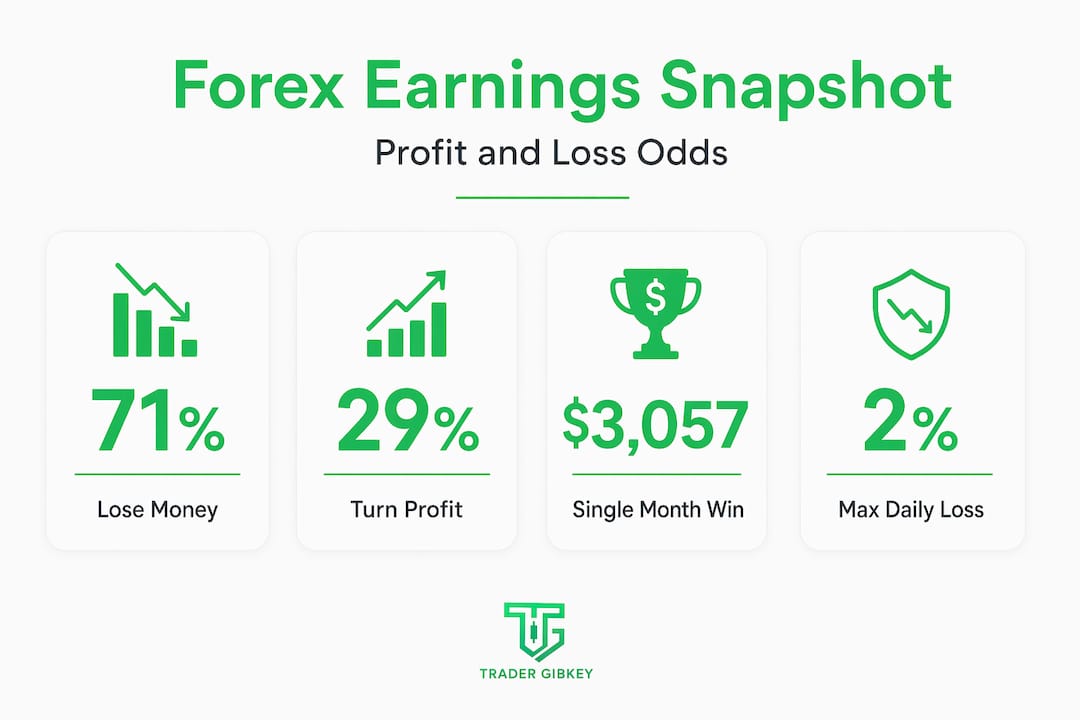
Around 71% of retail forex and CFD accounts lose money over any given reporting period. That means roughly 3 in 10 retail traders are profitable. This is not a damning statistic designed to scare you away. It is a baseline that tells you what the average unprepared trader achieves.
On the other end of the spectrum, a documented case from FTMO shows what disciplined execution looks like. One trader achieved a 32% monthly return on an €80,000 account by averaging under two high-quality trades per day, maintaining a 53.33% win rate and a reward-to-risk ratio of 2.40. That is not a story about trading harder or more often. It is a story about trading smarter.
Another real-world example comes from Nexus Forex, where a cent account posted $3,057.51 net profit in a single month with a 68.68% win rate and a profit factor of 2.87 across 348 trades.

Here is a rough earnings range breakdown by trader type:
| Trader Type | Typical Monthly Return | Notes |
|---|---|---|
| Beginner (under 1 year) | 0% to -15% | Learning curve, high error rate |
| Intermediate (1-3 years) | 0% to 3% | Inconsistent, developing edge |
| Consistent retail trader | 3% to 8% | Disciplined, proven system |
| Professional/funded trader | 5% to 15%+ | Structured plan, risk controls |
“Trader results require context. Trade count, max drawdown, and consistency of risk levels all matter. A 32% monthly return is one case study, not a forecast for your own account.” — FTMO Blog
Why most traders never reach consistent profits
This is where most forex education falls short. The math of profitability is straightforward. The execution is not.
Here are the four most common reasons traders fail to convert earnings potential forex trading has into actual income:
- Overtrading under pressure. When a trader hits a loss, the brain stops trading the chart and starts trading the pain. Revenge trades follow. Each one digs the hole deeper, not shallower.
- Ignoring drawdowns. Large drawdowns disrupt compounding and can force account resets or margin calls. A 20% drawdown requires a 25% gain just to get back to where you started. A 50% drawdown requires 100%. The math turns brutal quickly.
- Chasing unrealistic monthly targets. Traders who set a goal of 20% per month will take oversized risks to hit it. Oversized risks lead to outsized losses. This cycle kills more accounts than bad strategy ever does.
- Skipping performance tracking. If you do not track win rate, average risk-reward, and max drawdown, you are flying blind. Broker disclosures show loss rates across periods but do not separate consistent losers from traders who had one bad month. You need your own data.
Pro Tip: Set a hard rule for yourself: if you lose more than 2% of your account in a single day, you are done trading for that day. No exceptions. Protecting capital is the job. Profits follow from that discipline.
Building a practical approach to forex income
Knowing what you could earn from trading forex is useful. Knowing how to structure your trading to reach that potential is what matters.
Here is what the profitable minority actually focuses on:
- Target 1 to 3% monthly returns consistently. This sounds boring. Over 12 months with compounding, it builds a real track record and real equity. A trader who compounds 2% monthly doubles their account in roughly 36 months without taking reckless risks.
- Trade fewer, better setups. The FTMO example above is not a coincidence. Quality over quantity consistently produces better returns than high trade volume. Each trade you skip because it does not meet your criteria is a good decision, even if the market moved without you.
- Use a minimum 1:2 risk-reward ratio. If you risk $50 on a trade, you should be targeting at least $100 in potential profit. This means you can be wrong 40% of the time and still break even. Win 50% of the time and you are growing steadily.
- Separate your trading performance from your P&L emotion. Measure decision quality, not just outcomes. A well-executed trade that loses money is not a bad trade. A poorly executed trade that wins is still a problem.
Using a forex income calculator
A forex income calculator is a tool that lets you input your starting capital, expected monthly return percentage, win rate, and trade frequency to project potential earnings over time. Think of it as a planning tool, not a promise.
| Input | What it affects |
|---|---|
| Starting capital | Absolute dollar profit per period |
| Monthly return % | Growth rate and compounding speed |
| Win rate | Required risk-reward to stay profitable |
| Trade frequency | Exposure and total risk per month |
The limitation is real. Calculators assume your return percentage stays constant, which it never does. They do not account for drawdowns, emotional decisions, or market regime changes. Use them to set realistic floor targets, not ceilings. You can find practical forex tools at Tradergibkey alongside structured education to put those numbers in context.
My honest take on forex earnings
I have worked with traders at every level for a long time, and the pattern is consistent. The traders who eventually make money from forex are not the ones who found a magical system. They are the ones who stopped caring about getting rich and started caring about getting consistent.
The traders I have seen fail most reliably were chasing a monthly target that required them to risk too much. Every month started with good intentions. By week two, they were overexposed. By week three, they were revenge trading. By month end, they were back to zero or below.
The traders I have seen succeed were, almost universally, a little boring to watch. Two or three clean setups a week. Tight risk management. A trading journal they actually reviewed. They treated forex trading income like a craft, not a lottery ticket.
My personal view: if you cannot describe your edge in two sentences, you do not have one yet. And without an edge, the earnings potential forex trading offers means nothing because the market will simply redistribute your capital to someone who does have one. Build the process first. The profits become a byproduct of that.
— Gabriel
Ready to build real trading skills?
If you are serious about turning forex trading potential into actual, consistent income, the next step is structured education with someone who trades live markets, not just teaches from a whiteboard.

Tradergibkey offers trading courses, mentorship, and community built around 18 years of real market experience. The focus is on price action strategies that work across market conditions, not generic methods that look good on paper. Former students consistently describe the shift from guessing at setups to trading with genuine confidence. Whether you are just getting started or trying to break a plateau, Tradergibkey gives you the framework to earn from forex trading in a way that actually holds up over time.
FAQ
Can you really earn money from forex trading?
Yes, but roughly only 3 in 10 retail traders are profitable. Consistent earnings require a proven edge, disciplined risk management, and realistic monthly targets.
How much capital do you need to trade forex for a living?
Most professional traders target 3 to 8% monthly returns. To replace a $3,000 monthly income at that rate, you would need approximately $37,500 to $100,000 in trading capital, depending on your consistency.
What is a realistic monthly return for a forex trader?
For a disciplined retail trader with a tested strategy, 1 to 5% monthly is realistic and sustainable. Returns above 10% monthly are possible but require either high risk or exceptional skill, as shown in documented trader case studies.