
Effective engagement in a trading mentorship group is defined as purposeful, consistent participation that generates peer feedback, sharpens decision quality, and builds the accountability structures that solo trading cannot provide. Most traders join a group and then quietly consume content without contributing. That passive approach kills your growth. To engage a trading mentorship group effectively, you need structured habits, the right tools, and a clear understanding of how group dynamics actually work. Tradergibkey has spent over 18 years in live markets watching this pattern play out, and the difference between traders who grow fast and those who stagnate almost always comes down to how they show up in their community.
What does it take to engage a trading mentorship group effectively?
Before you post a single message, you need the right setup. The platform your group runs on shapes everything about how you participate. Telegram, Discord, and Slack each have distinct features. Telegram is built for broadcast-style updates and polls. Discord supports voice channels and role-based permissions, making it strong for structured learning tiers. Slack works best for professional, thread-based discussion. Knowing which platform you are on determines which engagement tools are even available to you.
Once you know your platform, set up your participation infrastructure. This means a shared calendar for live sessions, mobile alerts for pinned announcements, and a dedicated note-taking system like Notion or a simple trading journal. Effective online communities use verification, clear posting rules, and balanced commentary to build trust. That trust starts with your profile. Use your real trading name, display your experience level honestly, and if the group allows it, share a transparent performance record. Credibility is earned through consistency, not claims.
Here is what your pre-engagement checklist should cover:
- Platform setup: Notifications on, channels organized, pinned posts read
- Profile credibility: Real name or consistent handle, stated experience level, honest track record
- Communication norms: Read the group rules before posting anything
- Scheduling: Block time for live sessions and async review each week
- Note system: Capture key insights from every session in a searchable format
| Tool | Best use in trading groups |
|---|---|
| Telegram | Polls, broadcast updates, quick market reactions |
| Discord | Voice AMAs, role-based learning tiers, community events |
| Slack | Threaded trade analysis, professional peer review |
| Notion | Personal trade journaling and session note capture |
| Google Calendar | Scheduling live sessions and recurring engagement blocks |
How to establish a consistent engagement rhythm
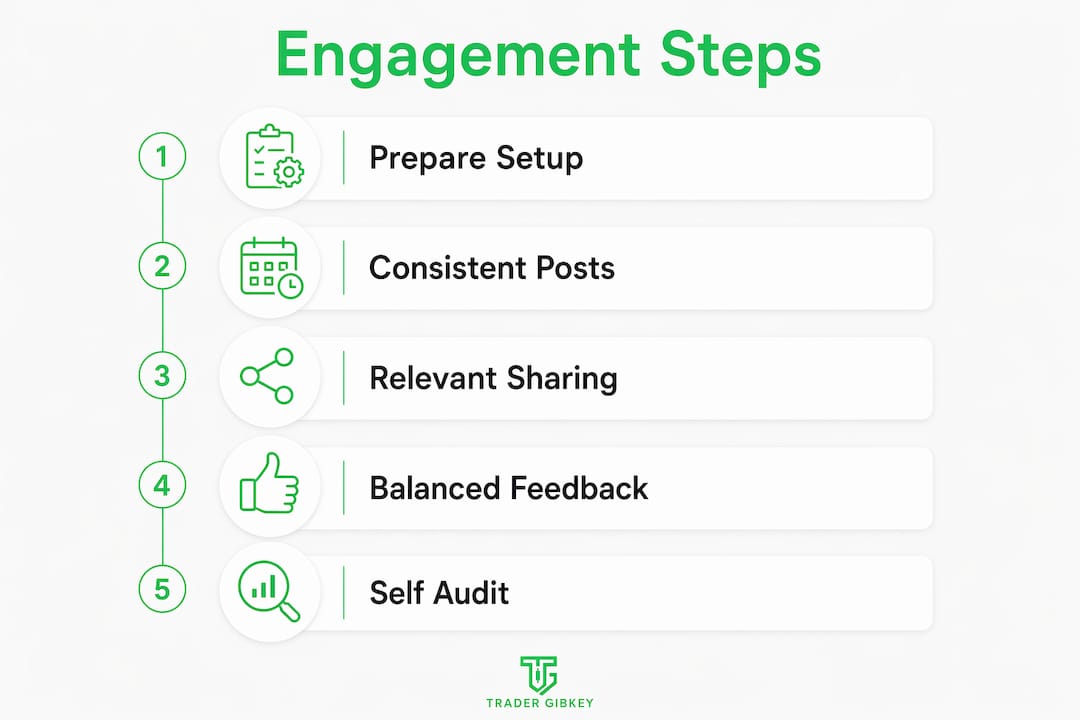
Consistency is the single biggest predictor of growth in any mentorship group. Random posting creates noise. Structured posting creates habit, anticipation, and real learning loops. The framework that works is a three-beat weekly rhythm: a value drop, an interactive session, and a community moment. Posting 3 to 5 times per week using this structure keeps you visible without overwhelming the group.
Here is how to execute that rhythm in practice:
- Value drop (Monday or Tuesday): Share a specific trade setup you are watching. Include the pair or instrument, the timeframe, your reasoning, and what you have ruled out. This is not a signal. It is a thinking-out-loud post that invites feedback.
- Interactive session (Wednesday or Thursday): Participate in or host a poll, a live AMA, or a challenge thread. Polls generate 3 to 5 times more interaction than standard text posts because they lower the barrier to participation. Even a simple “Which setup do you favor this week: breakout or pullback?” drives real discussion.
- Community moment (Friday or weekend): Reflect on the week. Share what worked, what did not, and one thing you are taking into next week. This is where peer accountability gets built.
Time-limited challenges are one of the most underused tools in trading groups. Seven to 30-day challenges in trading communities achieve completion rates of 70 to 80%, compared to single-digit engagement in passive groups. That gap exists because challenges create social commitment and a clear finish line. If your group does not run them, propose one.
Pro Tip: Pin your weekly schedule to your own profile or use a recurring post tool. When other members know when to expect your contributions, they start showing up to respond. Predictability builds community.

What are the best practices for contributing without overwhelming the group?
The most common mistake traders make in mentorship groups is posting too broadly. “What do you think of EUR/USD right now?” generates almost no useful feedback. A specific, framed post generates a real conversation. Micro-contributions are the standard: share a specific trade dilemma, a decision you are wrestling with, or a setup where you can see two valid interpretations.
Every strong contribution follows a simple frame: market, timeframe, reasoning, and what you have already ruled out. That last part is critical. When you tell the group what you have eliminated, you show your thinking process and invite correction at the right level. Communities that encourage specific, detailed questions about trade logic and risk control generate higher quality feedback than those that tolerate vague posts.
Here is what separates high-value contributions from low-value ones:
- High value: “I am watching GBP/JPY on the 4H. Price is at a previous demand zone. I am considering a long with a stop below the zone low. I have ruled out a short because the daily trend is still bullish. Does this invalidate if price closes below 192.50?”
- Low value: “Thoughts on GBP/JPY?”
- High value: Sharing a losing trade with your reasoning and asking where the logic broke down
- Low value: Only sharing wins, which builds a false image and shuts down real learning
Engagement quality beats engagement quantity every time. The goal is peer-to-peer feedback that sharpens your trading judgment, not a high post count that makes you look active.
Balancing wins and losses in your posts builds more trust than a highlight reel. When you share a loss with honest analysis, other members recognize their own patterns in yours. That recognition is where real learning happens. Group coaching often outperforms one-on-one mentorship precisely because peer visibility creates stronger accountability and learning through shared patterns.
How do you sustain engagement and avoid dropping out?
Dropout is the silent killer of mentorship group value. Most traders do not quit dramatically. They just go quiet. Then two weeks pass, the group feels unfamiliar, and re-entry feels awkward. Members silent for 14 or more days are at the highest risk for permanent churn. The fix is to catch yourself before you hit that threshold.
Use this four-step system to stay on track:
- Track your own activity weekly. Count your posts, your replies, and your session attendance. If any metric drops two weeks in a row, treat it as a signal, not a coincidence.
- Set a re-entry rule. If you miss a week, your first post back is always a reflection post. What did you trade? What did you learn? This removes the pressure of needing something impressive to say.
- Use milestone moments. Month-end reviews, quarterly performance check-ins, and group anniversaries are natural re-engagement triggers. Use them deliberately.
- Ask for feedback directly. If you have been quiet, message a peer or the group moderator and ask a specific question. Direct, specific outreach is the fastest way to rebuild momentum.
The most common mistake here is confusing activity for engagement. Reacting to every post with an emoji is activity. Asking a follow-up question on someone’s trade analysis is engagement. Sustained engagement depends on identifying your own inactivity patterns early and running a targeted re-engagement protocol before the gap becomes a habit.
Pro Tip: Set a calendar reminder every Sunday to review your group activity for the week. Five minutes of self-audit prevents the 14-day silence that leads to dropout.
Key takeaways
Engaging a trading mentorship group effectively requires structured rhythms, specific contributions, and proactive self-monitoring to convert community participation into measurable trading growth.
| Point | Details |
|---|---|
| Set up before you post | Configure alerts, read group rules, and build a credible profile before contributing. |
| Use the three-beat rhythm | Post 3 to 5 times weekly using value drops, interactive sessions, and community moments. |
| Contribute with specificity | Frame every post with market, timeframe, reasoning, and what you have ruled out. |
| Monitor your own activity | Track posts and replies weekly; treat two consecutive slow weeks as a warning sign. |
| Challenges drive completion | Time-limited group challenges achieve 70 to 80% completion versus single-digit passive engagement. |
What I have learned about group engagement after 18 years in the market
I will be straight with you. For the first several years of my trading career, I treated mentorship groups the way most traders do. I lurked. I read the posts, absorbed the setups, and told myself I was learning. I was not. I was consuming without processing, and there is a big difference.
The shift happened when I started posting my losing trades. Not the ones where I got unlucky. The ones where my logic was wrong. The response from the group was immediate and specific. Other traders recognized the same mistake in their own charts. That is the thing about peer pattern recognition: it accelerates learning in a way that no one-on-one session can replicate, because you are seeing your own blind spots reflected back through someone else’s experience.
The fear of public sharing is real. Nobody wants to look like they do not know what they are doing. But here is the truth: the traders who post imperfect analysis and ask honest questions are the ones who grow fastest. The traders who only post wins are the ones who stagnate, because they never get corrected. Group accountability forces a kind of self-review that solo trading simply does not. Individual mentorship lacks the exposure to broader trading mistakes and peer learning that group coaching provides. That is not a knock on one-on-one work. It is just a structural reality.
Use your community as a growth multiplier. Show up with specificity, stay consistent, and let the group do what groups do best: hold up a mirror.
— Gabriel
Take your trading further with Tradergibkey
If you are ready to put these engagement principles into a structured environment, Tradergibkey offers exactly that. The program combines weekly group coaching sessions, daily market coverage, and a community of traders at every experience level. You get access to price action courses built on 18 years of live market experience, plus ongoing peer learning that keeps your skills sharp between sessions.
Group mentorship through Tradergibkey costs a fraction of private coaching while delivering the accountability and feedback loops that actually move the needle. Whether you are just learning how to join a trading mentorship or you are a seasoned trader looking to sharpen your edge, the community is built for real progress. Visit Tradergibkey to explore current programs and find the right fit for your trading goals.
FAQ
What is the best posting frequency for a trading mentorship group?
The recommended frequency is 3 to 5 posts per week using a structured rhythm of value drops, interactive sessions, and community moments. Consistency matters more than volume.
How do I re-engage after going quiet in a group?
Post a specific reflection on a recent trade or ask a direct question to a peer or moderator. Members silent for 14 or more days are at the highest churn risk, so act before that threshold.
Are polls really worth using in trading groups?
Yes. Polls generate 3 to 5 times more interaction than standard text posts because they lower the barrier to participation and create immediate, visible discussion.