
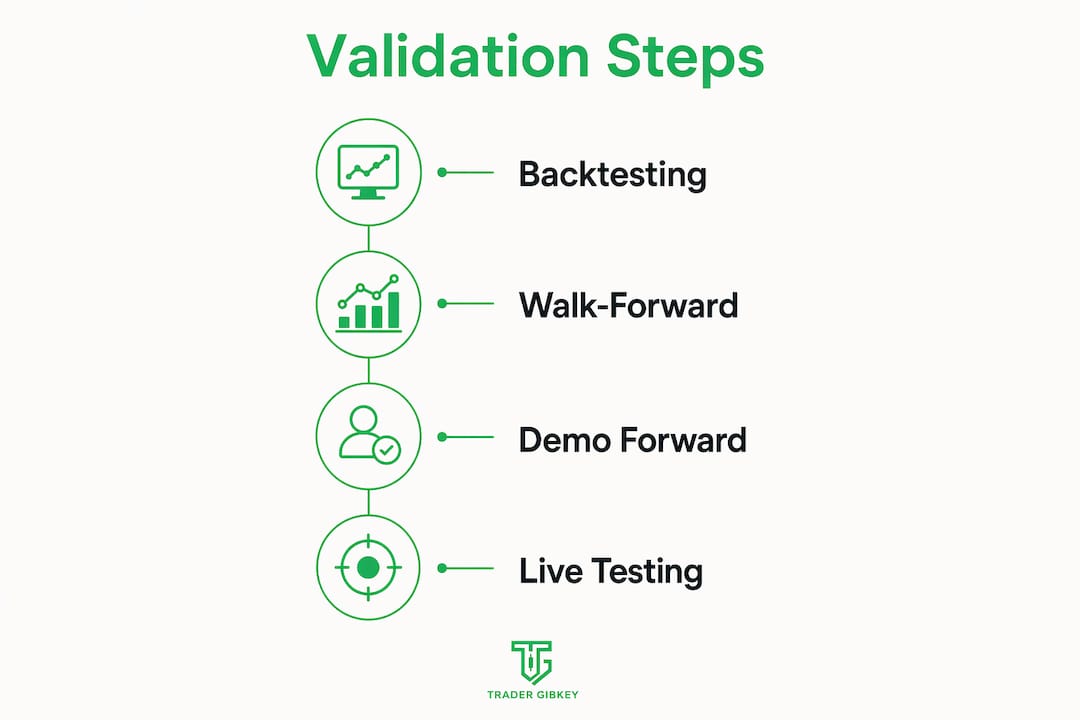
Live market validation is the process of confirming a forex strategy performs under real execution conditions, not just on historical price data. Most traders who blow accounts do so not because their strategy is wrong on paper, but because they never properly tested it against the friction of real markets. To validate forex strategy in live markets, you need a layered approach: backtesting, walk-forward analysis, demo forward testing, and finally small-scale live deployment. Each layer catches a different class of failure. Skip one, and you are flying blind.
What tools and conditions do you need to validate a forex strategy in live markets?
The foundation of live market strategy validation is having the right infrastructure before you place a single real trade. Without it, you are not testing your strategy. You are testing your setup.
Here is what you need in place:
- High-quality historical data. Use tick data or at minimum one-minute OHLC data from your actual broker or a reputable data provider. Data gaps and price feed inconsistencies corrupt backtest results before you even begin.
- A demo account that mirrors your live account. Use the same broker, same instrument, same spread type (fixed or variable), and same execution model. A demo account on a different broker tells you almost nothing about live execution.
- A trade journal or logging tool. Spreadsheets work. Dedicated tools like Edgewonk or FX Blue add automation. The goal is capturing fills, slippage, spread at entry, execution delay, and your emotional state at the time of the trade.
- A defined risk framework. Before testing live, set your maximum risk per trade, maximum daily drawdown, and position sizing rules. These are not optional. They are the guardrails that keep a bad testing phase from becoming a blown account.
Execution conditions are part of your strategy, not separate from it. Spreads, commissions, and slippage materially affect strategy results, and ignoring them invalidates any proof built only on signal logic.
| Tool | Purpose |
|---|---|
| Tick or 1-min historical data | Accurate backtesting without price feed distortion |
| Same-broker demo account | Replicates live execution environment |
| Trade journal (Edgewonk, FX Blue) | Logs fills, slippage, and rule adherence |
| Risk management framework | Controls exposure during testing phases |

Pro Tip: Set your demo account balance to match your planned live account size exactly. Position sizing psychology changes when the numbers feel real, even on demo.
How does walk-forward analysis reduce overfitting?
Walk-forward analysis (WFA) is the industry-standard method for testing whether a strategy’s parameters hold up across time periods it has never seen. It is the most rigorous tool available to evaluate forex trading methods before live deployment.
Here is how it works step by step:
- Divide your historical data into in-sample (IS) and out-of-sample (OOS) periods. The IS period is where you optimize your strategy parameters. The OOS period is where you test those parameters without touching them.
- Optimize on the IS window. Run your parameter optimization on this data only. Select the parameter set that performs best.
- Validate on the OOS window. Apply those exact parameters to the OOS data. Record the results without adjusting anything.
- Roll the window forward. Shift both the IS and OOS windows forward in time and repeat the process. This is called a rolling walk-forward. An anchored walk-forward keeps the IS start date fixed and only extends the end date.
- Aggregate results across all OOS periods. This is where most traders make a mistake. They look at the average OOS performance and stop there. You must also examine worst-case drawdowns and trade counts across every individual OOS window, not just the summary.
The reason WFA works is that rolling in-sample and out-of-sample windows simulate the adaptive nature of live trading far better than a single backtest ever can. A strategy that survives ten consecutive OOS windows has demonstrated something a single backtest cannot: it does not depend on one lucky parameter set.
Common pitfalls to avoid:
- OOS periods that are too short. If your OOS window contains fewer than 30 trades, the result is statistically meaningless.
- Over-tuning parameters on IS data. More parameters mean more ways to fit noise. Keep your parameter space small and meaningful.
- Ignoring worst-case OOS windows. If one window shows a 40% drawdown, that is a live scenario you will face. Plan for it.
Platforms like MetaTrader 5 include a Forward Optimization feature in the Strategy Tester that automates much of this process. It is not a perfect WFA implementation, but it is a practical starting point for most retail traders.
Pro Tip: A strategy that passes WFA with a profit factor above 1.3 across all OOS windows is worth moving to demo forward testing. Below that threshold, go back to the drawing board.
How to apply forward testing on a demo account
Forward testing runs your strategy on live or near-real-time market conditions after backtesting, letting you observe current market performance without risking capital. Think of it as the bridge between historical proof and live execution.
To run a meaningful forward test, follow these practices:
- Mirror live conditions exactly. Set spreads, commissions, and swap rates to match your live broker’s actual costs. Demo accounts often default to idealized execution. Override those defaults manually if your platform allows it.
- Use the same position sizing you plan for live. If you plan to risk 1% per trade on a $5,000 live account, run the demo at $5,000 with 1% risk. This makes the numbers psychologically real and keeps your risk management rules consistent across phases.
- Log every trade in detail. Record the planned entry, actual fill, spread at entry, slippage in pips, time to fill, and whether you followed your rules. This data is your comparison baseline when you go live.
- Run the forward test for a statistically meaningful period. A minimum of 50 to 100 trades is the standard threshold. Fewer trades and you are reading noise, not signal.
- Track discrepancies between backtest and forward test results. If your backtest showed a win rate of 55% and your forward test shows 42%, that gap needs an explanation before you go live. Common causes include spread widening during news, execution delays, and market regime shifts.
Forward testing with live data lets you adjust based on trade log reviews before committing real capital. That review process is where most of the real learning happens. You will see patterns in your rule adherence, your entry timing, and your reaction to drawdowns that no backtest can reveal.
One honest limitation: demo trading does not replicate emotional pressure. You will not feel the same urgency on a demo loss as a live loss. That gap matters, and you need to account for it when you transition.
How to transition from demo to live without blowing your account
The move from demo to live is where most traders lose the gains they built in testing. The strategy does not change. The execution environment does, and so does your psychology.
Follow these steps to make the transition without unnecessary damage:
- Start with reduced position sizes. If your demo used 1% risk per trade, start live at 0.25% to 0.5%. Live transitions require less capital and reduced sizing to manage emotional and execution risks. This is not timidity. It is calibration.
- Expect worse fills than demo. Live trading typically experiences fills 0.3 to 1.0 pips worse on order entry and stop slippage of several pips during volatility. Build this into your expected performance range before you start.
- Log every live trade with the same rigor as demo. The comparison between your demo log and your live log is your most valuable diagnostic tool. Consistent gaps in fill quality, win rate, or drawdown tell you exactly where the execution friction is.
- Do not scale up until your live statistics confirm viability. Scaling should wait until several months of live trades confirm the strategy performs within acceptable deviation from your demo baseline. Rushing this step is the most common and most expensive mistake traders make.
- Manage the psychological shift deliberately. Real money activates a different decision-making mode. You will feel the urge to move stops, exit early, or revenge trade after a loss. Recognize these as execution errors, not strategy signals. A hard rule against modifying trades once placed is your best defense.
“The strategy that worked on demo is the same strategy. What changed is you. Manage that change and the strategy has a real chance.”
Pro Tip: Keep a separate column in your trade journal labeled “Rule Adherence.” Score each trade 1 or 0 based on whether you followed your plan exactly. A live win rate that drops alongside a falling adherence score tells you the problem is execution, not strategy.
Key takeaways
A forex strategy is only proven when it survives real execution conditions, including slippage, variable spreads, and the psychological pressure of live capital.
| Point | Details |
|---|---|
| Layer your validation | Combine backtesting, walk-forward analysis, demo forward testing, and live micro trading for full coverage. |
| WFA beats single backtests | Rolling out-of-sample windows across multiple periods expose overfitting that a single backtest hides. |
| Demo must mirror live costs | Set spreads, commissions, and position sizes to match your planned live account before forward testing. |
| Scale live trading slowly | Start at 25 to 50% of planned position size and scale only after months of live data confirm viability. |
| Log execution, not just results | Tracking fills, slippage, and rule adherence reveals whether failures come from strategy or execution. |
Why most traders skip the hardest part of validation
Here is what I have seen over 18 years of live market trading: the traders who blow accounts are rarely wrong about direction. They are wrong about execution. They backtest a strategy, see a beautiful equity curve, and move straight to live trading with full size. Then the spreads widen, the fills are worse than expected, and the first drawdown triggers a revenge trade. The strategy never had a fair test.
Walk-forward analysis and demo forward testing are not bureaucratic steps. They are the difference between knowing your strategy works and hoping it does. The two-layer validation approach of WFA plus live forward testing is what separates traders who build a real edge from those who keep searching for a new system after every losing month.
The traders I have mentored who made the fastest progress were not the ones with the most sophisticated strategies. They were the ones who kept the most detailed logs and stayed patient through the validation process. Patience in testing translates directly into confidence in live trading. You stop second-guessing your entries because you have evidence, not just hope.
My honest advice: treat your validation process as seriously as you treat your entries. A profitable trading strategy is not just a signal system. It is a signal system that has been proven to survive real market conditions. Build that proof deliberately, layer by layer.
— Gabriel
Take your strategy validation further with Tradergibkey
Knowing the process is one thing. Having a structured program and a mentor who has walked through it in real markets is another.
Tradergibkey offers trading courses and mentorship built around practical, live market application. With over 18 years of live trading experience, the focus is on teaching you to test, refine, and execute strategies with real discipline, not just theory. The community gives you ongoing feedback as you move through each validation phase, from your first walk-forward test to your first live trade. If you are ready to stop guessing and start building a strategy with a real track record, start here at Tradergibkey and get the structured support that makes the difference.
FAQ
How long should you forward test before going live?
Run a minimum of 50 to 100 trades on demo before transitioning to live. Fewer trades produce statistically unreliable results that cannot confirm or deny strategy viability.
What is the biggest difference between demo and live trading?
Live trading typically produces fills 0.3 to 1.0 pips worse than demo, plus real slippage during volatility and the psychological pressure of actual capital at risk.
Can walk-forward analysis guarantee a strategy will work live?
No single test guarantees live performance, but walk-forward analysis significantly reduces overfitting risk by validating parameters across multiple unseen data periods rather than a single historical window.