
Trading is a skill built through sequential stages, starting with chart reading and ending with disciplined live execution backed by strict risk controls. Most beginners skip the middle steps and pay for it. The good news is that a clear, structured path exists. When you learn about trading the right way, you move from confusion to confidence without blowing up your account in the process. Resources like Quantum Algo, Fidelity, and Tradergibkey each map out this progression differently, but the core sequence is the same: foundations first, practice second, live capital last.
What are the essential foundational skills to learn about trading?
Price action trading is defined as the practice of reading raw price movements, market structure, and institutional order flow signals to make trading decisions without relying on lagging indicators. This is the language every serious trader needs to speak before placing a single live trade.
Start with candlestick charts. Each candle tells you four things: the open, close, high, and low of a given period. When you can read a chart and immediately spot who is in control, buyers or sellers, you have the first building block. From there, you learn to identify swing highs and swing lows, which form the skeleton of market structure.

Two concepts that separate informed traders from guessers are Break of Structure (BOS) and Change of Character (CHoCH). A BOS confirms that the current trend is continuing. A CHoCH signals that the trend may be reversing. According to price action concepts, these signals, combined with order blocks and liquidity zones, reflect institutional trading behavior that retail traders can use to their advantage.
Here is what you need to master in the foundational phase:
- Candlestick patterns: Understand what each formation signals about buyer and seller pressure.
- Market structure: Identify swing highs, swing lows, BOS, and CHoCH on multiple timeframes.
- Key zones: Mark support, resistance, Fair Value Gaps, and order blocks where price is likely to react.
- Trend vs. range: Determine whether the market is trending or consolidating before planning any trade.
Pro Tip: Do not try to memorize every candlestick pattern. Focus on understanding what price is doing at key zones. Context beats pattern recognition every time.
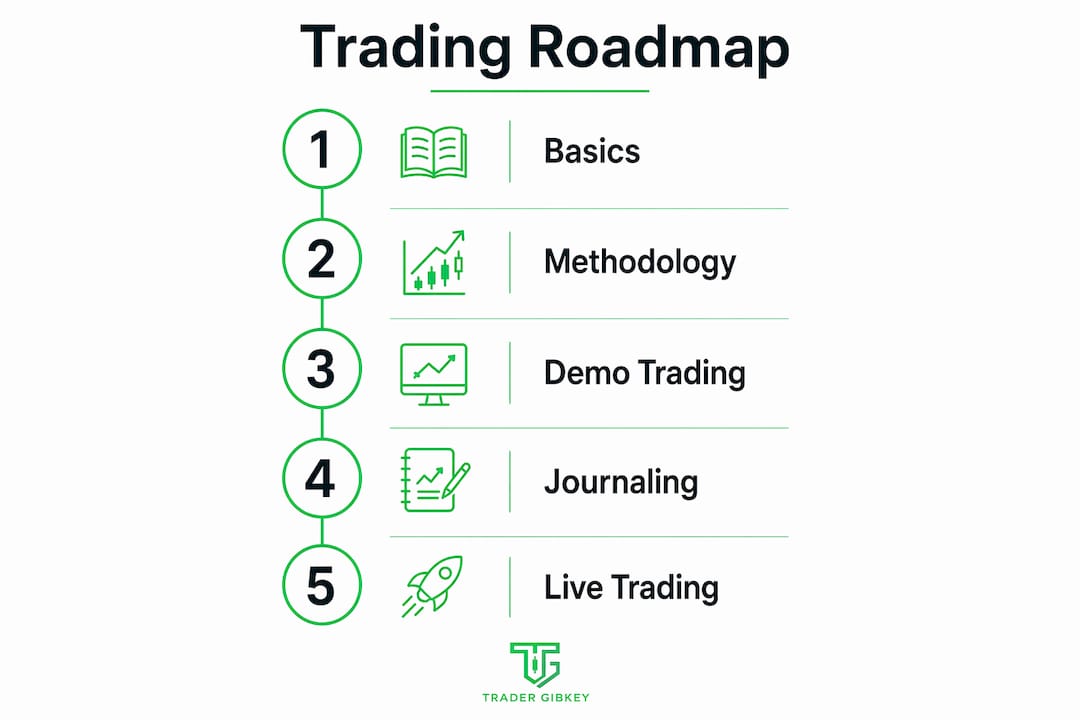
A practical beginner roadmap suggests spending roughly two weeks on trading basics before moving to methodology. That timeline feels fast, but it works if you are studying charts actively every day rather than reading passively.
How do you practice trading effectively before risking real money?
Deliberate practice separates traders who improve from those who repeat the same mistakes. The goal is not just to place trades. The goal is to build a feedback loop that tells you whether your edge is real.
Follow this sequence for effective practice:
- Set up a demo account. Most brokers and platforms offer paper trading environments. Use one that mirrors real spreads and execution conditions as closely as possible.
- Use TradingView Replay mode. This tool lets you simulate trades candle by candle on historical data, which means you can practice months of market conditions in days. It is one of the fastest ways to build pattern recognition.
- Complete at least 100 demo trades before going live. This is not an arbitrary number. It gives you enough sample size to identify whether your setups have a statistical edge or whether you are just getting lucky on a few trades.
- Journal every trade. Record your entry reason, the setup type, your stop-loss level, your target, and the outcome. Review weekly. Look for patterns in your wins and losses.
- Analyze for edge, not just profit. A trade can be profitable and still be a bad trade if you broke your rules. Conversely, a losing trade executed perfectly is a good trade. Judge decision quality, not just results.
Interactive simulators and pattern builders increase cognitive engagement and accelerate skill acquisition compared to passive reading. This is why platforms that gamify the learning process produce faster results than textbook-only approaches.
Pro Tip: After every 20 demo trades, pause and calculate your win rate, average risk-to-reward ratio, and which setup types are performing. If you cannot identify your edge in the numbers, you do not have one yet.
What makes a reliable trading plan and risk management strategy?
A trading plan is not a wish list. It is a set of hard rules that govern every decision before, during, and after a trade. Without it, emotion fills the gap, and emotion is the reason most traders lose money.
Your plan needs to define the following:
- Entry criteria: What specific conditions must be present before you enter? A setup without confirmation is just a guess.
- Stop-loss placement: Where does price need to go to prove your trade idea wrong? Place your stop there, not at a round number that feels comfortable.
- Take-profit targets: Define your exit before you enter. Trailing stops and partial exits are valid, but they need to be planned, not improvised.
- Position sizing: Risk 1 to 2% of capital per trade during your learning phase. This keeps any single loss from doing serious damage to your account.
- Daily loss limit: If you lose a set amount in one session, you stop trading for the day. This hard rule prevents revenge trading.
Trading costs are a real drag on profitability that beginners consistently underestimate. Bid-ask spreads, commissions, and order types vary significantly across markets and directly impact your bottom line. A trade that looks profitable on paper can become a loser once you account for spread and commission.
Here is a quick comparison of key risk management components:
| Component | What it controls | Common beginner mistake |
|---|---|---|
| Position sizing | How much capital is at risk per trade | Sizing too large relative to account |
| Stop-loss | Maximum loss on a single trade | Placing stops too tight or moving them |
| Daily loss limit | Total drawdown allowed per session | Trading through losses to “make it back” |
| Take-profit | Locking in gains before reversal | Exiting too early out of fear |
Separating research and planning from execution reduces avoidable losses and emotional mistakes. When you plan the trade before the market opens, you are thinking clearly. When you are in a live trade, your brain is under pressure. Let your plan do the thinking.
How does price action trading compare to other trading styles?
Price action trading is the method of making decisions based solely on what price is doing, using market structure, key zones, and confirmation signals rather than indicators. It is the foundation that makes every other trading style more effective.
Price action separates location from timing: zones show you where to look, and confirmation candles or patterns tell you when to enter. This two-step filter dramatically reduces premature entries, which are one of the most common and costly beginner mistakes.
Here is how the three main styles compare:
| Trading style | Core method | Best for | Key limitation |
|---|---|---|---|
| Price action | Market structure, zones, confirmation | All markets, all timeframes | Requires strong chart reading skill |
| Trend following | Moving averages, momentum indicators | Strong trending markets | Lags price, late entries |
| Swing trading | Multi-day holds, technical patterns | Part-time traders | Overnight risk, wider stops |
Price action works across Forex, equities, and crypto because it reads the universal language of supply and demand. Trend following and swing trading both benefit from price action as a filter. Knowing where the institutional zones are makes every other method sharper.
The execution sequence for price action is straightforward: identify whether the market is trending or ranging, mark your key zones, wait for a confirmation signal at those zones, execute with a defined stop-loss, and manage the trade according to your plan. That five-step process, when repeated consistently, builds the repeatability that a complete trading system requires.
What risks does leverage create and how do beginners handle them safely?
Leverage amplifies both profits and losses. A 10x leveraged position means a 5% move against you wipes out 50% of your margin. That is not a hypothetical. It happens to underprepared traders every day.
Margin calls and forced liquidations are the two outcomes that end leveraged trading accounts. A margin call happens when your account equity falls below the required maintenance margin. If you do not add funds or reduce your position, the broker liquidates your trade automatically, often at the worst possible price.
Here is how to handle leverage responsibly:
- Start with the lowest available leverage. Many experienced traders use 2x to 5x even when higher options are available. Lower leverage gives you more room to be wrong without getting liquidated.
- Use isolated margin, not cross margin. Isolated margin limits losses to the capital allocated to that specific trade. Cross margin can draw from your entire account balance, which multiplies the damage of a bad trade.
- Never skip your stop-loss on a leveraged position. A stop-loss on a leveraged trade is not optional. It is the mechanism that keeps a bad trade from becoming a catastrophic one.
- Practice leveraged strategies on paper first. Simulate the exact leverage ratio you plan to use in live trading before committing real capital.
- Apply volume and technical analysis together. Volume confirms whether a price move has institutional backing or is just noise. Reacting to noise on a leveraged position is expensive.
Pro Tip: If you feel the urge to increase leverage after a losing streak to recover faster, that is the exact moment to reduce it. The brain stops trading the chart and starts trading the pain. Recognize that shift and step back.
Key takeaways
Structured learning, disciplined practice, and layered risk management are the three non-negotiable pillars of trading success.
| Point | Details |
|---|---|
| Foundations before live trading | Master market structure, BOS, CHoCH, and key zones before placing real trades. |
| Demo trading builds real edge | Complete at least 100 journaled demo trades to validate your setup before going live. |
| Risk 1 to 2% per trade | Position sizing and daily loss limits protect capital during the learning phase. |
| Price action is the core skill | Reading zones and confirmation signals improves entry accuracy across all trading styles. |
| Leverage requires strict controls | Use isolated margin, low leverage, and mandatory stop-losses to survive leveraged markets. |
Why most traders learn the hard way (and how to avoid it)
I have watched traders come through structured programs with real potential and then blow their accounts within three months of going live. The pattern is almost always the same: they skipped the journaling, they sized too large too soon, and they trusted a “mentor” who promised consistent monthly returns without showing verified track records.
Investment scams caused $7.9 billion in losses in 2025, with a median loss of $10,000 per victim. The FTC is clear: urgency, guaranteed returns, and pressure to avoid verification are all red flags. Before you pay for any trading education, check the provider’s credentials on Investor.gov and look for real, verifiable student outcomes. Regulators warn that some trading education is specifically designed as a lure for scams.
The traders I have seen succeed share one habit: they treat every losing trade as data, not failure. They journal, they review, and they adjust. They also stay in communities where accountability is the norm, not the exception. Isolation is where bad habits survive. A good trading community surfaces your blind spots faster than any course can.
My honest advice: do not chase the shortcut. The 3 to 6 month structured roadmap feels slow when you are eager to trade. But the traders who follow it arrive at live trading with a real edge, not just hope.
— Gabriel
Start your trading education with Tradergibkey
If you are ready to move from theory to a structured, practical path, Tradergibkey is built for exactly that. With over 18 years of live market experience, Tradergibkey’s courses take you from foundational chart reading through advanced price action strategies and real risk management frameworks. You are not getting generic advice. You are getting methods tested in live Forex markets across nearly two decades.
The community element matters too. Accountability, peer feedback, and mentorship from someone who has traded through every market condition accelerates your progress in ways that solo study cannot match. Visit Tradergibkey’s trading courses to explore the full course structure, mentorship options, and community access. This is where aspiring traders become consistent ones.
FAQ
What is price action trading?
Price action trading is the method of making trading decisions based on raw price movements, market structure, and key zones rather than lagging indicators. It uses concepts like Break of Structure, order blocks, and confirmation candles to time entries and exits.
How long does it take to learn to trade the market?
A structured beginner roadmap spans 3 to 6 months, covering basics, methodology, demo trading with journaling, and then small live account trading. Skipping stages extends the timeline and increases losses.
How much should I risk per trade as a beginner?
Risk 1 to 2% of your total capital per trade during the learning phase. This limit, combined with a daily loss cap, prevents any single session from doing unrecoverable damage to your account.