
A liquidity sweep is defined as a deliberate price move by large market participants to push price beyond obvious stop-loss levels, triggering clustered retail orders before reversing in the opposite direction. This tactic, also called a stop hunt or stop run in institutional trading circles, is one of the most common reasons retail traders get knocked out of otherwise valid positions. 92% of retail traders fail within two years, and a significant portion of those failures trace back to chasing breakouts that were actually liquidity sweeps in disguise. Understanding how these traps work is not optional knowledge. For any retail trader serious about surviving volatile markets, it is the foundation everything else builds on.
How do liquidity sweeps trap retail traders?
The trap starts with predictability. Retail traders tend to place stop-loss orders at the same obvious locations: just below a recent swing low, just above a recent swing high, or at round numbers. When many traders do this simultaneously, those areas become dense clusters of resting orders. Equal highs and equal lows create stop clusters that are four times denser than single swing points, making them prime targets for institutional order flow.
Large players need liquidity to fill their own positions. They cannot simply buy millions of dollars worth of an asset without moving the market against themselves. So they push price into those stop clusters, triggering a wave of sell orders (or buy orders on the short side) that gives them the liquidity they need. Once filled, they reverse price in their intended direction, leaving retail traders stopped out at the worst possible moment.

Liquidity thins as price approaches stop clusters because passive liquidity providers withdraw ahead of the spike. That thinning amplifies the price move, making the false breakout look convincing and urgent. Your brain stops trading the chart and starts trading the fear of missing a real move.
Here is how a typical liquidity sweep event unfolds:
- Concentration. Stop orders accumulate at obvious technical levels as retail traders set similar entries and exits.
- Thinning. Passive liquidity providers pull back, reducing the counter-pressure needed to absorb a price spike.
- Cascade. Price pushes through the stop cluster, triggering a chain reaction of orders that accelerates the move.
- Reversal. Institutional players, now filled, reverse price sharply. Retail traders are left holding losing positions or sitting on the sidelines after being stopped out.
High leverage makes this worse. A 1% false breakout can cause a 10% capital loss on 10x leverage. That math punishes traders who chase breakouts without confirmation.
Pro Tip: Watch for wick-heavy candles at swing highs and lows. A long wick that closes back inside the previous range is the clearest visual signal of a stop hunt. The wick shows exactly where the sweep happened.
What distinguishes a genuine breakout from a liquidity sweep?
The difference comes down to follow-through and conviction. A genuine breakout shows fast, aggressive continuation after the level breaks. Price does not hesitate. Volume expands. New structure forms above or below the broken level. A liquidity sweep, by contrast, shows weak immediate rejection and quick price reclaim. The candle closes back inside the range it appeared to break.
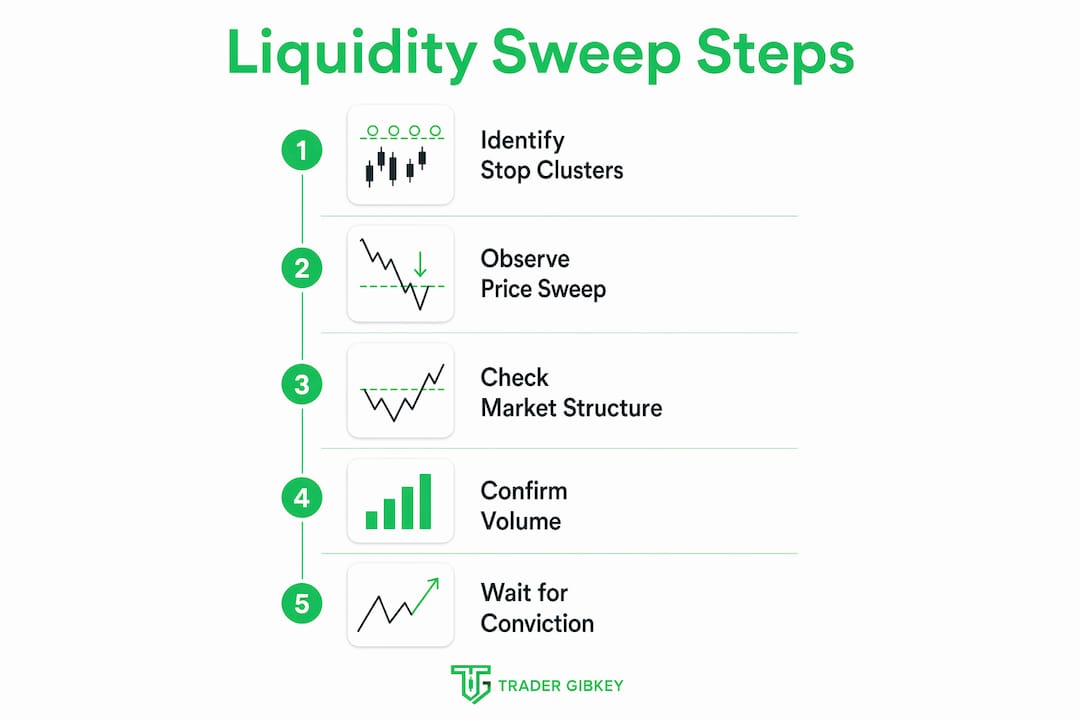
The Market Structure Shift (MSS) is the most reliable confirmation tool available. An MSS occurs when price, after sweeping a level, breaks a significant internal swing point in the opposite direction. That break signals that the sweep is complete and the real move is beginning. Waiting for MSS confirmation after a sweep significantly improves trade win rate. Entering on the initial sweep itself is where most traders lose money.
Here is a quick reference for reading the signals:
Signs of a true breakout:
- Strong close beyond the level with expanding volume
- Price holds above (or below) the broken level on a retest
- New swing highs (or lows) form quickly after the break
- No long wicks back into the prior range
Signs of a liquidity sweep:
- Long wick that closes back inside the prior range
- Volume spike followed by immediate contraction
- Price fails to form new structure in the breakout direction
- MSS forms in the opposite direction shortly after
Volume confirmation is the tie-breaker. A breakout without volume expansion is a red flag every time. Price action conviction, meaning the speed and decisiveness of the move, tells you whether real buyers or sellers are in control or whether the move was manufactured to collect stops.
How to identify and defend against liquidity sweep traps
The first line of defense is stop placement. Retail traders placing stops just one tick above or below obvious swings become the easiest targets. Placing stops 2–3 ATR (Average True Range) beyond the level significantly reduces accidental stop-outs. This one adjustment alone removes you from the most predictable stop cluster zones.
The second line of defense is patience. Successful traders treat the initial sweep as a setup, not a signal. Waiting for price to break subsequent micro-structure levels before entering gives you a statistical edge. You are not late. You are letting the trap complete before you trade the real move.
Practical safeguards every retail trader should apply:
- Avoid high leverage on breakout trades. A 10x leveraged position on a false breakout can wipe 10% of your account on a 1% move.
- Use higher timeframe analysis first. A sweep that looks significant on a 5-minute chart is often just noise on the 4-hour chart.
- Mark your stop clusters before the session. Identify equal highs, equal lows, and obvious swing points so you know where sweeps are likely to occur.
- Protect positions with stops beyond order blocks or fair value gaps. These areas provide structural cover that random retail stop levels do not.
- Wait for the MSS before committing capital. The MSS is your green light, not the sweep itself.
The mindset shift matters as much as the tactics. Most retail traders feel urgency when they see a breakout. That urgency is the trap. The market is designed to make you feel like you are missing something. Slowing down and waiting for confirmation is the discipline that separates consistent traders from the 92% who fail.
Pro Tip: Drop to a lower timeframe after a sweep on the higher timeframe. A clean MSS on the 15-minute chart after a sweep on the 1-hour chart is a high-probability entry signal. The lower timeframe gives you precision without sacrificing context.
Why do retail traders keep falling for the same traps?
Rigid pattern reliance is the core problem. Trend lines, classic chart patterns, and textbook support and resistance levels all work until they become too popular. Algorithmic order flow targets commonly used retail patterns like trend lines, exploiting the predictable behavior of traders who follow them. When everyone draws the same line, the algorithm knows exactly where the stops are.
FOMO breakout chasing compounds the damage. A trader sees price burst through a key level with momentum and jumps in, afraid to miss the move. That urgency is exactly what the sweep is designed to create. Stop hunting leverages predictable retail behavior to flush weak hands and accumulate institutional positions. The retail trader’s fear of missing out becomes the institutional trader’s entry fill.
Overcomplicated systems also increase exposure to liquidity traps. When a trader has 12 indicators on their chart, they often miss the simple price action signals that reveal a sweep. The wick, the failed close, the MSS. These are clean, readable signals. Burying them under layers of indicators creates confusion at exactly the moment when clarity matters most.
The fix is not a new system. It is a simpler one. Focus on understanding liquidity analysis as the foundation, then layer in price action confirmation. That combination cuts through the noise that algorithmic systems use to exploit retail behavior.
Key Takeaways
Liquidity sweeps are deliberate institutional moves that target retail stop clusters, and defending against them requires stop placement beyond obvious levels, MSS confirmation before entry, and strict leverage discipline.
| Point | Details |
|---|---|
| Sweeps target stop clusters | Equal highs and lows are four times denser than single swings, making them prime sweep targets. |
| MSS is the confirmation signal | Wait for a Market Structure Shift after the sweep before entering any trade. |
| Stop placement is your first defense | Place stops 2–3 ATR beyond obvious levels to avoid the most common sweep zones. |
| Leverage amplifies sweep losses | A 1% false breakout causes a 10% loss on 10x leverage. Reduce size on breakout trades. |
| Simplicity beats complexity | Fewer indicators and a focus on liquidity analysis improve your ability to read sweeps clearly. |
What 18 years of watching sweeps taught me
Most traders learn about liquidity sweeps and immediately try to trade them. They flip their approach and start fading every breakout they see. That is the second trap, and it is just as costly as the first.
The real lesson is not “fade breakouts.” The real lesson is “wait for the market to show its hand.” A sweep without an MSS is just a move. A sweep followed by a clean MSS on a lower timeframe is a setup. That distinction took me years to internalize, and I still see experienced traders skip it when they are in a hurry.
The traders who consistently profit from sweep awareness are not the ones who are fastest to react. They are the ones who are most comfortable doing nothing while the sweep plays out. That patience feels wrong in the moment. Your instinct says act. The discipline says wait. Every time I have ignored that discipline, I have paid for it.
The other thing I have noticed is that traders who understand retail trading traps at a structural level stop taking losses personally. When you know the market is designed to collect stops at obvious levels, getting stopped out once does not feel like failure. It feels like information. That mental shift alone changes how you manage risk going forward.
— Gabriel
Tradergibkey resources for trading liquidity sweeps
Knowing how sweeps work is one thing. Applying that knowledge under live market conditions is another challenge entirely.

Tradergibkey has spent over 18 years building practical frameworks for exactly this kind of market environment. The liquidity sweep strategies covered on the Tradergibkey platform go beyond theory, showing you how to read price action in real time, apply the MSS confirmation method, and size positions to survive false breakouts. The community also provides ongoing analysis of current market structure, so you are never applying yesterday’s framework to today’s conditions. If you are ready to trade with more clarity and less second-guessing, Tradergibkey is where that process starts.
FAQ
What is a liquidity sweep in trading?
A liquidity sweep is when price moves beyond a key level to trigger stop-loss orders clustered there, giving large players the liquidity they need before reversing price in the opposite direction.
How do I spot a liquidity sweep on a chart?
Look for a long wick that pushes through a swing high or low and closes back inside the prior range. That wick pattern, combined with a Market Structure Shift in the opposite direction, confirms a sweep.
How do I protect my trades from stop hunts?
Place your stop-loss 2–3 ATR beyond obvious swing points rather than directly at them, and wait for MSS confirmation before entering after a suspected sweep.