
A forex demo account is a risk-free, realistic platform that lets you practice live-market trading without putting real money on the line. The industry standard term is “paper trading,” and a demo account is the most widely used form of it in the forex world. Every serious beginner should use one before touching a live account. Platforms like MetaTrader 4 and MetaTrader 5 power most demo environments, giving you real-time price feeds, stop-loss orders, and full order management. The core insight is simple: you cannot learn to trade by reading alone. You need screen time, and a practice forex trading demo account gives you exactly that without the financial consequences.
How to set up your forex demo trading account
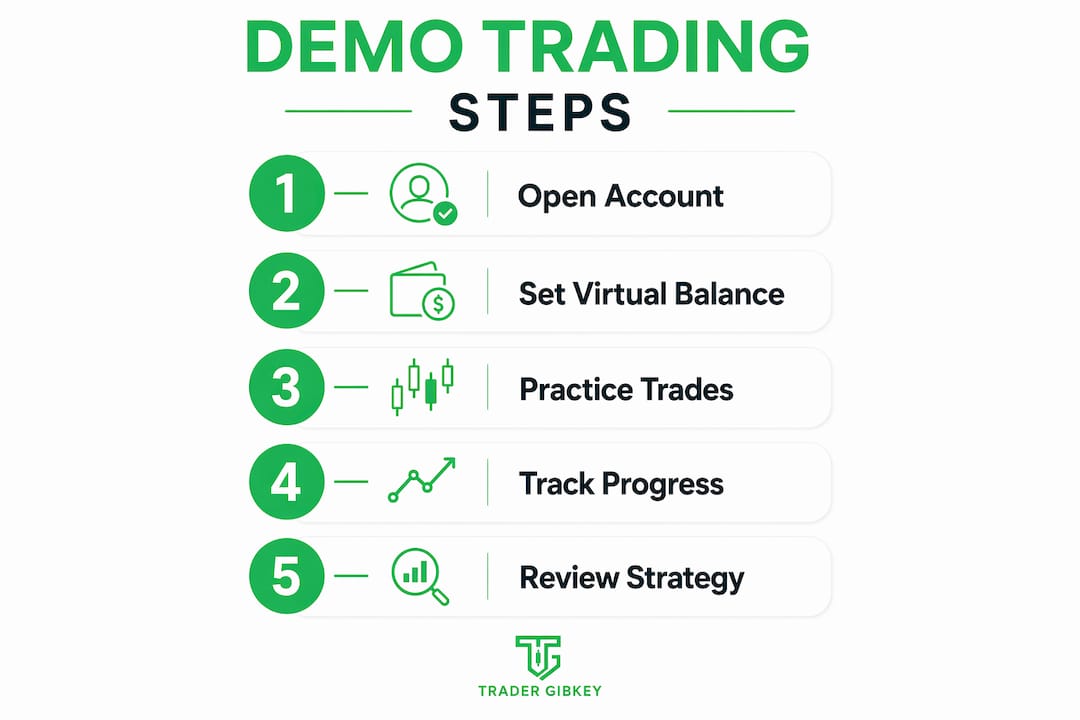
Opening a forex demo account is free and takes under five minutes. You need an email address and basic personal details. No deposit is required, and most brokers give you instant access after registration.
Follow these steps to get started the right way:
- Choose a regulated broker. Pick a broker regulated by a recognized authority such as the FCA, ASIC, or CySEC. Regulation protects you when you eventually go live.
- Register for a demo account. Fill in your name and email. Some brokers send login credentials immediately; others take a few minutes.
- Download the trading platform. Most brokers offer MetaTrader 4 or MetaTrader 5. Both are free and available on desktop and mobile.
- Set a realistic virtual balance. Demo balances should match your intended live deposit, typically $500–$2,000. A $100,000 virtual balance teaches you nothing about real position sizing.
- Check the account expiry terms. Demo access durations vary widely. Some brokers offer unlimited access; others cut you off after 14 or 90 days. Look for inactivity-based expiry rather than a hard deadline.
| Setup factor | What to check |
|---|---|
| Broker regulation | FCA, ASIC, or CySEC license |
| Platform | MetaTrader 4 or MetaTrader 5 |
| Virtual balance | Match your planned live deposit |
| Account expiry | Prefer inactivity-based, not fixed deadline |
| Order types available | Stop-loss, take-profit, market, and limit orders |
Pro Tip: Use the same broker for your demo and future live account. Execution speeds and spreads differ by broker, so practicing on the exact platform you will trade live avoids unpleasant surprises later.

For a full walkthrough of the account opening process, the first trading account guide at Tradergibkey covers every step in detail.
Practical ways to practice forex trading on a demo account
A demo account is a lab, not a video game. The traders who get real value from it treat every session with the same discipline they would bring to a live account.
Here is how to practice with purpose:
- Test one strategy per session. Switching strategies mid-session produces noise, not data. Pick one setup, such as a price action breakout or a moving average crossover, and run it consistently.
- Apply the 1–2% risk rule on every trade. Risk management learned on demo transfers directly to live trading. Never risk more than 2% of your virtual balance on a single trade.
- Log every trade. Write down your entry reason, exit reason, and result. Systematic demo testing with documented metrics like win rate, risk-reward ratio, and drawdown is the only way to separate skill from luck.
- Set a testing goal before you start. Run one strategy for at least 100 trades before judging it. Fifty trades is not enough data to draw conclusions.
- Learn every order type. Practice placing stop-loss orders, take-profit targets, and limit entries. High-quality demo accounts mirror live conditions with real-time data and complex order types, so use all of them.
- Study your losses, not just your wins. A losing trade with a clear reason is more valuable than a winning trade you cannot explain.
Pro Tip: Set a minimum demo period of 30 days before considering a live account. Shorter trials build surface familiarity, not real instincts. Patience here pays off later.
Demo trading also teaches you platform mechanics that no tutorial can replace. You learn how leverage affects your margin, how spreads widen during news events, and how fast prices move in volatile sessions. That knowledge is worth more than any theory.
What are the real limitations of forex demo accounts?
Demo trading has genuine limits. Knowing them upfront stops you from making costly assumptions when you go live.
- No emotional pressure. Demo trading lacks the psychological weight of real money. You will feel calm placing a $10,000 virtual trade. That calm disappears when the money is real.
- Execution differences. Some brokers simulate instant order fills on demo accounts. Live accounts experience slippage and latency, especially during high-impact news releases.
- Spread variations. Demo accounts often show the same spreads as live accounts under normal conditions. However, some brokers widen spreads during volatility on live accounts, making the demo a partial simulation.
- Overconfidence risk. A strong demo record does not guarantee live success. The market conditions are the same, but your emotional state is not.
- Unrealistic balance distortion. Trading a $100,000 demo account when you plan to deposit $1,000 teaches you the wrong habits. Position sizes, lot sizes, and risk feel completely different at scale.
“Demo trading lacks real market slippage and psychological pressure, limiting emotional realism. Some beginners overestimate their live readiness based on demo performance alone. The gap between demo confidence and live execution is where most new traders lose money.”
The solution is not to avoid demo trading. The solution is to use it with clear eyes. Treat your demo losses as seriously as you would treat real ones. When you blow a virtual account, stop and analyze why before restarting. That discipline is what carries over to live trading.
How do you transition from demo to live forex trading?
The move from demo to live is where most beginners stumble. A structured approach makes it far less painful.
- Match your demo settings to your live account. Use the same broker, the same platform, and the same virtual balance you plan to deposit. Consistency removes variables.
- Start with reduced risk on your live account. Risk 0.5% per trade for your first month, even if you were comfortable with 2% on demo. Real money changes your decision-making.
- Maintain the same risk management rules. The risk management discipline you built on demo is your only protection in the early weeks of live trading. Do not abandon it because you feel confident.
- Expect emotional discomfort. Your first live losing trade will feel different from any demo loss. That is normal. The goal is to follow your rules anyway.
- Keep your demo account active. Use it to test new strategies before applying them live. Demo accounts serve as an ongoing research lab even for experienced traders.
The biggest mistake new traders make is rushing this transition. A strong demo record built over 60 to 90 days gives you a real foundation. A two-week demo sprint gives you false confidence. Take the time. The market will still be there.
Key Takeaways
A practice forex trading demo account is the single most effective tool a beginner has for building real skills before risking real capital.
| Point | Details |
|---|---|
| Set a realistic virtual balance | Match your demo balance to your planned live deposit to practice real position sizing. |
| Test one strategy at a time | Run at least 100 trades per strategy and log every result to separate skill from luck. |
| Know the demo’s limits | Demo accounts lack real emotional pressure and may not replicate live slippage accurately. |
| Transition with reduced risk | Start live trading at 0.5% risk per trade, even if you used 2% on demo. |
| Keep the demo account active | Use it as a permanent testing lab for new strategies, even after going live. |
What I have learned after 18 years of watching traders use demo accounts
Most traders use demo accounts wrong. They open one, make a few trades, see some green, and decide they are ready to go live. That is not practice. That is a preview.
The traders I have seen succeed treat their demo account like a job interview. They show up with a plan, they execute it the same way every session, and they review their results honestly. They do not skip the losing days. They do not reset the account when things go badly. They sit with the discomfort and figure out what went wrong.
The biggest mistake I see beginners make is using a virtual balance that has no relationship to their real capital. Trading $50,000 virtual when you plan to deposit $500 is not practice. It is fantasy. Your lot sizes, your margin calls, your emotional responses to drawdown, all of it changes when the numbers are real and proportional.
Here is the uncomfortable truth: demo trading is necessary but not sufficient. You can be a flawless demo trader and still fall apart on your first live week. The reason is that your brain runs a different operating system when real money is at stake. The only way to train that operating system is gradual, deliberate exposure. Start live with the smallest position size your broker allows. Let yourself feel the discomfort of a real loss on a small scale. That experience is worth more than 500 demo trades.
The traders who get the most from their demo period are the ones who use it to build repeatable trading habits, not just profitable trades. Habits are what survive the emotional pressure of live markets. Profits on a demo account do not.
— Gabriel
What Tradergibkey offers for your forex practice and growth
Tradergibkey was built for traders who want real skills, not just theory. With over 18 years of live market experience, Tradergibkey teaches price action strategies that work in real conditions, not just on paper.
Whether you are still on your demo account or ready to go live, Tradergibkey gives you a structured path forward. The focus is on practical execution, disciplined risk management, and strategies you can test and validate yourself. You will not find generic advice here. You will find methods that former students have used to move from confused beginners to confident, consistent traders. Visit Tradergibkey to explore the full range of educational resources and take the next step in your trading development.
FAQ
What is a forex demo account?
A forex demo account is a practice trading account that uses virtual funds and real-time market data. It lets you trade without risking real money.
How long should I practice on a demo account before going live?
A minimum of 30 days is recommended, with 60 to 90 days being the stronger standard. The goal is consistent, documented results across at least 100 trades.
Can demo trading results predict live trading success?
Demo results show whether your strategy has logic, but they do not replicate the emotional pressure of real money. Use demo performance as a baseline, not a guarantee.