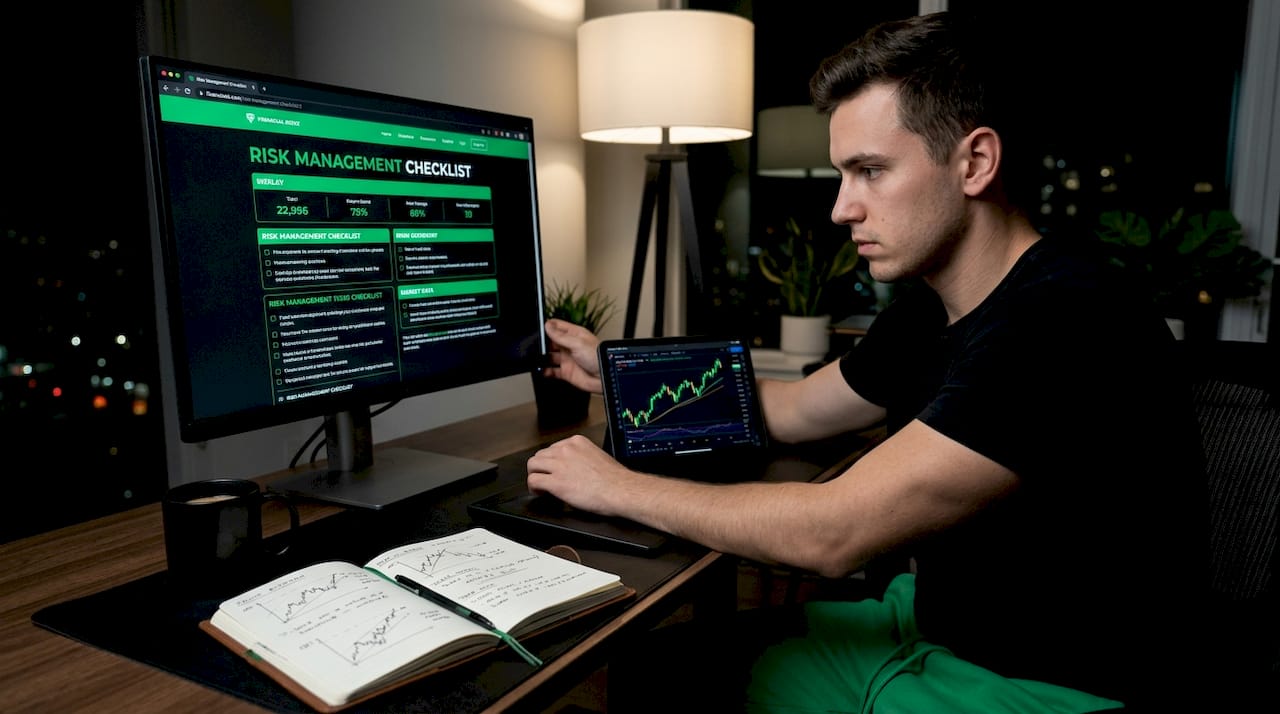
Most new traders blow their accounts not because they pick bad trades, but because they have no plan for when trades go wrong. The risk management rules new traders follow in their first months determine whether they survive long enough to get good. This article breaks down the core rules you need, why each one works, and the exact mistakes that will cost you your account if you skip them. No fluff. Just the framework that keeps you in the game.
Table of Contents
- Key takeaways
- 1. Limit risk per trade to 1% of your account
- 2. Use volatility-based stop losses
- 3. Set daily and weekly loss limits
- 4. Manage drawdowns with graduated responses
- 5. Common mistakes that undermine your risk management
- My honest take on why survival beats prediction
- Build your risk management foundation with Tradergibkey
- FAQ
Key takeaways
| Point | Details |
|---|---|
| Risk 1% per trade | Limit each trade’s risk to 1% of your account to survive losing streaks without panic. |
| Use volatility-based stops | Place stop losses based on ATR or market noise, not arbitrary fixed percentages. |
| Cap daily and weekly losses | A 3% daily and 5% weekly loss limit prevents one bad session from wrecking your account. |
| Manage drawdowns in tiers | Reduce position size after moderate drawdowns and stop trading entirely at severe levels. |
| Avoid revenge trading | Increasing size after a loss is the single fastest way to blow an account. |
1. Limit risk per trade to 1% of your account
This is the rule that separates traders who last from those who don’t. The idea is simple: never risk more than 1% of your total account on any single trade. On a $10,000 account, that means your maximum loss per trade is $100. That’s it.
Here’s why the math matters. If you risk 1% per trade and hit 10 consecutive losses, you’ve lost roughly 10% of your account. That’s painful, but recoverable. If you risk 10% per trade and hit 10 consecutive losses, you’re done. The layered risk management system that professionals use always starts here, because skipping this layer risks catastrophic losses you simply cannot come back from.

Calculating your position size from this rule is straightforward. You take your maximum dollar risk (1% of account), divide it by your stop-loss distance in pips or price units, and that gives you your position size. If your stop is 50 pips and your max risk is $100, you’re trading 2 micro lots. No guessing. No gut feeling.
The mistake most new traders make is increasing their size after a loss to “make it back faster.” That’s the revenge trade. Your brain stops trading the chart and starts trading the pain. Maintaining consistent position sizes regardless of recent results is one of the clearest differences between traders who survive and those who don’t.
Pro Tip: Position sizing is your only true edge as a trader. A mediocre strategy with disciplined small sizing outperforms a great strategy with sloppy sizing every single time.
2. Use volatility-based stop losses
Most new traders set their stops at round numbers or based on how much they’re willing to lose in dollar terms. That’s backwards. The market doesn’t care about your dollar threshold. It moves based on its own volatility.
Stops tied to market noise provide better trade survival rates than arbitrary fixed percentages. The Average True Range (ATR) is the most practical tool for this. ATR measures the average distance price moves over a set number of periods. If the daily ATR on EUR/USD is 80 pips, a 20-pip stop is going to get hit constantly by normal price movement. It’s not a bad trade. It’s just a stop that’s too tight for the instrument’s natural behavior.
Here’s how to apply this practically:
- Check the ATR on your trading timeframe before placing any trade
- Set your stop at 1x to 1.5x the ATR below your entry for longs, above for shorts
- Adjust your position size so that the wider stop still only risks 1% of your account
- Revisit your stop placement if market conditions shift significantly
One thing you need to understand clearly: stop-loss orders are not guaranteed fill prices. In fast-moving markets, slippage can cause your actual loss to exceed what you planned. Don’t treat your stop as an absolute safety net. It’s a tool, not a guarantee.
Pro Tip: If your stop-loss placement requires you to size so small that the trade feels pointless, that’s the market telling you the setup doesn’t fit your account size yet. Listen to it.
3. Set daily and weekly loss limits
You can follow the 1% rule perfectly on every trade and still blow your account if you keep trading through a terrible day. That’s why daily and weekly loss limits exist. They’re your circuit breakers.
Professional risk management caps daily losses at typically 3% of account equity and weekly losses at around 5% to 6%. Here’s what that looks like in practice on a $50,000 account:
- Daily loss limit: 3% equals $1,500. When you hit that number, you close your platform and walk away.
- Weekly loss limit: 5% equals $2,500. If you reach this by Wednesday, you don’t trade again until the following Monday.
- These limits are hard rules, not suggestions. The moment they become negotiable, they stop working.
The psychology here is critical. After two or three losing trades, most traders enter a state that runs a different operating system. Decision quality drops. Setups that you’d normally skip start looking attractive. The daily limit rule removes the decision entirely. You don’t have to decide whether to keep trading. The rule decides for you.
A bad day becomes a disaster when you don’t walk away. A bad week becomes an account-ending event when you keep pushing. These limits prevent that specific outcome, and they cost you nothing when you’re trading well.
4. Manage drawdowns with graduated responses
A drawdown is the percentage decline from your account’s peak to its current level. Understanding drawdowns is one of the most important parts of risk assessment for new traders, because the math of recovery is brutal and most people don’t realize it until it’s too late.
A 50% drawdown requires a 100% gain just to break even. That’s not a minor setback. That’s a near-impossible recovery for most traders. The goal isn’t to recover big drawdowns. The goal is to never let them get that large.
Here’s a tiered drawdown response system you can apply immediately:
| Drawdown Level | Action Required |
|---|---|
| 5% from peak | Review recent trades, check if strategy is still valid |
| 10% from peak | Reduce position size by 50%, limit trading sessions |
| 15% from peak | Drop to minimum position size, trade only A-grade setups |
| 20% from peak | Stop trading, conduct full strategy review before returning |
The psychological importance of these tiers is just as real as the financial protection they provide. When you’re in a drawdown, your judgment is compromised. Scaling down forces you to slow down. It gives you time to figure out whether the market has changed, whether your strategy has an edge problem, or whether you’re just in a normal losing streak that will pass.
5. Common mistakes that undermine your risk management
Knowing the rules is one thing. Knowing exactly how traders break them is another. These are the most common ways new traders sabotage their own risk control, even when they understand the rules intellectually.
- Revenge trading: After a loss, they double their size on the next trade to recover quickly. This fatal error causes larger drawdowns and account failure faster than almost any other behavior.
- Moving stops further out: They enter a trade, it goes against them, and instead of accepting the loss they move the stop to give it “more room.” This is not risk management. It’s hope management.
- Ignoring volatility when placing stops: Using a 20-pip stop on a pair with an 80-pip ATR is not a tight stop. It’s a stop that will be hit by random noise before the trade has any chance to develop.
- Skipping daily limits on bad days: The days you most need to walk away are the days you least want to. That’s the trap.
- Overestimating recovery speed: Traders think they can make back a 30% drawdown in a week. The math says otherwise, and the emotional pressure of trying makes it worse.
“Knowing when not to trade is a risk management skill.” Successful traders treat some sessions as no-trade opportunities based on market conditions, not just their own rules. Sometimes the best trade is no trade at all.
You can also monitor broader market risk signals across asset classes to understand when conditions are genuinely unfavorable, which reinforces the discipline of sitting out.
My honest take on why survival beats prediction
I’ve been in live markets for a long time, and the single biggest shift in my own trading came when I stopped trying to be right and started trying to stay alive. Early on, I thought the goal was to find better setups. More accurate entries. A higher win rate. What I actually needed was a better system for handling the losses that were always going to come.
The volatility-based stop approach changed my trading in a way that no entry technique ever did. I stopped getting shaken out of valid trades by noise. My win rate didn’t jump dramatically, but my average winner got bigger because I wasn’t exiting early out of fear. That’s the quiet benefit nobody talks about.
Daily loss limits felt like a constraint at first. They felt like giving up. What I learned is that they’re the opposite. They protect your mental state so that tomorrow you can trade with a clear head. The discipline that beats technical skill is not glamorous. It’s just walking away when the rule says to walk away.
Patience is underrated as a risk control tool. Some of my best trading months have included days where I simply didn’t trade. Not because there were no setups, but because conditions weren’t clean and I knew my decision quality would be low. That kind of restraint is a skill you build deliberately.
— Gabriel
Build your risk management foundation with Tradergibkey

Risk management for beginners doesn’t have to be overwhelming. At Tradergibkey, the focus is on giving you the practical skills to apply these rules in real market conditions, not just understand them on paper. With over 18 years of live market experience, the courses and mentorship programs cover position sizing, volatility-based stop placement, trading psychology, and how to build a personal risk framework that actually holds up under pressure. You get structured learning, a supportive community, and direct mentorship that helps you move from knowing the rules to trading them consistently. If you’re serious about protecting your capital and building real confidence in the Forex market, this is where to start.
FAQ
What is the 1% rule in trading?
The 1% rule means you never risk more than 1% of your total account balance on a single trade. On a $10,000 account, your maximum loss per trade is $100, which protects your capital through losing streaks.
How do I set a stop loss based on volatility?
Use the Average True Range (ATR) on your trading timeframe and place your stop at 1x to 1.5x the ATR from your entry point. This accounts for normal market noise and reduces the chance of being stopped out prematurely.
What is a daily loss limit and why does it matter?
A daily loss limit is a hard cap on how much you allow yourself to lose in one trading session, typically set at 3% of your account. When you hit it, you stop trading for the day to prevent emotional decisions from compounding your losses.
How bad does a drawdown have to be before I should stop trading?
Most professional risk frameworks suggest stopping trading entirely at a 20% drawdown from your account peak and conducting a full strategy review before returning. A 50% drawdown requires a 100% gain just to recover, which is why catching it early matters so much.
What is revenge trading and how do I avoid it?
Revenge trading is increasing your position size after a loss to recover quickly. You avoid it by treating your position size as a fixed rule tied to your 1% risk limit, not as something you adjust based on recent results.