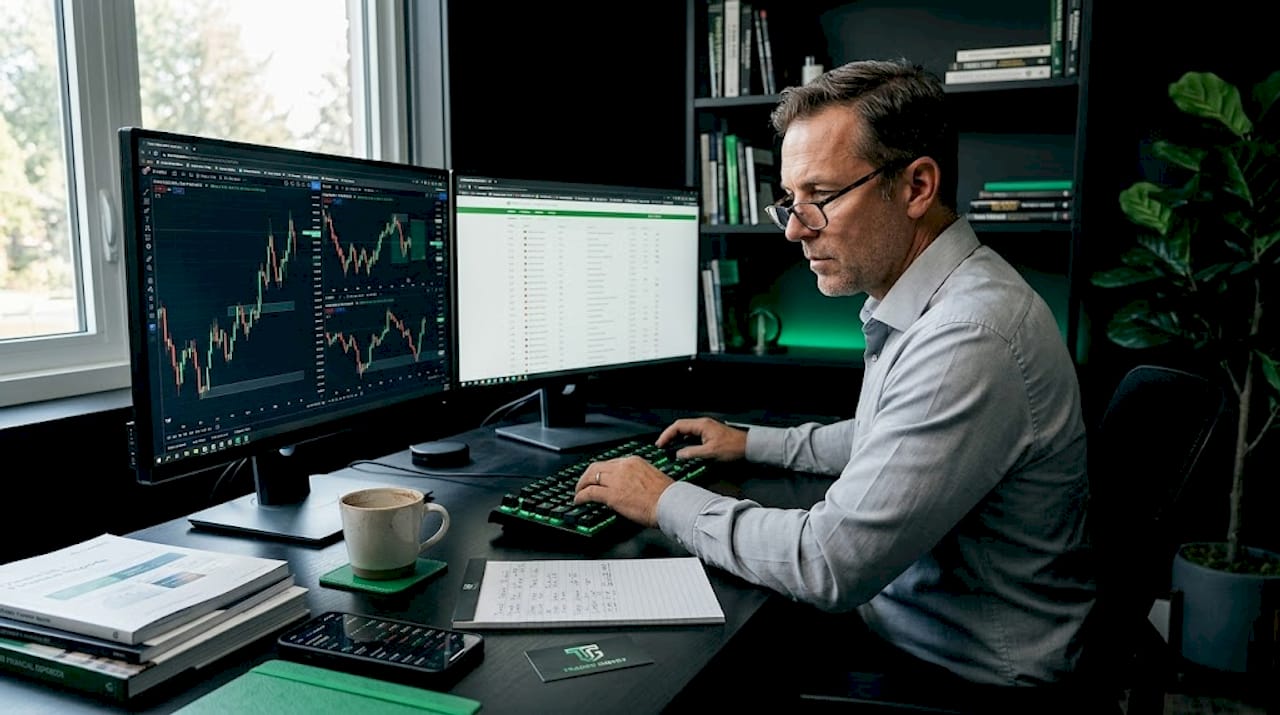
Most Forex traders consume more information than they act on. You check Twitter, scan three news sites, read a recap, and then open your charts feeling more confused than when you started. The traders daily challenge is not finding information. It is finding the right information and knowing what to do with it. This article cuts through that noise. You will get a practical look at the tools, strategies, and daily routines that actually move the needle on your trading performance, drawn from real market conditions and built for serious Forex traders.
Table of Contents
- Key takeaways
- 1. What makes traders daily insights worth your time
- 2. Top daily trading tools Forex traders actually use
- 3. Daily trading routines proven to improve results
- 4. News-driven vs. thesis-driven trading: which is right for you
- 5. How to build your personal daily trading plan
- My honest take on daily trading routines
- How Tradergibkey helps you trade smarter every day
- FAQ
Key takeaways
| Point | Details |
|---|---|
| Filter before you consume | Choose two or three reliable daily sources and ignore everything else to protect decision quality. |
| Thesis-driven beats news-driven | Relief rallies are typically temporary, so base trades on structure, not headlines. |
| Timing windows matter | Trade during opening and closing hours when volume and volatility create real setups. |
| Journal every single day | A detailed trade log eliminates emotional decisions and builds repeatable strategy over time. |
| Routine beats reaction | A consistent daily schedule protects you from impulsive trades during high-noise sessions. |
1. What makes traders daily insights worth your time
Not all daily market analysis is created equal. Some of it is noise dressed up as signal. Before you plug any resource into your daily routine, run it through these five filters.
- Timeliness. Forex moves fast. If a market analysis daily update lands three hours after London opens, it may already be irrelevant to your setup decisions.
- Actionability. Good daily trading tips point you toward a specific pair, a level to watch, or a condition to wait for. If the insight does not change your behavior that day, it is editorial filler.
- Source credibility. Look for resources backed by traders with live account experience, not just commentary writers. Tradergibkey, for example, builds every lesson around 18-plus years in live markets.
- Adaptability. The Forex market shifts. A good source updates its bias when the conditions change, rather than defending a thesis from Monday through Friday regardless of price action.
- Fit with your routine. The best resource is the one you actually use consistently. If a daily briefing takes 45 minutes to read, you will skip it on busy mornings.
Pro Tip: Set a hard rule for yourself: no more than two daily sources. One for macro context, one for technical setups. More than that creates decision fatigue before you even open a chart.
2. Top daily trading tools Forex traders actually use
The market for trading tools is crowded. Here is what actually delivers value when you need daily market insights fast.
| Tool Type | Best For | Key Strength |
|---|---|---|
| Economic calendar | Macro-aware positioning | Shows high-impact news events before they hit |
| Telegram signal channels | Quick setup alerts | Real-time callouts with entry and stop levels |
| AI-powered analytics | Directional bias | Filters volume data and trend shifts fast |
| Risk management apps | Daily position sizing | Enforces 1% risk rules automatically |
| Trading simulators | Strategy testing | Practice setups without live capital at risk |
Economic calendars should be your first stop every morning. Knowing when central bank statements, employment data, or inflation figures drop lets you plan around volatility instead of getting caught in it.
Telegram channels and Discord communities have become the go-to for real-time trader news updates. The good ones share specific levels with context. The bad ones spam signals without logic. Vet any channel by watching for a few days before relying on it.
AI-powered tools are increasingly useful for scanning pairs and identifying shifts in momentum before they fully develop on a standard chart. They do not replace your judgment, but they speed up your market scanning.
- Risk management apps that auto-calculate position size based on your account balance keep your 1% risk per trade rule consistent even when you are rushing a setup.
- Prop firm environments like FXIFY, which supports 250,000 traders globally and has paid out $40 million over three years, show what structured daily trading performance looks like at scale.
Pro Tip: Use a simulator alongside your live account. Testing new strategies in a demo environment before risking real capital is one of the most underused daily trading tips among intermediate traders.
3. Daily trading routines proven to improve results
How you structure your day matters as much as what you trade. Here is a routine framework that professional Forex traders actually follow.
-
Pre-market scan (15 minutes before London or New York open). Check the economic calendar, note any overnight news, and identify the two or three pairs you will focus on. Do not scan everything. Narrow your focus before the session starts.
-
Set your watchlist, not your bias. You are looking for levels where you will act if price reaches them, not deciding in advance which direction a pair is going. This keeps you reactive to real price action, not your own prediction.
-
Trade the open window. Successful day traders wait for high-probability setups and focus on market open and close, where volume spikes to five times the usual rate. That is where your best daily trades are found.
-
Observe midday, do not trade it. Low-volume midday sessions produce choppy, unpredictable moves. Watching instead of forcing a trade protects your daily P&L from unnecessary losses.
-
Apply your hard risk rule before every entry. Before you click buy or sell, check your position size. Maximum 1% of account per trade is not a suggestion. It is the rule that keeps you in the game through a losing streak.
-
End-of-session review (10 minutes). Before you close your platform, note what you traded, why, and what happened. This is the foundation of a trading journal that genuinely improves performance over time.
-
Weekly debrief. Once a week, review all journal entries. Look for patterns in your mistakes. Are you entering too early? Sizing up on emotion? Your journal tells you the truth that your memory rewrites.
4. News-driven vs. thesis-driven trading: which is right for you
This is one of the most important distinctions for Forex traders daily. Both approaches have real practitioners. But they produce very different outcomes depending on your psychology and setup.
News-driven trading means reacting to economic releases, geopolitical events, and market headlines in real time. The appeal is obvious. Big moves happen after major news. In May 2026, for example, Bitcoin surged over 7% and Brent crude dropped 10% in a single session following a geopolitical announcement, liquidating a wave of short positions. News moves markets. The trap is that reacting to every news item harms your emotional equilibrium and increases trading costs through unnecessary churn.
Thesis-driven trading means building a view on a pair based on technical structure, institutional flow, and macro context, then waiting for price to confirm your thesis before entering. You are not ignoring news. You are filtering it. First principles thinking focuses on where institutional buyers are positioned rather than what the latest headline says, which tends to produce more sustainable trade ideas.
| Approach | Strength | Risk |
|---|---|---|
| News-driven | Captures fast, large moves | High emotional cost, whipsaw losses |
| Thesis-driven | Builds repeatable, disciplined setups | Requires patience, misses some fast moves |
Which suits you? If you have strong emotional discipline and a fast execution setup, news-driven trading can work. Most traders, especially those building profitability over months rather than minutes, do better with a thesis-driven framework. Understanding your own trading psychology is not optional. It is the real edge.
5. How to build your personal daily trading plan
A customized plan is what separates traders who learn from their day from those who just repeat it. Here is how to build one that actually sticks.
Start by being honest about your trading style. Are you scalping short windows, or are you a swing trader checking in once or twice a day? Your daily insight sources should match your timeframe. A scalper needs tick-level data and real-time updates for traders. A swing trader needs daily or four-hour chart analysis and a clean macro view.
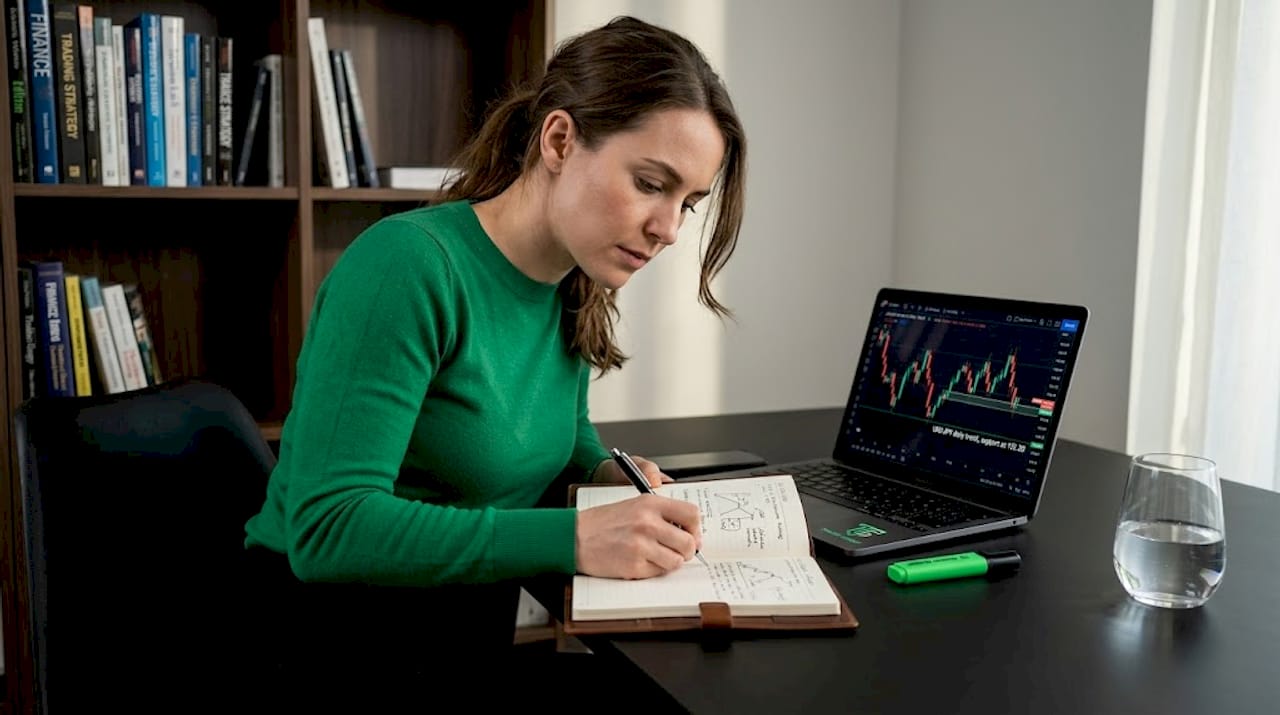
Combine your sources intentionally. One macro context source, one technical analysis feed, and one journaling tool is a complete daily stack. Anything beyond that starts competing for your attention without adding decision value.
Build a fixed daily schedule. Check the calendar at the same time each morning. Scan your watchlist at the same time. Review your journal at the same time each evening. Routine creates consistency. Consistency creates the mental state where good decisions happen. The sharp rise in US Treasury yields through early 2026, around 60 basis points over three months, is a perfect example of a macro shift that rewarded traders who monitored it systematically rather than noticing it late.
Avoid information overload. More data does not produce better trades. It produces analysis paralysis. When you feel overwhelmed, go back to your two-source rule and your watchlist. That is enough.
Adapt your plan monthly based on your journal. If a strategy or source is not improving your trader performance reviews, replace it. The plan serves your results, not your habits.
Pro Tip: Block 30 minutes each Sunday to set your weekly trading focus. Identify the one or two macro themes and the two or three pairs you will watch that week. Going into Monday with a clear thesis protects you from reactive, expensive trading on Monday’s open.
My honest take on daily trading routines
I have been in live Forex markets for a long time, and the single biggest shift in my own performance came when I stopped trying to trade the news and started trading my thesis.
For years I would watch trader earnings reports, scan every update for traders I could find, and try to react fast enough to capture the move. What actually happened was that I spent more time managing stress than managing positions. The market’s tendency to overprice headline effects without durable resolution burned me more times than I can count.
What changed everything was a simple daily journal. Not a spreadsheet with just P&L. A real record: the setup, my reasoning, my emotional state going in, and what actually happened. Within two months I could see my own patterns clearly. I was sizing up when I was confident and sizing down when I was cautious. The confident trades were actually my worst ones. That is a hard thing to see in yourself, but the journal showed me the truth.
My advice is this. Do not chase the best daily trades. Chase the right daily trades. Fewer entries, better reasoning, consistent execution. That is how you build a career in this market, not by reacting faster than everyone else.
— Gabriel
How Tradergibkey helps you trade smarter every day
If this article resonated with you, it is because the frustrations are real. Too much noise, too little structure, and too many days that end with you wondering where your edge went. Tradergibkey was built precisely for traders at that stage.
At Tradergibkey, you get access to structured trading courses built on 18-plus years of live market experience, not recycled theory. The mentorship program includes live calls, real-time market analysis, and a community where experienced traders share daily market insights and setups in real time. You are not just learning strategies. You are building the daily routine and mental discipline that make those strategies work. Whether you are starting from scratch or breaking out of a plateau, Tradergibkey gives you a practical, proven framework to trade with intention every single day. Start with the method that has turned frustrated beginners into confident, consistent Forex traders.
FAQ
What does “traders daily” mean in practice?
It refers to the daily habits, tools, and routines that keep a trader informed and decision-ready. This includes morning market scans, watchlist reviews, and end-of-day journaling.
How many daily trading sources should I follow?
Two to three reliable sources is enough. One for macro context and one for technical analysis. More than that creates information overload without improving your decision quality.
Is news-driven trading better than thesis-driven trading?
For most Forex traders, thesis-driven trading produces more consistent results. News-driven approaches carry higher emotional cost and greater whipsaw risk, which erodes profitability over time.