
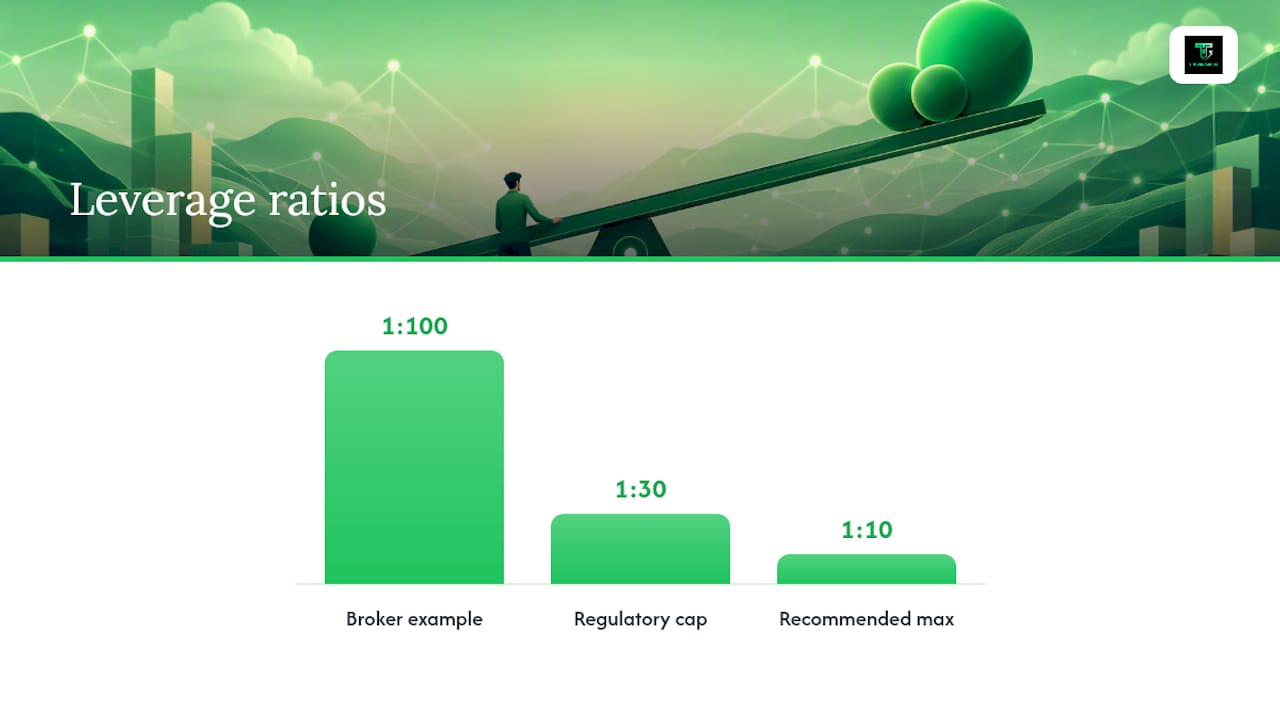
Leverage in trading is borrowed capital from your broker that lets you control a position much larger than your deposit. A $1,000 deposit at 1:100 leverage controls a $100,000 position. The single most important habit to build is keeping your effective leverage, not your broker’s maximum, low: most experienced traders target roughly 1:5 to 1:10 regardless of what the platform offers, a range echoed in guidance from regulators like the FCA and ESMA.
Broker maximums like 1:30 or 1:500 tell you what’s possible, not what’s wise. At Tradergibkey, we’ve watched this one distinction separate traders who last from traders who blow up their first account inside a month.
Key Takeaways
Leverage increases both potential profits and potential losses proportionally to position size, and keeping effective leverage near 1:10 or lower is what actually protects an account, not the broker’s advertised maximum.
| Point | Details |
|---|---|
| Leverage multiplies exposure | A $1,000 deposit at 1:100 controls a $100,000 position, magnifying every price move. |
| Effective leverage matters most | Calculate total position value divided by account equity, and aim for 1:10 or below. |
| Regulatory caps exist for a reason | ESMA/FCA cap retail forex near 1:30 because higher leverage correlated with higher losses. |
| Size positions to risk, not to leverage | Set risk per trade first, then calculate position size from your stop distance. |
| Tradergibkey teaches the discipline | Mentorship and courses build effective-leverage habits through live sessions and templates. |
This article is general information, not a substitute for advice from a qualified financial advisor. Consult a qualified financial professional about your own circumstances before acting on anything here.
Table of Contents
- What Does Leverage Mean in Trading, Mechanically?
- How Does Leverage Change Profit and Loss?
- What Leverage Ratios Are Common, and What Do Regulators Allow?
- Which Products Actually Use Leverage?
- What Are the Benefits and Risks of Trading with Leverage?
- How Do You Manage Leverage Risk in Practice?
- Ready to Trade Leverage with a System, Not Guesswork?
- Sources
- FAQ
What Does Leverage Mean in Trading, Mechanically?
Leverage is expressed as a ratio: leverage = position value ÷ margin. If you put up $1,000 in margin to control a $30,000 position, you’re trading at 1:30. Flip the formula around and margin becomes position value divided by leverage, which is exactly how your broker calculates what to hold back from your account.
A few terms show up constantly once you start watching your account in real time:
- Used margin — the amount currently locked up in open positions.
- Free margin — what’s left to open new trades or absorb losses.
- Margin level — free equity divided by used margin, shown as a percentage.
When margin level drops toward a broker’s threshold (often 100% or lower), you get a margin call, a warning that your account is thin. Keep losing and you hit a stop-out, where the broker automatically closes positions to stop the bleeding. Overnight positions also carry financing charges, sometimes called swap fees, which quietly erode returns the longer a leveraged trade stays open.
How Does Leverage Change Profit and Loss?
The math is the same whether the trade goes your way or against you: a bigger position multiplies whatever percentage move the market makes. That’s the entire appeal of leverage, and the entire danger.
At 1:100, a single 1% move against you wipes out your entire $1,000 deposit, which is exactly the scenario Alpha Trade Circle’s worked examples use to show how fast high leverage can end an account.

This is where effective leverage matters more than the number your broker advertises. Effective leverage = total position value ÷ account equity. You can open an account with 1:500 available and still trade at an effective leverage of 1:5 by simply sizing your positions smaller. The broker’s ceiling is not your target, and best-practice guidance consistently points to effective leverage near 1:10 or below as the range where most retail traders actually survive long enough to improve.
What Leverage Ratios Are Common, and What Do Regulators Allow?
Every ratio implies a margin percentage, and once you see them side by side the pattern is obvious: higher leverage means less skin in the game per dollar of exposure.
- 1:1 — no leverage, 100% margin required.
- 1:5 — 20% margin.
- 1:10 — 10% margin.
- 1:30 — about 3.3% margin, the typical ceiling for retail forex majors under ESMA and FCA rules.
- 1:50 — 2% margin, the common cap for US retail forex under CFTC rules.
- 1:100 — 1% margin, still widely offered outside tier-1 jurisdictions.
- 1:500 — 0.2% margin, common among offshore brokers with lighter oversight.
Regulators didn’t pull 1:30 out of thin air. ESMA and the FCA imposed these caps after data showed that retail accounts trading with higher available leverage lost money far more often. The same research base pushed the CFTC toward its own limits in the US market. Most regulated brokers in these jurisdictions also offer negative balance protection, which means you can’t lose more than your deposit even in an extreme, fast-moving market. Offshore platforms advertising 1:1000 or higher rarely offer that same protection, so a bad gap can leave you owing money beyond what you put in.
Which Products Actually Use Leverage?
Leverage shows up across most derivative-style instruments, but the mechanics shift depending on what you’re trading.
- Forex — typically the highest leverage available to retail traders, with overnight financing charges on positions held past the daily rollover.
- CFDs — contracts for difference on shares, indices, and commodities, with margin requirements that vary by underlying asset volatility.
- Futures — exchange-traded contracts with built-in leverage through margin requirements set by the exchange itself, not the broker.
- Margin equities — traditional stock trading using borrowed funds from a broker, generally far lower leverage than forex or CFDs.
- Spread betting — available to UK residents, tax-advantaged in some cases, and functionally similar to CFDs in how leverage and margin work.
Every instrument has its own margin schedule. Check the specific rate before you assume your usual leverage habits carry over.
What Are the Benefits and Risks of Trading with Leverage?
Leverage exists because it makes capital efficient. Without it, most retail traders couldn’t meaningfully participate in forex or indices at all. But the same mechanism that builds gains builds losses just as fast, and that asymmetry deserves respect, not fear.
The upside:
- Smaller deposits control meaningful position sizes.
- Capital not tied up in margin stays free for other trades.
- Diversification becomes realistic even on modest account balances.
The downside:
- Losses scale exactly as fast as gains, sometimes faster with slippage in volatile markets.
- A 2% adverse move at 1:50 effective leverage erases your entire account.
- High leverage encourages overtrading, revenge trading, and sizing positions to what’s available rather than what’s safe.
Capital calls leverage trading a double-edged sword for a reason: stop-losses aren’t guaranteed to fill at the exact price you set, especially during news events or thin liquidity.
How Do You Manage Leverage Risk in Practice?
Good leverage management starts with a number you choose before you ever open a chart: how much of your account you’re willing to risk on one trade.
- Pick your risk per trade. Most traders use a small single-digit percentage of account equity per position to manage risk.
- Set your stop distance. Decide where the trade is wrong based on chart structure, not on how much leverage feels comfortable.
- Calculate position size from risk, not leverage. Divide your dollar risk by the stop distance in pips or points to get position size. This makes the broker’s maximum leverage irrelevant to your actual decision.
- Check your effective leverage after sizing. Conservative traders sit around 1:1 to 1:5, moderate traders run 1:5 to 1:10, and anything consistently above 1:10 starts crossing into aggressive territory that few professionals sustain long term.
Position-sizing this way, rather than sizing toward whatever leverage your account allows, is the practical rule that separates traders who last from traders who don’t, a point our risk management and position sizing guide walks through in more depth.
It gives volatile sessions room to breathe without tripping a stop-out on a move that would have reversed the next hour.*
A Short Checklist Before Your Next Leveraged Trade
Set your risk percentage first, then compute position size from your stop distance, not from the leverage on offer. Cap your effective leverage under 1:10 and test any new approach in a demo account before risking real money.
The mistakes we see most often: trading at the headline maximum leverage, skipping stop-losses entirely, sizing inconsistently trade to trade, and ignoring financing costs on positions held overnight.
Why Conservative Leverage Wins Over Time
After 18 years in live markets and years spent teaching traders inside a structured community, the pattern never changes: the traders who survive long enough to get good are the ones who treat leverage as a tool for precision, not a shortcut to bigger wins. Chasing the highest number a broker offers is the fastest route to a blown account we’ve ever seen.
Ready to Trade Leverage with a System, Not Guesswork?
Understanding leverage on paper and applying it correctly under pressure are two different skills, and the gap between them is where most accounts get hurt. Tradergibkey’s structured courses and mentorship exist to close exactly that gap: instead of learning leverage theory once and improvising later, you get position-sizing templates you can reuse on every trade and live sessions where risk decisions get made in real time, not explained after the fact.
The community and mentorship packages also include daily market analysis and a risk-management routine built around the same effective-leverage discipline covered above, so what you read here becomes muscle memory rather than theory. If you want guided practice instead of trial and error, start with the structured learning roadmap or head straight to Tradergibkey to see current course and mentorship options.
Sources
- Forex Leverage Explained: Risks, Limits, Best Practices | BrokerAnalysis
- What Is Leverage in Forex? Complete Guide | Alpha Trade Circle
- Capital
FAQ
What does leverage mean in trading, in one sentence? Leverage is borrowed capital from your broker that lets you control a position larger than your deposit, multiplying both gains and losses.
What is the best leverage for forex beginners? Most beginners are safest around 1:5 to 1:10 effective leverage, regardless of the higher maximum a broker might advertise.
What happens when a margin call is triggered? Your broker warns you that account equity has dropped near a threshold; if losses continue, a stop-out automatically closes positions to limit damage.