
A profitable trading strategy is defined as a repeatable system that generates consistent positive returns over time through disciplined risk management, realistic execution, and alignment with a trader’s psychology and capital. The term “profitable trading strategy” is widely used, but the industry standard concept is a systematic edge, meaning a statistically validated approach where your wins outpace your losses across hundreds of trades. Understanding that distinction changes how you build, test, and execute every setup you take.
Most traders chase the best trading strategies without first defining what profitability actually requires. It is not a single winning trade or even a good month. It is a process where risk controls, execution quality, and consistent decision-making compound over time. Frameworks like the risk-reward ratio, stop-loss placement, and position sizing are not optional add-ons. They are the architecture that keeps a strategy alive through drawdowns and losing streaks.
What risk management principles make a trading strategy profitable?
Risk management is the single factor that separates traders who survive long enough to profit from those who blow up their accounts. Approximately 97% of persistent day traders lose money over time, and the primary cause is not bad entries. It is poor risk control that turns small losing streaks into account-ending events.
Here are the core risk management principles every profitable trader applies:
-
Limit risk per trade to 1-2% of account equity. Intraday risk guardrails widely recognized in the industry cap single-trade exposure at 1-2% of equity, with total intraday exposure not exceeding roughly 3-4x equity. This rule keeps any single bad trade from doing serious structural damage.
-
Use layered stop-loss orders. A single stop is better than none, but layered stops at logical price levels give you granular control. You exit part of your position at the first stop and the rest at a wider level, reducing the chance of being shaken out by normal volatility while still protecting capital.
-
Cap your daily drawdown. Set a hard rule: if you lose a defined percentage of your account in one session, you stop trading that day. This prevents the revenge trade spiral where the brain stops trading the chart and starts trading the pain.
-
Stress-test your risk under losing streaks. Run your strategy through scenarios where you take 10 or 15 consecutive losses. If that sequence would wipe your account, your position sizing is too large regardless of your win rate.
-
Integrate downside controls like CVaR into your sizing model. Hybrid risk-aware methods that incorporate Conditional Value at Risk alongside trading costs have demonstrated cost-inclusive returns of 46.7% with a maximum drawdown of just 6.8%. That combination of return and drawdown control is what separates a durable strategy from a lucky streak.
Pro Tip: Set your daily loss limit before you open your platform, not after you have already taken two bad trades. Decisions made under loss pressure are almost always wrong.
How does realistic execution affect trading strategy profitability?
A strategy can look perfect on paper and still lose money in live markets. The gap between backtest results and real performance is almost always caused by execution friction, and most traders never account for it.
-
Latency and fill delays. Backtests often overstate profitability because they assume instant fills at the signal price. In reality, your signal fires at time T, but your order reaches the market at T plus a delay. In fast-moving Forex pairs, that delay can mean a fill several pips away from your intended entry.
-
Slippage and adverse selection. When you place a market order, you often fill at a worse price than the last quoted price. This is especially true during news events or low-liquidity sessions. Over hundreds of trades, slippage erodes a strategy that looked profitable in testing.
-
Queue competition. Limit orders are filled in sequence. If you are competing with algorithmic traders for the same price level, your order may sit unfilled while the market moves away. This is a structural disadvantage that backtests rarely model.
-
Portfolio-level interactions. Many traders validate alpha signals but ignore how multiple open positions interact. Correlated trades can amplify drawdowns in ways that single-trade analysis never reveals.
The fix is separating strategy logic from execution logic. Good algorithmic frameworks keep signal generation and order execution in separate layers, allowing you to swap in realistic fill and fee models without changing your core strategy code. This creates parity between your backtest, paper trading, and live results.
Paper trading on a live feed, not historical data, is the most honest test available to retail traders. Run your strategy for at least 30-50 trades in paper mode before committing real capital. The results will surprise you.
Which trading strategies have proven profitability and how do they compare?
No single holy grail strategy works for every trader in every market condition. Profitability depends less on strategy choice and more on matching strategy behavior to market regime and personal psychology. That said, understanding the major approaches helps you make an informed choice.
Trend following captures large directional moves by entering after a trend is confirmed and holding through pullbacks. It requires patience and a tolerance for lower win rates, often 40-50%, because the winning trades are significantly larger than the losers. Traders using moving average crossovers or Donchian channel breakouts on daily and weekly charts are applying this method.
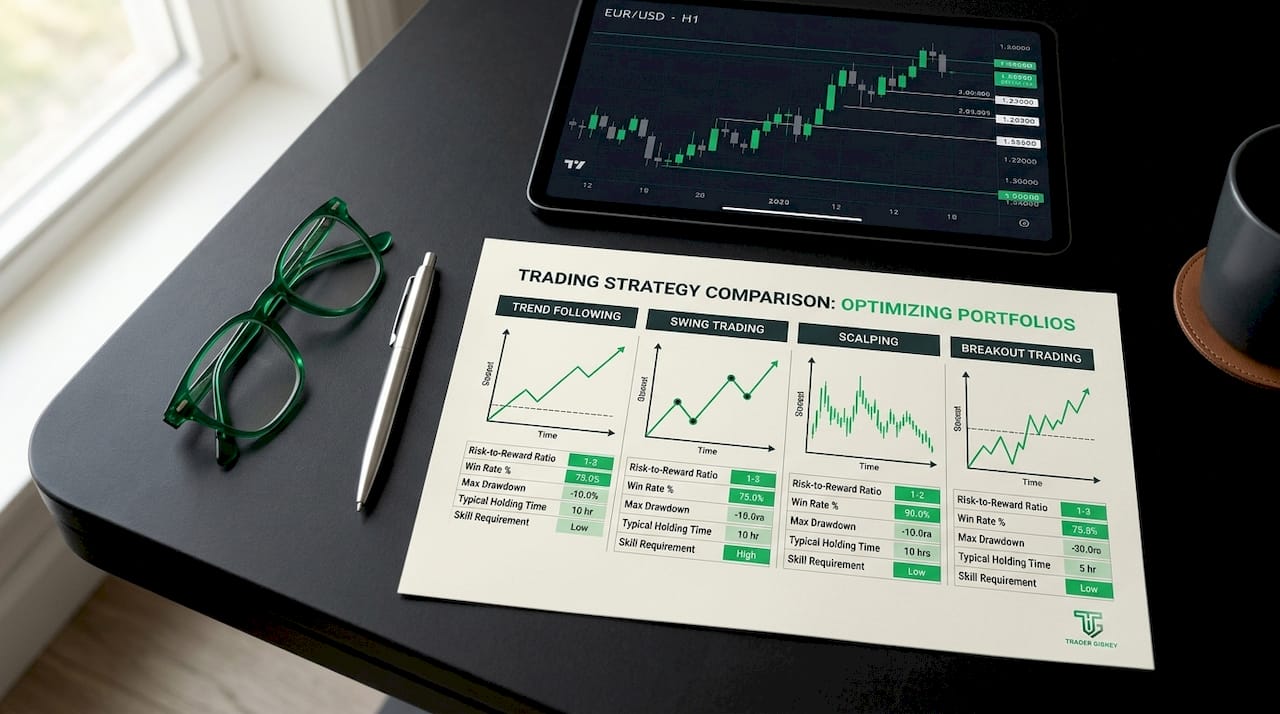
Swing trading targets medium-term price moves over days to weeks. It balances time commitment with profit potential and suits traders who cannot monitor charts all day. Price action setups on the 4-hour and daily charts, combined with support and resistance levels, are the core tools.
Scalping involves taking many small trades throughout a session, targeting a few pips or ticks per trade. It demands strict risk control and fast execution. The high frequency of trades means that even small slippage or spread costs can eliminate profitability if not carefully managed.
Breakout trading enters positions when price moves decisively beyond a defined range, confirmed by volume. It works well in trending markets but produces false signals in choppy conditions, making regime awareness critical.
| Strategy | Time commitment | Typical win rate | Risk level | Best suited for |
|---|---|---|---|---|
| Trend following | Low to medium | 40-50% | Medium | Patient, long-term traders |
| Swing trading | Medium | 50-60% | Medium | Part-time traders |
| Scalping | Very high | 60-70% | High | Full-time, disciplined traders |
| Breakout trading | Medium | 45-55% | Medium to high | Active, regime-aware traders |
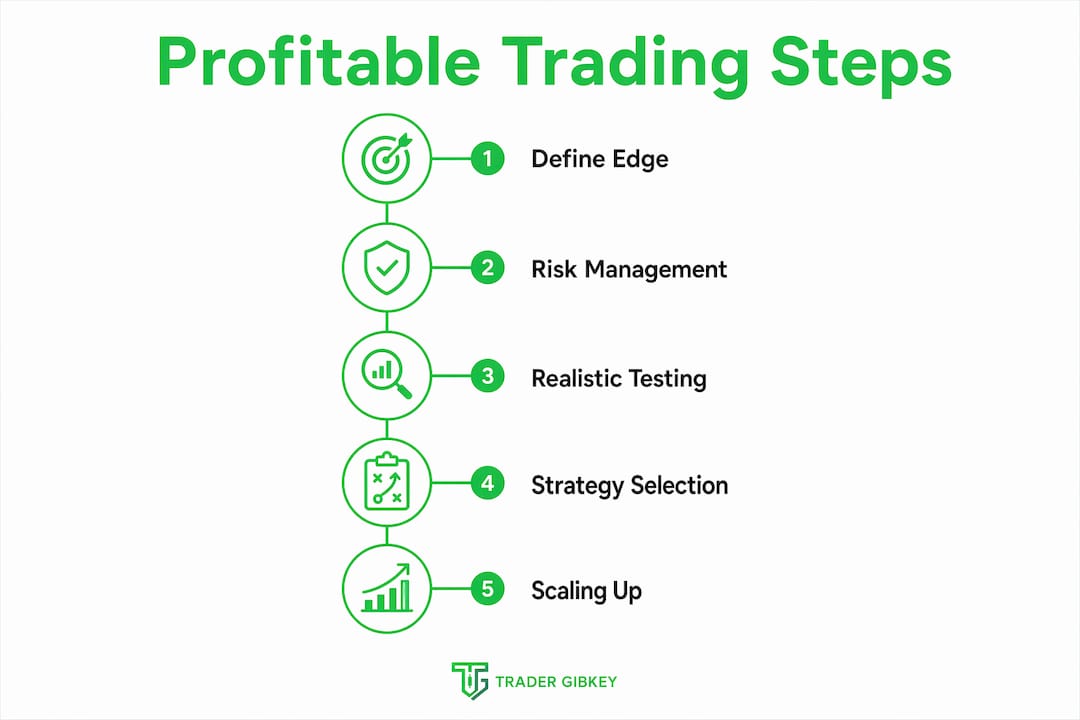
Pro Tip: Before committing to a strategy, paper trade it for one full month across different market conditions. A strategy that only works in trending markets will destroy your account the moment the market ranges.
How to choose and scale a profitable trading strategy
Choosing a strategy is not just a technical decision. It is a psychological one. A method that requires you to sit at your screen for six hours a day will fail if your lifestyle does not support that. Matching strategy behavior to your actual life is one of the most underrated factors in how to be a profitable trader.
Follow this process to choose and scale responsibly:
-
Audit your psychology first. Are you comfortable holding a position for three days through a 50-pip drawdown? Or do you need to see quick results to stay disciplined? Honest answers here eliminate entire categories of strategies that would cause you to overtrade or exit too early.
-
Start with the smallest viable position size. Test your chosen strategy on a live account with micro lots or the minimum contract size your broker allows. Real money creates real emotions that paper trading cannot replicate.
-
Track decision quality, not just outcomes. Log every trade with your reasoning, your emotional state, and whether you followed your rules. A losing trade taken correctly is better data than a winning trade taken on impulse.
-
Scale only after proven consistency. Increase position size in measured steps only after you have demonstrated consistent profitability over at least 50-100 trades at your current size. Scaling before consistency is confirmed is one of the fastest ways to turn a working strategy into a losing one.
-
Run Monte Carlo and drawdown analysis before scaling. Simulate thousands of random sequences of your historical trade results to understand the worst realistic drawdown you could face. If that number would cause you to abandon the strategy emotionally, your size is still too large.
Pro Tip: Treat your first three months on a live account as tuition, not income. The goal is to build process, not profit. The profit follows the process.
Key takeaways
A profitable trading strategy requires disciplined risk control, realistic execution modeling, and a strategy-psychology match that holds up under real market pressure.
| Point | Details |
|---|---|
| Risk per trade discipline | Limit each trade to 1-2% of account equity to survive losing streaks without structural damage. |
| Execution realism matters | Model slippage, latency, and fill delays before going live to avoid backtest-to-live performance gaps. |
| Strategy-psychology match | Choose a method that fits your lifestyle and emotional tolerance, not just your profit targets. |
| Scale after consistency | Increase position size only after 50-100 trades confirm your edge at the current size. |
| No guaranteed strategies | Any approach claiming zero-loss or guaranteed returns is a red flag. Skepticism protects capital. |
What 18 years in live markets taught me about profitable trading
After 18 years trading live markets, the pattern I see most often is this: traders spend months finding the perfect setup and almost no time building the discipline to execute it correctly. The strategy is rarely the problem. The execution is.
The traders I have seen succeed consistently share one trait. They treat every losing trade as information, not failure. They do not run a revenge trade after a stop-out. They do not double their size to “make it back.” They run the same process on trade 200 as they did on trade one.
Realistic expectations are not pessimism. They are protection. No legitimate strategy guarantees profits, and any mentor or platform claiming otherwise is selling you something that will cost you more than money. The traders who survive long enough to compound real returns are the ones who accepted early that drawdowns are part of the process, not proof that the strategy is broken.
The uncomfortable truth is that most traders need fewer strategies and more repetitions of one good strategy. Consistency beats novelty every time. If you are still jumping between methods after six months, the problem is not the method.
— Gabriel
Take your trading further with Tradergibkey
If this article clarified what separates a real edge from wishful thinking, the next step is building that edge with structured guidance. Tradergibkey offers trading courses and mentorship built on 18 years of live market experience, covering price action strategy, risk management, and the execution discipline that most courses skip entirely.

The community at Tradergibkey gives you a space to ask real questions, review your trades, and get feedback from traders who have been through the same struggles you are facing now. Whether you are refining your first strategy or scaling a method that is already working, the structured approach at Tradergibkey is designed to close the gap between knowing what to do and actually doing it consistently. Visit Tradergibkey to explore the available programs.
FAQ
What is a profitable trading strategy in simple terms?
A profitable trading strategy is a repeatable system where your average winning trades outpace your average losing trades over time, supported by strict risk management and consistent execution.
How much risk should I take per trade?
The industry standard is 1-2% of your account equity per trade. This limit allows you to absorb losing streaks without threatening your overall capital.
Can any strategy guarantee profits?
No. Regulators and experienced practitioners consistently warn that guaranteed-return claims are a red flag. Every strategy carries risk, and profitability depends on discipline and market conditions, not promises.