
A retail trading trap is a market setup where retail traders are lured into entering positions on false breakouts or momentum moves, only to be forced out at a loss as price reverses against them. The industry term for this phenomenon is “trapped traders,” and it describes one of the most consistent and costly patterns in modern markets. Understanding retail trading traps is not optional for anyone serious about improving their results. It is the difference between trading with the market and being used by it.
What is a retail trading trap and how does it work?
A retail trading trap occurs when price breaks a visible technical level, triggers a wave of retail entries, then immediately reverses and eliminates those positions. Two core mechanics drive this pattern: failed breakout reversals and stop-loss cluster triggering. Both result in retail traders becoming involuntary liquidity for larger participants.
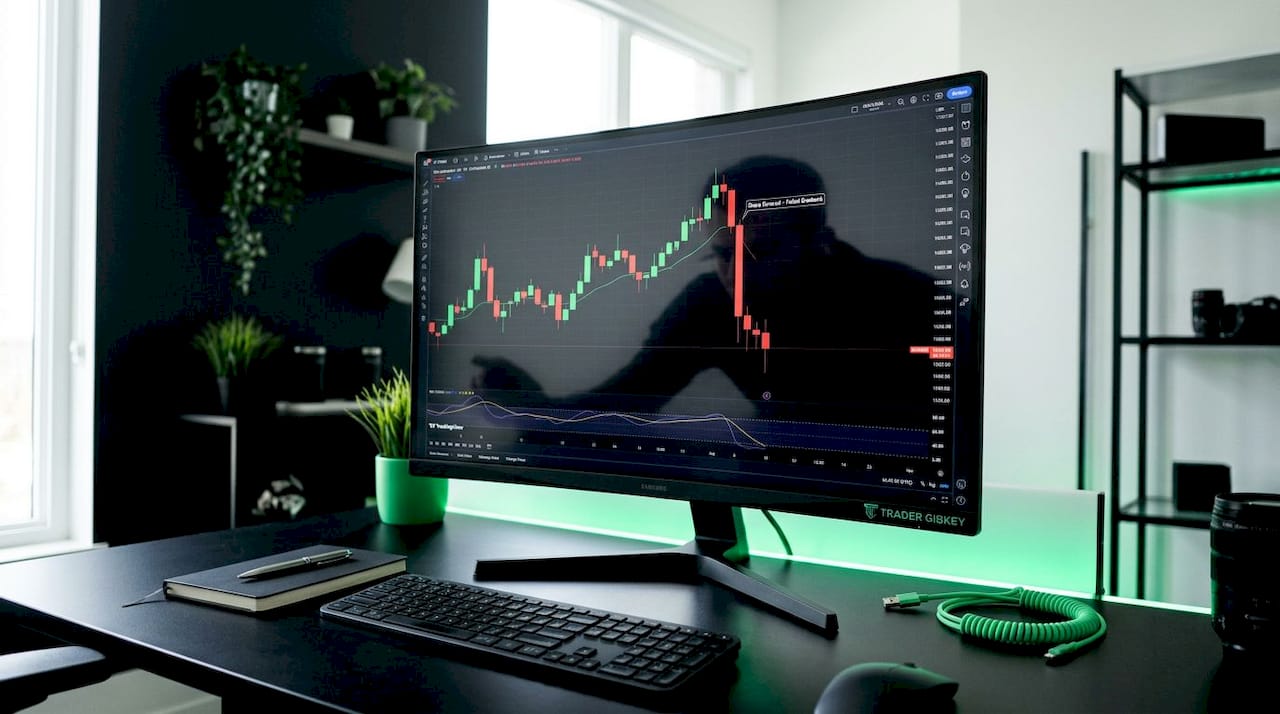
The mechanics are straightforward once you see them clearly. Large institutional players need significant liquidity to fill their own orders. Retail stop-loss orders and breakout entries clustered around obvious chart levels provide exactly that. When price sweeps through a prior high or low, it is not random. It is a liquidity event that fills institutional orders at favorable prices while simultaneously triggering retail exits.
The key distinction between a trap and a genuine breakout is momentum sustainability. If price breaches a level but fails to build momentum and quickly reclaims the original zone, the move was a trap. Genuine breakouts hold above or below the broken level and attract follow-through buying or selling. Traps do not. They spike, reverse, and leave retail traders holding losing positions.
Here is what the trap sequence looks like in practice:
- Price approaches a well-known resistance level, such as a prior swing high
- Retail traders anticipate the breakout and enter long positions
- Price briefly breaks the level, triggering more breakout buyers
- Momentum fades almost immediately after the breach
- Price reverses sharply, triggering stop-losses below the entry zone
- The cascade of stops fuels the reversal, benefiting whoever was positioned short
Pro Tip: Watch the candle that breaks the level. If it closes back inside the range on the same bar or the next, treat it as a trap signal until proven otherwise.
Why retail traders fall into these traps repeatedly
The psychological drivers behind retail trading pitfalls are well-documented and consistent. Retail traders are vulnerable to traps due to excessive confidence, short-term focus, and poor execution discipline. These three factors combine to create predictable, repeatable mistakes that the market exploits.
Overconfidence is the primary culprit. A Barber and Odean study of 66,465 accounts found that the most active retail traders underperform the least active by 7.1 percentage points annually, net of costs. This is not a stock-selection problem. It is a trading frequency problem driven by overconfidence. More trades mean more exposure to traps and higher transaction costs that erode any edge.
“Higher frequency trading by retail investors causes underperformance mostly due to overconfidence-driven excessive trading, not poor stock selection.” — Quant Decoded
The Disposition Effect compounds the damage. Retail traders tend to cut winning trades too early and hold losing trades too long, hoping for a recovery that often never comes. When a trap triggers, this bias causes traders to stay in the losing position rather than exit cleanly. The brain stops trading the chart and starts trading the pain. That is when the real damage happens.
Other behavioral patterns that increase trap vulnerability include:
- Revenge trading after a stop-out, entering the next setup with elevated size and reduced patience
- Recency bias, where the last few trades color judgment on the current setup
- Confirmation bias, where traders see what they want to see in a chart rather than what is actually there
- FOMO entries, where fear of missing a move causes traders to enter without waiting for confirmation
Understanding trading psychology is not a soft skill. It is a core competency for avoiding traps.
How to identify trap patterns on charts and in order flow
Recognizing a retail trading trap before or as it forms is a learnable skill. It requires knowing what to look for at specific price levels and understanding what order flow tells you about who is in control.
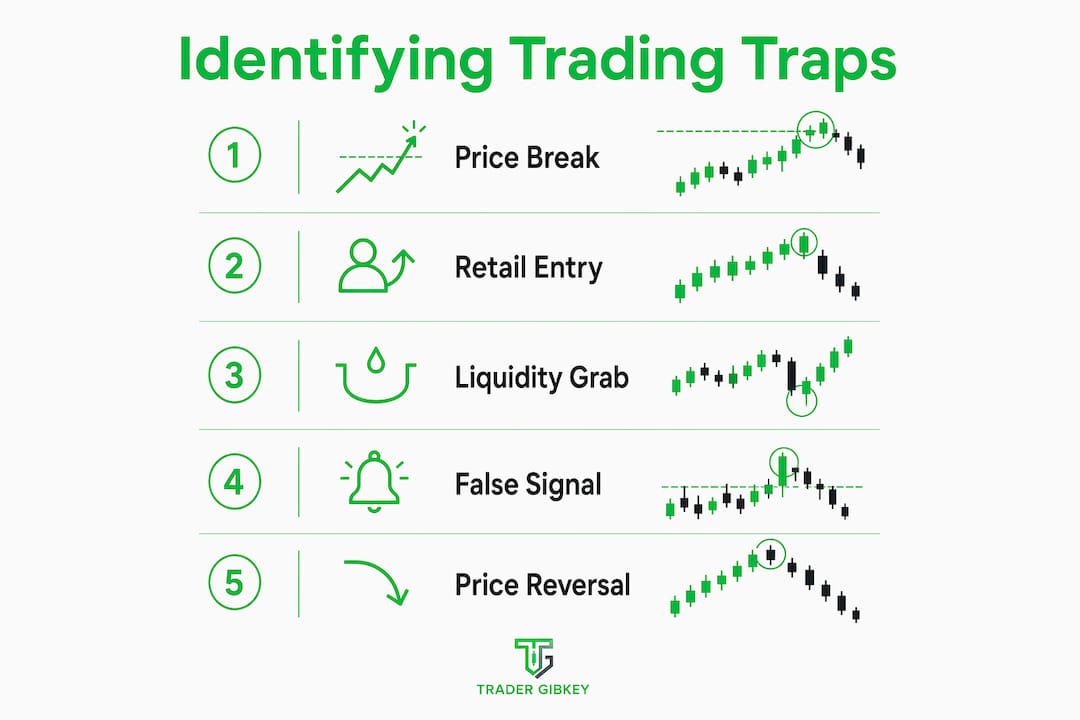
The most reliable trap setups form around three types of price levels:
| Level Type | Why Stops Cluster There | Trap Signal to Watch |
|---|---|---|
| Prior swing highs and lows | Retail traders place stops just beyond these levels | Price sweeps the level and immediately closes back inside |
| Round numbers (e.g., 1.2000 in Forex) | Psychological magnets for limit orders and stops | Spike through the number with no follow-through |
| Point of Control (POC) on volume profiles | High-volume nodes attract price repeatedly | Price touches POC, rejects sharply with high delta divergence |
Failed breakout sequences follow a consistent structure. Price breaks a level, retail traders chase the move, price reverses and triggers stops, and the reversal accelerates as stop-loss orders fuel it further. Professionals recognize this sequence and position accordingly.
Order flow tools add a layer of confirmation that price charts alone cannot provide. Volume Profile shows where the most trading activity occurred, highlighting levels where trapped traders are likely sitting. VWAP (Volume Weighted Average Price) acts as a real-time benchmark. When price deviates sharply from VWAP and then snaps back, it often signals that a trap has completed. Delta analysis, which measures the difference between buying and selling volume on each candle, reveals absorption. When a breakout candle shows negative delta despite rising price, sellers are absorbing buyers. That is a trap forming in real time.
Pro Tip: On a footprint chart, look for high-volume nodes at the top of a breakout candle paired with a bearish close. That combination is one of the clearest signs of trapped longs being absorbed by institutional sellers.
Stop-loss clustering around obvious technical levels creates predictable liquidity pools. The solution is not to avoid using stops. It is to place them outside the obvious zones using volatility-based measures like the Average True Range (ATR).
Practical strategies to avoid retail trading traps
Avoiding traps is not about being smarter than the market. It is about building a process that removes the conditions that make you vulnerable. Here is a structured approach that works.
-
Wait for confirmation before entering breakouts. Do not buy the break. Buy the retest. If price breaks a resistance level and then pulls back to test it as support, that retest is your entry signal. A trap will not hold the level on a retest. A genuine breakout will.
-
Use ATR-based stop placement. Place stops at a distance of at least 1x ATR beyond the nearest obvious level. Using ATR to place stops away from obvious lines directly reduces your vulnerability to stop hunts. This one adjustment alone can eliminate a significant percentage of stop-outs that are not your fault.
-
Build a hard rule against revenge trading. After any stop-out, take a mandatory break of at least 15 minutes before considering the next trade. The emotional state immediately after a loss runs a different operating system. Decisions made in that state are rarely good ones.
-
Reduce trading frequency deliberately. The data is clear. Overconfidence leads to excessive trading, and excessive trading destroys net returns. Set a maximum number of trades per session and stick to it. Quality over quantity is not a cliché in trading. It is a measurable edge.
-
Practice trap recognition on a demo account. Before risking real capital on trap-avoidance strategies, run through historical charts and mark every failed breakout you can find. Then practice practical risk management techniques in a simulated environment until the pattern recognition becomes automatic.
-
Distinguish traps from normal retracements. Not all breakouts are traps. Mislabeling normal pullbacks as traps is a common mistake among new traders that causes them to miss genuine moves. A retracement holds the broken level. A trap reclaims it entirely.
-
Size positions conservatively around key levels. If you are trading near a prior high or low where stop clusters are likely, reduce your position size. The risk of a liquidity sweep is highest at these points. Smaller size keeps you in the game if the trap fires against you.
Key takeaways
Retail trading traps are structural, repeatable market events driven by liquidity mechanics and retail behavioral biases, and recognizing them requires both technical pattern knowledge and psychological discipline.
| Point | Details |
|---|---|
| Core trap definition | A trap is a failed breakout that forces retail entries into becoming institutional exit liquidity. |
| Momentum is the tell | If price reclaims the broken level quickly, the move was a trap, not a genuine breakout. |
| Psychology amplifies losses | Overconfidence and revenge trading cause traders to overtrade and hold losing trap positions too long. |
| ATR stops reduce exposure | Placing stops beyond obvious levels using ATR buffers directly cuts vulnerability to stop hunts. |
| Confirmation before entry | Waiting for a retest of the broken level filters out the majority of false breakout traps. |
What 18 years in live markets taught me about traps
Most traders I have worked with over the years did not lose money because they lacked knowledge. They lost because they could not wait. The trap works because it is designed to feel like an opportunity. The breakout looks real. The momentum feels convincing. And that is exactly the point.
The uncomfortable truth is that the market does not need to be manipulated to trap retail traders. It just needs retail traders to behave predictably, and they almost always do. Stops below the obvious low, entries on the obvious breakout, exits on the obvious reversal. The pattern is so consistent that it shows up on every timeframe, in every liquid market, every single week.
What changed my own trading was shifting from a casino mentality to a business mentality. A casino player reacts to what just happened. A business operator follows a process regardless of the last outcome. When you stop trading the pain and start trading the plan, traps become visible instead of invisible. You start seeing the setup for what it is before you are inside it.
The traders who improve fastest at Tradergibkey are not the ones with the most screen time. They are the ones who commit to reviewing their trap-related losses honestly, identifying the behavioral pattern that caused the entry, and building a hard rule to address it. That process, repeated consistently, is what separates traders who survive from those who do not.
— Gabriel
Take your trading further with Tradergibkey
If this article clarified why retail trading traps keep catching you off guard, the next step is building a structured process to recognize and avoid them in real time. Tradergibkey’s courses and mentorship programs are built specifically for traders who are tired of repeating the same costly mistakes.

With over 18 years of live market experience, Tradergibkey teaches price action strategies that account for liquidity mechanics, trap patterns, and the psychological discipline required to trade them correctly. You get a structured learning path, direct mentorship, and a community of traders working through the same challenges. If you are ready to trade with a real edge, start here.
FAQ
What is a retail trading trap in simple terms?
A retail trading trap is when price breaks a key level, draws retail traders into the move, then immediately reverses and stops them out. Their exits become the liquidity that fuels the reversal.
How do I know if a breakout is a trap or real?
Watch whether price holds the broken level after the initial breach. A genuine breakout sustains momentum and holds above or below the level. A trap reclaims the level quickly, often within one or two candles.
Why do retail traders keep falling for the same traps?
Overconfidence, FOMO, and revenge trading cause retail traders to enter breakouts without confirmation and hold losing positions too long. Research shows the most active retail traders underperform by 7.1 percentage points annually, largely due to these behavioral patterns.