Most traders assume a stop-loss order means they’ll exit a trade at exactly the price they set. That assumption costs real money. Understanding what is a stop loss, and more specifically how it actually executes in live markets, is one of the most practical skills you can develop as a trader. This guide breaks down the stop loss definition, how different order types behave, where execution risks hide, and how to build stop-loss logic into your actual trading strategy, whether you’re new to the charts or have years of live experience.
Table of Contents
- Key Takeaways
- What is a stop-loss order
- Types of stop-loss orders
- Execution mechanics and real risks
- How to use stops effectively in your strategy
- Common challenges and advanced considerations
- My honest take on stop-loss discipline
- Take your trading further with Tradergibkey
- FAQ
Key Takeaways
| Point | Details |
|---|---|
| Stop losses automate exits | A stop-loss order triggers automatically when price hits your set level, removing emotional decision-making. |
| Fill price is not guaranteed | Your stop triggers a market order, but the actual exit price depends on liquidity and market conditions at that moment. |
| Three main order types exist | Standard stop-loss, stop-limit, and trailing stop orders each serve different risk management needs. |
| Placement requires context | Setting stops too tight or too wide leads to premature exits or larger losses than planned. |
| Stops are one layer of defense | They work best as part of a broader risk management approach, not as a standalone safety guarantee. |
What is a stop-loss order
A stop-loss order is a standing instruction you place with your broker to automatically close a trade when price reaches a specific level. The goal is simple: cap your downside before a losing position spirals beyond what you planned to risk. This is the core of the stop loss definition. You decide the pain threshold before you enter the trade, not in the heat of the moment when the chart is moving against you.
Here’s how it works in practice. Say you buy a stock at $100. You place a stop-loss at $90. If the price drops to $90, your broker automatically fires a sell order. You don’t need to be watching the screen. You don’t need to decide anything. The order executes on your behalf.
A few key mechanics to understand:
- The stop price is the trigger level you set in advance
- When price hits that level, your broker converts the stop into a market sell order
- That market order fills at whatever the best available price is at that moment
- The fill price and the stop price are often close, but they are not always identical
This last point is where most traders get caught off guard. The stop price activates the order. It does not lock in the price. In fast or thin markets, the difference between trigger and fill can be meaningful.
Pro Tip: Set your stop price at a level that reflects the actual trade idea. If you bought because of a support zone at $92, placing your stop at $91.50 rather than $89 gives you a tighter risk profile while still respecting the technical structure.
Types of stop-loss orders
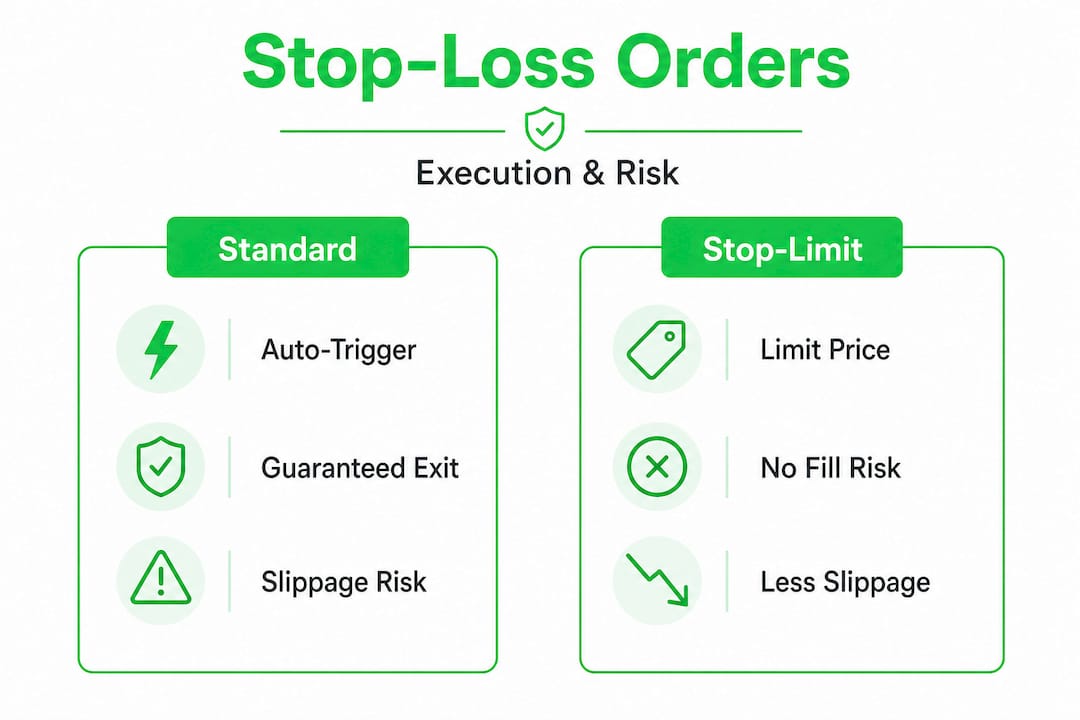
Understanding stop loss order types is what separates traders who use stops intelligently from those who treat them as an afterthought. There are three main types, and each one makes a different tradeoff between execution certainty and price control.
| Order Type | How It Executes | Main Advantage | Main Risk |
|---|---|---|---|
| Standard stop-loss | Triggers a market order at the stop price | Guaranteed execution | Fill price may differ from stop price |
| Stop-limit order | Triggers a limit order between stop and limit price | Controls exit price | May not fill if price gaps past limit |
| Trailing stop | Stop price moves with favorable price action | Locks in profits dynamically | Can be triggered by normal volatility |
Standard stop-loss orders prioritize getting you out of the trade above all else. As noted, execution is guaranteed but the exact price is not. These are best for traders who need certainty that the position closes.

Stop-limit orders add a second price layer. You set both a stop price and a limit price. When the stop triggers, a limit order fires instead of a market order. This means you control the exit price but risk no fill at all if the market moves too fast. In a gap-down scenario overnight, a stop-limit can simply be skipped over entirely, leaving you stuck in a position that has already moved far past your intended exit.
What is a trailing stop loss? A trailing stop is a smarter version of the standard stop. Instead of a fixed price, the stop level adjusts automatically as price moves in your favor. Set a trailing stop 3% below price, and if the stock climbs from $100 to $120, your stop climbs from $97 to $116.40. You lock in gains without manually adjusting the order.
- Trailing stops work well in trending markets where you want to ride momentum
- They can be set as a fixed dollar amount or a percentage
- In choppy, sideways markets, they tend to get triggered prematurely by normal price noise
Pro Tip: For trending Forex setups, a percentage-based trailing stop often performs better than a fixed dollar amount because it scales with the actual price range of the pair you’re trading.
Execution mechanics and real risks
This is the section most beginner guides skip, and it’s where real money gets lost. Knowing how stop-loss orders work on paper is different from understanding how they behave under live market pressure.
The critical distinction is between the stop trigger price and the fill price. Practitioners think about these as two separate events. The trigger is when your order becomes active. The fill is when your broker actually closes your position. These prices can differ materially depending on what is happening in the order book at that exact moment.
Four conditions that increase the gap between trigger and fill:
- Low liquidity. Thin markets mean fewer buyers on the other side of your sell order. Your order fills across multiple price levels, each one slightly worse than the last.
- High volatility. Fast price moves mean the market jumps past your stop level before the order can fill cleanly at or near the trigger.
- Market gaps. If a major news event hits overnight, price can open far below your stop. Your order still executes, but at the open price, not your stop level.
- Extended hours trading. Liquidity during pre-market and after-hours sessions is thinner, making execution less predictable.
“Stop-loss orders work best as automated safety nets prioritizing exit certainty, not price precision. Traders who understand this distinction make better decisions about when to use a standard stop versus a stop-limit.”
The practical takeaway is this: stops don’t protect against all risks. They reduce risk. That’s not a flaw. It’s the reality. Knowing the limitation helps you use the tool correctly rather than trusting it blindly. For traders using practical risk management frameworks, the stop-loss is one layer in a system, not the whole system.
How to use stops effectively in your strategy
Stop-loss strategy importance becomes clear the moment you’ve held a losing trade far longer than you should have. The brain stops trading the chart and starts trading the pain. A pre-set stop removes that decision entirely. That’s one of the core benefits of stop loss orders that rarely gets enough attention.
When deciding where to place a stop, three factors matter most:
- Volatility. A currency pair or stock with wide daily ranges needs more breathing room. Place stops based on average true range (ATR) rather than round numbers.
- Structure. Setting stops relative to support and resistance levels makes technical sense. Your stop should sit just beyond a level where, if broken, your trade idea is invalidated.
- Risk tolerance. Know your max loss per trade as a percentage of account size before you place the stop, not after.
Balancing tight versus wide stops is one of the more nuanced parts of trading. Tight stops preserve capital but generate more losing trades through normal price fluctuation. Wide stops mean fewer premature exits but larger individual losses when they do trigger.
Pro Tip: As a trade moves in your favor, consider moving your stop to breakeven once price clears a meaningful level. You take the risk of loss completely off the table without closing the trade early.
For short positions, the logic mirrors long trades. You’re selling with the expectation of lower prices, so your stop sits above your entry. If price climbs to your stop level, you exit with a defined loss. The mechanics are identical.
Common challenges and advanced considerations
Even traders who understand stops conceptually run into problems in live conditions. These are the most common ones.
The biggest frustration is getting stopped out during a temporary dip, only to watch price reverse and run in your direction without you. This happens when stops are placed too close to current price without accounting for normal market noise. The solution is not to remove stops but to place them more thoughtfully.
| Scenario | Challenge | Strategic Response |
|---|---|---|
| Volatile news event | Price gaps past stop-limit, no fill | Use standard stop-loss near high-impact news |
| Choppy market | Trailing stop triggers prematurely | Widen trail distance or pause trailing in ranging conditions |
| Overnight gap | Fill far below stop price | Reduce position size on trades held overnight |
| Tight stop on liquid pair | Frequent premature exits | Base stop placement on ATR rather than fixed pips |
A few additional considerations worth noting:
- Stop-loss orders placed during extended hours may behave differently due to reduced liquidity
- Trailing stops require careful parameter selection to balance profit protection with normal volatility tolerance
- For consistent trading results, treat stop placement as part of your entry criteria, not an afterthought
The choice between a standard stop and a stop-limit ultimately comes down to one question: do you need the trade to close no matter what, or is it acceptable to stay in if price moves too fast? Most retail traders are better served by the certainty of a standard stop-loss over the price control of a limit.
My honest take on stop-loss discipline
I’ve placed thousands of stop-loss orders across live Forex markets over the years, and the honest truth is that the mechanics were never the hard part. The hard part was respecting the stop when every instinct said to widen it “just a little” because I was sure price would reverse.
What I’ve learned is that widening a stop in the moment is almost never about logic. It’s about pain avoidance. The trade idea hasn’t changed. The chart structure hasn’t changed. The only thing that changed is that losing became more real. That’s when discipline matters most, and that’s exactly when most traders abandon it.
My contrarian view is this: the most valuable thing a stop-loss does has nothing to do with the order mechanics. It’s the pre-commitment. Deciding your exit before you’re emotionally invested in the outcome is what separates traders who survive drawdowns from those who blow accounts. The order is just the mechanism that enforces the decision you made with a clear head.
I still review my stop placement regularly. Markets change, volatility regimes shift, and what worked in a trending environment needs adjustment in a choppy one. Adapt the parameters. Never adapt out of discomfort.
— Gabriel
Take your trading further with Tradergibkey
Understanding stop-loss orders is one piece of a much larger risk management puzzle. Tradergibkey offers structured trading courses, one-on-one mentorship, and a supportive community built specifically for traders who want to move from reactive to deliberate in how they manage every trade.
With over 18 years of live market experience, Tradergibkey focuses on price action strategies that work in real conditions, not just clean backtests. If you’re ready to build a disciplined trading process that includes smarter stop placement, position sizing, and emotional control, visit Tradergibkey’s trading courses to explore what’s available. The community alone is worth it.
FAQ
What is a stop-loss order in simple terms?
A stop-loss order is an automatic instruction to close your trade when price reaches a specific level, limiting how much you can lose on any single position.
Does a stop-loss guarantee my exit price?
No. A standard stop-loss triggers a market order when your stop price is hit, but the actual fill price depends on liquidity and market conditions at that moment.
What is the difference between a stop-loss and a trailing stop?
A standard stop-loss stays at a fixed price, while a trailing stop adjusts upward automatically as price moves in your favor, helping lock in profits on winning trades.