
A trading journal is a structured record of every trade you take, capturing not just the result but the reasoning, emotional state, and setup behind each decision. Unlike a broker statement or P&L spreadsheet, which only show outcomes, a true trading journal records the why behind every entry and exit. That distinction is everything. Between 70–90% of retail traders lose money by repeating the same mistakes, and a journal is the primary tool that breaks that cycle. Tools like Tradezella and TraderVue exist specifically to make this process systematic and consistent.
What is a trading journal and what should be in it?
A trading journal is a log that captures the full context of each trade, not just the dollar result. The fields you track determine how useful your journal actually becomes. Start too complex and you quit within a month. Start too simple and you miss the data that matters.
Beginners should log 5 essential fields consistently for at least two weeks before adding anything else. Those five fields are:
- Date and time of the trade
- Instrument traded (e.g., EUR/USD, GBP/JPY, S&P 500)
- Trade direction (long or short)
- P&L result in dollar or pip terms
- Rationale for taking the trade, written in plain language
The rationale field is the one most traders skip. It is also the most valuable. Writing down why you entered a trade forces you to confront whether your reasoning was sound or emotional. That single habit separates traders who grow from traders who spin their wheels.
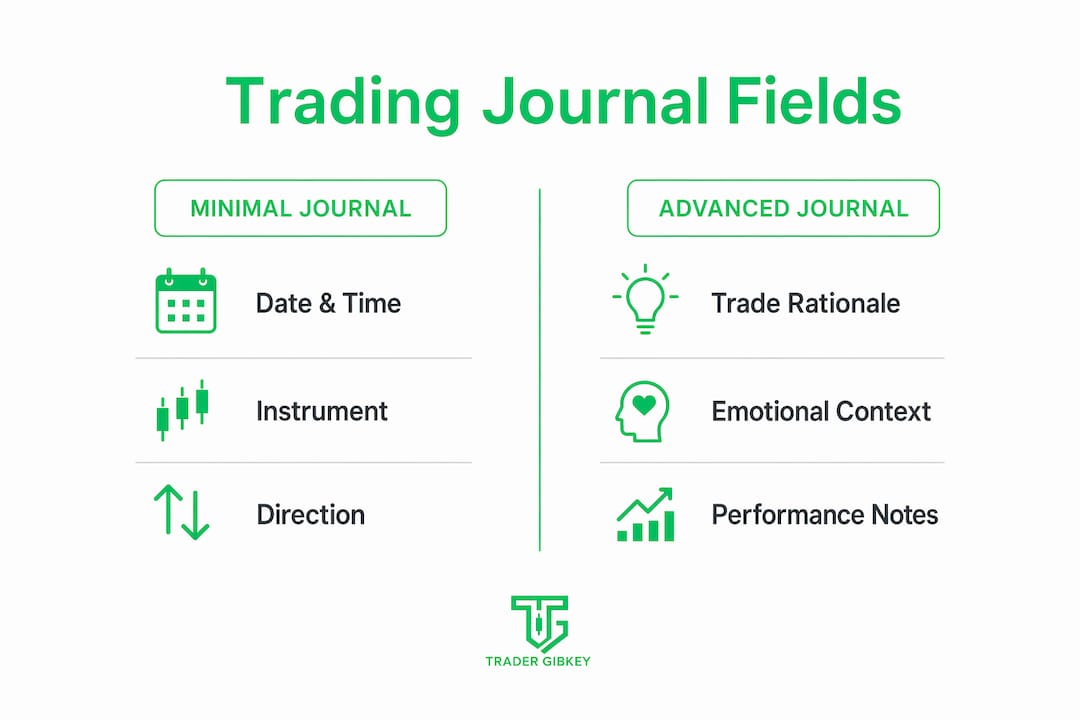
Here is a comparison of minimal versus advanced journaling fields to help you decide where to start:
| Field Category | Minimal Journal | Advanced Journal |
|---|---|---|
| Date and time | Yes | Yes |
| Instrument and direction | Yes | Yes |
| P&L result | Yes | Yes |
| Trade rationale | Yes | Yes |
| Emotional state | No | Yes |
| Setup screenshot | No | Yes |
| Risk/reward ratio | No | Yes |
| Rule compliance check | No | Yes |
| Session and market conditions | No | Yes |

The advanced fields add real diagnostic power. But logging more than 20 fields causes most traders to abandon their journal within a month. Build the habit first. Add complexity only after consistency is locked in.
Pro Tip: If logging a single trade takes you more than two minutes, your journal is already too complex. Trim it back until the process feels effortless.
How does journaling actually improve your trading?
A journal does more than store records. It creates a feedback loop that your memory alone cannot replicate. Memory is selective and self-serving. A journal is not.
“Journaling forces traders to confront reality versus perception, accelerating skill acquisition beyond relying on memory alone.” — Tradezella
Patterns that take months to identify without support emerge within 4–6 weeks of consistent journaling. That is not a small advantage. It means you can identify your worst setups, your most emotional trading sessions, and your best-performing instruments in under two months instead of a year.
A brokerage statement cannot diagnose strategy flaws, but a well-designed journal can analyze expectancy, setup quality, and rule compliance. Those are the metrics that tell you whether you have an edge or just a lucky streak. Here is what consistent journaling reveals that broker reports never will:
- Which setups produce positive expectancy versus which ones drain your account slowly
- The specific times of day or week when your decision quality drops
- Whether you follow your trading plan consistently or only when it is convenient
- Emotional triggers that lead to revenge trades or premature exits
- The instruments where your edge is strongest versus where you are guessing
The most valuable journal entries come from losing trades where rules were broken. Those entries are uncomfortable to write. They are also the ones that teach you the most. The brain stops trading the chart and starts trading the pain after a loss. Your journal is the record that shows you exactly when that switch happened.
How often should you review your trading journal?
Logging trades is only half the work. The review session is where the real learning happens. Without scheduled reviews, your journal becomes a graveyard of data with no one reading the headstones.
For beginners, the process looks like this:
- Log every trade the same day it occurs. Do not rely on memory the next morning.
- Conduct a brief weekly review every Sunday before the new trading week opens.
- Run a monthly deep review where you analyze patterns across all trades for the month.
- Quarterly, reassess your overall strategy based on cumulative journal data.
For traders executing 25 or more trades per week, a weekly 30-minute Sunday review is the recommended cadence for detecting patterns without overreacting to short-term noise. That time constraint matters. Longer reviews tend to spiral into second-guessing rather than pattern recognition.
The two-week minimum is not arbitrary. Building a consistent journaling habit over at least two weeks puts you ahead of the majority of traders who abandon the practice early. Two weeks of daily logging creates enough data to spot at least one repeating behavior, and that first discovery is what keeps most traders hooked on the process.
Pro Tip: Block 30 minutes every Sunday evening specifically for your journal review. Treat it like a hard rule, not an optional task. Traders who skip this step consistently are the ones who keep asking why they are not improving.
For a structured approach to these reviews, the performance review guide at Tradergibkey covers optimal schedules and review frameworks in detail.
Manual vs. automated: which journal format works best?
The format you choose should match your trading volume and your tolerance for manual data entry. There is no single right answer, but there are wrong ones for your situation.
Manual formats include Excel spreadsheets, Google Sheets, and Notion templates. These work well for traders taking fewer than 20 trades per week. They are free, fully customizable, and force you to engage with each trade as you log it. That friction is actually useful at the beginner stage because it builds awareness.
Automated platforms like Tradezella, TraderVue, and Edgewonk connect directly to your broker and import trade data automatically. They generate analytics, equity curves, and setup performance reports without manual input. Auto-capturing tools become necessary once you exceed roughly 50 trades per week, where manual entry simply breaks down.
Here is how the most common options compare:
| Tool | Format | Price Range | Auto-Import | Best For |
|---|---|---|---|---|
| Google Sheets | Manual | Free | No | Beginners, low volume |
| Excel | Manual | Free/paid | No | Beginners, custom builds |
| Notion | Manual | Free/paid | No | Visual thinkers, flexible setup |
| Tradezella | Automated | Paid subscription | Yes | Active traders, analytics focus |
| TraderVue | Automated | Free/paid tiers | Yes | Stock and futures traders |
| Edgewonk | Automated | One-time fee | Yes | Serious traders, deep analytics |
The biggest mistake traders make is choosing a tool that is too advanced for their current volume. A beginner using Edgewonk before they have a consistent logging habit is like buying a professional camera before learning to frame a shot. Start with Google Sheets or a simple Notion template. Move to an automated platform when your trade volume demands it.
For practical tips on building daily trading habits that support consistent journaling, Tradergibkey’s Forex tips guide is worth your time.
Key takeaways
A trading journal is the single most effective tool for diagnosing performance gaps, because it captures the context and psychology behind every trade that broker statements permanently ignore.
| Point | Details |
|---|---|
| Journal vs. broker statement | A journal records the why behind trades; broker data only shows outcomes. |
| Start with 5 fields | Date, instrument, direction, P&L, and rationale are enough to build the habit. |
| Review on a schedule | A weekly 30-minute Sunday review reveals patterns without creating noise. |
| Match tool to volume | Use Google Sheets under 20 trades per week; switch to automated tools above 50. |
| Losing trades teach most | Entries from rule-breaking losses are the highest-value data in your journal. |
Why most traders journal wrong (and what i’ve learned about it)
Here is my honest take after 18 years in live markets: most traders treat their journal like a report card. They log the wins proudly and rush through the losses. That is exactly backwards.
The trades where you followed your rules and still lost are fine. The market does that. The trades where you broke your rules and won are the dangerous ones, because they teach your brain the wrong lesson. Your journal needs to capture both with equal honesty. If you are not writing down “I entered early because I was afraid of missing the move,” you are not journaling. You are just keeping records.
The other mistake I see constantly is overbuilding the journal before the habit exists. Traders spend a weekend designing a 30-field spreadsheet with conditional formatting and color codes. By Wednesday, they have stopped filling it in. Simplicity is not laziness. It is the only way the habit survives contact with a real trading week.
Start with five fields. Write one honest sentence about why you took the trade. Do that every day for two weeks. You will learn more about your trading in those 14 days than in the previous six months. That is not an exaggeration. The feedback loop is that fast when you are actually looking at your own data instead of guessing.
Journaling also reveals something most traders do not expect: your edge is probably smaller and more specific than you think. You might be profitable on EUR/USD during the London session but bleeding on every trade you take after 2 PM New York time. Your broker statement will never show you that. Your journal will show you in week three.
— Gabriel
Take your trading further with Tradergibkey
If you are serious about building a journaling habit that actually improves your results, having a structured learning environment makes the process faster and more reliable.
Tradergibkey’s courses and mentorship programs are built around practical, real-market experience, including dedicated modules on performance review, journaling best practices, and price action strategy. With over 18 years of live trading behind the curriculum, the focus is always on what works in real conditions, not theory. Join a community of traders who are actively using these tools to build consistent, repeatable results. Visit Tradergibkey to explore courses, mentorship options, and community access.
FAQ
What is a trading journal used for?
A trading journal records every trade’s details, rationale, and emotional context so you can identify patterns, fix repeated mistakes, and improve decision quality over time.
How do i start a trading journal as a beginner?
Start with five fields: date, instrument, direction, P&L, and trade rationale. Log every trade the same day it occurs and review weekly.
Do i need special software to keep a trading journal?
No. Google Sheets or a simple Notion template works well for traders taking fewer than 20 trades per week. Automated platforms like Tradezella or TraderVue become useful at higher volumes.