
A trading plan is a predefined, rules-based strategy that directs how you buy and sell securities, with the goal of keeping your decisions consistent and free from emotional interference. Known formally as a structured trading strategy, it covers everything from your financial goals and risk tolerance to your exact entry and exit rules. Without one, you are essentially reacting to the market in real time, which is where most traders lose money. Fidelity, Investopedia, and TradeZella all treat a written trading plan as the single most foundational tool a trader can have.
What is a trading plan and why does it matter?
A trading plan is your strategy for tactically buying and selling assets like stocks, bonds, ETFs, and currencies, with ground rules that reduce emotion and guesswork. Think of it as the operating system your trading runs on. When the market spikes or drops, your plan tells you exactly what to do instead of letting fear or greed make the call.
The difference between a trading plan and a vague trading idea is specificity. A trading idea says “I’ll buy when the price looks good.” A trading plan says “I’ll enter a long position when price closes above the 20-period EMA on the 4-hour chart, with a stop loss 15 pips below the entry candle low, risking no more than 1% of my account.” That level of detail is what separates consistent traders from gamblers.

No trading plan guarantees success, but detailed plans that are consistently followed remove many of the hurdles to consistent profitability. That is the honest truth. The plan does not predict the market. It protects you from yourself.
What are the essential components of a trading plan?
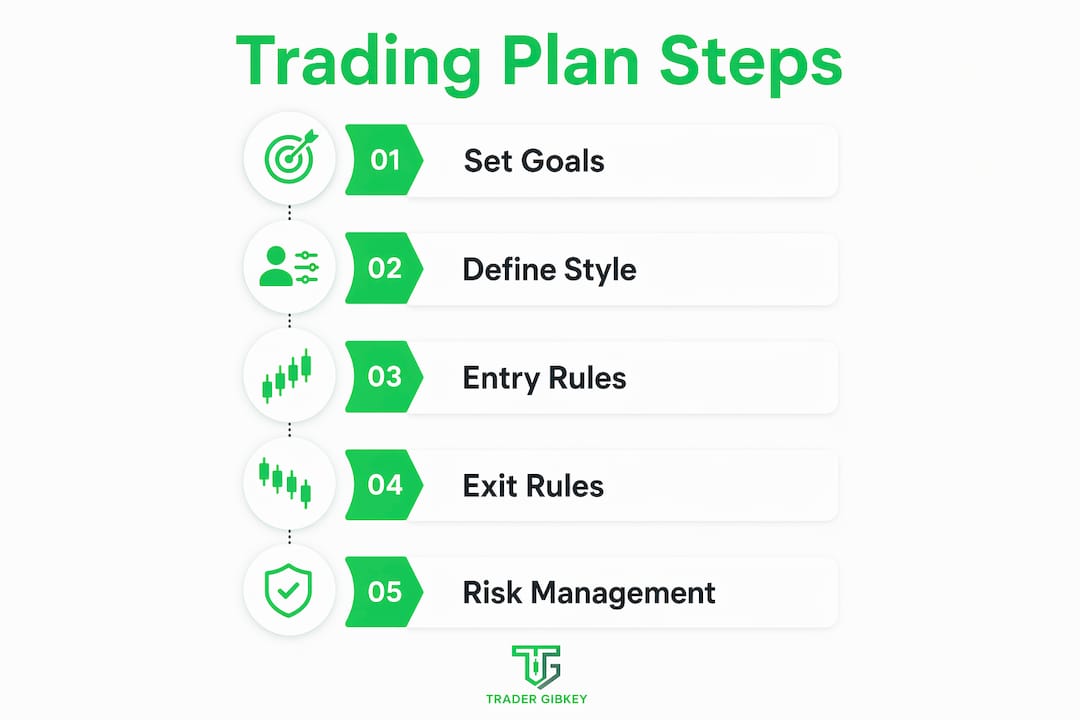
Every solid trading plan contains the same core building blocks, even if the specific rules differ from trader to trader. Here is what yours needs to include:
- Financial goals and risk tolerance. Define what you want to achieve, whether that is a monthly income target, capital growth, or learning consistency. Be specific about how much you are willing to lose before stopping.
- Trading style. Choose between day trading, swing trading, or position trading. Your style determines your timeframes, the frequency of your setups, and how much screen time you need.
- Entry and exit rules. This is the heart of the plan. Your entry rules define exactly what conditions must be met before you place a trade. Your exit strategies define your profit targets and stop-loss levels before you ever click buy.
- Position sizing. Decide how large each trade will be relative to your account. Most professional traders risk between 0.5% and 2% of their account per trade.
- Risk management rules. Set a daily loss limit, a weekly drawdown cap, and a hard rule for when you stop trading for the day.
- Trade review process. Schedule time to review your trades, identify patterns in your wins and losses, and update your plan accordingly.
Pro Tip: Write your trading plan in a document you can print out and keep at your desk. When you are in a live trade and your emotions are running hot, having the rules physically in front of you is a stronger anchor than trying to remember them from memory.
The plan also needs to cover order execution mechanics. Stop-loss, limit, and conditional orders are integral parts of the strategy, not afterthoughts you figure out after entering a position. Knowing which order type you will use for each scenario is part of what makes a plan executable under pressure.
How does a trading plan help manage emotion and improve decision-making?
The brain stops trading the chart and starts trading the pain the moment a losing streak hits. That is when impulsive decisions happen: revenge trades, oversized positions, ignoring stop losses. A trading plan short-circuits that cycle by making the decision before the emotion arrives.
Planning entries and exits in advance eliminates the two most dangerous moments in trading: the moment you decide to enter and the moment you decide to exit. Both of those moments are loaded with cognitive bias when you are in the middle of a live trade. Your plan removes the decision entirely. You already made it.
“Planned exit strategies help remove emotion and enable dispassionate decision-making.” — Fidelity
Consider a common scenario: you enter a trade, it moves against you by 20 pips, and your stop loss is at 25 pips. Without a plan, your brain starts rationalizing. “Maybe I should move the stop.” “The market will turn.” With a plan, there is no decision to make. The stop is where it is because you decided that before you entered. That is the power of aligning decisions with risk tolerance before the trade is live.
Understanding trading psychology is what makes this click on a deeper level. Emotional control is not about willpower. It is about removing the need for willpower by having rules that do the work for you.
Pro Tip: After any trade where you felt a strong urge to break your rules, write down what triggered that urge. Over time, you will see patterns in your emotional responses that you can address directly in your plan.
What are effective risk management rules within a trading plan?
Risk management is the part of your plan that keeps you in the game long enough to get good. TradeZella’s layered risk defense approach breaks it down into four levels: per-trade risk, stop-loss placement, daily and weekly loss limits, and drawdown management. Each layer catches what the previous one misses.
Here is how a practical risk framework looks on a $50,000 account:
| Risk Layer | Rule | Dollar Impact |
|---|---|---|
| Per-trade risk | 1% of account per trade | $500 max loss per trade |
| Daily loss limit | 3% of account per day | $1,500 max daily loss |
| Weekly loss cap | 6% of account per week | $3,000 max weekly loss |
| Drawdown rule | Stop trading at 10% drawdown | $5,000 total before reassessment |
The numbers matter less than the principle. What you are building is a set of circuit breakers. Professional traders treat risk rules as hard stops, not suggestions. When the daily limit is hit, trading stops. Full stop. No exceptions.
A few additional rules that belong in every risk management section:
- Never move a stop loss further away from your entry to avoid being stopped out.
- Scale down position size after two consecutive losses, not up.
- Use a hard stop rather than a mental stop. Mental stops fail under pressure.
One nuance worth knowing: stop-loss orders trigger at defined prices but cannot protect against price gaps, particularly around major news events. Sophisticated traders account for this by reducing position size ahead of high-impact economic releases. That kind of detail is what separates a real trading plan from a basic template. For a deeper look at building these layers, the guide on consistent risk management is worth your time.
How to develop, follow, and review a personalized trading plan
Building a personalized trading plan is not a one-afternoon project. It is an ongoing process that starts with a draft and improves through real trading experience. Here is a practical sequence to follow:
- Define your goals. Write down your monthly profit target, your maximum acceptable monthly loss, and the number of hours you can dedicate to trading each week. Be honest. Overestimating your available time is one of the most common planning mistakes.
- Choose your market and timeframe. Forex, equities, futures, and crypto all behave differently. Pick one market to start. Then pick one or two timeframes that fit your schedule.
- Document your setup criteria. Write out the exact conditions that must be present before you enter a trade. Use price action signals, support and resistance levels, or indicator readings. Whatever your method, it must be specific enough that another trader could follow the same rules.
- Set your risk parameters. Use the layered framework above. Decide your per-trade risk percentage, your daily limit, and your weekly cap before you trade a single live position.
- Start a trade journal. Tools like TradeZella allow you to log every trade with entry, exit, reasoning, and emotional state. Reviewing this data weekly reveals patterns you cannot see in the moment.
- Schedule monthly plan reviews. Treat your plan as a living document. Trading plans require regular updates based on performance data and shifting market conditions. What worked in a trending market may fail in a ranging one.
Pro Tip: Before going live, paper trade your plan for at least two to four weeks. This is not about proving the strategy works. It is about proving you can follow the rules consistently before real money is on the line.
The most common reason traders abandon their plan is not that the plan was wrong. It is that they never built the habit of following it. Treat plan adherence as a skill you practice, not a personality trait you either have or do not.
Key takeaways
A trading plan works because it converts real-time emotional decisions into pre-made rules, protecting your capital and your decision quality across every market condition.
| Point | Details |
|---|---|
| Core definition | A trading plan is a rules-based strategy covering entries, exits, position sizing, and risk limits. |
| Emotional control | Predefining trades removes the need for willpower in the moment, cutting impulsive decisions. |
| Risk management layers | Use per-trade limits, daily caps, weekly caps, and drawdown thresholds as four separate circuit breakers. |
| Living document | Review and update your plan monthly based on trade journal data and changing market conditions. |
| Personalization matters | A personalized trading plan aligned with your goals and schedule outperforms any generic template. |
Why I think most traders skip the one thing that would actually help them
After 18 years of live market trading, the pattern I see most often is this: traders spend weeks studying strategies and almost no time building a plan to execute them. They know their setup. They do not know their rules.
The traders who improve fastest are not the ones with the best strategy. They are the ones who treat trading like a business. They write things down. They review their numbers. They adjust based on evidence, not gut feeling. A personalized trading strategy is not a constraint on your freedom as a trader. It is what gives you the freedom to trade without second-guessing every decision.
The uncomfortable truth is that most losing streaks are not caused by a bad strategy. They are caused by inconsistent execution of a decent strategy. You enter too early, exit too late, or skip the stop loss “just this once.” The plan is what stops that. Not discipline alone. The plan.
If you are serious about trading, write the plan first. Then trade it. Then review it. That cycle, repeated consistently, is what actually builds a profitable trader.
— Gabriel
Build your trading plan with Tradergibkey
Knowing what goes into a trading plan is the first step. Building one that actually fits your goals, your schedule, and your risk tolerance is where most traders need real guidance.

Tradergibkey offers structured trading courses and one-on-one mentorship built around 18 years of live Forex trading experience. The focus is on price action strategies, disciplined execution, and building the kind of personalized trading plan that holds up under real market pressure. You also get access to a community of traders who are working through the same process, so you are never figuring it out alone. If you are ready to trade with a real structure behind you, start here at Tradergibkey.
FAQ
What is a trading plan in simple terms?
A trading plan is a written set of rules that tells you when to enter a trade, when to exit, and how much to risk. It removes guesswork and keeps your decisions consistent.
How many components does a trading plan need?
At minimum, a trading plan needs goals, a defined trading style, entry and exit rules, position sizing, and risk management limits. Each component serves a specific function in protecting your capital and guiding your decisions.
Can a trading plan guarantee profits?
No trading plan guarantees profits, but consistently following a detailed plan removes many of the behavioral mistakes that cause losses, making profitability far more achievable over time.