
A trading session is the designated time frame during which a financial market is open for buying and selling, providing the structured window for price discovery and liquidity. The NYSE runs its regular session from 9:30 a.m. to 4:00 p.m. Eastern Time, and that six-and-a-half-hour window is where the vast majority of U.S. equity volume concentrates. Forex markets operate differently. They run 24 hours across three regional sessions: Asian (Tokyo), European (London), and North American (New York). Understanding what a trading session means, and how it varies by asset class, is the foundation every serious trader builds strategy on.
What is a trading session and how does it differ by market?
A trading session is defined as the operational window when an exchange accepts, matches, and executes trade orders with live price discovery. That definition sounds simple, but the practical reality varies significantly depending on what you trade.
For U.S. equities, the regular session runs Monday through Friday, 9:30 a.m. to 4:00 p.m. ET, with early closes on select holidays. This is the core liquidity window. Outside of it, extended-hours trading adds pre-market access from 4:00 a.m. to 9:30 a.m. ET and after-hours access from 4:00 p.m. to 8:00 p.m. ET. These windows exist, but they carry a different risk profile entirely.
Forex operates without a central exchange, so the concept of a single session does not apply. Instead, the market cycles through three regional sessions with overlapping hours:
- Asian session (Tokyo): 7:00 p.m. to 4:00 a.m. ET. Lower volatility, tighter ranges on most pairs.
- European session (London): 3:00 a.m. to 12:00 p.m. ET. High liquidity, strong directional moves.
- North American session (New York): 8:00 a.m. to 5:00 p.m. ET. Peak activity during the London/New York overlap.
Futures and bond markets add further variation. CME equity futures trade nearly 24 hours on weekdays, with a brief daily maintenance break. U.S. Treasury futures follow a similar schedule. The session timing depends on the specific contract and exchange, so always verify hours for your instrument before building a strategy around them.
| Market | Regular Session (ET) | Extended/Additional Hours |
|---|---|---|
| NYSE (U.S. Stocks) | 9:30 a.m. to 4:00 p.m. | Pre-market 4:00 a.m., After-hours to 8:00 p.m. |
| Forex (London) | 3:00 a.m. to 12:00 p.m. | Continuous 24-hour cycle |
| Forex (New York) | 8:00 a.m. to 5:00 p.m. | Continuous 24-hour cycle |
| CME Equity Futures | Nearly 24 hours weekdays | Brief daily maintenance break |
How do session mechanics affect execution, liquidity, and volatility?
The mechanics of a trading session are not passive. They actively shape the quality of your fills, the spreads you pay, and the volatility you face.

At the open and close of major sessions, exchanges run auction processes. The NYSE opening cross, for example, collects orders before 9:30 a.m. and matches them at a single price to set the day’s opening reference. The closing auction works the same way in reverse. These auction processes manage order imbalances and establish reference prices that index funds, ETFs, and institutional desks use for benchmarking. For retail traders, this means the first and last minutes of a session often behave differently from the middle of the day.
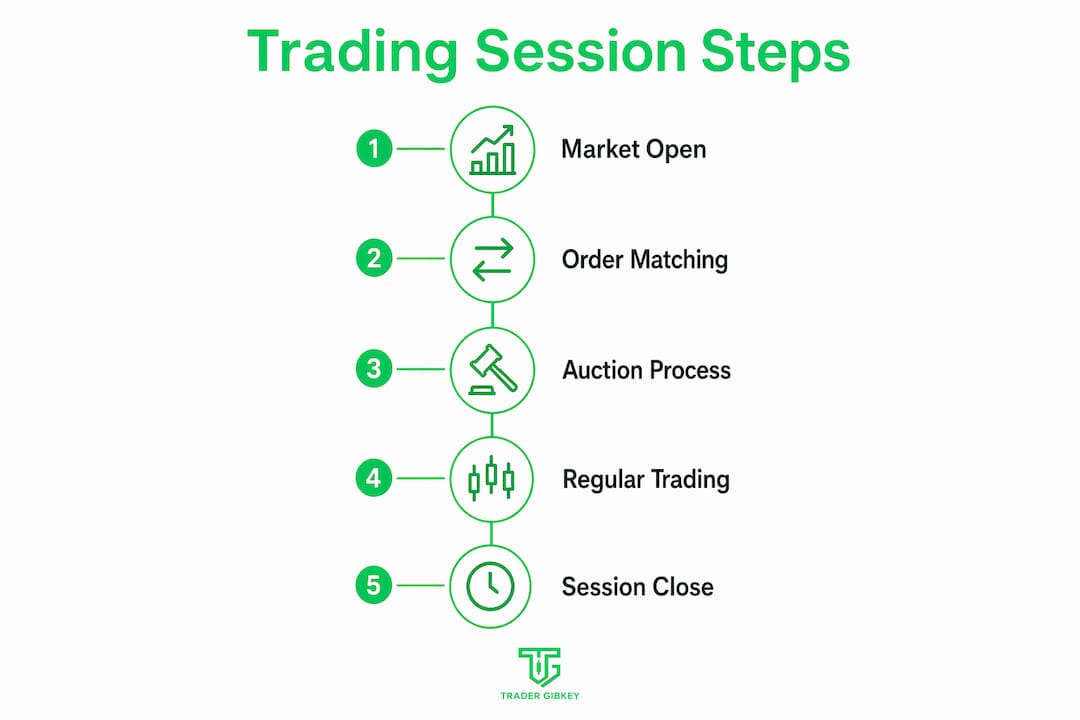
During the core session, a continuous matching engine processes orders in real time. Liquidity pools form as market participants come online, tightening spreads and improving fill quality. The more participants active in a session, the closer the bid-ask spread and the less slippage you experience on entries and exits.
Volatility follows a predictable intraday pattern in most markets:
- High at the open: News, overnight gaps, and institutional order flow create sharp moves.
- Calmer mid-session: Activity often dips in the early afternoon for U.S. stocks.
- Active into the close: Volume picks back up as funds rebalance and traders square positions.
Extended hours break this pattern. Thinner participation means wider spreads, larger price gaps on small orders, and less reliable price action. Extended-hours execution conditions differ enough from the regular session that experienced traders treat them as a separate regime entirely.
Pro Tip: If you are backtesting a strategy, filter your data to match the exact session hours you plan to trade. Mixing extended-hours data with regular-session data distorts your results and makes your edge look weaker or stronger than it actually is.
How trading sessions shape your strategy design
Knowing the trading session definition is one thing. Knowing how to use it in your strategy is what separates consistent traders from those who wonder why their backtests do not match live results.
Here is a practical framework for integrating session knowledge into your trading:
-
Match your backtest to your session. Aligning market data and signal generation to the same session hours preserves your statistical edge. A setup that works during the London session may fail during the Asian session because the volatility profile is completely different.
-
Execute in high-liquidity windows. The regular session is the most liquid and preferred window for high-confidence trades. Tighter spreads and deeper order books mean your entries and exits cost less.
-
Plan around the open and close separately. Session open and close auctions feature unique price dynamics. Many traders avoid placing market orders in the first five minutes of the NYSE open because the spread between intent and execution can be significant.
-
Size down in extended hours. If you trade pre-market or after-hours, use limit orders and reduce your position size. Extended sessions carry wider spreads and less liquidity, so your risk per trade is higher even if the dollar amount looks the same.
-
Select sessions that match your style. Forex traders who prefer session-specific volatility profiles pick one or two sessions to focus on rather than trading around the clock. A scalper may prefer the London open. A swing trader may focus on the New York session close.
Pairing this session awareness with solid chart setups gives you a much cleaner framework for deciding when to act and when to stay flat.
Pro Tip: Build a session schedule into your trading plan as a hard rule. Write down which hours you trade, which you observe only, and which you ignore completely. Traders who define their session boundaries in advance make fewer impulsive decisions outside their edge.
How do session overlaps create opportunities and risks?
Session overlaps occur when two major regional markets are open at the same time. These windows concentrate liquidity and often produce the sharpest, most tradable moves of the day.
The most significant overlap in forex is the London/New York window, which runs from approximately 8:00 a.m. to 12:00 p.m. ET. Both the European and North American sessions are active simultaneously, which means institutional banks, hedge funds, and retail traders from two continents are all placing orders at once. Volatility peaks during these overlaps, and major currency pairs like EUR/USD and GBP/USD tend to see their largest daily ranges during this four-hour window.
The Tokyo/London overlap is smaller but still relevant. It runs from roughly 3:00 a.m. to 4:00 a.m. ET and marks the transition from Asian to European participation. Pairs involving the Japanese yen or the euro often see a pickup in activity during this brief crossover.
Here is what overlaps mean in practice:
- Tighter spreads: More participants competing to fill orders compress the bid-ask spread.
- Stronger trends: Institutional order flow from multiple regions can sustain directional moves longer.
- Higher risk of reversals: The same concentration of activity that creates trends can also produce sharp, fast reversals when one session’s participants exit.
- Spread widening at session transitions: Right at the moment one session closes and another opens, spreads can temporarily widen before the new session’s liquidity fully arrives.
High-volatility overlaps require active risk management because price can move quickly against you. Some traders reduce size during overlaps. Others specifically target them because the moves are large enough to justify the risk. Understanding liquidity dynamics during these windows helps you decide which approach fits your strategy.
Key takeaways
Trading sessions define when markets are open, and aligning your strategy with session timing directly improves execution quality, backtest accuracy, and risk management.
| Point | Details |
|---|---|
| Core session definition | A trading session is the structured window when a market accepts and executes orders with live price discovery. |
| Session types vary by market | Stocks, forex, and futures each have distinct session hours; forex runs 24 hours across three regional sessions. |
| Mechanics shape execution | Opening and closing auctions set reference prices; liquidity and spreads improve during peak session hours. |
| Strategy must match session | Backtests, entries, and risk controls should be calibrated to the specific session you trade, not generic market hours. |
| Overlaps amplify activity | London/New York overlap produces the highest forex volatility; use reduced size or defined rules to manage the risk. |
Why session timing is the most underrated edge in trading
After 18 years in live markets, the single most common mistake I see from traders at every level is ignoring session context. They find a setup, they take the trade, and they never ask: is this the right time of day for this setup to work?
The open is not the same as mid-session. The Asian session is not the same as the London session. I have watched traders blow up perfectly good strategies simply because they ran them at the wrong time of day. The setup was valid. The session was wrong.
What I have found works is treating session timing as a filter, not an afterthought. Before I place any trade, I know exactly which session I am in, whether I am near an open or close, and whether I am in an overlap window. That context changes my position size, my stop placement, and sometimes whether I take the trade at all.
Extended hours are where I see the most damage done. Traders see a big move in pre-market, chase it, and get caught in a spread that eats their edge before the regular session even opens. The move was real. The execution conditions were not suitable for their strategy.
Session discipline is not glamorous. It does not show up on a highlight reel. But it is one of the most consistent ways I know to protect your capital and keep your decision quality high. If you want to go deeper on applying real market tactics with session awareness built in, that is where the real edge lives.
— Gabriel
Take your session strategy further with Tradergibkey
Understanding trading sessions is the foundation. Knowing exactly how to apply that knowledge to live trades, across forex pairs and timeframes, is where most traders need structured guidance. Tradergibkey’s courses and mentorship programs are built around practical, session-aware strategies developed over 18 years of live market experience. You get a clear framework for timing entries, managing risk around session transitions, and building consistency. The community gives you a place to ask questions and refine your approach with traders who are doing the same work. If you are ready to trade with more structure and less guesswork, start here.
FAQ
What is a trading session in simple terms?
A trading session is the time window when a financial market is officially open for buying and selling. For U.S. stocks, that is 9:30 a.m. to 4:00 p.m. ET on weekdays.
Do forex markets have trading sessions?
Yes. Forex runs 24 hours but is organized into three regional sessions: Asian (Tokyo), European (London), and North American (New York), each with distinct liquidity and volatility characteristics.
Why does session timing matter for strategy?
Session timing affects spread width, order fill quality, and volatility patterns. Strategies backtested and executed within the same session hours produce more reliable results than those run across mixed session data.