
Most traders assume a trading group is just a Discord server where someone pastes buy and sell signals. That assumption keeps a lot of people stuck. A trading study group is something fundamentally different. It is a structured, feedback-driven learning environment where traders review concepts, analyze real trades, and build skills together over time. If you have been grinding through charts alone and wondering why progress feels slow, understanding what a trading study group actually is could change how you approach your education entirely.
Table of Contents
- Key Takeaways
- What a trading study group actually is
- The real benefits of joining a trading study group
- Cohort models vs. ongoing groups
- What to expect when you join
- How study groups differ from chatrooms and signal services
- My honest take on trading study groups
- Take your trading further with Tradergibkey
- FAQ
Key Takeaways
| Point | Details |
|---|---|
| Structured learning format | A trading study group uses scheduled sessions, trade reviews, and feedback loops, not passive signal feeds. |
| Accountability drives consistency | Regular trade submissions and group feedback reduce impulsive decisions and build lasting discipline. |
| Cohort vs. ongoing models | Cohort programs run 12 to 14 weeks with defined milestones; ongoing groups offer continuous mentorship access. |
| Trade review is the core mechanic | Sharing full trade rationale, not just outcomes, helps members identify blind spots and improve decision quality. |
| Commitment is non-negotiable | Expect 1.5 to 3 hours per week of calls, journaling, and homework to see meaningful progress. |
What a trading study group actually is
A trading study group is a structured, group-based learning format where traders review concepts and trades together rather than passively following chat feeds. That distinction matters more than it sounds.
Think of it like the difference between sitting in a lecture hall and working through problem sets with a study team. One is passive consumption. The other forces you to think, explain, and defend your reasoning. That active engagement is where real learning happens.
Here is what a well-run trading study group typically includes:
- Weekly live coaching calls where a mentor or lead trader walks through current market conditions, setups, and concepts
- Trade review channels or sessions where members submit their own trades, including the setup, entry, exit, and rationale, for group feedback
- Structured onboarding phases that sequence skill building so newer traders are not thrown into advanced concepts before they have the foundation
- Homework and journaling assignments that reinforce what was covered in sessions and build the habit of reviewing your own process
- Feedback loops where the same concepts are revisited across multiple weeks so understanding deepens over time
Some programs use a 90-day onboarding framework to help new members build a base before expanding into more complex strategies. That kind of sequencing is intentional. It prevents the common trap of jumping between setups before mastering any of them.
Pro Tip: Before joining any group, ask whether they have a defined curriculum and a structured onboarding process. If the answer is vague, you are probably looking at a chatroom with a membership fee.
The contrast with signal services is sharp. A signal service tells you what to trade. A study group teaches you why a trade makes sense, when it does not, and how to evaluate your own decisions going forward. One creates dependency. The other builds competence.
The real benefits of joining a trading study group
Solo trading education has a serious flaw. You can read every book, watch every YouTube video, and still reinforce the same bad habits for years because nobody is there to catch them. Self-directed trading education often fails to provide timely corrective feedback, which means traders often get better at doing the wrong things more confidently.
Trading study groups fix that problem in a few specific ways.
- Accountability through trade submissions. When you know your trades will be reviewed by a group, you think more carefully before entering. That pause alone reduces impulsive decisions.
- Blind spot identification. You cannot see what you cannot see. When another trader or coach reviews your full trade rationale, they often spot patterns in your thinking that you have been blind to for months.
- Learning from collective mistakes. Group coaching exposes traders to a wider range of errors and patterns than any individual could encounter alone. Watching someone else make a mistake you have not made yet is one of the most efficient forms of learning available.
- Structured feedback prevents bad habit reinforcement. Instead of guessing whether your approach is sound, you get direct, specific feedback tied to your actual trades.
“The most significant value in a trading study group comes from reviewing the full trade decision process, not just whether a trade won or lost. Feedback focused on process over outcomes is what actually changes behavior.”
The data on retail trading outcomes makes the case even more clearly. A majority of retail traders lose money according to regulated broker disclosures, which points directly to the gap between entering markets and being genuinely prepared for them. Structured education closes that gap faster than solo study.
Cohort models vs. ongoing groups

Not every trading study group is built the same way. Understanding the two main formats helps you pick the right fit for your goals and schedule.
Cohort-based programs have defined start dates, fixed durations, and a curriculum that progresses in sequence. Some programs start on the first Monday of each month and run 12 to 14 weeks, combining formal training sessions with homework and live trading practice. The advantage here is focus. You move through material with a group at the same pace, which creates natural accountability and reduces the temptation to skip ahead.
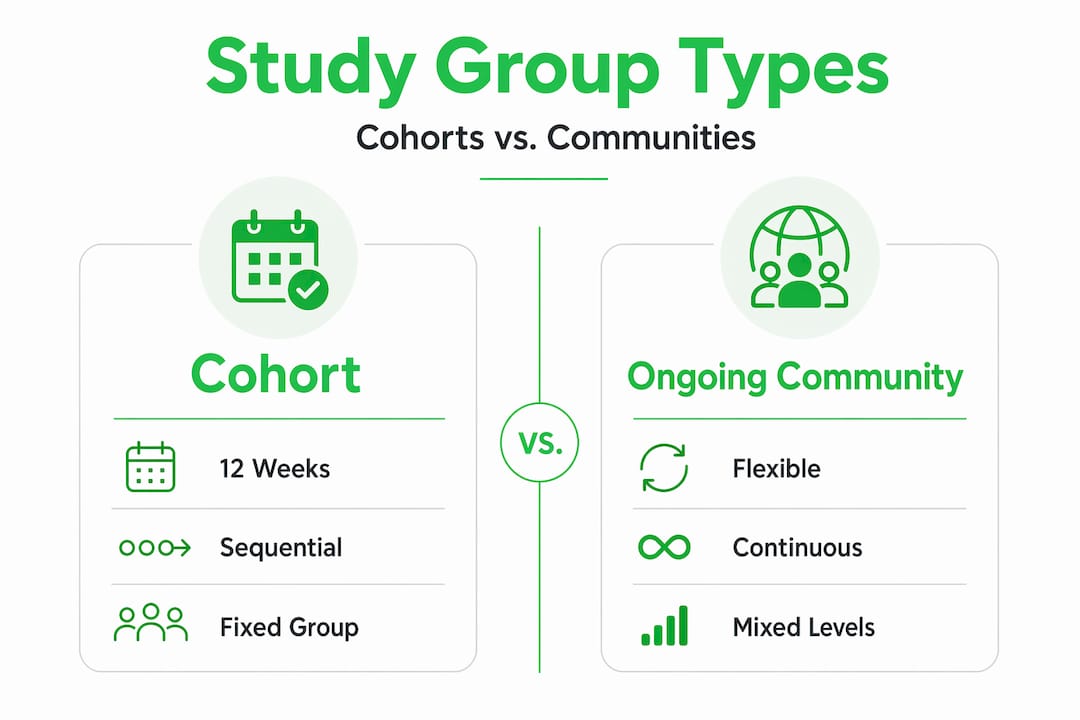
Cohort-based structures reduce decision fatigue by defining clear milestones. You know exactly where you are in the learning path and what comes next. That clarity is underrated.
Ongoing community groups work differently. Access is continuous, sessions happen on a regular schedule, and members at different experience levels interact in the same space. The benefit is long-term mentorship. You are not locked into a 12-week window. The trade-off is that without personal discipline, the open-ended format can lead to passive participation.
| Format | Duration | Best for | Key trade-off |
|---|---|---|---|
| Cohort-based | 12 to 14 weeks | Beginners building foundations | Fixed timeline may not suit all schedules |
| Ongoing community | Continuous | Traders wanting long-term mentorship | Requires self-discipline to stay engaged |
| Hybrid model | Cohort entry, ongoing access | Traders who want structure plus continuity | Higher commitment level required |
Pro Tip: If you are newer to trading, start with a cohort model. The defined timeline and sequenced curriculum give you structure when you need it most. You can always move into an ongoing community group afterward.
Having a clear agenda and planned coverage is what separates a real study group from a social meet-up. If there is no agenda, there is no consistent value.
What to expect when you join
Knowing what to expect in a trading group before you join saves you from frustration and sets you up to get the most out of the experience. Here is a realistic picture.
-
Expect a time commitment of 1.5 to 3 hours per week. This covers live coaching calls, trade journaling, homework review, and any async feedback channels. That is not a huge ask, but it does require consistency. Missing sessions regularly means missing the feedback loops that drive progress.
-
Expect to submit your trades for review. This is the part that makes most traders uncomfortable at first. Sharing a losing trade with a group feels exposing. That discomfort is exactly the point. The feedback you receive on a bad trade is worth more than a dozen winning trades you never analyzed.
-
Expect a growth mindset to be required. If you come in defensive about your current approach, the group dynamic will not help you. The traders who progress fastest are the ones who treat every piece of feedback as data, not judgment.
-
Expect trade journaling to be non-negotiable. Successful trading study groups emphasize repeating routines like journaling, reviewing plans after trade sets, and mastering a limited number of setups before expanding. Journaling is not busy work. It is how you track whether your thinking is improving over time.
-
Expect to be held accountable. Accountability in trading groups helps members resist impulsive decisions and builds the discipline needed for consistent execution. That accountability is a feature, not a burden.
Pro Tip: Treat your first 30 days in any study group as an observation period. Focus on absorbing the feedback culture before worrying about whether your trades are being judged.
How study groups differ from chatrooms and signal services
This distinction is worth being direct about because confusing casual trading communities with structured study groups is one of the most common reasons traders stagnate. They join something that looks like education but functions like entertainment.
Here is how the formats actually differ:
- Chatrooms are reactive and unstructured. Conversations follow market noise. There is no curriculum, no feedback loop, and no accountability. You can spend months in a chatroom and leave with no measurable improvement in your trading process.
- Signal services tell you what to trade without explaining why. They create dependency and do nothing to build your ability to read the market independently. When the signals stop, so does your edge.
- Trading study groups are explicitly not chatrooms or signal services. They are built around coaching, curriculum, and trade review. The goal is to make you a better trader, not to give you fish.
The core difference comes down to process versus outcome. Signal services optimize for outcomes. Study groups optimize for the process that produces good outcomes consistently. Structured learning and feedback loops shift traders from reactive to analytical thinking. That shift is what actually produces long-term consistency.
University-based groups like the Leeds Investment and Trading Group at the University of Colorado Boulder show that this model works across contexts. They use simulated trading events and structured discussion to build financial literacy. The format is the same whether you are a college student or a retail Forex trader. Structure and feedback drive learning.
My honest take on trading study groups
I have watched traders grind through years of solo study, reading every book, testing every indicator, and still showing up to the market running on guesswork. Then I have seen those same traders join a structured group and start making real progress within weeks. Not because the group gave them some secret strategy. Because someone finally told them, specifically, what their thinking was getting wrong.
The truth is that most traders do not have a strategy problem. They have a feedback problem. They are making decisions in a vacuum and calling it independence. Real independence in trading comes from building a process that holds up under review. You cannot do that without outside eyes on your work.
What I have also seen is traders join the wrong kind of group and come away more confused than when they started. They paid for access to a chatroom, got a flood of other people’s opinions, and mistook noise for education. That is not a study group. That is a distraction with a subscription fee.
If you are going to invest time and money into a trading community, hold it to a standard. Does it have a curriculum? Does it review your actual trades? Does someone give you specific feedback on your decision-making? If the answer to any of those is no, keep looking.
— Gabriel
Take your trading further with Tradergibkey
If this article has you thinking seriously about finding a structured trading study group, Tradergibkey is worth a close look.
Tradergibkey offers live coaching and trade review built around the same principles covered here: structured curriculum, real feedback on real trades, and a community designed to build consistency rather than dependency. With over 18 years of live market experience behind the teaching, the focus is on practical price action strategies that hold up in actual market conditions, not theoretical frameworks that fall apart when real money is on the line. Whether you are newer to Forex or looking to sharpen a process that has stalled, the structured learning paths at Tradergibkey are designed to meet you where you are and move you forward.
FAQ
What is a trading study group?
A trading study group is a structured, group-based learning environment where traders review concepts, analyze real trades together, and receive feedback on their decision-making process. It is distinct from chatrooms or signal services because it includes a defined curriculum, scheduled coaching sessions, and accountability mechanisms.
Why join a trading study group instead of learning alone?
Solo trading education rarely provides corrective feedback in time to prevent bad habits from forming. A trading study group gives you outside perspective on your actual trades, exposes you to collective mistakes, and holds you accountable in ways that self-study simply cannot replicate.
How much time does a trading study group require?
Most trading study groups ask for 1.5 to 3 hours per week, covering live coaching calls, trade journaling, and homework. Consistency matters more than total hours. Missing sessions regularly breaks the feedback loops that drive improvement.
What is the difference between a cohort group and an ongoing trading community?
A cohort-based group runs for a fixed period, typically 12 to 14 weeks, with a sequenced curriculum and defined milestones. An ongoing community offers continuous access and longer-term mentorship. Cohort models suit beginners who need structure; ongoing groups suit traders looking for sustained coaching.
How do I know if a trading study group is legitimate?
Look for a defined curriculum, structured trade review sessions, and specific feedback on your decision-making process. Legitimate groups are not chatrooms and do not rely on signals. If a group cannot clearly explain how it will improve your trading process, it probably will not.