
Risk management trading is the structured system of rules and controls traders use to limit losses, protect capital, and stay in the game long enough to profit. It covers position sizing, stop-loss orders, daily loss limits, and drawdown controls working together as a layered defense. The 1% risk rule is the most widely used starting point: never risk more than 1% of your account on a single trade. On a $50,000 account, that caps your max loss per trade at $500. Get this system right, and profitability follows naturally. Ignore it, and even the best strategy will eventually wipe you out.
What is risk management in trading?
Risk management in trading is the practice of controlling how much capital you expose to loss on any single trade, any single session, and across your entire portfolio. The industry term is “trade risk control,” and it operates across four distinct layers: position sizing, stop-loss placement, daily loss limits, and drawdown management.
Each layer serves a specific purpose. Position sizing determines how large a trade you take. Stop-loss orders define the exact price where you exit a losing trade. Daily loss limits cap how much you can lose in one session. Drawdown management governs how you scale back after a string of losses. Together, these layers prevent any single bad decision from becoming a catastrophic event.

The core benefit is survival. Traders using daily loss limits maintain drawdowns 34% lower than those who trade without them. Lower drawdowns mean you stay in the market longer, which is the only way compounding works in your favor.
What are the core components of risk management in trading?
Position sizing
Position sizing is the calculation that determines how many units or lots you trade based on your account size and how much you are willing to lose. The formula is straightforward:
Position Size = (Account Size × Risk %) ÷ Stop Distance
This position sizing formula standardizes your risk regardless of market volatility. If your stop is wider on a volatile day, your position size shrinks automatically. If your stop is tight, your size increases. The math keeps your dollar risk constant even when market conditions change.
Stop-loss placement
A stop-loss order is a pre-set exit point that closes your trade automatically when price moves against you by a defined amount. The most common mistake traders make is placing stops at round numbers or too close to entry, where normal market noise triggers them before the trade has a chance to develop.
Professionals place stops beyond a structural level: below a swing low for long trades, above a swing high for short trades. That placement reflects where the trade idea is actually wrong, not just where you feel uncomfortable.
Reward-to-risk ratio
Every trade you take should offer a minimum 1:2 reward-to-risk ratio. For every $1 you risk, you target at least $2 in profit. This ratio means you can be wrong 50% of the time and still come out ahead. Drop below 1:2 consistently, and you need an unrealistically high win rate just to break even.
Daily loss limits
Set a hard daily loss limit of 2–3% of your account. When you hit it, you stop trading for the day. Full stop. This rule exists because losses trigger emotional responses that degrade your decision quality. Once you are down 2–3%, your brain stops trading the chart and starts trading the pain.
Pro Tip: Write your daily loss limit on a sticky note next to your monitor. Physical reminders create a pause between the impulse to keep trading and the action of placing another order.
How does risk management trading differ between professional and retail traders?
The gap between professional and retail traders is not strategy. It is mindset. Institutional traders prioritize strict risk execution over strategy perfection. Retail traders do the opposite: they chase perfect entries and treat risk controls as optional.
Here is how that plays out in practice:
- Professionals define risk before entry. They know their stop, their size, and their target before they click buy or sell. Retail traders often size up based on conviction and set stops as an afterthought.
- Professionals manage portfolio heat. They track total exposure across all open trades, not just individual positions. The correlation trap is a real danger: multiple positions reacting the same way to one news event can blow through your daily limit in minutes. Portfolio heat limits of 5–10% prevent that kind of compound failure.
- Professionals handle tilt with hard rules. When a professional hits their daily loss limit, they close the platform. No exceptions. Retail traders tend to override their own rules when emotions run high, which is exactly when the worst trades get placed.
- Professionals separate decision quality from outcomes. A well-managed losing trade is a success. A poorly managed winning trade is a failure. That reframe takes time to internalize, but it is the foundation of consistent performance.
“Profitability is the result of disciplined risk control, not strategy perfection.” This is the single most important shift a retail trader can make.
What practical steps can traders take to implement risk management trading?
Here is a step-by-step process you can apply starting with your next trade.
Step 1: Set your risk percentage. Start at 1% of your account per trade. On a $10,000 account, that is $100 maximum loss per trade. Do not adjust this upward until you have at least three months of consistent execution.
Step 2: Calculate your position size. Use the formula: Position Size = (Account Size × Risk %) ÷ Stop Distance. If your stop is 50 pips and you are risking $100, your position size is $2 per pip. This keeps your dollar risk fixed regardless of where you place your stop.
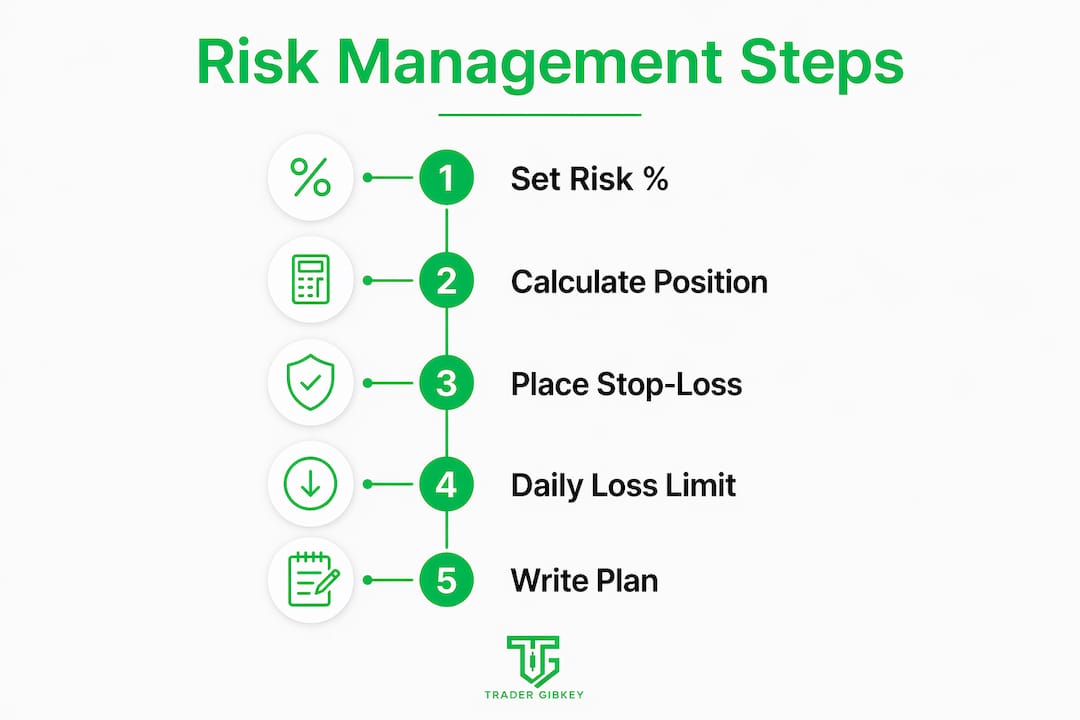
Step 3: Place your stop-loss before you enter. Decide where the trade is wrong before you decide where you want to enter. This reverses the typical retail sequence and forces you to think about risk first.
Step 4: Set a daily loss limit and honor it. A 2–3% daily limit is the standard. When you hit it, close your platform and step away. Hard-stop protocols that include closing the platform after hitting daily limits are the most effective way to prevent revenge trading.
Step 5: Write your risk rules into a trading plan. Rules that exist only in your head get broken under pressure. A written trading plan creates accountability and gives you something to review after every session.
Here is a quick reference for how risk scales with account size:
| Account Size | 1% Risk Per Trade | 2% Daily Loss Limit |
|---|---|---|
| $5,000 | $50 | $100 |
| $10,000 | $100 | $200 |
| $25,000 | $250 | $500 |
| $50,000 | $500 | $1,000 |
Pro Tip: After any losing session, review your trades for process, not just outcome. Ask whether you followed your rules, not whether the market moved against you.
What are advanced considerations and common mistakes in risk management trading?
Once you have the basics in place, these are the areas where traders most often undermine their own system.
- Moving stops to breakeven too early. Professionals wait until price reaches at least a 1:1 reward-to-risk ratio before adjusting stops. Moving to breakeven at the first sign of profit gets you stopped out by normal market noise, turning a valid trade into a zero.
- Ignoring correlated positions. If you are long EUR/USD, GBP/USD, and AUD/USD at the same time, you are not in three trades. You are in one trade with three times the size. Track your total portfolio exposure and keep it within your heat limit.
- Scaling back after drawdowns. When your account drops 5%, reduce your risk per trade to 0.75%. At 10% drawdown, drop to 0.5%. At 20%, drop to 0.25%. This graduated reduction protects what is left and prevents a bad streak from becoming a full account wipeout.
- Emotional overrides. Risk management is 80% psychological discipline and only 20% math. The calculations are simple. Executing them when you are frustrated, excited, or on a losing streak is the hard part.
- Poor journaling. Traders who do not track their trades cannot identify patterns in their mistakes. A basic journal with entry, stop, target, and outcome is enough to spot where your risk discipline breaks down.
The common retail trading traps almost always trace back to one of these five mistakes. Fix them systematically, and your results will reflect it.
Key takeaways
Effective risk management trading is the foundation of long-term profitability: position sizing, stop-loss discipline, and daily loss limits work together to protect capital and keep emotions in check.
| Point | Details |
|---|---|
| The 1% rule | Never risk more than 1% of account equity on a single trade to survive losing streaks. |
| Position sizing formula | Use (Account Size × Risk %) ÷ Stop Distance to standardize risk across all market conditions. |
| Daily loss limits | Cap daily losses at 2–3% and close the platform when you hit the limit to prevent revenge trading. |
| Reward-to-risk ratio | Maintain a minimum 1:2 ratio so you profit even with a win rate below 50%. |
| Psychology over math | Risk management is 80% discipline; execution failures come from emotions, not bad calculations. |
Why risk management is the only edge that compounds
After 18 years in live markets, I can tell you that the traders who survive long enough to become consistently profitable share one trait. They are obsessed with not losing, not with winning.
Most traders spend their first years hunting for the perfect strategy, the perfect indicator, the perfect entry. I did the same thing. What changed everything for me was realizing that a mediocre strategy with excellent risk management beats a brilliant strategy with poor risk control every single time. The math is unforgiving. A 50% drawdown requires a 100% gain just to get back to even. Protect the account first, and the profits take care of themselves.
The psychological piece is where most traders fall apart, and I say that with empathy because I have been there. When you are on a losing streak, your brain runs a different operating system. It wants to recover the loss immediately. That urgency is the enemy of good decision-making. Hard rules, written down and committed to before the session starts, are the only reliable defense against that state.
If you take one thing from this article, let it be this: your job as a trader is not to make money today. Your job is to still be trading six months from now. Risk management is how you do that.
— Gabriel
Take your risk management further with Tradergibkey
Understanding the framework is the first step. Applying it consistently under live market pressure is where most traders need real support.

Tradergibkey offers structured trading courses and mentorship built around exactly this: practical risk management, price action strategy, and the psychological discipline to execute your plan when it counts. With over 18 years of live market experience behind every lesson, the focus is on what actually works, not what sounds good in theory. Join a community of traders who are building real skills, protecting real capital, and developing the confidence that comes from knowing your risk is always under control.
FAQ
What is the 1% rule in trading?
The 1% rule means you never risk more than 1% of your total account equity on a single trade. On a $50,000 account, that limits your maximum loss per trade to $500.
How do daily loss limits protect traders?
Daily loss limits cap how much you can lose in one session, typically 2–3% of your account. Traders who use them maintain drawdowns 34% lower than those who trade without them.
Is risk management more important than trading strategy?
Yes. Profitability results from disciplined risk control, not strategy perfection. A consistent risk system keeps you in the market long enough for any solid strategy to produce results.