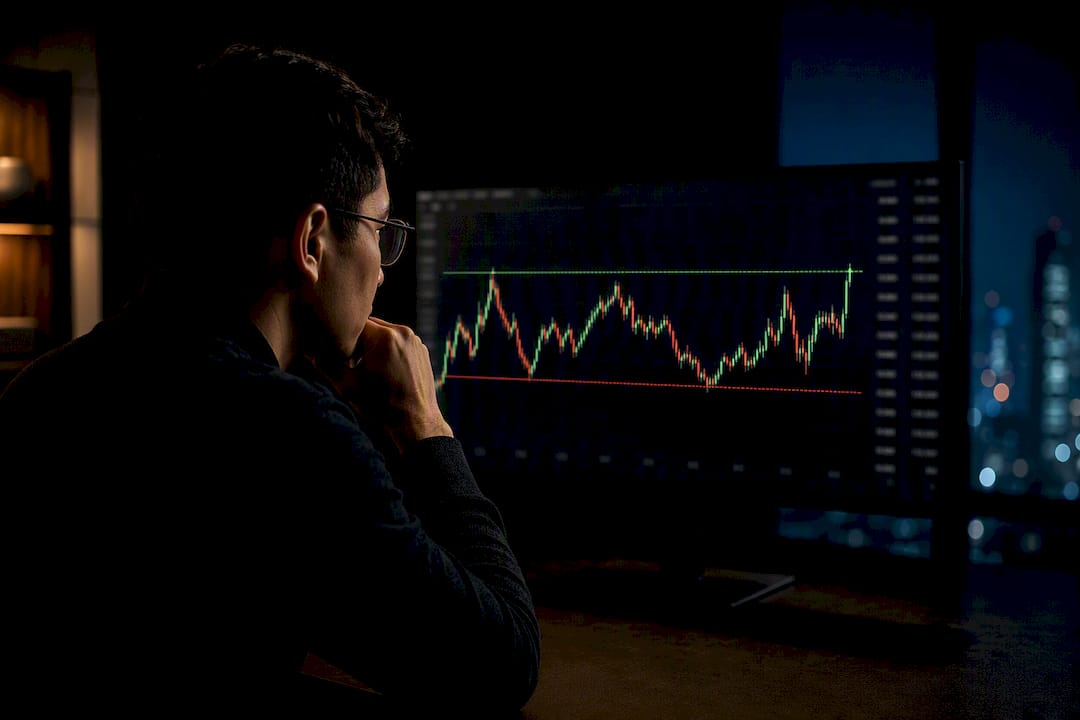
The Asian range is the high-low box formed while Tokyo, Singapore, and Sydney trade, and it gives you two clean setups: fade the edges when the box holds, or trade the breakout once London sweeps the liquidity resting there. Most traders run this on 15 to 30 minute charts, watching a fixed window like 22:00 to 06:00 GMT. Know your setup type before the box even closes.
TL;DR:
- The Asian range is most reliable for USD/JPY and JPY crosses, which produce the tightest and most orderly boxes, especially during quiet nights.
- Using the default 22:00 to 06:00 GMT session window and confirming platform time accuracy is crucial for consistent backtesting and reliable setup execution.
- Fade trades work best in tight Asian ranges with no imminent news, whereas wider or volatile ranges often benefit from breakout strategies confirmed by momentum signals.
- Anchoring entries with volume-weighted average price and ATR-based stops enhances effectiveness and helps avoid false breakouts.
- Consistent journal recording, strict adherence to a cancel-by time, and disciplined risk management are essential for turning Asian range trading into a repeatable edge.
Table of Contents
- What Is the Asia Range in Forex, and Why Does It Matter?
- Nailing Down Asian Session Timing on Your Charts
- Which Pairs Actually Respect the Asian Range?
- Two Repeatable Ways to Trade the Box
- Indicators That Actually Earn Their Chart Space
- Your Risk and Execution Checklist
- How Trader Gibkey Traders Journal the Asian Range
- Why Discipline Beats the Setup Itself
- Get Direct Feedback on Your Asian-Range Setups
- Sources
What Is the Asia Range in Forex, and Why Does It Matter?
The Asian range is simply the highest high and lowest low printed during the Tokyo trading window, plotted as a box with a mid-range line splitting it in half. Because Asian trading hours carry less volatility than London or New York, price often chops between those two boundaries instead of trending, according to Investopedia’s breakdown of the three forex sessions.
That chop is not random. Orders pile up at the edges of the box as traders place stops and breakout entries around obvious levels, which turns the range into a magnet for later liquidity.
- Liquidity accumulates at the box edges, giving London and New York traders a target to sweep.
- The mid-range line often acts as a magnet during low-momentum stretches before a real breakout.
- The range is less reliable during holiday weeks, month-end flows, or when the box prints unusually wide, since thin liquidity distorts the high and low.
Nailing Down Asian Session Timing on Your Charts
Get the window wrong and every backtest you run afterward is worthless. The Asian session is commonly represented by Tokyo hours, running roughly 00:00 to 09:00 GMT from a UK vantage point, though brokers and chart providers define it differently, per CMC Markets’ guide for UK traders. A tighter 22:00 to 06:00 GMT window is also common among range traders looking to capture the full overnight session before London opens.
- Pick one definition (we default to 22:00 to 06:00 GMT) and write it into your trading journal so every backtest uses the identical window.
- Adjust for daylight saving twice a year. British Summer Time shifts your local clock but not GMT itself, so recheck your platform’s session settings each spring and fall.
- Confirm your broker’s server time against GMT before marking the box. A two-hour mismatch will hand you the wrong high and low every single day.
- Lock the session box on your charting platform using a fixed-time drawing tool or an automated script so you are not eyeballing candle boundaries by hand.
Our guide to trading sessions walks through overlap timing in more detail if you want the full weekly picture.
Which Pairs Actually Respect the Asian Range?
Not every pair compresses cleanly overnight, so picking the right ones matters as much as picking the right window.
- USD/JPY, AUD/JPY, and other JPY crosses tend to print the tightest, most orderly boxes because Tokyo flow dominates their price discovery.
- AUD/USD and NZD/USD compress well during the Sydney and early Tokyo hours, reflecting regional liquidity documented in the BIS report on Asia-Pacific FX markets, which shows onshore turnover in hubs like Hong Kong and Singapore climbing between 2013 and 2022.
- EUR/USD and GBP/USD still range overnight but often trade in a noticeably tighter overnight footprint than during London hours, since European desks are largely offline.
Pip range check: if your Asian box on EUR/USD or GBP/USD prints wider than roughly 40 to 50 pips on a quiet night, treat it with suspicion. An abnormally wide range often means a news event or thin-liquidity spike distorted the high or low, and fading that box is a low-quality trade.
Two Repeatable Ways to Trade the Box
You have two real options here, not five. Pick the one that matches the range’s character before you place a single order.
Mean reversion (the fade). This works best when the box is tight and orderly, with no news catalyst sitting on the calendar.
- Enter a limit order just inside the range edge rather than chasing price to the exact boundary.
- Set your stop just beyond the range high or low, adding a small buffer (often ATR-based) so a wick doesn’t tag you out.
- Target the mid-range line first, then the opposite edge if momentum carries through.
- Cancel any unfilled pending orders at London open. If the fade hasn’t triggered by then, the setup is dead. Sources describing this fade approach recommend exactly this cancel-by rule at London open to avoid getting run over by the session handoff.
Breakout / liquidity sweep (ICT-style). This fits wider, more volatile boxes or sessions where you suspect stops are sitting obvious.
- Watch for price to sweep beyond the Asian high or low, ideally with a wick that immediately rejects.
- Confirm the move with a market structure shift (MSS) or a clear momentum candle rather than trading the sweep blind.
- Enter either on the confirmation candle close or wait for a retest of the broken level for a tighter stop.
- Place your stop beyond the sweep’s extreme, not just beyond the original range, since liquidity hunts often overshoot before reversing.
Pro Tip: Avoid forcing a breakout trade into a major news release window. A liquidity sweep ahead of a data print is often just noise, not a genuine structure shift.
Choose the fade on tight, quiet ranges and the breakout on wider ones with a visible catalyst. Our breakout strategy guide and London session strategy piece both dig deeper into how the handoff between sessions plays out.
Indicators That Actually Earn Their Chart Space
You don’t need a cluttered chart to trade this well. A handful of tools, used correctly, cover almost every decision point.
- Session-range scripts like the FXN Asian Session Range indicator automatically draw the box and extend the high, low, and midline into London and New York, saving you from manual guesswork.
- ATR sizes your stop distance objectively instead of picking a round number that feels safe.
- VWAP gives you an intraday bias read, helping you decide whether the market favors longs or shorts once the box breaks.
- A basic momentum filter, even something as simple as a candle-close confirmation, cuts down on fakeout entries during the breakout approach.
Before any of this works, double check that your chart’s timezone matches your broker’s server time. A mismatched clock quietly ruins every session-box script you run, no matter how good the indicator is.
Your Risk and Execution Checklist
None of the setups above matter if your position sizing is sloppy. Build these controls into every trade before you touch the order ticket.
- Risk a fixed percentage of equity per trade, commonly 0.5% to 1%, and size your position using ATR rather than a flat lot count.
- Cap total daily exposure so a string of Asian-range trades doesn’t stack risk across correlated JPY or AUD pairs.
- Prefer limit orders for fades since market orders during thin overnight liquidity can slip badly.
- Set a hard cancel-by time for pending orders, and check spreads before entry. Wide spreads overnight are a signal to skip, not force, the trade.
- Backtest each rule set across 30 to 90 days minimum, then run a forward demo period before committing real capital.
| Checklist item | What to record |
|---|---|
| Session window used | Exact start/end time in GMT |
| Entry rule | Fade or breakout, with trigger condition |
| Stop size | Distance in pips or ATR multiple |
| Risk:Reward | Planned ratio before entry |
| Outcome | Win, loss, or scratch, with pips |
How Trader Gibkey Traders Journal the Asian Range
Gabriel has spent years applying price-action rules like these across live sessions, and the pattern holds: traders who skip the journal skip the learning. Watching how the box behaves matters less than tracking what you actually did with it.
- Record your chosen session window every single day, even when you skip the trade, so you can spot drift in your own decision making.
- Log entry rule used, stop size, R:R, and outcome, plus a one-line lesson while the trade is still fresh in your head.
- Track “edge touches” versus “filled orders” separately. A box edge that gets touched five times but only fills once tells you something about how that pair is being hunted that night.
- Leave a field open for adding your own backtest results or case studies as you accumulate sample size. Numbers mean more once you’ve logged 50 trades than after five.
Pro Tip: If your journal shows edges getting swept but never respected on a given pair, stop fading that pair overnight and switch it to your breakout watchlist instead.
Why Discipline Beats the Setup Itself
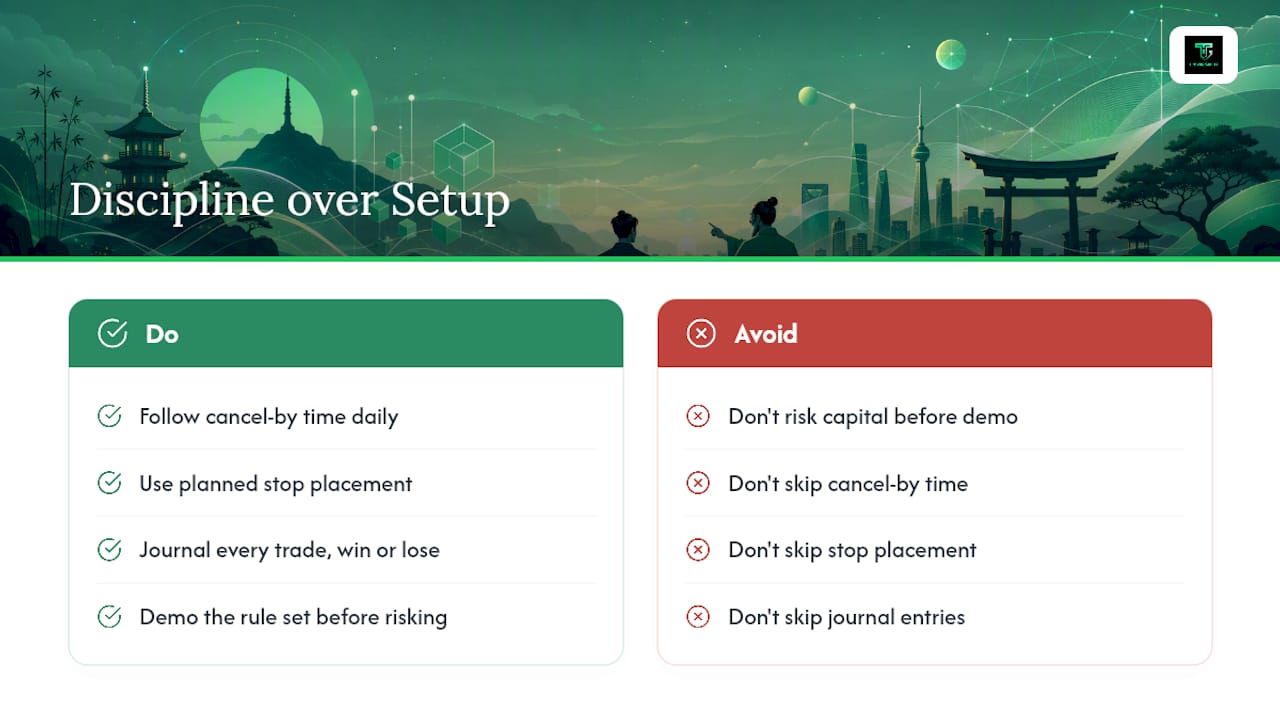
The Asian range works because it gives you a defined box with defined rules, not because either the fade or the breakout is inherently superior. What separates traders who profit from it is whether they actually follow the cancel-by time, the stop placement, and the journal entry every single day, win or lose.
Demo the rule set for a real stretch before risking capital, and write down every trade regardless of outcome. That habit, more than any indicator, is what turns this into a repeatable edge.
— Gabriel
Get Direct Feedback on Your Asian-Range Setups
Reading the rules is one thing. Getting someone to look at your actual charts and tell you why your fade got stopped out three nights running is another. Tradergibkey runs live-review mentorship built specifically around session-based strategies like this one, where Gabriel walks through real Asian-range setups, entry timing, and journal habits alongside traders working through the same 22:00 to 06:00 GMT window you just read about.
If you want your journal fields checked, your stop placement questioned, and your backtest held to an actual standard before you go live, that structured feedback is exactly what the Trader Gibkey mentorship program is built for. Book a session and bring your last ten Asian-range trades with you.
Sources
- Asian session forex time: a guide for UK traders (CMC Markets)
- Fx-brokers
- Foreign exchange markets in Asia and the Pacific (BIS)