
The highest-probability approach to trading London hours is running a London open breakout on a tight, well-defined Asian range, backed up by a London-New York overlap fade when that breakout stalls near a key level. Use the breakout when the Asian range is narrow and news is quiet. Switch to the overlap fade when price has already run hard into the London open and starts stalling against resistance or support during the New York handoff.
Here’s the rule set, stripped down to what you need before the session opens:
- Mark the range. Use the low-volatility Asian session (roughly 00:00 to 07:00 UTC) high and low as your breakout boundaries.
- Place OCO orders, not market orders, just above and below that range 15 to 30 minutes before London opens.
- Stop-loss goes at the opposite side of the range, or 1x ATR(14) from entry, whichever is tighter.
- Target 1 to 1.5x the range size, or scale out at the first major swing level.
- Cancel the unfilled order once one side triggers. Never let both legs sit live once price commits.
- Skip the setup entirely if a high-impact release lands within 30 minutes of the open; always check a reliable economic calendar for traders to stay informed.
Roughly 38% of global FX turnover happens during core London hours, which is exactly why this window rewards a breakout structure more than a scalp-and-hope approach. Paste that checklist into your trading journal tonight. You’ll use it tomorrow morning.
Key Takeaways
A disciplined London breakout, paired with strict range, volume, and news filters, consistently outperforms trading the session without any structure at all.
| Point | Details |
|---|---|
| Define the range first | Mark the Asian session high and low before placing any orders. |
| Use OCO, not market orders | Place pending buy-stop and sell-stop orders 15 minutes before the open. |
| Cancel the opposite leg | The instant one side fills, cancel the other to avoid a whipsaw fill. |
| Size stops with ATR | Use ATR(14) or the range midpoint, whichever produces the tighter stop. |
| Cap risk at 0.5% to 1% | Never risk more per trade regardless of how strong the setup looks. |
| Get structured guidance | Trader Gibkey’s mentorship and live sessions turn this checklist into a repeatable, coached skill. |
Where to Verify the Data Behind This Strategy
- BIS Triennial Survey: confirms London’s roughly 38% share of daily global FX turnover.
- Bank of England FX turnover survey: institutional liquidity context and 4pm fix behavior.
- Global Financial Centres Index: explains London’s institutional concentration.
- ForexFactory economic calendar: live release timing to filter fakeout risk.
This article is general information, not a substitute for advice from a qualified financial advisor. Consult a qualified financial professional about your own circumstances before acting on anything here.
Table of Contents
- What Makes the London Session Strategy So Reliable for Breakouts?
- When Does the London Open Breakout Actually Win?
- How Do You Execute the London Breakout Step by Step?
- Which Chart Setup Works Best for London Session Trading?
- How Much Should You Risk Per London Session Trade?
- Why Do London Breakout Trades Fail?
- Should You Automate Your London Breakout Orders?
- What Does a Repeatable London Session Routine Look Like?
- Learn London Session Trading With Structured Mentorship
- Sources
- FAQ
What Makes the London Session Strategy So Reliable for Breakouts?
London hours account for close to 38% of daily FX turnover, making it the single busiest window in the trading day. That volume doesn’t arrive gradually. It floods in within the first 30 to 60 minutes after the London open, which is why the session produces some of the cleanest directional moves you’ll see all week.
The mechanics are straightforward once you see them. The Asian session, running roughly midnight to 7:00 AM UTC (an hour earlier during British Summer Time), is thin. Fewer institutions are active, so price tends to coil inside a narrow range. When London desks come online, that coiled energy gets released fast. Institutional order flow rushes in, liquidity providers widen their books, and the range that held for six quiet hours often breaks in one direction with real conviction.
The second surge comes during the London-New York overlap, typically 12:00 PM to 4:00 PM UTC (adjusted for daylight saving), when both major sessions are trading simultaneously. This is where you’ll often see the largest single-hour ranges of the entire day, since EUR/USD and GBP/USD tend to print a disproportionate share of their daily range during these overlapping hours.
Not every quiet Asian range is worth trading, though. A tight, orderly range with low tick volume and no erratic wicks tells you compression is building. A choppy, wide range with spiky wicks in both directions usually means the market already made its decision overnight, and you’re late to it.
Pro Tip: Measure your Asian range in pips, not just visually. If it’s under 20-25 pips on EUR/USD, you’re looking at genuine compression. Anything wider than 40 pips has probably already done its breaking.
When Does the London Open Breakout Actually Win?
The London open breakout isn’t a strategy you run every single day with the same conviction. It has a sweet spot, and knowing when you’re in it separates traders who compound gains from those who bleed out on fakeouts.
The ideal setup stacks several conditions at once:
- A tight Asian range under 25-30 pips on majors, signaling real compression rather than indecision.
- No high-impact news scheduled within 30 minutes of the open. Check a live economic calendar every single morning, without exception.
- Rising tick volume in the 10-15 minutes before the open, a tell that institutional desks are already positioning.
- ATR expansion on the 15-minute chart relative to the prior day’s average, confirming volatility is picking up rather than flatlining.
Tuesday through Thursday tend to produce the cleanest breakouts. Monday often carries weekend gap noise, and Friday afternoons get thin as desks square positions before the close. That’s not a hard rule, but it’s a pattern worth tracking in your own journal over a few months.
Run this quick check before you place a single order: is the range tight, is the calendar clear, is volume climbing? Three yeses means you trade it. Any no means you sit the session out and wait for the overlap instead.
How Do You Execute the London Breakout Step by Step?
This is where most guides get vague and traders get burned. Precision here is what separates a repeatable edge from a coin flip.
1. Define your setup window. Use the Asian session, roughly 00:00 to 07:00 UTC (23:00 to 06:00 UTC during British Summer Time offsets, so double-check your platform’s timestamp). Mark the highest high and lowest low that printed during that window on your 15-minute chart. This becomes your breakout box.
2. Choose your entry style. There are three ways to play this, and each carries a different risk profile.
- Aggressive first-break entry: you buy or sell the instant price closes beyond the range boundary. Fastest into the move, but most exposed to fakeouts.
- Retest entry: you wait for price to break, then pull back to retest the broken level before entering. Fewer false signals, but you’ll miss some of the fastest runners.
- Conservative OCO pending orders: you place a buy-stop above the high and a sell-stop below the low simultaneously, 10 to 15 minutes before the open, and let the market pick its direction. This is the method Trader Gibkey teaches most often, because it removes the emotional trigger-pulling entirely.
**3. Practitioner methodology consistently favors ATR-based sizing because it adapts to that day’s actual volatility instead of a fixed pip count that might be too tight on a wild day and too loose on a calm one.
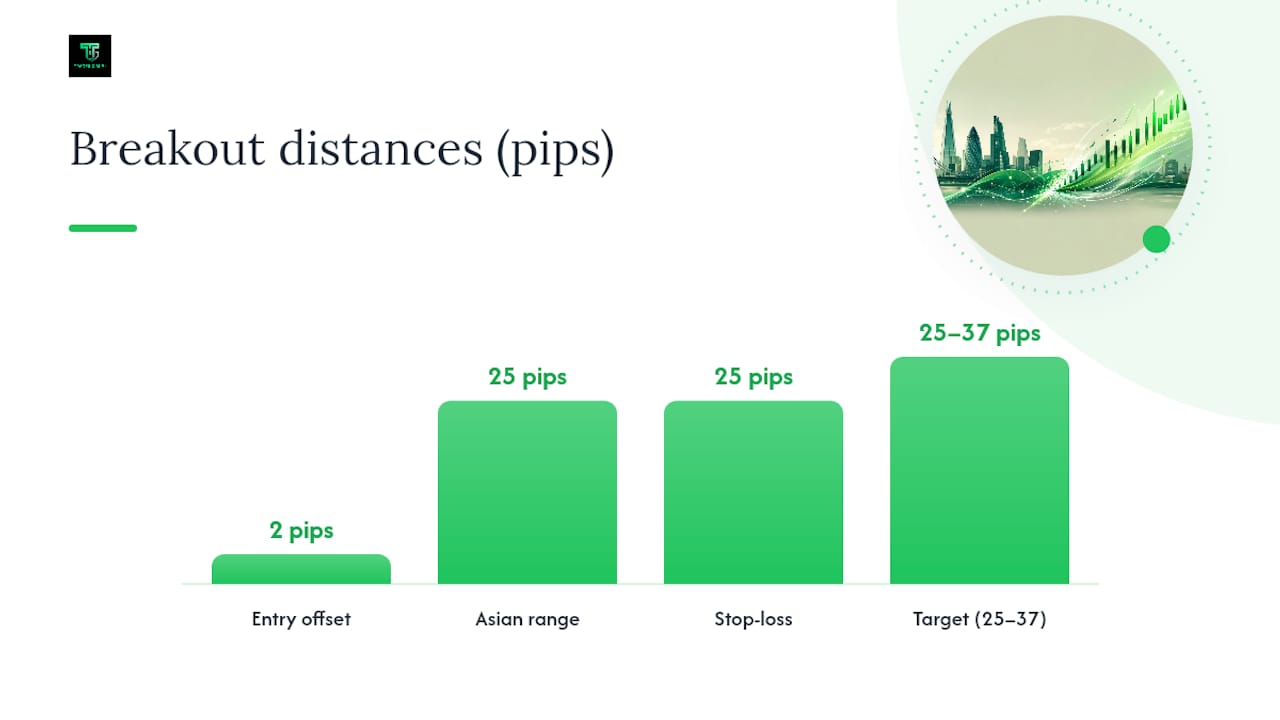
**4. If your range was 25 pips, you’re targeting 25 to 37 pips on the breakout leg.
5. Cancel the opposite order the moment one side fills. This step is the one traders forget most often, and it’s costly. If your buy-stop triggers, your sell-stop needs to cancel immediately, either through your broker’s native OCO function or manually within seconds. Leaving both live risks a whipsaw filling both directions in a fast market.
Here’s a worked example using EUR/USD, with all numbers rounded for clarity:
| Element | Value |
|---|---|
| Asian range | 25 pips range |
| Buy-stop order | 2 pips above high |
| Sell-stop order | 2 pips below low |
| Stop-loss (if buy fills) | 25 pips |
| Target (1x range) | 25 pips |
| Account risk | $25,000 account, $125 to $250 risk |
| Position size | risk divided by stop-loss pips determines lot size |
If both orders somehow fill within seconds of each other, which can happen during a violent spike, close the losing side immediately and manage the winning position per your normal rules. Don’t average the two into a synthetic straddle. That’s not a strategy, that’s an accident you’re rationalizing after the fact.
Which Chart Setup Works Best for London Session Trading?
Your chart layout should make the decision easy before you even reach for the mouse. Overcomplicating this is one of the fastest ways to hesitate into a missed entry.
Run your entries off the 5-minute or 15-minute chart, and check the 1-hour chart for broader trend context before you commit. If the 1-hour trend contradicts your breakout direction, treat the setup with more caution, not blind confidence.
Your indicator stack should stay lean:
- VWAP (Volume-Weighted Average Price) to gauge whether price is trading at a premium or discount relative to the session’s average.
- EMA 5, 10, and 20 on the entry timeframe, watching for alignment (5 above 10 above 20 for bullish momentum, reversed for bearish).
- ATR(14) to size your stop-loss dynamically rather than guessing a fixed pip value.
- RSI with a 50-level filter, using readings above 50 to favor long breakouts and below 50 to favor short ones, rather than chasing overbought or oversold extremes.
For layout, draw a vertical line at your local London open time and shade the Asian range as a rectangle box directly on the chart, so the breakout boundaries are visually obvious the second price approaches them. Most modern platforms let you save this as a template, and pairing it with pre-built OCO order templates means you’re not manually typing price levels while the market is already moving. Set price alerts 3 to 5 pips inside each boundary so you get a heads-up before the actual breakout, not after.
How Much Should You Risk Per London Session Trade?
Position sizing is where discipline either holds or collapses, and it’s the single most controllable variable in this entire strategy.

On a $25,000 account, that’s $125 to $250 at risk, full stop, regardless of how confident the setup looks. If your stop-loss is 20 pips based on ATR, and you’re risking $150, you divide $150 by 20 pips to get your dollar-per-pip value, then size your lots accordingly. Most trading platforms include a position-size calculator, so use it every single time instead of eyeballing lot sizes.
ATR(14) should be recalculated fresh each morning before the open, since volatility shifts week to week. A stop that made sense last Tuesday might be too tight this Thursday if ATR has expanded.
Trade management matters as much as entry. If the trade hasn’t reached your first target within 90 minutes of entry, consider closing it manually. Range-breakout methodology generally treats a stalled session trade as a signal the original thesis has weakened, not an invitation to widen your stop and hope.
Pro Tip: Set a hard daily loss limit, two consecutive stopped-out trades and you’re done for the session. This isn’t about the money on any single trade. It’s about the version of you that starts revenge trading after the second loss.
Deeper risk management rules apply just as much here as they do on any other session, so don’t treat London hours as an exception to your normal sizing discipline just because volume is higher.
Why Do London Breakout Trades Fail?
Most failed London breakouts trace back to one of a handful of repeatable mistakes, and every single one is fixable once you can name it.
- Entering before the range is confirmed, jumping in on a mid-session Asian wick instead of waiting for the full range to complete.
- Ignoring the volume filter, trading a breakout that has price movement but no real participation behind it, which is a classic setup for a liquidity sweep that reverses hard.
- Trading straight into the 4:00 PM London fix, when institutional book-balancing creates erratic, low-signal price action that has nothing to do with your setup.
- Holding a session trade into the weekend, exposing yourself to gap risk your stop-loss can’t actually protect against.
If your win rate drops over a stretch of weeks, don’t blame the strategy outright. Tighten your Asian-range filter first, drop your risk per trade by half, and skip Mondays and news days until performance stabilizes. A false breakout usually looks the same on the chart every time: a sharp spike through the level, followed by an immediate snap back inside the range within a few candles. Read more on how liquidity sweeps trap retail traders if this pattern keeps costing you.
Should You Automate Your London Breakout Orders?
Manual execution during a fast London open is genuinely hard. Automation closes that gap, but only if you set it up correctly.
Run a checklist before you rely on any automated system: use a low-latency VPS located near your broker’s server during the open and overlap windows, confirm exactly how your broker’s OCO orders behave on simultaneous fills, and build in a slippage guard so a spike doesn’t fill you 10 pips worse than intended.
Your options range from simple to sophisticated. Platform price alerts paired with manual OCO placement work fine if you’re at your desk every morning. Native broker OCO orders remove the manual cancellation step entirely. A basic EA or preset script can place both legs automatically at a set time, though you should forward-test any automated script on a demo account against a live economic calendar for at least a few weeks before risking real capital on it.
Pro Tip: Backtest your exact range window, whether that’s the full Asian session or just the 60 minutes before London opens, since small changes to that window measurably shift your win rate. Don’t assume the textbook definition is automatically the best one for your pair.
What Does a Repeatable London Session Routine Look Like?
Consistency beats cleverness in this session, and consistency comes from a checklist you actually use, not one you read once and forget.
Copy this into your notes before tomorrow’s open:
- Pre-open: mark the Asian range, check the economic calendar, confirm ATR expansion, place OCO orders 15 minutes before London opens.
- Entry rules: confirm volume is rising, confirm no major news within 30 minutes, cancel the opposite order the instant one fills.
- Post-trade journal fields: entry reason, setup type (breakout or retest), position size, outcome in pips and dollars, and one honest lesson learned.
Use those journal fields after every single session, not just the losers. Winning trades hide mistakes just as easily as losing ones do, and reviewing both is how the risk management side of your process actually improves.
Build your learning in stages: the first 30 days, focus purely on following the rules exactly as written, win or lose. The next 30, start tracking which filters correlate with your best trades. The final 30, tighten those filters based on your own data rather than a generic rule someone else wrote.
How Gabriel Trades the London Open
Every morning before the open, Gabriel marks the Asian range and walks away from the charts for the final ten minutes, deliberately avoiding the urge to stare at price and second-guess the levels. The habit that’s preserved the most capital over the years is simple: cancel the losing order the second the winning one fills, no exceptions, no “let’s see what happens.” A typical entry might catch 20 of a 30-pip target, with half closed at breakeven-plus and the rest trailed behind the 20-period EMA until momentum fades.
Learn London Session Trading With Structured Mentorship
Reading a strategy is one thing. Executing it live, under real pressure, while your stop-loss is ticking against a fast-moving market, is another thing entirely. That gap is exactly what Trader Gibkey’s mentorship closes, with 18 years of live price-action experience behind the curriculum instead of theory borrowed from a textbook.
Traders working through the program get three concrete advantages over trying to piece this together solo:
- Structured learning that builds from range definition to full session execution in a defined sequence, not scattered blog posts.
- Live trade feedback during real London-session hours, so you get corrected in the moment a mistake happens, not weeks later in hindsight.
- Community support through daily market analysis and a live trade discussion space where you can compare your read on the Asian range against other active traders before the open.
If you’re ready to trade the London open with actual accountability behind you, visit Trader Gibkey’s course page and see which mentorship option fits where you are right now.
Sources
FAQ
What time does the London session open? London trading generally opens around 7:00 or 8:00 AM UK local time, which is 07:00 or 08:00 UTC depending on daylight saving adjustments.
Which pairs work best for the London breakout? EUR/USD and GBP/USD tend to offer the cleanest breakouts, since London hours drive a large share of their daily volume and range.
How tight should the Asian range be before I trade the breakout? Look for a range under 25 to 30 pips on major pairs. Wider ranges usually mean the move already happened overnight.