
Yes, ATR-based stops work, and they work because they adjust to what the market is actually doing instead of guessing at a fixed number of pips or dollars. Use Entry ± ATR(14) × multiplier, start with a 2× multiplier, and never treat that number as final until you’ve checked it against price structure and resized your position to match. That’s the whole method in one breath. The rest of this guide is how you apply it without blowing it up on your first trade.
TL;DR:
- Using a 2× ATR multiplier for stops balances the risk of premature exit and large loss, with backtests showing it outperforms other settings across various assets.
- Match the ATR stop variant to your trading style: basic or percentage stops suit scalpers, while the chandelier exit fits swing and position traders better.
- Always recalculate position size based on ATR shifts to maintain consistent risk and avoid overexposure during increased volatility.
- Set activation rules for trailing stops before entering trades and avoid manual adjustments, because emotional interference typically reduces effectiveness.
- Rely on ATR as a volatility buffer, not as a decision tool for trade entries, and combine it with price action invalidation points for a robust system.
Table of Contents
- What Are the Main Types of ATR Stop Loss?
- How Do You Calculate ATR and Turn It Into a Stop?
- Which ATR Period and Multiplier Should You Use?
- How Do You Set Up an ATR Trailing Stop or Chandelier Exit?
- How Should ATR Stops Affect Your Position Size?
- What Does an ATR Stop Checklist Look Like in Practice?
- What Are the Limitations of ATR Stop Losses?
- What’s Trader Gibkey’s Take on ATR Stops?
- Ready to Put ATR Stops Into a Full Trading System?
- Sources
What Are the Main Types of ATR Stop Loss?
Not every ATR stop works the same way, and picking the wrong variant for your style is one of the fastest ways to get chopped out of a good trade.
- Basic ATR stop: a fixed-distance stop set once at entry using ATR × multiplier. Simple, static, ideal for day trades with a defined thesis.
- ATR trailing stop: ratchets in your favor as price moves, locking in gains without ever loosening. It never moves backward.
- Chandelier Exit: anchors the trail to the highest high (for longs) over the last N bars, minus ATR × multiplier. Built for trend-following swing and position trades, per the mechanics on ChartSchool.
- ATR percentage stop: expresses the stop as a percentage of ATR rather than a raw multiplier, giving scalpers a tighter distance and swing traders more room, a distinction Investopedia breaks down well.
Match the variant to your timeframe: scalpers want basic or percentage stops, day traders lean on basic or early trailing stops, and swing or position traders get the most value from the Chandelier Exit.
How Do You Calculate ATR and Turn It Into a Stop?
True Range for any bar is the largest of three values: the current high minus the current low, the current high minus yesterday’s close, or the current low minus yesterday’s close. Welles Wilder built ATR as a smoothed moving average of that True Range, with 14 periods as his original and still-standard lookback, according to Investopedia’s stop-placement guide.
Here’s the process:
- Calculate True Range for each of the last 14 bars.
- Average those 14 values (Wilder used a smoothing method, not a simple average, but most platforms handle this automatically).
- Multiply the resulting ATR by your chosen multiplier.
- For a long position: Stop = Entry Price − (ATR × Multiplier).
- For a short position: Stop = Entry Price + (ATR × Multiplier).
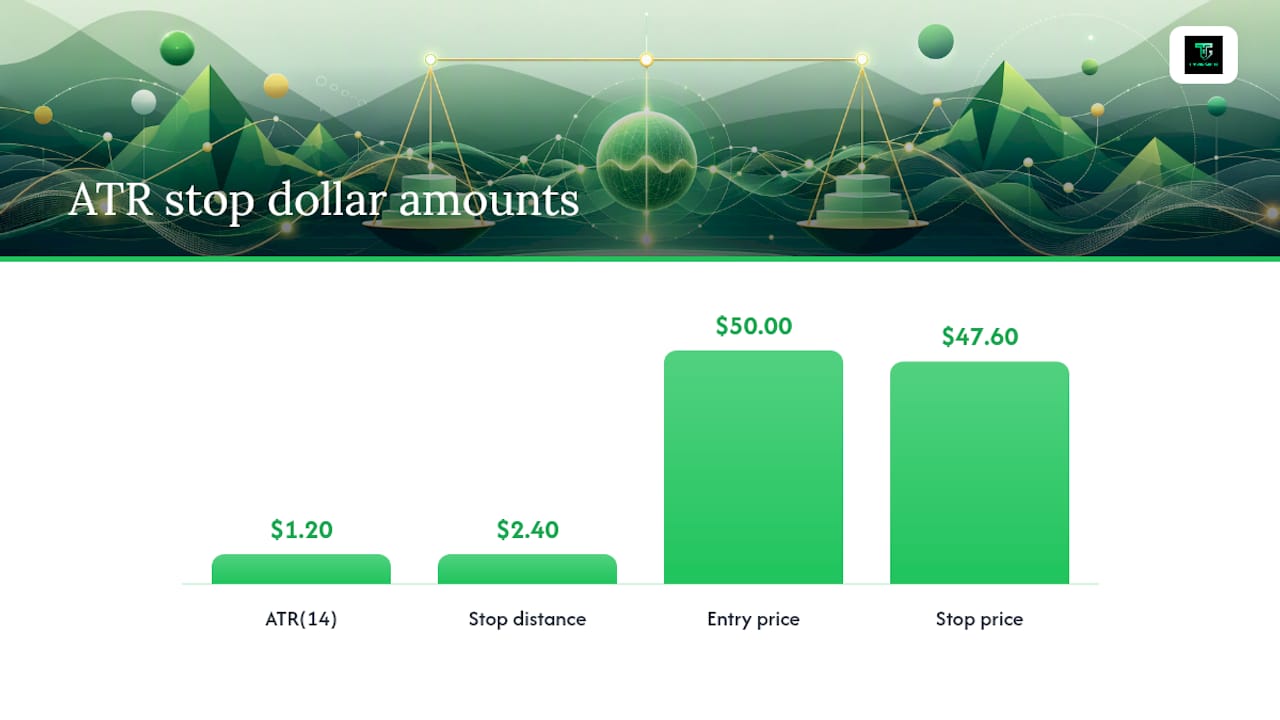
Say a stock is trading at $50.00 and its ATR(14) reads $1.20. With a 2× multiplier, your stop distance is $2.40, placing a long stop at $47.60. A free ATR stop calculator can double-check this math before you commit real capital.
Which ATR Period and Multiplier Should You Use?
ATR(14) is the default for good reason, but it’s not the only setting worth knowing. A shorter lookback, around 7 to 11 periods, reacts faster to fresh volatility spikes. A longer lookback, 20 to 22 periods, smooths out noise but reacts slower to regime changes.
Multiplier choice matters more than most traders admit:
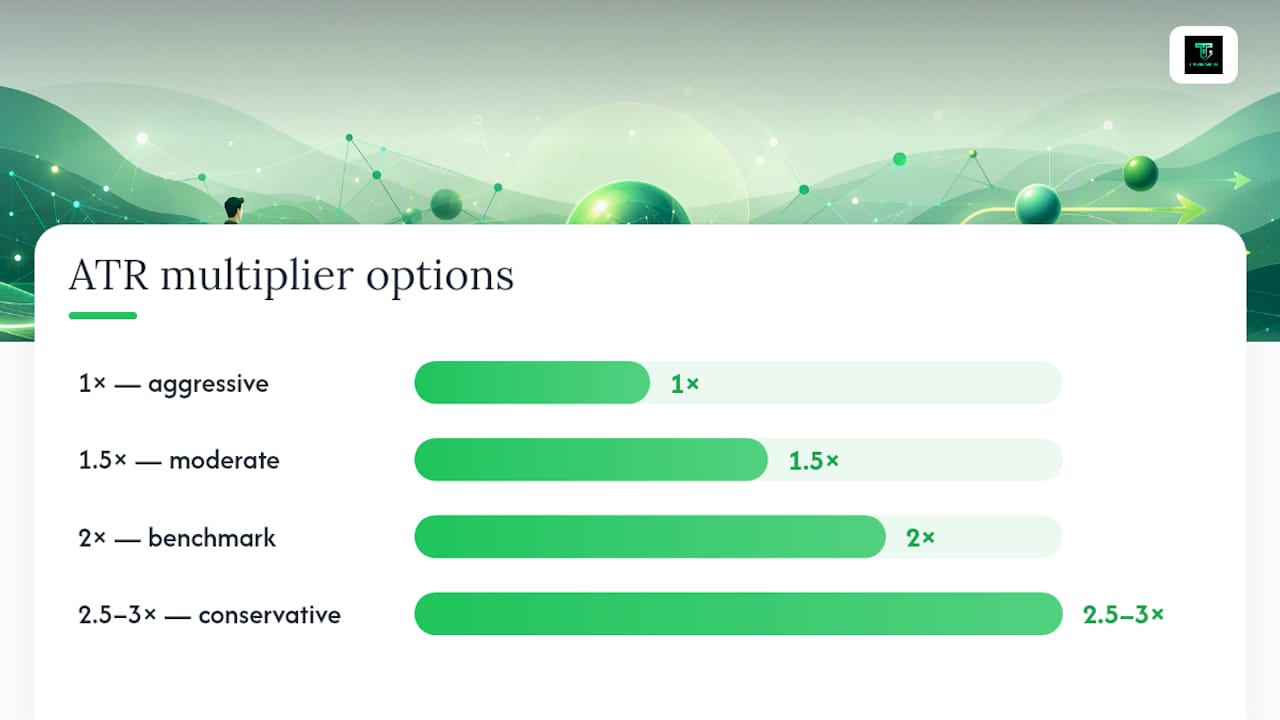
- 1×: aggressive, tight, gets you stopped out often in choppy conditions.
- 1.5×: moderate, works for trending instruments with low noise.
- 2×: the benchmark most traders start with.
- 2.5× to 3×: conservative, used for swing trades and Chandelier trails where you want to survive pullbacks.
One backtest across 9,433 trades on six assets found the 2.0× multiplier delivered the best overall balance between premature exits and oversized losses, with daily-timeframe setups consistently outperforming hourly ones, according to Quant Signals. Treat 2× as your default hypothesis, not gospel. Every instrument and timeframe behaves differently, so run your own numbers before trading it live.
How Do You Set Up an ATR Trailing Stop or Chandelier Exit?
A plain ATR trail moves in one direction only. For a long trade, the trail equals the highest price seen since entry, minus ATR × multiplier, and it never steps backward even if price pulls back. Shorts mirror this in reverse.
The Chandelier Exit works almost identically but anchors to the highest high over a fixed lookback window (commonly 20 to 22 bars) rather than the highest price since entry, per the calculation steps at ChartSchool.
- Set your initial hard stop first. Keep it independent of the trail.
- Wait until the trade has moved roughly 1R (one full risk unit) in profit before activating the trail.
- Let the trail update mechanically, bar by bar. Do not intervene.
- Never manually tighten the trail mid-trend based on a gut feeling. That habit gets traders shaken out of winners more than any indicator flaw does.
Trailing stops also tend to underperform on noisy hourly charts compared with daily implementations, so match your trail’s timeframe to your actual holding period, a point Forex-basics makes clear in its discussion of trail mechanics.
Pro Tip: Set your trail activation rule in writing before you enter the trade. If you decide “after 1R” in the heat of the moment, you’ll almost always talk yourself into activating early or late.
How Should ATR Stops Affect Your Position Size?
Wider stops mean smaller positions, full stop. A forex trader working with a $1,000 risk budget and a 40-pip ATR stop divides that budget by the pip value to land on the correct lot size, rather than trading a fixed lot size regardless of volatility.
- Wider multipliers (3×) demand smaller size to hold risk constant.
- Tighter multipliers (1×) allow larger size, but with more frequent stop-outs.
- Recalculate size every time ATR shifts meaningfully, not just at entry.
This is the piece traders skip most often, and it’s the one that actually protects the account. Our deeper breakdown on position sizing and risk management walks through the math for multiple instrument types.
Pro Tip: If you’re unsure whether your ATR multiplier is too wide, check your position size first. If it’s shrinking to an oddly small number, that’s often your answer.
What Does an ATR Stop Checklist Look Like in Practice?
Before you place a single order, run through this sequence:
- Confirm the setup is valid on its own terms (price action, structure, momentum), never based on ATR.
- Identify the invalidation level where the trade thesis is simply wrong.
- Calculate ATR(14) and select your multiplier.
- Compute position size from the resulting stop distance.
- Check spread and margin requirements fit the trade before entering.
- Place the stop and order together, not as an afterthought.
Example A (intraday): EUR/USD trades at 1.0850, ATR(14) reads 45 pips. With a 2× multiplier, your stop sits 90 pips away at 1.0760 for a long entry.
Example B (swing): A generic instrument trades at $120, ATR(14) reads $3.50. Using a 3× Chandelier trail against the 20-bar high, your stop trails $10.50 below that rolling high.
Log entry price, ATR value, multiplier used, stop distance, and outcome for every trade. That journal is what turns a guess into a tested system.
What Are the Limitations of ATR Stop Losses?
ATR measures volatility, not direction, and it says nothing about whether your trade idea is actually correct. Fidelity’s ATR indicator guide is direct about this: use ATR as a volatility buffer, but let price-action invalidation points remain your true stop logic.
Common mistakes worth avoiding:
- Using ATR to decide whether to enter a trade, rather than just where to place the stop.
- Tightening a trail manually out of nerves during normal volatility.
- Ignoring spread and slippage on tighter multipliers, which can trigger stops before price actually reaches your level.
- Applying one multiplier across every instrument without retesting.
When backtesting, evaluate at least 30 to 200 trades per instrument and timeframe, tracking profit factor, max drawdown, and expectancy. If your risk-adjusted return improves and holds up across that sample, keep the setting. If it doesn’t, adjust the multiplier before risking more capital, not after.
What’s Trader Gibkey’s Take on ATR Stops?
ATR gives you a number. It doesn’t give you judgment, and that’s the part most retail traders skip. Over 18 years of live trading, the pattern Gibkey keeps seeing is traders trusting the multiplier more than the chart in front of them. We teach ATR stops layered on top of price-action invalidation and fixed-percentage position sizing, never as a standalone rule. Before adopting any new multiplier, paper trade or run a small live sample of 30 to 100 trades. Our guide on price action invalidation covers the structural side ATR alone can’t.
— Gabriel
Ready to Put ATR Stops Into a Full Trading System?
Reading about ATR multipliers is one thing. Applying them under live pressure, with real spread and real emotion, is another. Tradergibkey builds that bridge through structured price action courses, personalized mentorship, and live trading sessions where ATR-based risk rules get applied to real setups in real time, not just theory on a chart.

You get direct feedback on your stop placement, your position sizing, and the invalidation logic behind both, from a community that’s already worked through the mistakes this guide warns against. If you’re ready to stop guessing at multipliers and start trading a tested system, explore Trader Gibkey’s courses and mentorship and see which format fits where you are right now.
This article is general information, not a substitute for advice from a qualified financial advisor. Consult a qualified financial professional about your own circumstances before acting on anything here.
Sources
- Forex Trading: Effective Methods for Stop Order Placement
- ATR Trailing Stops - ChartSchool
- ATR Stop Loss Strategy: Optimal Multipliers Tested Across 6 Assets | Quant Signals
- Average True Range (ATR) Indicator & Strategies