
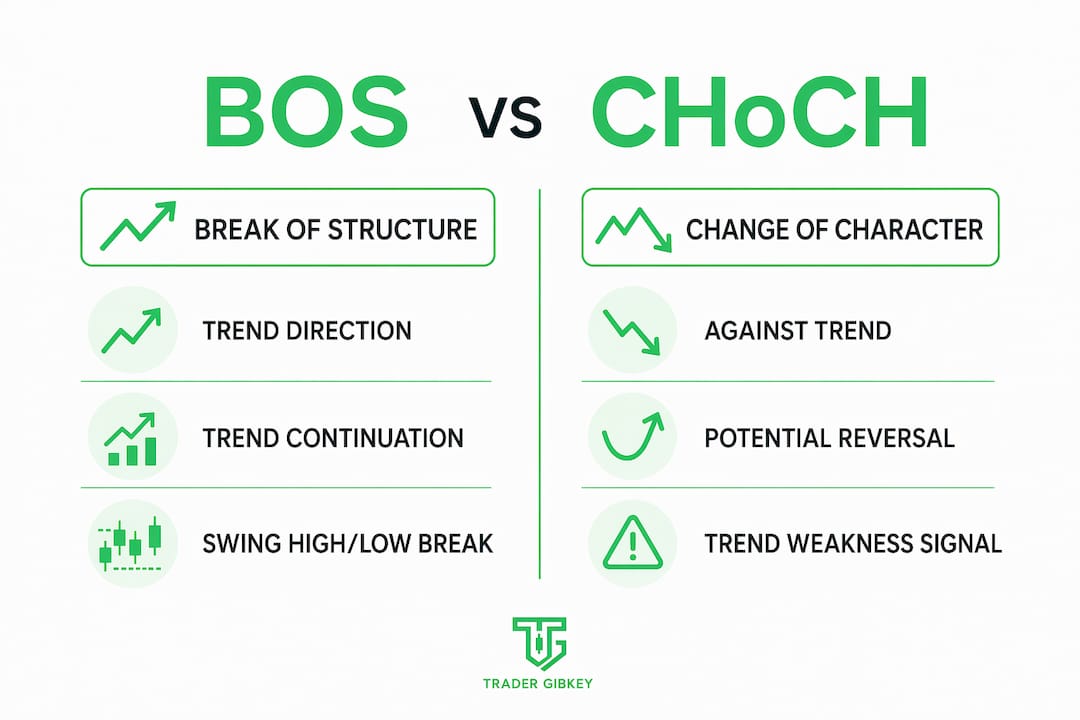
A Break of Structure (BOS) is defined as a price move that confirms trend continuation by breaking a significant swing high or low in the direction of the prevailing trend. A Change of Character (CHoCH) is the first structural break against that prevailing trend, signaling that momentum may be shifting. Understanding the difference between these two signals sits at the core of market structure analysis and Smart Money Concepts (SMC) trading. If you confuse them, you will enter trades at the wrong time, in the wrong direction, and wonder why your setups keep failing.
Both signals appear on raw price charts without any indicators. That is exactly what makes them powerful. Price action trading gives you the ability to read what the market is actually doing, not what a lagging indicator thinks it did three candles ago.
What is Break of Structure (BOS) in market structure analysis?
BOS confirms trend continuation when price breaks a significant swing high in an uptrend or a significant swing low in a downtrend. Think of it as the market saying, “Yes, we are still going this way.” Each confirmed BOS adds another brick to the wall of evidence that institutional money is pushing price in one direction.

The confirmation rule is straightforward. A valid BOS requires a candle body close beyond the prior swing point, not just a wick. A wick poke through a swing high does not count. The candle must close above it. This single rule eliminates a large portion of false signals that trap newer traders.
Here is how BOS looks in both trend directions:
| Trend direction | Swing point broken | What it confirms |
|---|---|---|
| Uptrend | Prior swing high | Buyers remain in control; trend continues higher |
| Downtrend | Prior swing low | Sellers remain in control; trend continues lower |
| Uptrend (no BOS) | Swing high holds | Potential weakness forming; watch for CHoCH |
| Downtrend (no BOS) | Swing low holds | Potential weakness forming; watch for CHoCH |
BOS is the language of institutional momentum. When large players are accumulating or distributing, they leave footprints in the form of consecutive BOS signals. Each one tells you the order flow is still one-sided.
A common mistake is treating every minor price break as a BOS. Valid swing points are identified by candle clusters or specific pattern criteria, not every minor fluctuation. A real swing high has at least two lower highs on each side. A real swing low has at least two higher lows on each side. Anything less is noise.
Pro Tip: Mark your swing highs and lows on the higher timeframe first. Then drop to the lower timeframe to watch for a candle close beyond those levels. This keeps you focused on meaningful structure, not random price movement.
What is Change of Character (CHoCH) and how does it signal potential reversals?
CHoCH is the earliest indication that the ruling market participants may be losing control. In an uptrend, a CHoCH occurs when price breaks below a prior swing low for the first time. In a downtrend, it occurs when price breaks above a prior swing high for the first time. That word “first” is critical. It is not a confirmed reversal. It is a whisper, not a shout.
Here is what makes CHoCH different from BOS at its core:
- Direction: BOS breaks in the trend direction. CHoCH breaks against it.
- Meaning: BOS says the trend is alive. CHoCH says the trend might be dying.
- Risk level: BOS entries carry lower risk because you trade with momentum. CHoCH entries carry higher risk because you are betting on a shift that has not been confirmed.
- Confirmation needed: BOS is self-confirming with a candle close. CHoCH requires a follow-through signal, often called a Market Structure Shift (MSS), before you act on it.
A CHoCH in a bullish scenario looks like this: price has been making higher highs and higher lows. Then price breaks below the most recent higher low. That break is the CHoCH. It tells you the structure of the uptrend has been violated for the first time. It does not tell you the trend is over.
A CHoCH in a bearish scenario is the mirror image. Price has been making lower highs and lower lows. Then price breaks above the most recent lower high. That is the CHoCH. The downtrend structure has cracked, but it has not necessarily broken.
CHoCH signals trend weakening but should not be traded without further confirmation like a Market Structure Shift. An MSS is a stronger displacement candle that follows the CHoCH and confirms that institutional players have genuinely changed their position. Without it, you are trading a rumor, not a fact.
Pro Tip: When you spot a CHoCH, put your pen down and wait. Watch for a strong displacement candle that closes convincingly beyond the CHoCH level. That displacement is your MSS. Only then does a reversal trade have a solid structural foundation.
How do you differentiate BOS from CHoCH in live market conditions?
The clearest way to separate these two signals is to ask one question: is this break in the direction of the current trend or against it? If it is with the trend, it is a BOS. If it is against the trend, it is a CHoCH. That single question resolves most of the confusion traders face on live charts.
| Feature | BOS | CHoCH |
|---|---|---|
| Direction | With the trend | Against the trend |
| Signal type | Continuation | Potential reversal warning |
| Confirmation required | Candle close beyond swing point | Candle close plus MSS displacement |
| Trade risk | Lower | Higher |
| Timeframe sensitivity | Works on all timeframes | More prone to false signals on lower timeframes |
Timeframe context changes everything. A CHoCH on a 1-minute chart is almost meaningless noise. The same signal on a 4-hour chart carries real weight. Experienced traders use higher timeframes to set bias and lower timeframes only for precision entries. This approach filters out the majority of false CHoCH signals that appear on short timeframes.
Another common error is confusing a minor swing point with a major one. Not every pullback creates a meaningful swing. When you mark a swing high or low that only has one candle on each side, you are working with weak structure. Weak structure produces weak signals. Always qualify your swing points before labeling a break as BOS or CHoCH.
Pro Tip: Pair your BOS and CHoCH analysis with liquidity sweeps and order blocks. A CHoCH that follows a liquidity sweep of a major high or low carries far more weight than a CHoCH that appears in the middle of a range.
How do traders integrate BOS and CHoCH into their trading strategies?
Applying these signals effectively requires a top-down approach. Here is a practical framework you can build into your trading plan:
-
Set your higher timeframe bias. Use the daily or 4-hour chart to determine whether the market is in an uptrend, downtrend, or range. Look for consecutive BOS signals to confirm the direction. This is your macro filter.
-
Drop to the execution timeframe. Move to the 1-hour or 15-minute chart. You are now looking for BOS signals that align with your higher timeframe bias. These are your continuation entries.
-
Wait for CHoCH plus MSS before trading reversals. If you want to trade a reversal, a CHoCH alone is not enough. Wait for the MSS displacement candle. That candle shows institutional commitment to the new direction.
-
Combine with liquidity sweeps. The highest probability setups occur when a CHoCH follows a sweep of a key liquidity level. The sweep clears out stop losses. The CHoCH signals the reversal. Together, they tell a complete story.
-
Define your invalidation level. Every BOS trade has a clear invalidation point: the swing low that was just broken (in an uptrend). Every CHoCH trade has one too: the swing point that triggered the CHoCH. If price returns to that level and closes through it, the signal is invalid.
-
Manage the trade around structure. Do not use arbitrary take-profit levels. Target the next significant swing high (for longs) or swing low (for shorts). Let structure define your exit, not a fixed pip count.
Higher timeframe bias aligned with lower timeframe BOS and CHoCH produces the most consistent execution. This multi-timeframe approach is the backbone of how professional traders use these signals in practice.
What are common misconceptions about BOS and CHoCH?
Most trading mistakes with these signals come from impatience and misidentification. Here are the errors that show up most often:
- Treating CHoCH as an immediate reversal signal. The primary error is treating CHoCH as a direct reversal signal instead of an alert that needs confirmation. Jumping in at the CHoCH candle without waiting for MSS puts you in a trade before the market has committed to a new direction.
- Overtrading minor structural breaks. Not every break of a swing point is meaningful. If you are marking every small pivot on a 5-minute chart as BOS or CHoCH, you will generate dozens of signals per session. Most will fail.
- Ignoring candle close confirmation. A wick through a swing point is not a BOS. A wick through a swing point is not a CHoCH. The candle body must close beyond the level. This rule is non-negotiable.
- Confusing minor and major swing points. Separating real structural shifts from noise is a key skill. Identifying significant swings is more critical than knowing the terminology. A swing point with only one candle on each side is minor. A swing point with three or more candles on each side is major. Trade the major ones.
- Ignoring the broader institutional context. Market structure is the grammar of price action. Indicators track what structure already shows. If you are reading BOS and CHoCH signals without understanding where price sits relative to major supply and demand zones, you are reading words without understanding the sentence.
Developing patience with these signals is a skill in itself. The chart will always give you another setup. Missing one clean entry is far better than forcing a bad one.
Key Takeaways
BOS confirms trend continuation with a candle close beyond a swing point in the trend direction, while CHoCH signals a potential reversal and requires Market Structure Shift confirmation before trading.
| Point | Details |
|---|---|
| BOS confirms continuation | Price must close beyond a prior swing high or low in the trend direction to validate BOS. |
| CHoCH is a warning, not a trigger | CHoCH signals the trend may be weakening; wait for MSS displacement before entering a reversal trade. |
| Timeframe context matters | CHoCH signals on lower timeframes carry high false-signal risk; always align with higher timeframe bias. |
| Swing point quality is critical | Only trade BOS and CHoCH from major swing points with multiple candles on each side. |
| Combine with liquidity sweeps | CHoCH signals following a liquidity sweep carry the highest probability for reversal setups. |
Market structure is the language you need to learn first
I have been watching traders struggle with BOS and CHoCH for years, and the pattern is almost always the same. They learn the labels before they learn the logic. They can tell you what a CHoCH is, but they cannot tell you why it matters in the context of where price has been for the last 20 candles.
My honest take: market structure is the grammar of trading. You would not try to write a novel without knowing how sentences work. You should not try to trade without knowing how price builds and breaks structure. Every indicator you add on top of a chart is just a translation of what structure already shows you. Learn the original language first.
The traders I have seen grow fastest are the ones who spend weeks doing nothing but marking swing highs, swing lows, BOS signals, and CHoCH signals on historical charts. No trades. Just observation. They build pattern recognition that no course can shortcut. When they finally start trading, they see the market differently. They are reading the chart, not reacting to it.
The other thing I want to say directly: CHoCH is one of the most misused signals in retail trading. Traders see a CHoCH and immediately think “reversal trade.” That impulse costs money. A CHoCH is a question mark, not an exclamation point. The MSS that follows it is the answer. Wait for the answer before you commit capital.
If you want to build a structured learning path that takes you from basic structure reading to full trade execution, the work is worth it. There are no shortcuts, but there is a clear sequence. Follow it.
— Gabriel
Tradergibkey resources for mastering market structure
Tradergibkey has spent over 18 years in live market conditions building and refining the exact frameworks covered in this article. The resources on the Tradergibkey blog go deep on price action, liquidity, and structure-based trading in a way that connects theory directly to real chart setups.

If you want to go further with the concepts here, the Tradergibkey blog covers liquidity sweeps, order blocks, and the full Smart Money Concepts framework in plain language. Every post is written for traders who want to understand the “why” behind price movement, not just the “what.” Visit Tradergibkey to access the full library of trading education built for traders who are serious about getting consistent.
FAQ
What is the main difference between BOS and CHoCH?
BOS breaks in the direction of the current trend and confirms continuation. CHoCH breaks against the trend and signals a potential reversal that still requires confirmation.
Can you trade a CHoCH signal directly?
No. CHoCH is a warning signal, not a direct entry trigger. Wait for a Market Structure Shift (MSS) displacement candle before committing to a reversal trade.
Which timeframe is best for reading BOS and CHoCH?
Set your structural bias on the daily or 4-hour chart, then use the 1-hour or 15-minute chart for entry timing. Lower timeframes produce too many false signals when used without higher timeframe context.