
Overtrading is defined as executing more trades than your strategy’s quality setups justify, resulting in higher transaction costs and measurable account erosion. The overtrading definition from Investopedia also covers a regulatory dimension: brokers who churn client accounts to generate commissions face legal consequences, while individual traders who overtrade face a quieter but equally damaging outcome. Pattern day trading rules require a $25,000 minimum balance for frequent day trades in margin accounts, which shows regulators take trade frequency seriously. For beginner and intermediate traders, overtrading is less a legal issue and more a performance killer hiding in plain sight.
What does overtrading mean for your trading performance?
Overtrading is not just about trading too much. It is about trading beyond the point where your setups have a real edge. The moment you take trades that do not meet your entry criteria, you are no longer trading your strategy. You are trading your emotions.
The clearest signs show up in your numbers. A significant win rate drop after your first three trades in a session is one of the most reliable red flags. Another is your commission-to-profit ratio. A healthy ratio sits between 5% and 15%. When commissions and spreads consume over 20% of your gross profits, you are almost certainly taking too many trades. That number tells you the market is not taking your money. Your own behavior is.

How overtrading affects profit factor
The profit factor is the ratio of gross winning trades to gross losing trades. A profit factor near 1.1 signals you are barely breaking even, while your top setups may carry a profit factor above 2.0. That gap exists because low-quality trades drag the average down. Professionals earn up to 80% of their returns from just 20% of their trades. Every extra trade you take outside that 20% dilutes the results of your best work.
The effects go beyond numbers. Overtrading creates psychological stress that compounds over a session. The more trades you take, the more mental bandwidth you burn. By trade five or six, your decision quality has already dropped. You are no longer reading the chart. You are reacting to your open P&L.
Signs you are overtrading right now
- You feel restless when you are not in a trade
- Your win rate is strong early in the session but collapses by midday
- You take trades during lunch hours or near market close, when spreads widen and setups are weak
- You justify entries that do not fully meet your rules
- Your commissions are eating more than 15% of your monthly profits
What causes overtrading and how does psychology drive it?
Overtrading is a decision-quality problem before it is a volume problem. The root cause is almost always emotional. 73% of impulsive trades happen after a loss in the same session. That statistic captures the revenge trade perfectly. You lose, your brain shifts into recovery mode, and suddenly every candle looks like an opportunity.
The main emotional triggers behind overtrading are:
- Revenge trading: Taking a trade specifically to recover a loss, not because a setup exists
- FOMO: Entering a move already in progress because you fear missing out on profit
- Boredom: Trading during slow sessions just to feel productive
- Chasing losses: Scaling up size or frequency after a drawdown to “get back to even”
There is also a subtler trap called the busyness myth. Many traders believe that more trades equal more productivity. That belief is wrong. The best traders spend most of their time waiting for high-probability setups, not executing. Sitting on your hands during a choppy session is not laziness. It is discipline.
Overtrading also shares dopamine pathways with gambling behavior. Each trade triggers a small neurological reward, regardless of outcome. That reward loop is why willpower alone rarely fixes the problem. Mechanical rules beat willpower every time because they remove the decision from the emotional brain entirely.
Pro Tip: If you feel a strong urge to enter a trade right after a loss, wait five minutes before touching your keyboard. That pause breaks the emotional feedback loop before it becomes a revenge trade.
It is worth separating two distinct types of overtrading. Discretionary overtrading is a behavioral pattern where a trader takes too many trades on their own initiative. Broker churning is a regulatory violation where a broker executes excessive trades in a client’s account to generate commissions. Both cause harm, but only one is illegal. As a self-directed trader, your version of overtrading is entirely within your control to fix.
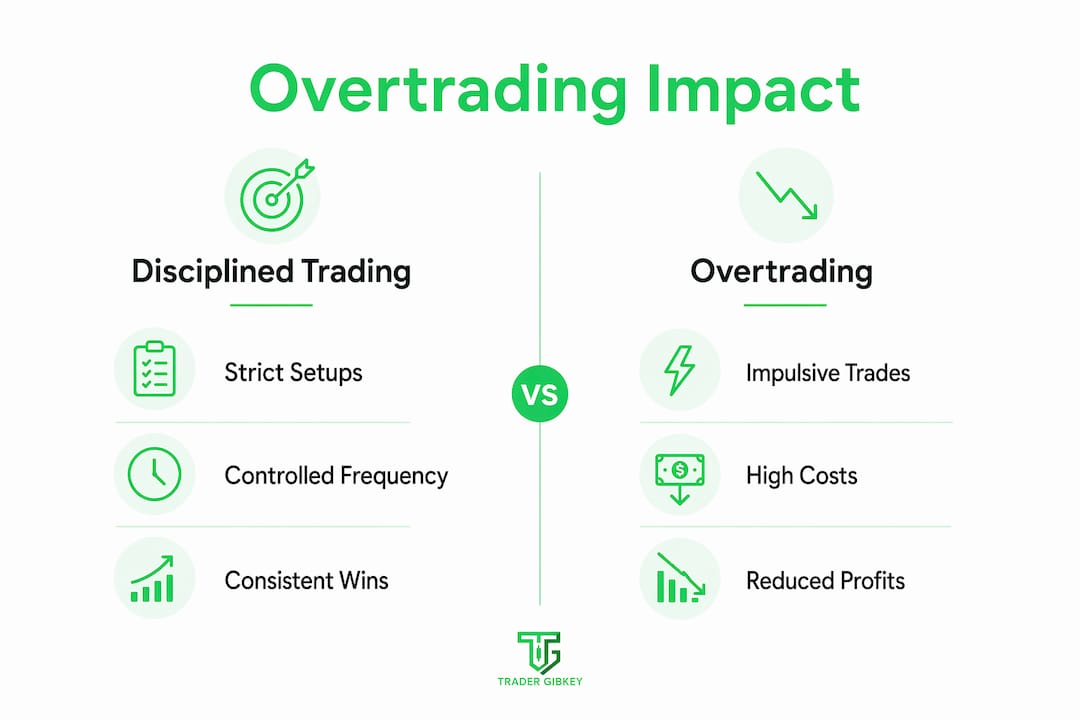
Disciplined strategy vs. overtrading: what is the real difference?
Overtrading is not defined by trade volume alone. A scalper who takes 30 trades a day using a tested, systematic approach is not overtrading. A swing trader who takes three trades in a week without valid setups is. The defining factor is whether each trade meets your pre-defined entry criteria.
The table below shows how disciplined trading and overtrading differ across key dimensions:
| Dimension | Disciplined trading | Overtrading |
|---|---|---|
| Entry basis | Pre-defined setup criteria | Impulse, boredom, or emotion |
| Trade frequency | Matches historical quality setups | Exceeds quality setup frequency |
| Commission ratio | 5–15% of gross profits | Over 20% of gross profits |
| Profit factor | Consistent above 1.5 | Dragged toward 1.0–1.1 |
| Decision driver | Chart and strategy | Open P&L and emotional state |
The key question to ask yourself is: “Would I take this trade on day one of a new account, with no prior losses today?” If the answer is no, the trade is emotional. That is the line between strategy and overtrading.
Unplanned trades do not just lose money directly. They dilute the profitability of your good trades by inflating your total trade count. If your best setups win 65% of the time but you pad your session with five extra mediocre trades, your overall win rate drops to something that looks like random noise. Your trading performance review will show the damage clearly if you track it honestly.
How to diagnose and prevent overtrading with practical methods
The most effective way to stop overtrading is to replace willpower with data and structure. Here is a step-by-step approach that works:
-
Run a P&L breakdown by trade number. Open your trade journal and sort your trades by sequence within each session. Calculate your average P&L for trade one, trade two, trade three, and so on. Most traders discover a profit cliff after a few trades, where returns drop sharply. That cliff is your personal overtrade threshold.
-
Set a hard daily trade limit. Once you identify your optimal trade count from your data, make it a non-negotiable rule. Setting personal trade limits based on historical P&L is one of the most measurable improvements a trader can make. Traders who exceed their optimal trade count lose an average of 23% more per month due to commissions and emotional losses.
-
Create no-trade zones. Low-probability market hours like the lunch hour and the final 30 minutes before market close carry wider spreads and more random price action. Block these times on your trading schedule. Your best performance typically happens in the first 90 minutes of a session.
-
Use a pre-trade checklist. Before every entry, confirm that your setup meets every criterion in your strategy. If one condition is missing, skip the trade. No exceptions.
-
Track your emotional state. Add a simple mood rating to each trade in your journal. Rate yourself 1 to 5 before entry. Trades taken at a 1 or 2 (frustrated, anxious, or bored) almost always underperform. That data will change your behavior faster than any motivational advice.
Pro Tip: Set a physical or digital alarm for your no-trade zones. When the alarm fires, close your charts and step away. Removing the visual stimulus removes the temptation.
Understanding risk management rules alongside trade frequency gives you a complete picture of where your account is leaking. Overtrading and poor risk management often occur together, and fixing one without the other only solves half the problem.
Key Takeaways
Overtrading destroys performance not through a single bad trade but through the steady accumulation of low-quality decisions that erode both your account and your edge.
| Point | Details |
|---|---|
| Overtrading definition | Taking trades beyond your strategy’s quality setups, not just trading frequently |
| Primary warning sign | Commissions exceeding 20% of gross profits signals excessive trade frequency |
| Root cause | Emotional triggers like revenge trading and FOMO drive most overtrading behavior |
| Key distinction | Volume alone does not define overtrading; decision quality and setup validity do |
| Best prevention method | Set hard trade limits based on your own historical P&L data, not general rules |
Why the profit cliff changed how I think about trade frequency
I have watched traders go through the same cycle for years. They start a session sharp, take two or three clean trades, and then something shifts. Maybe they hit a loss. Maybe the market slows down. And then they start filling the silence with trades that have no business being taken.
The profit cliff is real. When you map your own P&L by trade number, the pattern is almost always the same. Trades one through three carry the weight. After that, the returns flatten or go negative. The brain stops trading the chart and starts trading the pain. It is running a different operating system by that point, one built on emotion rather than analysis.
What I have found is that the traders who fix overtrading fastest are not the ones with the most willpower. They are the ones who stop trusting themselves to make the right call in the moment and instead build rules that make the decision for them. A hard stop at trade four is not a limitation. It is protection.
Patience is not passive. Waiting for a high-quality setup while the market chops around is one of the hardest and most profitable skills in trading. The retail trading traps that catch most beginners are built on the assumption that you will keep trading when you should be sitting still. Do not give the market that edge.
Track your data. Set your limits. Then trust the rules more than you trust your gut in the heat of the moment.
— Gabriel
Stop overtrading with structured guidance from Tradergibkey
If you recognize yourself in this article, you are not alone. Overtrading is one of the most common performance problems Tradergibkey sees across all experience levels, and it is also one of the most fixable.
Tradergibkey offers trading courses, mentorship, and a community built around practical price action strategies developed over 18 years of live market experience. The structured learning approach helps you build the rules, habits, and data-driven discipline that replace emotional trading with consistent execution. Whether you are just starting out or trying to break through a performance plateau, the trading education at Tradergibkey gives you the framework to trade less and earn more.
FAQ
What does overtrading mean in simple terms?
Overtrading means taking more trades than your strategy’s quality setups justify. It leads to higher costs and lower overall performance.
How do I know if I am overtrading?
Check your commission-to-profit ratio. If commissions exceed 20% of your gross profits, or your win rate drops sharply after your first few trades in a session, you are likely overtrading.
Can overtrading be fixed without changing your strategy?
Yes. Setting a hard daily trade limit based on your own historical P&L data is often enough to stop overtrading without altering your core strategy at all.