
What a daily trading routine actually is — and why it changes everything
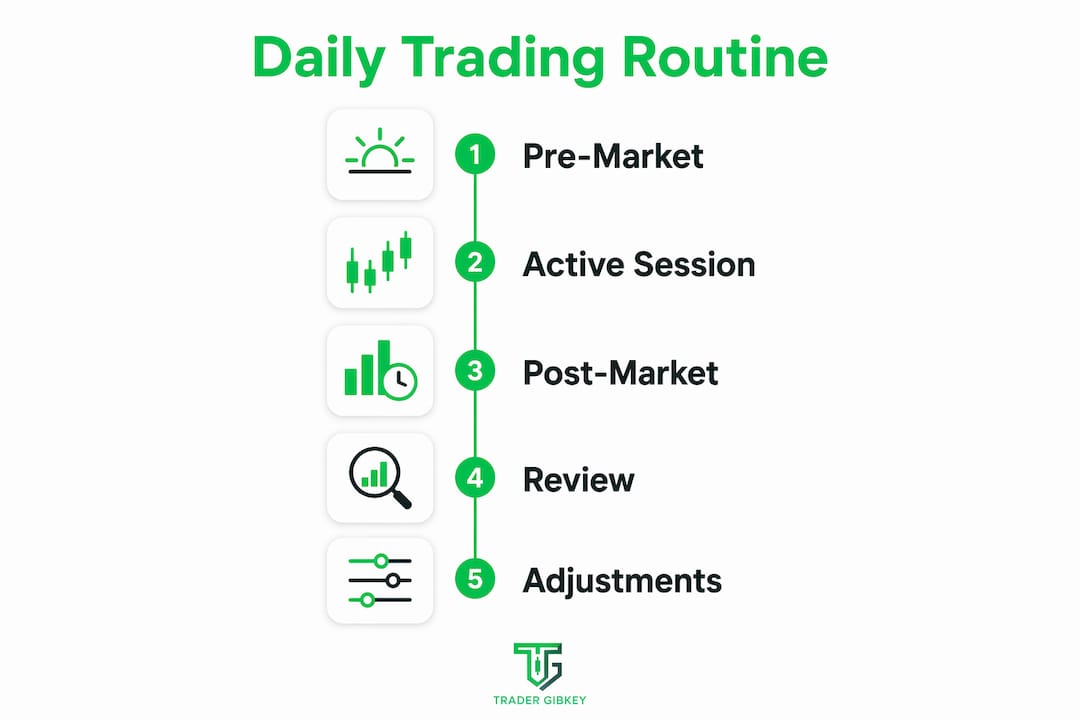
A daily trading routine is a structured, repeatable sequence of three phases: pre-market preparation, active trade execution, and post-market review. For beginners, it is the single most practical tool for building the discipline that separates traders who improve from those who spin their wheels for months.
Without a routine, you are reacting. Every morning becomes a fresh scramble — scanning charts without context, entering trades on gut feel, and exiting on emotion. A routine removes that guesswork. Traders who follow a documented routine show measurably higher consistency scores than those who improvise their process each session.
Here is what a solid beginner routine covers:
- Pre-market preparation: mental and workspace readiness, economic calendar review, key level identification, and setting daily loss limits
- Active trading session: executing only pre-planned setups, managing risk per trade, and controlling emotional responses in real time
- Post-market review: journaling trades, grading plan adherence, and extracting one lesson per session
The routine does not tell you what to trade. Your written trading plan does that. The routine ensures you show up prepared, execute with a checklist, and learn from every session regardless of outcome.
One regulatory reality every U.S. beginner needs to know upfront: the Pattern Day Trader rule requires a minimum equity threshold in a margin account to place multiple day trades within a short period. Futures and forex sit outside this rule, making them common starting points for undercapitalized beginners. Knowing this before you build your routine prevents a nasty surprise on day three.
The deeper value of a routine is psychological. When you follow the same steps every morning, your brain stops making decisions about how to prepare and starts making decisions about what the market is doing. That shift frees up mental bandwidth for the moments that actually matter.
1. Build your pre-market preparation block
Pre-market prep is the highest-leverage part of your trading day. Done right, it converts you from a reactive trader asking “what’s moving?” into a prepared trader who already knows their levels, their risk, and their limits before the bell rings.
A consistent morning routine clears your head and sets the pace for everything that follows. That could mean a short walk, five minutes of quiet, or simply reviewing your plan with coffee. The hard rule: do not open your charts half-asleep with no plan.
Your pre-market checklist:
- Workspace check: test your internet connection, log into your platform, confirm your settings are correct, and eliminate distractions
- Mental state rating: score yourself 1–10 on focus and calm. Below 6 means you trade half size or sit out entirely
- Economic calendar: flag all high-impact events for the session. Mark 15-minute no-trade windows around them using a tool like ForexFactory or Investing.com
- Key levels: mark support, resistance, yesterday’s high and low, and any relevant moving averages on your primary timeframe
- Price alerts: set alerts at every level you marked so you are not staring at charts waiting for price to arrive
- Journal review: read yesterday’s entry. Carry one lesson into today’s session
- Daily limits: write down your maximum loss in dollars, your maximum trade count, and your target setups for the day
Setting daily goals that match your account size matters here. A beginner risking 1% per trade on a $10,000 account has a $100 per-trade risk budget. Write that number down before you trade, not after a loss forces you to think about it.
Pro Tip: Keep your pre-market checklist on a single printed page taped near your screen. The physical act of checking boxes builds the habit faster than any app.
2. How to find and execute trades during the active session
The active session is where your preparation either pays off or falls apart. For beginners, the goal is not to find the most trades. It is to execute the right ones cleanly.

Focus on mastering one setup before you add a second. Depth in a single pattern beats shallow familiarity with five. The opening range breakout and VWAP reclaim are two of the most objective setups for beginners because their entry triggers are clear, not subjective. Once you know exactly what your setup looks like, you stop second-guessing entries and start executing mechanically.
During-session discipline rules:
- Entry checklist before every trade: confirm the setup matches your plan, your stop is defined, your position size is calculated, and your risk-to-reward is at least 1:1.5
- Risk per trade in dollars, not percentages: knowing your exact dollar risk before entry removes emotion from the sizing decision. Successful beginner traders risk less than 1–2% of their account per trade
- Daily loss limit is a hard stop: when you hit it, you close the platform. No exceptions, no “one more trade to get it back”
- Trade count cap: limit yourself to 3–5 trades per session. More trades usually means lower-quality setups and compounding commissions
- Emotion check-ins: set a timer every 30–60 minutes. If you feel anything other than calm and alert, step away from the screen for 10 minutes before placing another trade
- No revenge trades: when the brain stops trading the chart and starts trading the pain of a loss, you are running a different operating system. That version of you has a terrible track record
The first 15 minutes after the open are the most volatile of the day. Most beginners get chopped up in that window. Watching the open without trading it teaches you more about how your market behaves than any book.
Pro Tip: Before you click buy or sell, pause for 10 seconds and run your entry checklist. If the setup is still valid after 10 seconds, it will survive a 30-second checklist. If it is gone, that urgency was a symptom of overtrading behavior, not a real opportunity.
3. Post-market review and journaling to actually improve
Most beginners skip the post-session review. That is exactly why they repeat the same mistakes for months. The review is where the feedback loop that drives real improvement gets built.

Do your review within one hour of your last trade, while the session is still fresh. Waiting until the next morning means details fade and emotional context disappears. The post-session review covers four things: log all trades with entry reasons, grade each trade on plan adherence, write one lesson from the session, and calculate your discipline score (plans followed divided by total trades, multiplied by 100).
Post-market review checklist:
- Trade log: record entry price, stop, target, outcome, and the specific setup that triggered the entry
- Plan adherence grade: for each trade, a simple yes or no. Did you follow your rules? This single metric reveals more about your progress than your P&L
- Emotional notes: what did you feel before, during, and after each trade? Patterns in your emotional triggers are as important as patterns in your setups
- One lesson: write one sentence about what you would do differently. Not a paragraph. One sentence
- Rest: trading discipline is not just mental. Sleep deprivation degrades decision quality the same way emotional stress does
For tracking your performance over time, a simple spreadsheet with win rate, average reward-to-risk, and discipline score tells you more than any indicator. Review it weekly, not daily, so you see trends rather than noise.
The journal is not a diary. It is a performance database. After 50–100 entries, patterns emerge in both your market behavior and your own psychology. Those patterns are the most valuable education you will ever get as a trader.
4. What research and experience reveal about beginner misconceptions
Here is the misconception that costs beginners the most: they believe a good setup guarantees a good outcome. It does not. High-probability setups produce expected losses frequently. Success comes from disciplined execution across many trades, not from finding a pattern that wins most of the time.
Beginners often abandon a sound setup after a few losing trades, expecting a “good” setup to win the majority of the time. That expectation leads them to keep switching approaches, which means they never build the sample size needed to know if anything actually works. Profitability comes from positive expectancy over many trades, the combination of win rate and reward-to-risk, executed with discipline. A strategy does not need to win 70% of the time to be profitable. Traders can be successful profiting on 50–60% of trades, provided winners are larger than losers.
Key research-backed realities for beginners in 2026:
- Routine consistency beats setup perfection: documented routines improve trading consistency because they act as a circuit breaker against emotional decisions in live market conditions
- The PDT rule has real workarounds: the minimum equity requirement for U.S. margin accounts applies to stocks only. Futures (CME micro contracts) and forex sit outside the PDT framework, letting smaller accounts trade actively without restriction. Funded account programs offer a third path
- Start with a minimum viable routine: a 5-minute pre-market check and a 5-minute post-session log captures the majority of the value without the burnout risk of a complex multi-hour ritual. Build complexity only after 30 consecutive days of completing the basics
- Mechanical execution under stress is the real skill: when you are in a losing trade, your brain wants to move the stop, hold longer, or size up to recover. A written one-page rule book makes the right decision automatic, not a judgment call under pressure
- Overtrading ends more beginners than bad strategy does: taking trades out of boredom or FOMO is the fastest route to a blown account. Most sessions have only a few genuinely good setups, and doing nothing is often the correct trade
The trading psychology mistakes that derail beginners most often, chasing, tilting after losses, and oversizing after wins, are all symptoms of the same root problem: no routine to anchor behavior when emotions run hot.
Tradergibkey’s approach, built on 18 years of live market experience, reinforces this directly. Price action strategies only work when the trader executing them is in a calm, prepared state. The routine is what creates that state, session after session.
The minimum viable routine for week one: check the economic calendar, write your daily loss limit, rate your mental state 1–10, read yesterday’s one lesson. Five items. Five minutes. That is your entire commitment to start.
If you are still setting up your trading account, a solid first step is understanding your brokerage account options before you commit to a platform. The account structure you choose (cash vs. margin) directly affects how the PDT rule applies to your routine.
For a broader look at risk management rules that protect your capital while you build these habits, Tradergibkey’s dedicated guide covers the loss limit and position sizing frameworks that belong inside every beginner’s daily process.
Key Takeaways
A daily trading routine built around pre-market preparation, disciplined execution, and honest post-session review is the most direct path from reactive beginner to consistent trader.
| Point | Details |
|---|---|
| Routine beats willpower | A documented daily routine acts as a circuit breaker against emotional decisions, removing the need to rely on discipline alone. |
| PDT rule affects U.S. stock traders | Margin accounts require $25,000 equity for 4+ day trades in 5 business days; futures and forex sit outside this rule. |
| Risk 1–2% per trade maximum | Successful beginner traders cap risk per trade at 1–2% of account equity and stop trading after hitting a daily loss limit. |
| Start with a minimum viable routine | Five minutes pre-market and five minutes post-session captures most of the value without burnout risk for new traders. |
| Post-session review drives improvement | Grading plan adherence and writing one lesson per session builds the feedback loop that produces real skill over time. |
FAQ
What should a beginner’s daily trading routine include? Pre-market prep (calendar check, key levels, daily loss limit), a focused trading session with a defined entry checklist, and a post-session journal review. Keep it under 30 minutes total when starting out.
How does the PDT rule affect my daily routine? If you trade U.S. stocks on margin with under $25,000, you are limited to three day trades per rolling five-business-day window. Futures and forex accounts avoid this restriction entirely.
How long before a trading routine produces results? Most traders notice clearer, calmer decision-making within a few weeks of consistent routine use. Measurable performance improvement typically requires 50–100 journaled trades to identify real patterns.