
A Fair Value Gap (FVG) is a three-candle price pattern where price moves so fast that no two-sided trading occurs, leaving an unfilled imbalance between the wick of candle one and the wick of candle three. This pattern sits at the core of ICT (Inner Circle Trader) price action methodology and shows up across Forex, futures, and equities. Understanding Fair Value Gaps gives you a repeatable framework for spotting where institutional money entered the market and where price is likely to return. This guide covers identification, step-by-step execution, common mistakes, and multi-timeframe application so you can start trading FVGs with real confidence.
What are Fair Value Gaps and how do you identify a valid one?
A valid FVG requires three consecutive candles with no wick overlap between candle one and candle three. The middle candle, candle two, is the displacement candle. It drives price so aggressively in one direction that it leaves a void the market has not yet rebalanced. That void is the gap itself.
The identification rules are specific:
- Bullish FVG: The high of candle one is lower than the low of candle three. The space between those two points is the gap zone.
- Bearish FVG: The low of candle one is higher than the high of candle three. Same logic, opposite direction.
- Displacement size: The body of candle two should be at least 1.5x the recent average candle size. Smaller displacement candles produce weaker gaps.
- No wick overlap: If the wicks of candle one and candle three touch or cross, the gap is invalid.
- Structural context: The FVG must align with the higher timeframe trend. A bullish FVG in a downtrend is a low-probability setup.
- Institutional context: The strongest FVGs form after a liquidity sweep preceding the displacement move. Gaps without a prior sweep often lack institutional backing.
FVGs represent areas of unfinished business where price moved too quickly for two-sided trading to occur. That imbalance creates a magnetic pull. Price tends to return to fill or partially fill the gap before continuing in the original direction.
Pro Tip: Mark your FVGs on a higher timeframe first, then drop to a lower timeframe to watch price approach the zone. You will see the setup forming in real time instead of reacting late.

How to execute a Fair Value Gap trade step by step
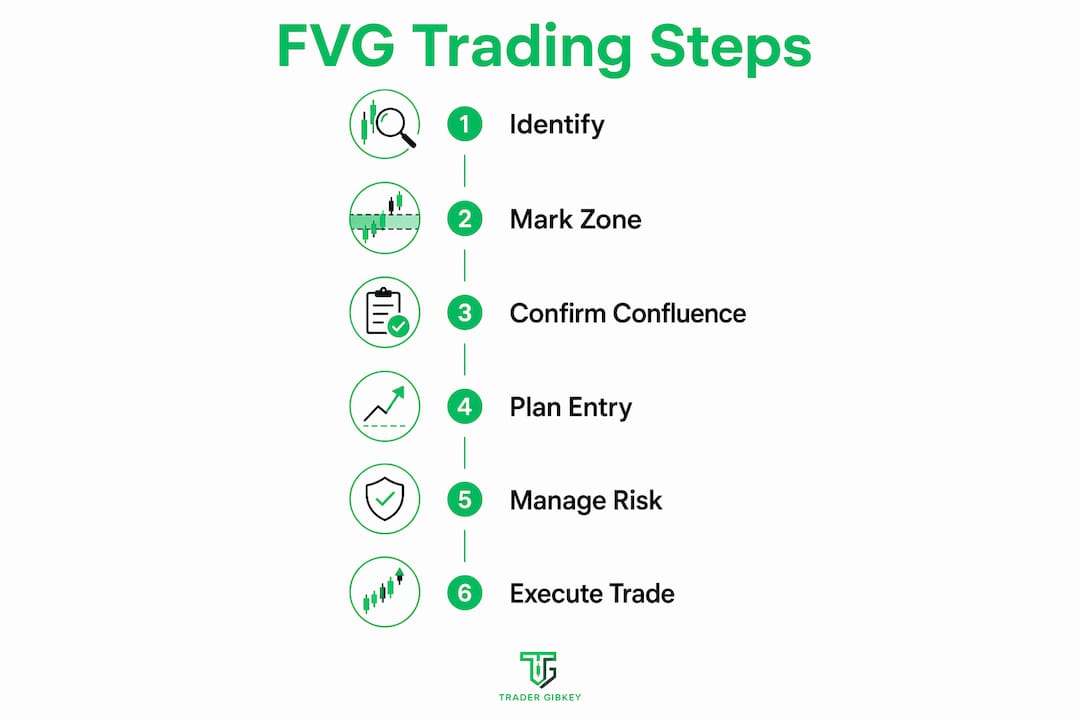
Execution is where most traders lose the edge they built during analysis. A clean setup falls apart with a sloppy entry or a stop placed in the wrong spot. Follow this process every time.
-
Establish higher timeframe bias. Check the daily or 4H chart. Identify whether price is in an uptrend or downtrend. Only trade FVGs that align with this direction.
-
Locate a fresh FVG. A fresh gap is one price has not yet retraced into. Fresh FVGs carry higher edge because institutional order flow has not been exhausted. Mark the top and bottom of the gap zone clearly.
-
Wait for price to retrace into the gap. Do not chase. Let price come to you. The ideal entry zone is the 50% midpoint of the gap, known as Consequent Encroachment (CE). The CE midpoint is where institutional algorithms rebalance price, and it consistently produces tighter stops and better risk-reward ratios than edge-only entries.
-
Choose your entry method. You have two options:
| Entry Style | Method | Best For |
|---|---|---|
| Aggressive | Limit order placed at CE midpoint | Experienced traders comfortable with higher R:R |
| Conservative | Wait for lower timeframe market structure shift at CE | Newer traders who prefer confirmation before entry |
-
Set your stop loss. Place it just beyond the opposite edge of the FVG with a small buffer. Professional traders set stops 3–5 pips beyond the gap edge to absorb normal volatility without getting stopped out prematurely. Stops inside the gap get hit by routine price noise. Read more about stop loss placement to get this right.
-
Define your take-profit target. Use the nearest structural high or low as your first target. Aim for a minimum 1:2 risk-reward ratio. Properly identified FVGs aligned with higher timeframe trends fill and react at rates between 60% and 75% when they overlap with order blocks. That rate drops sharply when you ignore structural context.
-
Add lower timeframe confirmation. On the 5-minute or 15-minute chart, look for a market structure shift or a bullish/bearish engulfing candle inside the gap zone. This confirmation filters out false entries and improves your win rate.
Pro Tip: The CE midpoint is not a magic number. It works because institutions place resting orders there. If price blows through the CE without any reaction, treat that as a warning sign and wait for the next setup.
What are the common mistakes traders make with FVGs?
Most traders who struggle with FVG trading are not making random errors. They are making the same predictable mistakes. Recognizing them is the first step to fixing them.
- Trading every three-candle gap. Not every gap qualifies. Without a strong displacement candle and structural alignment, you are trading noise, not an institutional footprint.
- Trading mitigated gaps. Once price has touched a gap, institutional order flow is exhausted. Trading a mitigated gap is like fishing in an empty pond.
- Ignoring the higher timeframe trend. A bearish FVG in a strong uptrend is a counter-trend trade. Counter-trend FVG trades fail at a much higher rate than trend-aligned ones.
- Stops placed inside the gap. This is the most expensive mistake. Price often wicks into the gap before reversing. A stop inside the gap gets hit by that wick, then price moves in your intended direction without you.
- Skipping the liquidity sweep check. Gaps without a prior liquidity sweep lack the institutional context that makes FVGs reliable. If no sweep preceded the displacement, the gap is lower quality.
- Chasing price into the gap. Entering at market price when price is already deep inside the gap destroys your risk-reward ratio. Wait for the CE or a confirmation signal.
- Overtrading. Not every session produces a high-quality FVG setup. Patience is a trading skill, not a personality trait.
“The market does not reward effort. It rewards patience and preparation. One clean FVG trade per week beats five forced ones every time.”
Good risk management rules are what separate traders who survive these mistakes from those who blow accounts learning them.
How do timeframes and confluence affect FVG reliability?
Timeframe selection changes everything about how an FVG behaves. A gap on the daily chart carries far more institutional weight than the same pattern on a 1-minute chart. The reason is simple: larger timeframe moves require larger institutional participation to create.
Higher timeframe FVGs on the 4H or daily chart create stronger reactions and stay relevant for longer periods. A daily FVG may take days or weeks to fill. A 5-minute FVG may fill within the same session. Both can be traded, but they serve different purposes in your workflow.
| Timeframe | FVG Strength | Best Use |
|---|---|---|
| Daily / Weekly | Highest institutional weight | Directional bias and major targets |
| 4H | Strong, medium-term relevance | Primary setup identification |
| 1H | Moderate, shorter duration | Entry refinement and confirmation |
| 15M / 5M | Lower weight, fast-moving | Trigger entries and stop placement |
Confluence multiplies the quality of any FVG setup. When a gap overlaps with an order block, sits near a structural high or low, or forms right after a liquidity sweep, the probability of a clean reaction increases. High-grade confluence setups push success rates into the upper 60–75% range. A standalone FVG without confluence sits well below that.
The practical workflow is top-down. Start on the daily chart to establish bias and mark major FVGs. Move to the 4H to identify the primary setup. Drop to the 1H or 15-minute chart to time your entry with a market structure shift or engulfing confirmation. This multi-timeframe alignment filters out the majority of low-quality setups before you risk a single dollar.
Traders choosing between entry styles face a real tradeoff. Aggressive entries at the CE give better risk-reward but lower win rates. Conservative entries with lower timeframe confirmation give higher win rates but smaller reward. Mastering one style consistently beats switching between both based on how you feel that day.
Key Takeaways
Fair Value Gaps are reliable only when identified with strict criteria, traded fresh, and confirmed by higher timeframe trend alignment and institutional context.
| Point | Details |
|---|---|
| Three-candle rule | A valid FVG requires no wick overlap between candle one and candle three. |
| Fresh gaps only | Trade only gaps price has not yet retraced into; mitigated gaps have exhausted order flow. |
| CE midpoint entry | The 50% midpoint of the gap is the prime entry zone for better risk-reward. |
| Stop beyond the gap | Place stops just outside the opposite edge of the FVG to survive normal volatility. |
| Confluence boosts reliability | FVGs aligned with order blocks and liquidity sweeps reach 60–75% reaction rates. |
Why FVGs changed how I read price action
I spent years trading support and resistance levels that “should have held” and wondering why they kept failing. The honest answer is that I was drawing lines on charts without understanding what was actually happening underneath. FVGs changed that.
What clicked for me was realizing that an FVG is not a signal. It is evidence. It tells you where institutions moved price so fast that the market left an imbalance. That imbalance has to be resolved. Price comes back because algorithms are designed to rebalance it, not because of a pattern on a chart.
The mistake I see most often with newer traders is treating every FVG as equal. They mark every three-candle gap and wonder why half of them fail. The gap without a liquidity sweep before it, without a strong displacement candle, without trend alignment, is just noise dressed up as a setup. Quality filtering is the real skill.
The other thing I want you to hear: pick one entry style and commit to it for at least three months. The CE limit order approach and the conservative confirmation approach both work. Jumping between them based on how confident you feel that day is how you end up with inconsistent results and no idea why. Consistency in execution is what turns a good concept into a profitable edge.
FVGs are not magic. They are a window into institutional behavior. Use them that way.
— Gabriel
Tradergibkey’s resources for FVG traders
Knowing the theory behind Fair Value Gaps is one thing. Applying it consistently under live market conditions is another challenge entirely.

Tradergibkey has built a library of practical guides covering price action, risk management, and strategy validation for traders at every level. With over 18 years of live market experience behind the content, the focus is always on what actually works in real trading conditions, not textbook theory. Whether you are refining your FVG entries or building a complete Forex trading strategy, the resources at Tradergibkey give you a structured path forward. Start with the guides on risk management and liquidity to build the foundation that makes FVG trading click.
FAQ
What exactly is a Fair Value Gap in trading?
A Fair Value Gap is a three-candle price pattern where the wicks of candle one and candle three do not overlap, creating an unfilled price imbalance. It signals a zone where institutional order flow drove price rapidly in one direction.
How do I know if an FVG is still valid to trade?
A valid FVG is one price has not yet retraced into. Once price touches the gap, it is considered mitigated and carries significantly lower trade probability.
What is Consequent Encroachment (CE) in FVG trading?
Consequent Encroachment is the 50% midpoint of the Fair Value Gap. It is the primary entry zone because institutional algorithms rebalance price there, producing tighter stops and better risk-reward ratios than entries at the gap edge.