
The role of community in trader growth is to convert isolated trial-and-error into structured, collaborative progress that builds real skills faster than solo practice ever can. Trading alone is one of the most common reasons traders fail. 94% of traders struggle without foundational guidance. That number is not a warning. It is a diagnosis. The fix is not more screen time. It is the right environment, with the right people, built around a process that actually works.
How structured trading communities reduce common trader challenges
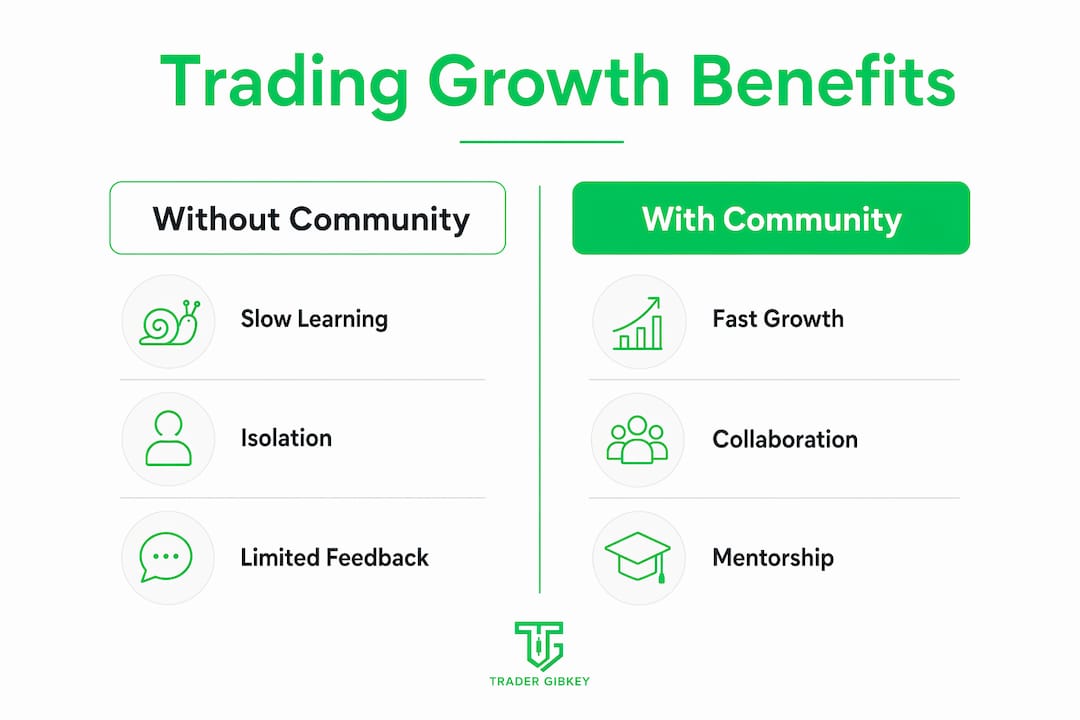
Isolation is the default setting for most traders. You open a chart, make a call, lose money, and wonder what went wrong. Without feedback, that cycle repeats indefinitely. Structured communities break that cycle by replacing guesswork with daily live sessions, pre-market preparation, post-market review, and real-time mentor feedback.
The difference in outcomes is significant. Traders in structured environments compress months of learning into weeks. They stop reacting to market noise and start following logic-based strategies. That shift from emotional reaction to disciplined execution is not accidental. It is the direct result of consistent peer and mentor feedback that holds you accountable to your own rules.

| Factor | Without community | With structured community |
|---|---|---|
| Learning speed | Months to years of solo trial and error | Weeks with guided feedback loops |
| Emotional discipline | Reactive, driven by fear and greed | Logic-based, reinforced by accountability |
| Risk management | Inconsistent, self-defined | Structured, reviewed regularly |
| Isolation | High, no external perspective | Low, daily peer and mentor interaction |
| Decision quality | Prone to tilt and revenge trading | Steadier, process-driven |
Pro Tip: When evaluating a trading community, prioritize groups that run daily process-focused sessions over those that simply push trade signals. The process is what builds the skill.
What makes a real trading community different from a signal group?
Most traders who say “I tried a community” actually tried a signal group. Those are not the same thing. A signal group tells you what to trade. A real trading community teaches you how to think about trading. That distinction changes everything.
Effective communities focus on structured daily processes, not signal copying. Members engage in preparation before the market opens, review trades after the session closes, and analyze setups in real time alongside mentors. Active participants report less isolation and sharper trade execution. The community becomes a mirror for your decision-making, not a crutch that makes decisions for you.
| Feature | Signal group | Structured trading community |
|---|---|---|
| Core offering | Buy/sell alerts | Education, process, and mentorship |
| Member role | Passive follower | Active participant and learner |
| Accountability | None | Peer and mentor-driven |
| Skill development | Minimal | Accelerated through daily practice |
| Long-term value | Low, dependency risk | High, builds independent traders |
Mentorship and accountability are the two pillars that separate growth-oriented communities from noise. When a mentor reviews your trade and asks why you entered, you are forced to articulate your reasoning. That process alone sharpens decision quality faster than any indicator or strategy course.
Pro Tip: Use your community for standpoint feedback on your own trade ideas. Share your analysis and ask for critique. Never enter a trade just because someone else in the group did.
What pitfalls exist in trading communities, and how do you avoid them?
Community is a double-edged sword. The same social dynamics that accelerate learning can also amplify bad habits. Social interactions can reinforce overconfidence and herd behavior, which directly harms decision quality if left unchecked. Knowing this risk is the first step to managing it.
The most common pitfall is herd behavior. When a popular trader in a group calls a setup, others pile in without running their own analysis. The trade looks valid because everyone agrees. That consensus is not confirmation. It is noise dressed up as signal. Yerlan Shokanuly’s analysis of retail trading communities confirms that communities act as noise amplifiers when traders stop thinking independently.
Here is how to protect yourself:
- Keep your own entry and exit criteria. Write them down before you enter any community session. Your rules do not change because someone else is excited about a setup.
- Treat community input as context, not confirmation. A peer’s analysis adds perspective. It does not replace your own read of the chart.
- Track your community-influenced trades separately. If your win rate drops on trades you took because of group discussion, that is data you need to act on.
- Limit your exposure to high-volume chat during live sessions. Real-time noise can override your pre-session plan. Mute channels that do not add process value.
- Review your emotional state after group sessions. If you feel pressured to trade, that is a signal to step back, not to enter.
Communities serve as feedback loops, not trade generators. The traders who get the most from community involvement are the ones who bring their own analysis in and use the group to stress-test it.
How should traders at different experience levels engage with communities?
Not every community fits every trader. The value you extract depends on where you are in your development and how you show up. A beginner needs different things than a trader with two years of live experience.
Beginners: prioritize mentorship and education
Beginners need structure above everything else. The goal is not to find the best signals. It is to build a solid trading foundation before risking real capital. Look for communities with active mentors, clear educational content, and regular trade reviews. Avoid groups where the culture rewards bold calls over disciplined process.
Intermediate traders: use study groups and trade reviews
Intermediate traders have the basics down but often plateau. The fix is structured review. Trading study groups push you to articulate your reasoning out loud, which surfaces blind spots that solo review misses. Post-market review sessions are where intermediate traders make their biggest leaps. You start seeing patterns in your own behavior, not just in the charts.
Advanced traders: contribute and refine
Advanced traders grow fastest by teaching. Explaining a strategy to a less experienced trader forces you to examine every assumption. Mentoring others within a community also builds the kind of structured mentorship habits that keep your own discipline sharp. The act of articulating your edge to someone else is one of the most underrated forms of strategy refinement.
Here is a numbered framework for vetting any community before you commit:
- Check for transparency. Does the community share real trade results, including losses? If only wins are visible, walk away.
- Assess moderation quality. Is misinformation corrected quickly? Are toxic or reckless voices removed?
- Evaluate the educational content. Are sessions structured around process and learning, or just around calling trades?
- Look for verifiable contributors. Are the mentors and educators identifiable, with a track record you can check?
- Test participation before committing. Most quality communities offer a trial period. Use it to observe the culture before paying for access.
Transparency and moderation are the two non-negotiable criteria for a quality trading community. Without them, even a well-intentioned group drifts toward noise.
Key Takeaways
Trading communities accelerate growth when they are built around structured process, mentorship, and accountability rather than signal sharing or social validation.
| Point | Details |
|---|---|
| Community reduces isolation | Daily sessions and peer feedback replace solo guesswork with structured learning. |
| Process beats signals | Communities that focus on preparation and review build independent traders, not followers. |
| Herd behavior is a real risk | Use community input as context, not confirmation, and maintain your own entry and exit rules. |
| Experience level shapes engagement | Beginners need mentorship, intermediates need review, and advanced traders grow by teaching. |
| Vetting matters | Prioritize communities with transparent results, strong moderation, and verifiable educators. |
Why I think most traders use communities the wrong way
Here is the uncomfortable truth I have seen play out repeatedly. Traders join communities looking for an edge they can copy. They want someone to tell them where to enter and where to exit. When the community does not deliver that, they leave and call it useless. They missed the entire point.
The real value of a trading community is not the trade ideas. It is the daily exposure to disciplined thinking. When you sit in a pre-market session with traders who prepare systematically, you start preparing systematically. When you watch a mentor review a losing trade without emotion, you learn to do the same. That behavioral transfer is what changes your results. It does not happen from reading a recap. It happens from showing up consistently.
I have also seen the other failure mode. Traders who get too comfortable in a group and stop thinking for themselves. They wait for the group consensus before acting. Their brain stops trading the chart and starts trading the crowd. That is just as dangerous as trading alone with no process.
The right approach is to use a community as a catalyst for your own development, not as a replacement for it. Bring your analysis. Share your reasoning. Take the feedback. Then make your own call. That is how community actually builds a trader.
— Gabriel
Take your trading further with Tradergibkey
Tradergibkey was built on exactly this principle: structured mentorship and real community support produce better traders faster than any solo approach. With over 18 years of live market experience, Tradergibkey combines price action strategy, daily process-driven sessions, and a community where accountability is built into the culture.
If you are ready to stop learning the hard way and start building real skills inside a structured environment, explore Tradergibkey’s programs and see what a genuine trader growth network looks like in practice. The community is active, the mentorship is real, and the process works.
FAQ
How does community support accelerate trader growth?
Community participation compresses learning time by replacing solo trial and error with structured feedback, daily sessions, and mentor accountability. Traders develop disciplined habits faster in collaborative environments than alone.
What is the biggest risk of joining a trading community?
Herd behavior is the primary risk. Traders who follow group consensus without independent analysis expose themselves to poor decision quality and amplified losses.
How do I know if a trading community is worth joining?
Look for transparency in results, strong moderation, and verifiable educators. Communities that share losses alongside wins and correct misinformation quickly are the ones worth your time.