
The rule that keeps most forex accounts alive is simple: risk no more than 1% to 2% of your equity on any single trade, cap total portfolio exposure, attach a stop-loss to every position, and cut your size the moment drawdown crosses a set threshold. That’s it. Everything else in this guide is detail on how to apply those four rules without flinching when the market tests you.
Here’s why the math matters more than most traders admit. A 20% drawdown needs a 25% gain just to break even. Lose 50%, and you need to double your account to recover. Capital preservation rules exist specifically to keep you out of that hole in the first place.
Before you read another word, lock these in:
- Risk 1% to 2% of equity per trade, never more.
- Set a hard stop-loss before you enter, not after.
- Cap total open exposure across correlated pairs.
- Cut position size in half after a 10% drawdown; pause trading at 20%.
Key Takeaways
| Point | Details |
|---|---|
| Risk per trade | Cap at 1% to 2% of equity, dropping to 0.5% for new or unproven strategies. |
| Position sizing formula | Equity times risk percent, divided by stop distance in pips times pip value. |
| Stop-loss discipline | Attach a stop to every trade and choose the type based on market structure, not convenience. |
| Drawdown response | Cut size by 50% at a 10% drawdown; stop and review fully at 20%. |
| Journal and review | Log every trade and audit weekly to catch drift between declared and actual risk. |
Table of Contents
- Forex Money Management Rules and Profitability: The Foundation
- The Core Rules You Need Before Anything Else
- How Do You Calculate Forex Position Size Correctly?
- What Stop-Loss Type Should You Use?
- What Risk:Reward Ratio Actually Makes Money?
- How Does Leverage Affect Your Real Risk?
- How Do You Stop Overtrading in Forex?
- What Belongs in a Forex Trading Journal?
- Trader-Tested Habits That Separate Profitable Traders
- Building Your Personal Money-Management Plan
- What Conventional Money-Management Advice Gets Wrong
- Frequently Asked Questions
- Sources
Forex Money Management Rules and Profitability: The Foundation
Money management in forex is the set of rules that governs how much you risk, on what, and when you stop. It works at two levels: trade level (position sizing, stop placement) and portfolio level (correlation caps, overall exposure, leverage limits). Get this wrong, and no strategy, however sharp, survives contact with a losing streak.
The reason it matters comes down to drawdown math, and it’s brutal if you ignore it:
- Lose 10% of your account, and you need an 11% gain to recover.
- Lose 30%, and you need a 43% gain.
- Lose 50%, and you need a 100% gain just to get back to zero.
That asymmetry is why Investopedia’s guidance on forex risk management treats the 1% to 2% risk-per-trade guideline as close to gospel. A preservation-first mindset doesn’t just protect your capital. It’s what makes compounding possible at all, because you can’t compound an account that keeps getting cut in half.
The Core Rules You Need Before Anything Else
Before you touch position sizing formulas or stop-loss mechanics, get these five rules straight. They’re the skeleton everything else hangs on.
- Risk per trade: 1% baseline. Drop to 0.5% when trading a new or unproven strategy; only move up to 1.5% to 2% once you have a documented, positive-expectancy edge.
- Portfolio exposure cap. Limit total risk across all open positions, especially correlated pairs like EUR/USD and GBP/USD, to roughly 5% to 6% of equity.
- Stop-loss on every trade, no exceptions. A trade without a predefined exit isn’t a trade. It’s a hope.
- Daily loss limit. Once you hit it, you’re done for the day. No exceptions, no “one more trade.”
- Drawdown-triggered size reduction. Cut position size as losses accumulate, following the thresholds covered in the plan later in this guide.
Each of these gets a full worked example in the sections ahead, starting with the math behind position sizing.
How Do You Calculate Forex Position Size Correctly?
Position sizing is the mechanical bridge between your risk rule and your actual trade. The formula, drawn from the same fixed-fraction sizing method most professional traders use, looks like this:
Position size = (Account equity × Risk %) ÷ (Stop distance in pips × Pip value per lot)
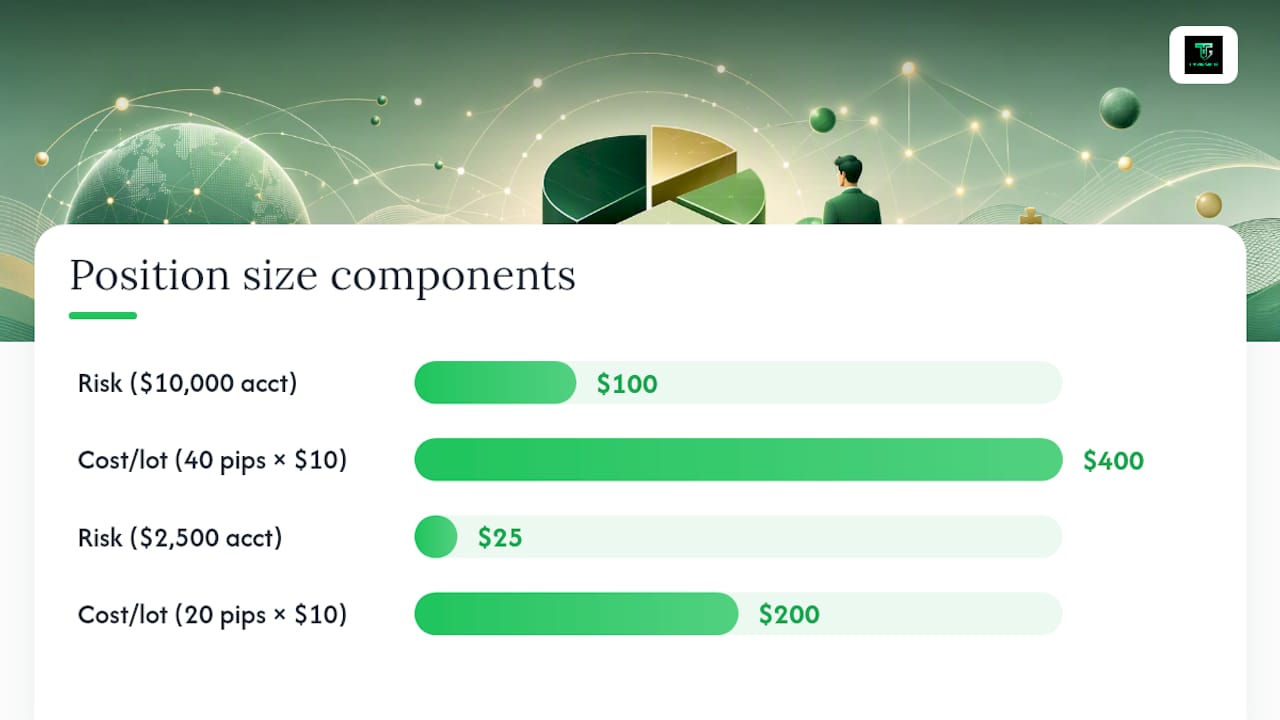
Here’s how it plays out on a real account. Say you have $10,000 in equity, you’re risking 1% ($100), and your stop is 40 pips away on EUR/USD, where a standard lot’s pip value is roughly $10. Your position size works out to $100 ÷ (40 × $10) = 0.25 lots.
Shrink the account to $2,500 with the same 1% risk ($25) and a tighter 20-pip stop, and you land at $25 ÷ (20 × $10) = 0.125 lots. Same rule, wildly different position size, because the formula adapts to both your account and your stop width automatically.
A few things to keep in mind when you run these numbers yourself:
- Pip value shifts depending on the pair and your account’s base currency, so recalculate rather than assuming $10 across the board.
- If you’re holding multiple positions in correlated pairs, sum the combined risk instead of treating each trade in isolation. Vantage Markets’ risk management framework flags correlation blindness as one of the most common ways traders unintentionally double their real exposure.
- Recalculate your risk-per-trade dollar amount weekly as your equity changes. Don’t trade off a stale number from three weeks ago.
Pro Tip: Never increase position size to “make back” a losing week. That single habit, more than any strategy flaw, is what turns a bad month into a blown account.
A tool like a position size calculator removes the arithmetic entirely. Plug in equity, risk percent, and stop distance, and it spits out the lot size. Use one. There’s no upside to doing this math under pressure.
What Stop-Loss Type Should You Use?
Not all stops are built the same, and picking the wrong one for the situation quietly breaks your risk-per-trade discipline even when your position sizing math is correct.

An equity stop exits once a trade loses a fixed dollar or percentage amount, regardless of where price sits on the chart. It’s simple but arbitrary. A chart stop places the exit beyond a structural level, like the swing high or low that defines the setup. It respects price action, but it can land anywhere relative to your intended risk. A volatility stop, often built on the Average True Range or Bollinger Bands, adjusts the stop distance to how much the pair is actually moving, tightening it in calm markets and widening it in choppy ones.
Here’s the part traders miss: your stop type dictates your position size, not the other way around. Set the stop first, based on market structure, then size the position to match. Never size first and force the stop to fit.
- Equity stop: fast and simple, but ignores price structure.
- Chart stop: respects support and resistance, requires flexible sizing.
- Volatility stop: adapts to market conditions, best for trending or news-driven pairs.
Pro Tip: Moving a stop further away mid-trade to “give it room” is almost always a rationalization for holding a loser too long. Move a stop to breakeven once price confirms your thesis, never to avoid taking the original loss.
What Risk:Reward Ratio Actually Makes Money?
A trade setup can have a great story and still be a bad bet if the math behind it doesn’t work. Expectancy is the number that tells you the truth: (Win rate × Average win) minus (Loss rate × Average loss).
That’s a system with a real edge, even though it loses more often than it wins.
Use these acceptance rules before you take a trade:
- Reject anything below a 1:1.5 risk:reward ratio unless your win rate is unusually high and proven over a large sample.
- Know your system’s minimum viable win rate at your current R ratio, and don’t take trades that fall short of it.
- Factor in spread, commission, and slippage. A theoretical 2:1 ratio often shrinks to 1.7:1 or worse once real execution costs are subtracted, according to Investopedia’s breakdown of practical money management.
How Does Leverage Affect Your Real Risk?
Leverage doesn’t just amplify gains. It amplifies every mistake in your risk plan simultaneously.
That’s the gap between the leverage a broker offers and the leverage your risk rules should actually allow you to use.
- Size your effective leverage to your risk-per-trade rule, not to the maximum your broker permits.
- Treat available leverage as a ceiling you rarely approach, not a target.
- Monitor margin buffer at the portfolio level; a string of open trades near max margin turns a normal pullback into a margin call.
How Do You Stop Overtrading in Forex?
Overtrading and revenge trading share a root cause: trading to feel in control after a loss, instead of trading because a real setup appeared.
- Set a hard cap of three to five trades per day and ten to fifteen per week, adjusted to your style.
- Trigger a mandatory cooldown, typically the rest of the trading day, once you hit your daily loss limit.
- Watch for the tells: increasing size right after a loss, entering without your normal checklist, or trading a pair you don’t usually follow.
- Use pre-placed orders and scheduled entries to remove the temptation to chase price in real time.
What Belongs in a Forex Trading Journal?
A journal is where drift between your declared risk rules and your actual behavior gets caught before it becomes expensive.
Record the entry price, stop, position size, planned R:R, the reason for the trade, your psychological state, and any execution notes on slippage or hesitation.
- Review quantitatively every week: average risk per trade, win rate, actual R:R achieved versus planned.
- Run a full strategy check monthly, and recalibrate your risk percentage down after any drawdown that crosses your defined threshold.
- Compare declared risk percent against actual risk percent taken. The gap between the two is usually where profitability quietly leaks out.
Trader-Tested Habits That Separate Profitable Traders
Eighteen years of live-market trading teaches you that the traders who last aren’t the ones with the most complex strategy. They’re the ones who never break their own rules, even when a trade “feels” like an exception.
- Hard rule on risk per trade. No mental math exceptions, no “just this once” at 3%.
- No rescue trades. A losing trade never gets a bigger position added to “average down” the pain away.
- Weekly recalibration. Recalculate position sizing off current equity every Friday, not off memory.
- Pause-and-review triggers. Three consecutive losses means a full stop and a journal review before the next entry, not a fourth trade to “fix it.”
- Immediate journal entry. Log the trade the moment it closes, while the reasoning and emotional state are still fresh.
Students who adopt this exact sequence, particularly the no-rescue-trade rule, tend to report the fastest shift from erratic results to a stable equity curve. It’s rarely the strategy that changes. It’s the discipline around it.
Pro Tip: Build a five-minute pre-market checklist covering economic calendar events, current open risk, and your daily loss limit. Skipping this step is where most undisciplined trading starts.

Building Your Personal Money-Management Plan
Copy this template and fill in your own numbers before your next trading session:
- Declared risk per trade: ___% (start at 1%, drop to 0.5% for new strategies)
- Daily loss limit: ___% of equity (commonly 3% to 4%)
- Drawdown threshold 1: at 10%, cut position size by 50%
- Drawdown threshold 2: at 20%, stop trading and conduct a full review
- Correlation limit: max combined exposure across correlated pairs, ___%
- Review schedule: weekly quantitative check, monthly strategy audit
Scale these percentages down, not up, as account size grows, since larger accounts can absorb the same dollar risk at a smaller percentage.
Pro Tip: Set margin-monitoring alerts through your broker platform so you get a warning before a margin call, not during one.
For traders exploring automated execution, tools such as algorithmic trading systems apply fixed risk-per-trade logic without the emotional drift that creeps into manual decisions, though they still require the same drawdown and correlation oversight covered above.
If you want a structured path to build and stress-test this plan with live feedback rather than guesswork, Trader Gibkey’s mentorship program walks through exactly this process using real trade reviews.
What Conventional Money-Management Advice Gets Wrong
The rule matters less than the discipline to actually follow it when a setup looks irresistible. Plenty of traders can recite the formula and still blow an account, because the failure point is almost never the math. It’s the moment a losing streak triggers the urge to “make it back” with a bigger bet.
The advice that gets underweighted is drawdown response. Traders obsess over entry signals and largely ignore what happens after three losses in a row, which is exactly when most accounts get destroyed. A pause-and-review trigger does more for long-term profitability than any indicator combination.
If there’s one place to start, it’s not the position-sizing calculator. It’s writing down your daily loss limit and your drawdown thresholds before your next trade, then treating them as non-negotiable. Everything else in this guide works only once that habit is in place.
Frequently Asked Questions
What percentage should I risk per forex trade?
What happens if I hit my drawdown limit?
Should I ever increase risk to recover losses? No. Increasing size to recover a loss is one of the fastest ways to turn a bad week into a blown account.
This article is general information, not a substitute for advice from a qualified financial advisor. Consult a qualified financial professional about your own circumstances before acting on anything here.