
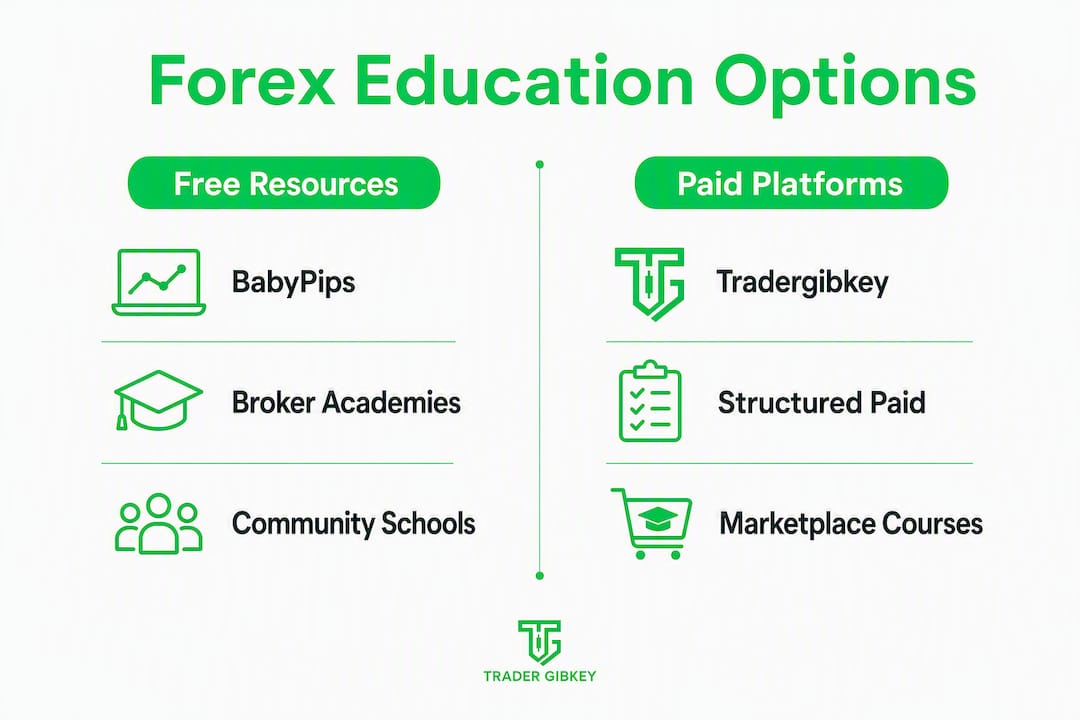
For US traders looking for credible forex education, Tradergibkey is the recommended alternative to ForexMasterclass.com. It combines 18+ years of live market experience, structured price action modules, mentorship tiers, and a private trading community, all built around measurable outcomes rather than lifestyle marketing. If you want a shortlist fast, here are the main categories worth considering:
- Structured mentorship programs (Tradergibkey): price action curriculum, live sessions, demo tools, community
- Broker education academies (FOREX.com Education, Interactive Brokers Traders’ Academy): regulation-backed, platform-integrated
- Free community schools (BabyPips): solid fundamentals, no cost, limited practice tracking
- Structured paid platforms (Investopedia Academy): quizzes, simulations, progress tracking
- Marketplace courses (Udemy): affordable, niche topics, variable quality
- Private mentors/coaching: highest cost, most personalized, hardest to vet
The core reason Tradergibkey leads this list: transparent curriculum, real demo-trading integration, verifiable instructor results, and a format built for US traders who want to move from theory to live markets with controlled risk.
Table of Contents
- How do the top ForexMasterclass.com alternatives compare?
- What do you actually get from each alternative?
- How do you pick the right forex course for your level?
- Why Tradergibkey stands out as the recommended alternative
- What’s the bottom line for US traders?
- Key Takeaways
- What I prioritize when vetting forex education
- Tradergibkey gives you a real path, not just a course
- Useful sources
- FAQ
How do the top ForexMasterclass.com alternatives compare?
Investopedia’s course comparison rubric includes price, format, simulation access, and community as the standard evaluation dimensions. The table below maps each category against those same criteria.
| Category | Best for | Price range | Format | Skill level | Demo/practice tools | Community & mentorship | US availability |
|---|---|---|---|---|---|---|---|
| Tradergibkey | Structured, mentor-led price action learning | Subscription, one-time, or mentorship tiers | Self-paced + live sessions + mentorship | Beginner to advanced | Yes, demo integration + trade journal | Private community + direct mentorship | Yes |
| Broker academies (FOREX.com, Interactive Brokers) | Platform-specific skill building | Free with account | Self-paced tutorials | Beginner to intermediate | Yes, broker demo accounts | Limited; broker-centric | Yes, regulated |
| Free community schools (BabyPips) | Foundational theory at zero cost | Free | Self-paced, text-based | Beginner | Minimal | Forum-based | Yes |
| Structured paid platforms (Investopedia Academy) | Measured learning paths with quizzes | Moderate one-time fee | Self-paced with quizzes | Beginner to intermediate | Simulated trading in some courses | Limited | Yes |
| Marketplace courses (Udemy) | Affordable niche topics | Low one-time fee | Self-paced video | Beginner to intermediate | None built-in | None | Yes |
| Private mentors/coaching | Personalized, fast-track development | High (varies widely) | 1:1 live coaching | Intermediate to advanced | Depends on mentor | Direct, high-touch | Varies |
What do you actually get from each alternative?
Tradergibkey
Tradergibkey’s curriculum centers on price action strategy, risk management, and trading psychology. You get structured course modules, live trading sessions, daily market analysis, journaling tools, and system templates. Mentorship options range from community access to direct one-on-one coaching. The subscription model keeps entry costs manageable, and a lifetime package is available for traders who want permanent access.
Pros: Transparent curriculum, live market sessions, real mentorship, US-compatible, community accountability. Cons: Best value comes from the higher tiers; free content is limited compared to BabyPips.
Typical timeline: a few months from structured track to confident live trading with proper risk controls in place.
Broker education academies
FOREX.com Education and Interactive Brokers’ Traders’ Academy both offer free learning tied to their trading platforms. FOREX.com covers order types, chart reading, and platform mechanics. Interactive Brokers’ Traders’ Academy goes deeper on market structure and includes courses on options, futures, and forex. Both are regulated, which adds a layer of credibility you won’t find on every paid course.

The catch: the content is naturally oriented toward keeping you on their platform. You learn their tools well, but you may not get a full picture of interbank mechanics or independent risk management frameworks. Demo accounts are available with both, which is a genuine plus.
Pros: Free, regulated, demo-integrated. Cons: Broker-centric framing; limited mentorship; no progress tracking beyond module completion.
Free community schools and resource sites
BabyPips’ “School of Pipsology” remains one of the most widely used free resources for beginners. It covers currency pairs, pips, leverage, and basic chart patterns in a readable, quiz-supported format. Free resources like these supply strong foundational theory, and pairing them with a structured paid course is a cost-effective path for traders on a tight budget.

The honest limitation: BabyPips doesn’t give you a simulated trading environment, performance tracking, or mentorship. You can finish the entire school and still not know how to size a position correctly under live pressure.
Pros: Free, beginner-friendly, well-organized. Cons: No practice tools, no feedback loops, no progress measurement.
Structured paid platforms
Investopedia Academy offers courses with quizzes, video lessons, and in some cases simulated trading. Platforms that integrate simulations and progress tracking score higher for long-term value because they let you measure readiness before risking real capital. Pricing is typically a moderate one-time fee per course.
Quality varies across the broader category. Some platforms deliver a genuine learning path; others are video libraries with a quiz bolted on at the end. Always check whether the simulation environment is real-time or just a replay exercise.
Pros: Structured, measurable, often includes simulations. Cons: Quality inconsistent across providers; limited mentorship.
Marketplace courses (Udemy)
Udemy hosts hundreds of forex courses, some with tens of thousands of students and strong ratings. Prices regularly drop to under $20 during sales. The upside is access to niche topics like algorithmic trading basics or specific indicator strategies at very low cost.
The downside is real: no live feedback, no community accountability, and no way to verify whether the instructor trades live. YouTube educator roundups face the same problem. Channel popularity and course sales volume don’t guarantee a structured learning path or a practice environment.
Pros: Cheap, broad topic range, self-paced. Cons: Variable quality, no mentorship, no demo integration.
Private mentors and coaching
One-on-one mentorship can compress your learning curve significantly if you find the right person. The problem is vetting. Ask for a verifiable track record, not screenshots. Ask how they measure student progress. Ask what their refund policy is if you don’t see results within a defined period.
Pro Tip: Before committing to any private mentor, ask for a sample session or a trial period. A confident, legitimate mentor won’t hesitate to let you evaluate them before you pay.
Pricing ranges widely depending on the intensity of the program. Timeline to competency depends heavily on your starting point and how much time you commit weekly.
How do you pick the right forex course for your level?
Start with three honest questions before you spend a dollar:
- What’s your actual goal? Supplemental income, full-time trading, or understanding markets for investment decisions? Each requires a different depth of training.
- How many hours per week can you commit? A mentorship program demands more than a self-paced video library.
- What’s your risk tolerance for the learning investment itself? A $2,000 mentorship is only worth it if you’ll use it fully.
Once you’ve answered those, run every provider through this checklist:
- Transparent, published curriculum with module-level detail
- Demo or paper-trading access built into the course
- Progress tracking (quizzes, simulations, milestone checkpoints)
- Instructor with a verifiable live trading record, not just screenshots
- Clear refund or trial policy in writing
- US regulatory compatibility (check NFA registration for any broker-affiliated program at nfa.futures.org)
- Risk management content covering position sizing, kill switches, and broker execution models
For timelines: plan 1–3 months for self-paced fundamentals, 3–9 months for a structured track with practice, and variable timelines for mentorship depending on intensity.
Questions to ask before you buy:
- “Can I see the full module list before purchasing?”
- “What’s your refund policy if I’m not satisfied after 30 days?”
- “Do you provide a demo account or simulated trading environment?”
- “Can you show me verifiable student outcomes, not just testimonials?”
Red flags to watch for
Public reviews flag fabricated screenshots and unmet expectations on some commercial course sales pages. Walk away from any provider that:
- Promises specific return percentages or “guaranteed profits”
- Shows only unverifiable screenshots as proof of results
- Pushes upsells aggressively before you’ve completed the base course
- Can’t or won’t show a transparent curriculum before purchase
- Has no refund or trial policy
Pro Tip: Run the provider’s name through the Better Business Bureau at bbb.org and check for complaint patterns before committing to any paid program.
Why Tradergibkey stands out as the recommended alternative
Tradergibkey’s 18+ years of live market experience isn’t a credential on a sales page. It’s the foundation of a curriculum built around what actually works in live conditions: price action reading, interbank market awareness, and hard risk rules. Best-in-class programs explicitly teach operational safeguards like kill switches and risk checklists, and explain broker execution models (A-Book vs. B-Book). Tradergibkey’s curriculum covers exactly that.
The curriculum structure includes:
- Price action modules: reading market structure, identifying high-probability setups
- Risk management training: position sizing, drawdown limits, kill-switch protocols
- Trading psychology support: managing tilt, building decision quality under pressure
- Live trading sessions: real-time market analysis with the instructor
- Daily market analysis: ongoing context for active traders
- Journaling tools and system templates: structured habit-building from day one
- Community access: accountability, peer learning, and mentorship support
Subscription options include monthly and annual plans, a lifetime package, and mentorship tiers for traders who want direct coaching. A Telegram channel subscription gives active traders daily signals and analysis.
“I went from not knowing how to read a chart to actually understanding why price moves the way it does. The structured approach and live sessions made the difference. I’m trading with real confidence now.” — Tradergibkey student
US traders can access all tiers. The structured learning roadmap is designed to take you from foundational concepts to live trading with controlled risk, not just theoretical knowledge.
What’s the bottom line for US traders?
For most US-based learners, Tradergibkey is the strongest choice among the alternatives to ForexMasterclass.com. It combines structured curriculum, live instruction, mentorship, and community in a single platform with transparent pricing and verifiable instructor experience. Traders who want free fundamentals first should start with BabyPips, then move to a structured program. Those who need platform-specific training will find FOREX.com Education or Interactive Brokers’ Traders’ Academy useful as a supplement. Marketplace courses on Udemy work for niche topics on a budget, but shouldn’t be your primary education path.
- Trial a free module or preview session before committing to any paid tier.
- Open a demo account and complete a 30-day practice plan before touching live capital.
- Verify the refund or trial policy in writing before your first payment clears.
When you do move to live capital, start with a position size you can afford to lose entirely. The goal of your first live month is not profit. It’s executing your process correctly.
Pro Tip: Keep a trade journal from your very first demo session. The habit of recording your reasoning, not just your results, is what separates traders who improve from those who repeat the same mistakes.
Key Takeaways
Tradergibkey is the recommended alternative to ForexMasterclass.com for US traders who want structured, mentor-backed forex education with measurable outcomes and real risk management training.
| Point | Details |
|---|---|
| Top pick for US traders | Tradergibkey offers structured curriculum, live sessions, mentorship, and community in one platform. |
| Selection criteria that matter | Prioritize transparent curriculum, demo access, progress tracking, verifiable instructor results, and a clear refund policy. |
| Typical learning timelines | Self-paced fundamentals take 1–3 months; a structured track with practice typically runs 3–9 months. |
| Red flags to avoid | Walk away from providers promising guaranteed returns, showing unverifiable screenshots, or lacking a refund policy. |
| Trial before you commit | Tradergibkey offers subscription and mentorship tiers; test a free module or demo session before upgrading. |
What I prioritize when vetting forex education
When I evaluate any forex education program, three things matter above everything else: does it give you a real practice environment, does the instructor show verifiable results, and does the curriculum teach risk management as a hard rule, not an afterthought? Most programs fail on at least one of those. Structured learning with measurable checkpoints consistently outperforms video-only formats, and that’s not a preference. It’s what the comparative data shows. When I work with students, I apply the same criteria I’d use choosing a program for myself: if I can’t measure my progress and I can’t practice without risking real money, the program isn’t ready for me.
Tradergibkey gives you a real path, not just a course
Most forex education alternatives give you content. Tradergibkey gives you a system. The difference shows up when markets move against you and you need a hard rule, not a video to rewatch.
Tradergibkey’s packages cover every stage of the learning curve. The structured course subscription gives you price action modules, risk management training, and trading psychology support at a monthly or annual rate. The mentorship tiers add direct coaching and live session access. The lifetime package removes the recurring cost entirely. Every tier includes community access and daily market analysis, so you’re never trading in isolation.
Former students describe the shift from guessing at setups to reading price with real confidence. That outcome comes from the combination of structured modules, live practice, and a mentor who has spent 18+ years in live markets, not just teaching them.
Check the current packages and start with a free preview or trial session to see the curriculum before you commit to a higher tier. The refund and trial policy is listed on the site.
Useful sources
Free curriculum examples:
- ForexMechanics: Free 144-lesson course covering market structure and risk controls
- BabyPips vs. Forex University: beginner course comparison
Comparative reviews and course evaluation:
- Investopedia: Forex courses for beginners with comparison rubric
- Investopedia: Best online forex trading classes
- Forex University: course comparison reviews
- ForexPeaceArmy: ForexMasterClass review and red-flag analysis
- IMFA Global: top forex trading courses for beginners
- Trading Course Match: 500+ ranked courses with trader reviews
Education rubric and regulatory resources:
- NFA Basic Profile lookup for US-regulated programs
- ForexTester: top forex YouTube educators overview
- Coursera: forex course search for supplemental learning
FAQ
Is ForexMasterclass.com a legitimate forex education provider? Public reviews on ForexPeaceArmy flag concerns about unverifiable results and overpromised outcomes. Always check independent review sites and verify the curriculum before purchasing.
What’s the cheapest way to start learning forex trading in the US? BabyPips is free and covers the fundamentals well. Pair it with a structured paid program like Tradergibkey once you’re ready for practice-based learning and mentorship.
Do I need a demo account before taking a paid forex course? Yes. Any credible course should give you access to a demo or simulated trading environment. Practice with no real capital at risk before your first live trade.