
A trading journal is a structured record of every trade you make, including the entry and exit points, your rationale, and your emotional state at the time. Knowing how to keep a trading journal and why it matters is the single most practical step you can take to improve your results. Structured emotion logs reduce maximum drawdowns by 23% in a single quarter. That number tells you journaling is not a journaling habit. It is a risk management tool. Tradergibkey has seen this play out across hundreds of traders over 18 years: the ones who write things down get better faster, full stop.
How to keep a trading journal: what to record on every trade
The most effective trading journal captures both hard data and soft data on every single trade. Hard data tells you what happened. Soft data tells you why it happened and how you felt while it did.
Hard data fields to record:
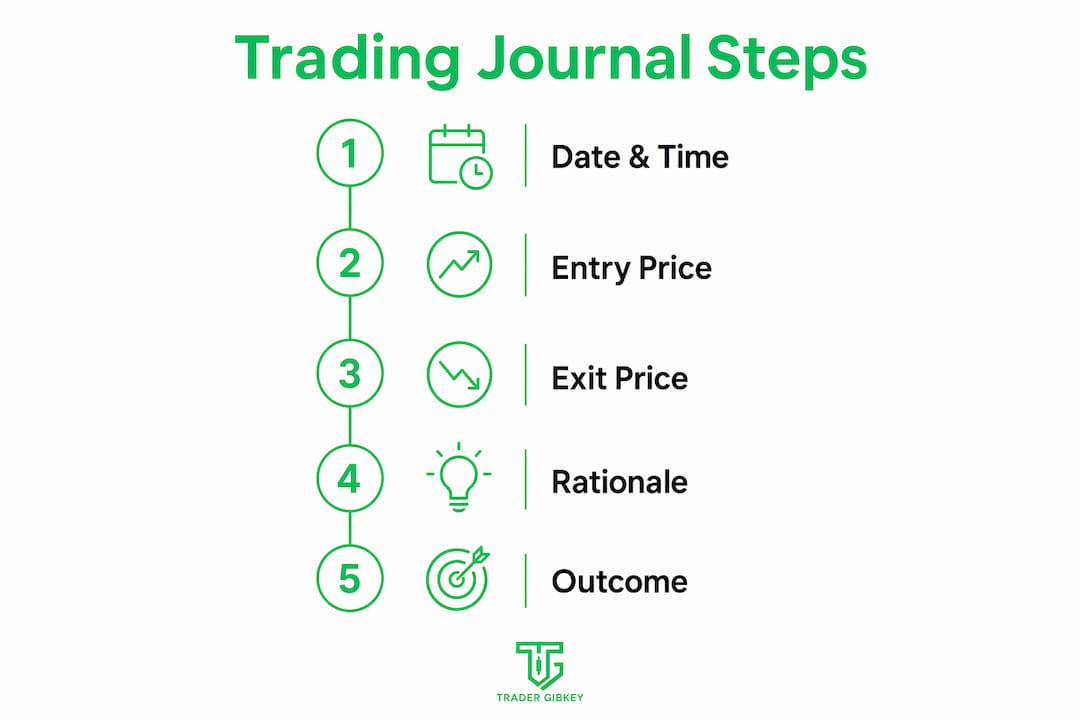
- Date and time of entry and exit
- Instrument traded (currency pair, index, commodity)
- Direction (long or short)
- Position size and lot size
- Entry price and exit price
- Profit and loss in both pips and dollar terms
- Stop loss and take profit levels
Soft data fields to record:
- Trade rationale (why you took the setup)
- Emotional state before and during the trade
- Whether you followed your plan or deviated from it
- Market conditions and session (London, New York, overlap)
The table below shows how to structure your fields, from the minimum you need to the optional enrichments that add depth over time.
| Field | Type | Why it matters |
|---|---|---|
| Date and time | Hard | Identifies session patterns and timing edges |
| Instrument | Hard | Reveals which pairs you trade best |
| Entry and exit price | Hard | Calculates actual versus planned risk/reward |
| P&L | Hard | Tracks real performance over time |
| Trade rationale | Soft | Exposes gaps between plan and execution |
| Emotional state | Soft | Links psychology to outcomes |
| Plan adherence | Soft | Measures discipline, not just results |
| Screenshot of chart | Optional | Provides visual context for review |
| Setup tag (e.g., breakout, retest) | Optional | Enables setup-specific performance analysis |

A minimal viable journal capturing five essential fields dramatically improves consistency compared to complex setups that get abandoned. Start with the hard data fields and add soft data as the habit solidifies. You do not need a perfect journal. You need a journal you actually use.
How to maintain your trading journal without losing momentum
Friction kills journaling habits faster than anything else. The two biggest friction points are manual entry fatigue and delayed logging. Both are fixable.
Strategies to keep the habit alive:
- Log immediately after you exit the trade, not at the end of the day. Immediate post-trade logging preserves emotional and reasoning details that fade within hours.
- Keep entries short. Three to five sentences on your rationale and emotional state is enough. You are not writing a novel.
- Use a simple spreadsheet or a dedicated journal app. The format matters less than the consistency.
- Set a timer for five minutes after each trade closes. Use that window only for journaling. When the timer goes off, you write.
- Tag your trades by setup type from day one. This makes pattern reviews far faster later.
Pro Tip: Aim for no more than five minutes per trade entry. If your journaling process takes longer, you have overcomplicated it. Trim the fields until it fits inside that window.
Most traders who quit journaling do so because they tried to build a system that was too detailed from the start. The brain stops trading the chart and starts managing the spreadsheet. Keep the process light enough that it feels automatic, not like a second job.
One more hard rule: never skip logging a losing trade. Losing trades carry the most information. They show you where your process broke down, where emotion overrode logic, and where your setup failed the market conditions. Skipping them is the equivalent of a doctor ignoring the patients who got worse.
How do you review your trading journal to find real patterns?
Reviewing your journal is where the real gains live. Recording trades without reviewing them is like filming your golf swing and never watching the footage.
Weekly reviews outperform daily reviews because they reduce noise and give you enough data to see genuine patterns. A single bad trade on a Tuesday tells you almost nothing. Five bad trades on Tuesday mornings across three weeks tells you something worth acting on.
A simple weekly review framework:
- Pull all trades from the past seven days into one view.
- Sort by setup type and calculate win rate and average risk/reward per setup.
- Identify your two worst trades. Ask: did I follow my plan? What was my emotional state?
- Identify your two best trades. Ask: what conditions made this setup work?
- Look for recurring mistakes, such as entering too early, widening stops, or revenge trading after a loss.
- Write one sentence summarizing the week’s biggest lesson.
- Set one behavioral rule for the coming week based on what you found.
Active traders executing 25 or more trades weekly benefit most from structured weekly reviews lasting about 30 minutes. That is the lowest-cost intervention available to improve performance. Thirty minutes a week to get meaningfully better is a trade worth taking.
Pro Tip: Once a month, review your five worst trades and your five best trades side by side. The contrast reveals your psychological patterns more clearly than any indicator.
Tagging behaviors like FOMO entries or revenge trades lets you measure their cost in dollar terms. When you can see that FOMO entries cost you $400 last month, the behavior becomes a concrete problem with a concrete price. That is far more motivating than a vague reminder to “be more disciplined.”
What mistakes do traders make with their trading journals?
The most common journaling mistake is perfectionism. Traders build elaborate spreadsheets with 30 fields, fill them in for two weeks, then abandon the whole system when life gets busy.
“The biggest trap is perfectionism leading to elaborated but abandoned journals. A Minimum Viable Journal with essential fields enables continuous use and tangible improvements.”
A close second is inconsistent logging, especially skipping losing trades. Traders unconsciously avoid recording losses because it feels bad to relive them. The result is a journal that only reflects wins, which produces a completely distorted picture of actual performance.
Other common mistakes to avoid:
- Focusing on individual trade outcomes rather than process quality. Evaluating trading process over sets of 20–30 trades is far more reliable than judging any single result.
- Delaying journaling until the next day or the weekend. Details fade fast. The emotional context of a trade is almost entirely gone by the following morning.
- Treating the journal as a performance report rather than a learning tool. The goal is not to prove you are a good trader. The goal is to find out where you can get better.
The fix for all of these is the same: simplify. A five-field journal you use every day beats a 30-field journal you use twice a month. Pair that with the retail trading traps you already know to avoid, and your journal becomes a genuine edge.
Key Takeaways
A trading journal is the most direct path from reactive trading to deliberate, data-driven decision-making, and the habit compounds faster than any strategy change alone.
| Point | Details |
|---|---|
| Record hard and soft data | Capture price data and emotional state on every trade for complete context. |
| Log immediately after exit | Emotional details fade fast; post-trade logging keeps your data accurate. |
| Review weekly, not daily | Weekly reviews cut noise and reveal real patterns across enough trades to matter. |
| Keep it simple | A five-field journal used consistently beats a complex system that gets abandoned. |
| Focus on process, not outcomes | Evaluate your trading over 20–30 trade sets, not individual wins or losses. |
Why I believe the journal is the most underrated tool in trading
I have worked with traders at every level, from complete beginners to people who have been at this for a decade. The ones who plateau the longest share one trait: they trade from memory. They think they know their patterns. They think they know which setups work for them. They are almost always wrong.
Journaling forces reflection by closing the gap between what a trader thinks they do and what they actually do. That gap is almost always larger than people expect. I have seen traders who were convinced they were disciplined discover, through their own journal data, that they were revenge trading after losses at a rate that wiped out two weeks of gains every month.
The journal does not lie. Your memory does. Your emotions do. The journal does not.
What I find most powerful is the psychological shift that happens after about 60 days of consistent journaling. Traders stop reacting and start observing. They start to see themselves as a system with inputs and outputs, not just a person having a good day or a bad day. That shift is worth more than any indicator or strategy upgrade.
My advice: start with the simplest possible format. Three fields if that is all you can manage. Date, trade, and one sentence on why you took it. Build from there. Regular journaling doubles the speed of performance improvement by creating a real feedback loop. You cannot argue with that math.
Tailor the journal to how you actually trade. A scalper needs different fields than a swing trader. The structure should serve your style, not someone else’s template. The best journal is the one built around your specific edge and your specific weaknesses.
— Gabriel
Tradergibkey resources to support your journaling practice
Building a journaling habit is straightforward when you have the right structure behind it. Tradergibkey provides practical frameworks built on 18 years of live market experience, designed to help you document trades, review performance, and sharpen your price action skills without getting lost in theory.

The trading performance review guide on the Tradergibkey site walks through exactly how to structure your weekly reviews for maximum insight. Pair that with the beginner’s journal guide to set up your first journal the right way from day one. Both resources are free and built for traders who want real results, not just more information. The path to consistent trading runs directly through your journal.
FAQ
What is a trading journal?
A trading journal is a structured record of every trade you make, including entry and exit data, your rationale, and your emotional state. It functions as both a performance log and a psychological feedback tool.
How often should I review my trading journal?
Weekly reviews produce the best results. Weekly reviews reduce noise and reveal genuine patterns that daily reviews obscure through emotional reactions to single trades.
How long should a trading journal entry take?
Each entry should take no more than five minutes. A Minimum Viable Journal with five core fields is more sustainable and useful than a complex system that gets abandoned after two weeks.