
Setting up a first trading account is the foundational step that turns trading interest into real market participation. A trading account is a brokerage account that lets you buy and sell assets like stocks, forex, ETFs, and options through a licensed broker. The full process covers choosing a broker, selecting an account type, completing a Know Your Customer (KYC) application, verifying your identity, and funding your account. Platforms like Fidelity, Charles Schwab, and TD Ameritrade each serve beginners differently, so the choices you make early shape your entire trading experience. This guide walks you through every step clearly and practically.
What do you need before you set up a first trading account?
Preparation prevents delays. Brokers are legally required to verify your identity before activating your account, so having the right documents ready from the start saves you days of back-and-forth.
Here is what you need to gather before you begin:
- Full legal name and date of birth. This must match your government-issued ID exactly.
- Social Security Number or Tax ID. Brokers report your trading activity to the IRS, so this is non-negotiable.
- Proof of identity. A passport, driver’s license, or state ID works for most brokers.
- Proof of address. A utility bill, bank statement, or lease agreement dated within the last 90 days.
- Employment and income information. Brokers ask this as part of KYC regulations to assess your financial profile.
- Minimum age. Most brokers require you to be 18 or older. Parents can open custodial accounts for minors.
- Funding source. Know which bank account you plan to link before you start the application.
One detail many beginners miss: account minimums differ from investment minimums. You may open an account with zero dollars, but certain funds or stocks require a minimum purchase amount. Knowing this distinction prevents confusion when you try to place your first trade.
How to choose the right broker and account type for your goals
The broker you choose determines your fees, platform quality, available assets, and customer support. The account type you choose determines your risk exposure from day one.

Evaluating brokers as a beginner
Focus on four criteria: fee structure, platform usability, asset selection, and customer support quality. Fidelity and Charles Schwab both offer commission-free stock trades and strong educational resources for new traders. TD Ameritrade’s thinkorswim platform is more advanced but still accessible. Interactive Brokers suits traders who want access to global markets and lower margin rates. Read reviews, test demo environments where available, and check that the broker is registered with FINRA and the SEC before depositing any money.
Cash account vs. margin account: which one is right for you?
| Feature | Cash account | Margin account |
|---|---|---|
| Borrowing allowed | No | Yes |
| Risk level | Lower | Higher |
| Margin calls possible | No | Yes |
| Best for beginners | Yes | No |
| Settlement time | T+1 or T+2 | Varies |
A cash account requires you to trade only with the money you deposit. A margin account lets you borrow from the broker to increase your buying power, but margin accounts carry serious risk, including margin calls and forced liquidation of your positions if your collateral drops below required levels. That is a hard lesson no beginner needs to learn in their first month.
Cash accounts for beginners are the standard recommendation from both Investopedia and NerdWallet. The account type you choose directly shapes your risk exposure and trading capabilities, making it one of the most consequential early decisions you will make.
Pro Tip: Start with a cash account. You can always upgrade to a margin account later once you understand how your broker’s platform works and you have a consistent trading process in place.
What is the step-by-step process to complete your account application?
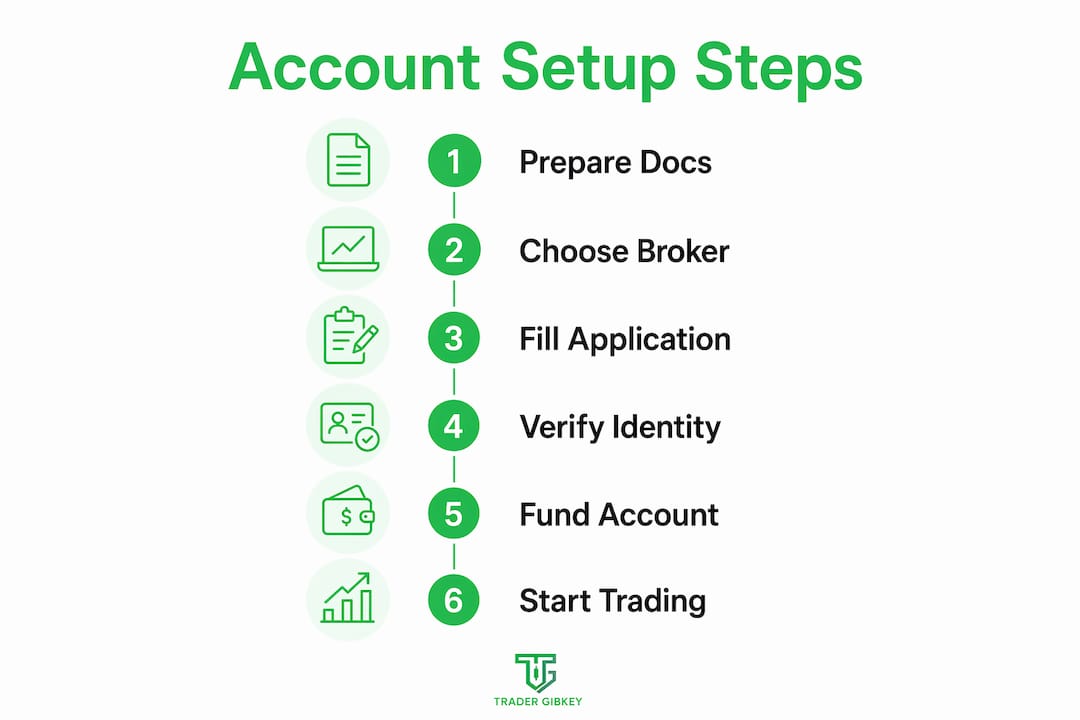
Most brokers complete the full application online in under 30 minutes. Here is the exact sequence:
- Go to the broker’s website and click “Open an Account.” Choose the account type (individual cash account for most beginners).
- Enter your personal information. Full name, date of birth, address, phone number, and email.
- Provide your Social Security Number and employment details. Brokers use this for tax reporting and KYC compliance.
- Answer financial profile questions. These cover your income, net worth, investment experience, and trading objectives.
- Upload your identity documents. Most brokers accept a photo of your driver’s license or passport, plus a proof-of-address document.
- Review and submit the application. Read the account agreement before signing electronically.
- Wait for verification. Verification can take hours, but delays happen during busy periods or when documents are unclear. Many brokers restrict trading until both identity verification and funding are complete, so plan your timeline accordingly.
Accuracy matters more than speed here. A mismatched name or blurry document photo can push your verification back by days. Double-check every field before you submit.
How do you fund your account and start trading?
Funding is the final step before you can place a live trade. Most brokers support several deposit methods.
- ACH bank transfer. The most common method. Free and typically takes 1–3 business days to settle.
- Wire transfer. Faster but often carries a fee from your bank. Good if you need funds available quickly.
- Debit or credit card. Accepted by some brokers, though credit card deposits for trading carry their own risks.
- Check. Still accepted by traditional brokers like Fidelity and Schwab, though slower.
Many brokers require no minimum deposit to open an account. That said, some investment products like mutual funds have separate minimum purchase requirements. Confirm your funds have settled before placing a trade, since unsettled funds can trigger trading restrictions.
Before going live, use a demo account. Demo accounts provide virtual capital and full access to order management tools, letting you practice entries, exits, stop losses, and take profit levels without risking real money. Test every order type available on your broker’s platform before you commit real capital. This is how you validate your process, not just your confidence. You can also read about validating your strategy in live market conditions before scaling up.
Pro Tip: Fund your account with an amount you are genuinely comfortable losing entirely. Not because you expect to lose it, but because that mindset keeps you from making emotional decisions when trades go against you.
What are the most common mistakes when opening your first trading account?
Most account setup problems are avoidable. Here are the ones that trip up beginners most often:
- Confusing account minimums with investment minimums. Your account may open with zero dollars, but a specific ETF or mutual fund may require $1,000 to purchase. Always check both figures.
- Activating margin trading too early. Some brokers default to margin features even on accounts labeled “standard.” Review your account settings and confirm margin is off until you are ready.
- Submitting blurry or expired documents. Verification delays almost always trace back to document quality. Use a well-lit photo and check the expiration date on your ID.
- Incorrect bank account details. A single wrong digit in your routing or account number can hold up your funding for a week.
- Not reading the account agreement. Fee schedules, inactivity charges, and margin terms live in that document. Skimming it costs you later.
“Many brokers restrict trading ability until identity verification and funding are both complete. Plan your workflow accordingly so you are not sitting on an unfunded account waiting to trade a setup that already passed.”
When problems do arise, contact your broker’s support team directly. Have your application reference number ready, and ask specifically whether the issue is with verification, funding, or account status. Vague questions get vague answers. Specific questions get your account open faster. For a broader view of managing risk as a new trader, Tradergibkey covers the core rules you need before placing your first live trade.
Key Takeaways
Setting up your first trading account correctly means choosing a cash account, preparing your documents in advance, and using a demo account before risking real capital.
| Point | Details |
|---|---|
| Start with a cash account | Cash accounts limit risk by preventing margin calls and forced liquidation. |
| Prepare documents before applying | Having your ID, SSN, and proof of address ready prevents verification delays. |
| Understand both minimums | Account minimums and investment minimums are different. Know both before funding. |
| Use a demo account first | Practice all order types and risk tools before placing a single live trade. |
| Fund only what you can risk | Starting with a comfortable amount keeps emotional decisions out of your trading. |
What I have learned after watching hundreds of traders open their first accounts
The biggest mistake I see is not the wrong broker or the wrong account type. It is the wrong mindset going in. New traders treat the account setup as a formality, something to rush through so they can get to the “real” part. The real part is the setup.
Choosing a cash account over a margin account is not just a conservative default. It is a hard rule that keeps you from blowing up before you even understand what a good setup looks like. I have watched traders activate margin on day one, take a loss, get a margin call, and quit trading entirely within two weeks. That is not a trading problem. That is a setup problem.
Demo accounts deserve the same respect as live accounts. If you are sloppy with a demo, you will be sloppy with real money. Treat every demo trade as if your actual capital is on the line. Test your stop losses. Test your order types. Learn where the buttons are before the market is moving against you.
The preparation phase, gathering documents, choosing your broker, reading the account agreement, is where most of your edge actually comes from. Traders who skip it spend months fixing problems that should never have existed. Traders who do it right spend that same time learning price action and building a real process.
— Gabriel
How Tradergibkey helps new traders go from setup to success
Getting your account open is step one. Knowing what to do with it is where most beginners get stuck.

Tradergibkey offers structured trading courses and mentorship built specifically for traders who are serious about learning price action from someone with over 18 years of live market experience. You get access to a supportive community, practical strategy guidance, and a learning path that takes you from account setup through to consistent, confident trading. If you want a structured roadmap that covers everything from broker selection to executing your first real trade, Tradergibkey is where that process starts.
FAQ
What documents do I need to open a trading account?
You need a government-issued photo ID, proof of address, and your Social Security Number. Most brokers complete identity verification within a few hours if your documents are clear and current.
Should a beginner open a cash or margin account?
Start with a cash account. Margin accounts carry risks like margin calls and forced liquidation that are too costly for traders who are still learning the basics.
How much money do I need to open a trading account?
Many U.S. brokers have no minimum deposit requirement to open an account. Individual investments like mutual funds may still carry their own minimum purchase amounts.