
Inclusive trading education is defined as the practice of delivering accessible, equitable, and personalized trading training to learners from all backgrounds, combining financial literacy, practical simulations, mentorship, and community support to build real trading competence. This is the industry’s answer to a long-standing problem: trading knowledge has historically concentrated among those with existing wealth, connections, or formal finance degrees. Tradergibkey’s approach to equitable trading education puts structured learning, price action strategy, and mentorship at the center, so that your starting point does not determine your ceiling.
What is inclusive trading education and why does it matter?
Inclusive trading education is a structured method of teaching trading skills that removes the barriers most learners face: cost, language, geography, and prior experience. It is not simply about making courses “available to everyone.” The goal is to design learning pathways that actually work for people from different backgrounds, learning speeds, and financial starting points.
The evidence for this approach is concrete. A five-month virtual program reached 26,000 participants, with 70% from minority ethnic backgrounds, gender parity across attendees, 53% aged 18–24, and 63% residing outside major financial centers. Those numbers show that when programs are designed with inclusion as a hard requirement, not an afterthought, diverse learners show up and complete the training.

The importance of trading inclusivity goes beyond fairness. Markets function better when more participants bring different perspectives and risk tolerances. For you as a learner, the practical benefit is access to training that meets you where you are, not where a traditional finance curriculum assumes you should be.
How inclusive programs break down barriers to participation
Structural barriers keep most people out of trading education before they ever open a chart. Cost is the most obvious one. But geography, language, and the assumption of prior knowledge are just as damaging.
Effective programs address these barriers through specific design choices:
- Virtual delivery removes the need to live near a financial center. The program cited above had 63% of participants residing outside London, which proves remote formats work at scale.
- Multilingual curriculum expands access beyond English-speaking learners. Modern platforms now support over 10 languages, making foundational concepts available to a genuinely global audience.
- Tiered learning paths let beginners start with interest, inflation, and basic order types, then progress to liquidity, slippage, and risk modeling without hitting a wall of assumed knowledge.
- Disaggregated participation data by ethnicity, gender, age, and geography lets program designers see exactly where drop-off happens and fix it.
Pro Tip: Accessibility without rigor is not education. The best inclusive programs maintain high standards for risk awareness and technical competence. If a program skips position sizing or stop-loss discipline to keep things “simple,” it is not protecting you. It is setting you up for a live-market loss.
The goal of inclusive trading strategies is not to lower the bar. It is to build a longer ramp so more people can clear it.
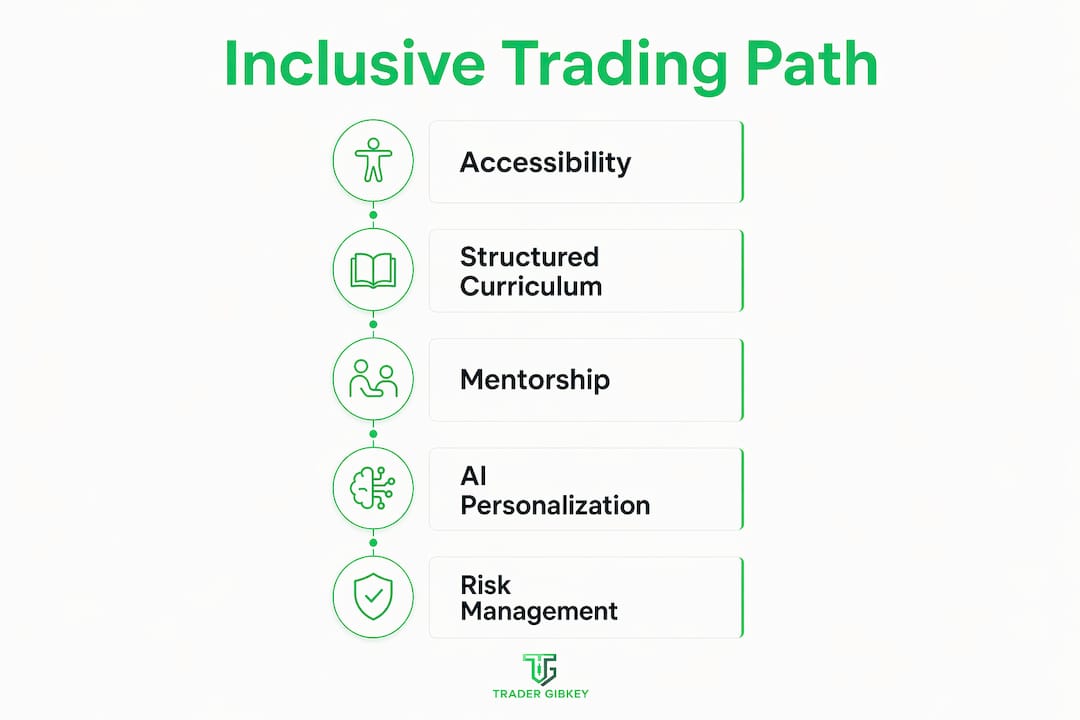
Key components of an effective inclusive trading curriculum
A well-built inclusive curriculum moves in a deliberate sequence. Skipping steps is where most self-taught traders get hurt.
- Financial literacy foundations. Before you touch a chart, you need to understand interest rates, inflation, diversification, and the risk-return tradeoff. These are not optional prerequisites. They are the operating system everything else runs on.
- Market mechanics. Order types, bid-ask spreads, slippage, liquidity, and the difference between Forex, equities, and derivatives. You cannot manage risk you do not understand.
- Risk management modules. Position sizing, stop-loss discipline, and maximum drawdown rules. Sandbox environments teach these mechanics without putting real capital at risk.
- Psychological skills training. Managing stress, recognizing cognitive biases like recency bias and loss aversion, and building the discipline to follow a plan when the market moves against you. Soft skills training on stress and cognitive biases is as critical as technical strategy for long-term trading success.
- Mentorship from experienced practitioners. Pairing curriculum with mentorship from practitioners with direct industry experience is the single most effective way to advance diverse trading professionals. Theory without context produces traders who know the rules but cannot apply them under pressure.
Pro Tip: When evaluating any trading education program, ask whether mentorship is built into the structure or sold as an add-on. Programs that treat mentorship as optional are telling you something about their priorities.
Tradergibkey’s model is built around this exact sequence. Over 18 years of live market experience informs how each component is taught, not as abstract theory, but as practical skill you can apply to a real setup.
How does AI personalize trading education for diverse learners?
AI-driven personalization is the most significant structural change in trading education over the past five years. Static lecture models treat every learner the same. AI-adapted platforms do not.
AI-driven adaptation adjusts curriculum difficulty based on quiz performance and trading behavior, which improves retention compared to fixed-pace courses. That means a learner who struggles with order flow gets more practice on that concept before advancing, while a learner who grasps it quickly moves on without waiting.
The practical benefits for inclusive trading education are significant:
- Behavior-based difficulty adjustment prevents learners from advancing before they are ready, which is the most common cause of live-market losses among beginners.
- Multi-language support means the platform adapts to the learner’s language, not the other way around.
- Simulated trading environments with real-time data let you practice entries, exits, and risk management without financial consequences. Simulated environments neutralize financial risk while teaching order types, technical analysis, and risk management simultaneously.
- Peer communities and remote mentorship scale the human element of learning, so you are not dependent on geography to find a knowledgeable trading community.
The combination of AI personalization and human mentorship is where the best programs separate themselves from generic online courses.
Balancing inclusivity with real risk management
Opening trading education to more people creates a responsibility. More learners means more people who could lose real money if programs rush them into live markets before they are ready.
The hard rule is clear: beginners should focus entirely on simulation, disclosure, and mentorship before engaging in live-money trading. This is not a conservative suggestion. It is the foundational competence requirement that separates education from speculation.
Effective programs build in several protective layers. Disclosure and disclaimers clarify that trading education is not investment advice. Psychological training prepares learners for the emotional reality of drawdowns before they experience them with real capital. Risk controls like maximum position size rules and mandatory stop-loss practice are embedded in the curriculum, not mentioned once and forgotten.
Marginalized learners need more than access to markets. They need the knowledge to negotiate better terms, read market conditions accurately, and protect their capital. Training that skips this layer is not inclusive. It is exploitative.
Pro Tip: Before moving from a demo account to live trading, set a personal benchmark: three consecutive months of profitable simulated trading using your actual strategy. If you cannot hit that benchmark in simulation, live capital will not fix the problem.
Key Takeaways
Inclusive trading education works when it combines structured curriculum, AI personalization, mentorship, and risk controls into a single learning pathway designed for diverse learners.
| Point | Details |
|---|---|
| Inclusion requires design | Effective programs build access into structure through virtual delivery, multilingual content, and tiered paths. |
| Simulation before live trading | Beginners must complete sandbox practice before risking real capital to build foundational competence. |
| Mentorship accelerates progress | Pairing curriculum with experienced practitioners is the most effective way to advance diverse trading professionals. |
| AI improves retention | Behavior-based difficulty adjustment outperforms static lecture models for learner retention and skill development. |
| Risk management is non-negotiable | Psychological training and position sizing rules protect learners from premature exposure to live-market losses. |
What I’ve learned about inclusive trading education after 18 years
Most trading education programs fail diverse learners not because the content is wrong, but because the delivery assumes a specific type of learner. The assumption is that you already have a finance background, a stable income to absorb losses, and access to a network of experienced traders. Most people have none of those things.
What I have seen work, consistently, is the mentorship model. Not the kind where you watch a video of someone explaining a concept. The kind where a practitioner sits with you through a live setup, explains why they are waiting for a specific price level, and shows you what patience actually looks like in real time. That experience is what trading mentorship delivers that no course can replicate.
The other thing I have learned is that psychological preparation is chronically undervalued. Traders who understand position sizing and stop-loss rules still blow accounts because they cannot manage the emotional weight of a losing streak. The brain stops trading the chart and starts trading the pain. Inclusive education that takes this seriously, and builds psychological skills training into the core curriculum, produces traders who last.
The future of equitable trading education runs through AI personalization and community-driven learning. But the foundation is still human. A learner who has never seen a live trade needs a mentor who has seen thousands. Technology scales that relationship. It does not replace it.
— Gabriel
How Tradergibkey supports your trading education
Tradergibkey is built on the principle that practical experience produces better traders than theory alone. With over 18 years in live Forex markets, the Tradergibkey approach combines structured learning formats with direct mentorship, price action strategy, and a community of traders at different experience levels.
The curriculum covers financial literacy, market mechanics, risk management, and the psychological skills that keep traders in the game long-term. Every component reflects the same inclusive principles covered in this article: meet learners where they are, build competence before live exposure, and pair instruction with real practitioner insight. Visit Tradergibkey to explore learning opportunities and connect with a community built around honest, practical trading education.
FAQ
What is inclusive trading education in simple terms?
Inclusive trading education is structured trading training designed to be accessible to learners from all backgrounds, regardless of prior experience, language, or geography. It combines financial literacy, simulated practice, and mentorship into a single learning pathway.
Should beginners use a demo account before trading live?
Yes. Beginners should complete simulated trading practice before risking real capital. Sandbox environments teach order types, risk management, and technical analysis without financial consequences.
How does mentorship fit into inclusive trading education?
Mentorship from experienced practitioners is the most effective way to advance diverse trading professionals. It provides the practical context that curriculum alone cannot deliver, especially for learners without existing finance networks.