
Learning from an experienced traders community is defined as joining a structured group where verified mentors provide live feedback, trade reviews, and accountability to accelerate your skill development. This is distinct from simply watching YouTube videos or reading PDFs. The industry term for this model is “structured trader mentorship,” and it operates very differently from passive education. Tradergibkey has built exactly this kind of environment over 18 years of live market experience, giving traders access to price action strategies grounded in real results. If you want to compress years of trial and error into months, a serious trading community is the most direct path.
What does it take to learn from an experienced traders community?
Serious mentorship is best suited for traders with at least one year of consistent trading experience. It is not designed for complete beginners. It is built for traders who have already tried self-study and hit a ceiling they cannot break through alone.
Before you join any community, you need three things ready: a trading journal with at least three months of documented trades, a P&L report that shows your actual results, and a reliable internet connection for live sessions. These are not optional extras. They are the raw material a mentor uses to diagnose what is actually holding you back.
Mental readiness matters just as much as technical preparation. You need to show up ready for diagnostic work, not passive consumption. The goal is not to sit back and absorb information. The goal is to have your habits, decisions, and execution examined under a microscope.
Trading community models vary widely in structure and cost. Here is a breakdown of the main types:
| Community model | Access style | Typical cost | Feedback quality |
|---|---|---|---|
| Public Discord or forum | Open to all | $0–$125/month | Low, peer-driven |
| Group mentorship cohort | Application required | ~$750 for 8 weeks | Medium to high |
| 1-on-1 mentorship | Selective intake | $2,500–$6,500+ | Highest |
| Live trading room | Subscription | $0–$125/month | Medium |
Public trading communities offer live chat and watchlists but lack formal coaching or feedback structures. That distinction matters enormously for your growth rate.
How do you find and join the right trading community?
Start by identifying what you actually need. If you want live observation of how professionals manage risk in real time, a live trading room works well. If you want your specific mistakes diagnosed and fixed, a cohort mentorship or 1-on-1 program is the right fit.
Quality indicators separate serious programs from noise. Look for these four things before you commit:
- Mentor verification. The mentor should have a documented, auditable track record. Ask for it directly.
- Structured diagnostic phase. Top programs analyze 3 months of trade data before prescribing any changes. This is non-negotiable in a quality program.
- Live screen-sharing. Watching a mentor execute in real time is irreplaceable. It shows you how calm, rule-based trading actually looks.
- Accountability sessions. Weekly sessions of 60–90 minutes focused on your actual trades are the engine of real progress.
Approximately 70–80% of elite mentorships require an intake process, including discovery calls and application reviews. Cohort sizes typically range from 3 to 100 members. Smaller cohorts mean more personalized feedback and faster improvement.
Costs range from $0 for public groups to over $6,500 for premium 1-on-1 engagements. The price reflects the depth of access and the quality of feedback you receive.

Pro Tip: Before joining any paid program, ask the mentor to show you one real student outcome with verifiable trade data. If they cannot or will not, walk away.
Before you sign up anywhere, ask these questions:
- How many traders are in each cohort?
- What does the intake process look like?
- How are sessions structured and how often do they occur?
- Does the program build my own trading system or teach me to copy yours?
- What happens if I miss a session?
The answers reveal whether a community is built for your growth or built for their revenue.
How to engage actively and get the most from your trading community
Passive participation kills progress. You get out exactly what you put in, and in a mentorship setting, that means showing up prepared every single time.
Follow these steps to maximize your learning:
- Prepare your data before every session. Bring your journal, your P&L, and a list of three specific trades you want reviewed. Vague questions get vague answers.
- Participate in live sessions with targeted questions. Do not ask “what should I trade?” Ask “here is my setup, here is my entry logic, here is where I went wrong.”
- Apply feedback within 48 hours. Feedback loses its power when you sit on it. Execute one adjustment immediately after each session.
- Build your own decision tree. Effective mentorship requires traders to develop written decision rules under mentor review. This builds autonomous judgment, not dependency on signals.
- Attend weekly accountability sessions consistently. Weekly reviews of 60–90 minutes focused on real trades are where the real calibration happens. Missing them breaks the feedback loop.
- Track your behavioral patterns. Note which mistakes repeat across multiple sessions. Recurring errors are your performance leaks, and fixing them is where the biggest gains live.
Observing real-time risk management by professionals helps traders understand practical execution far better than theory alone. Watch how a mentor handles a losing trade. That moment teaches more than any PDF.
Pro Tip: Spend at least 30 minutes after each community session writing down one behavioral pattern you noticed in your own trades. Over 8 weeks, this log becomes a personal performance audit.
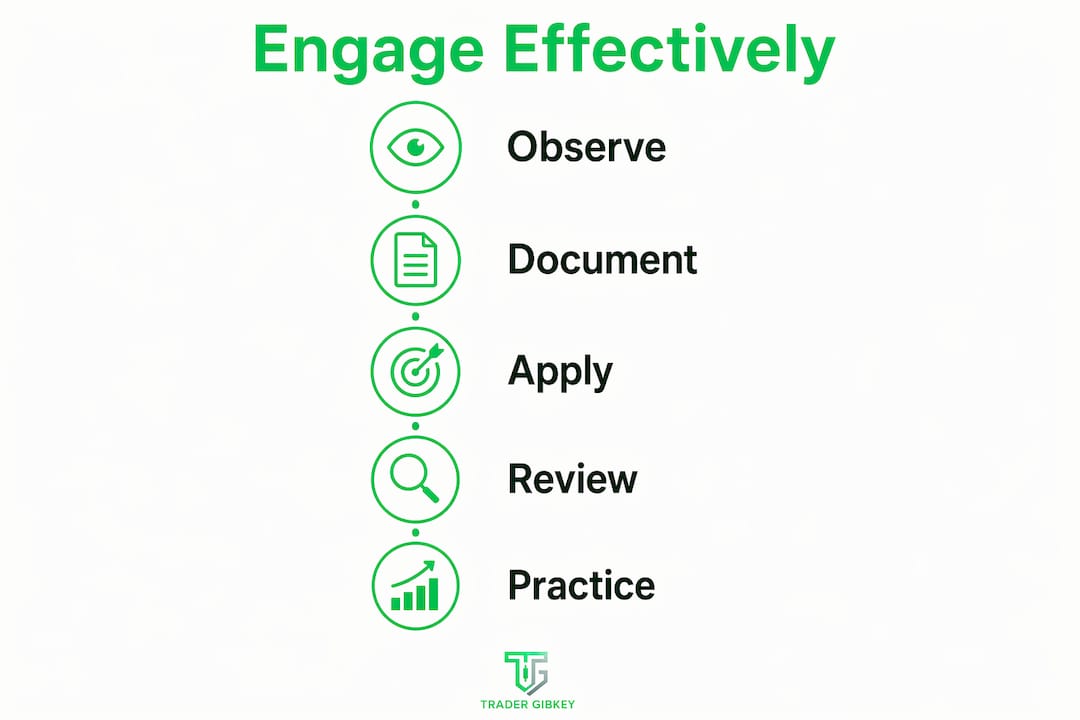
Balance community learning with independent practice. Apply what you learn in your own sessions, then bring the results back for review. The loop of practice, review, and adjustment is what builds a real edge.
Common mistakes that reduce the value of community learning
The biggest mistake traders make is joining a community and waiting for signals. Signals create dependency. They do not build skill. A mentor who gives you signals is not teaching you to trade. They are trading for you, and you are paying for the privilege of staying stuck.
Watch out for these specific errors:
- Joining too early. Mentorship is not for absolute beginners. Joining before you have a baseline of experience means you cannot contextualize the feedback you receive.
- Ignoring accountability structures. Skipping sessions or showing up unprepared wastes your money and your mentor’s time.
- Confusing content consumption with implementation. Watching more videos does not fix behavioral leaks. Performance gains come from fixing persistent behavioral errors through objective analysis, not from consuming more course material.
- Failing to bring objective data. Showing up to a mentorship call without your trade data is like going to a doctor’s appointment without describing your symptoms.
- Expecting fast results without doing the work. Mentorship compresses learning, but it does not eliminate the effort required.
“The brain stops trading the chart and starts trading the pain. Mentorship works because it forces you to look at the data instead of the emotion. You cannot fix what you refuse to measure.”
Maintain realistic expectations. An 8–12 week mentorship program will not make you a professional trader overnight. It will, however, identify your specific recurring mistakes and give you a structured path to fix them. That is worth more than years of solo trial and error.
Key Takeaways
Joining a structured trading community with verified mentors and accountability sessions is the fastest way to fix behavioral errors and build a consistent trading edge.
| Point | Details |
|---|---|
| Preparation is required | Bring at least 3 months of trade data and a journal before joining any serious program. |
| Community models vary widely | Costs range from $0 for public groups to $6,500+ for 1-on-1 mentorship with matching feedback quality. |
| Accountability drives results | Weekly sessions of 60–90 minutes focused on real trades are the core of meaningful progress. |
| Signals create dependency | The goal of mentorship is building your own decision system, not copying someone else’s trades. |
| Behavioral leaks are the real problem | Fixing recurring execution and psychological errors outperforms consuming more educational content. |
Why mentorship changed how I think about trader development
I have watched traders spend two, three, even five years grinding through the same mistakes on their own. They read every book. They watch every webinar. They still blow up the same way every quarter. The problem is never a lack of information. The problem is always a behavioral leak they cannot see because they are too close to it.
The diagnostic approach is what separates real mentorship from everything else. When a mentor sits with your actual trade data and points to the exact moment your decision quality collapsed, something shifts. You stop defending your habits and start seeing them clearly. That is the moment real improvement begins.
What I find most underrated about high-quality communities is the accountability structure itself. Knowing you have to show your trades to someone who will ask hard questions changes how you trade all week. You stop making lazy entries because you know you will have to explain them. That external pressure, applied consistently, rewires your process faster than any solo discipline effort.
The trading psychology work that happens inside a good community is not soft or secondary. It is the core product. Mentorship is an intensive commitment, and it requires you to show up ready to be wrong. But the payoff is a trading process you actually own, built on your own rules, tested against real feedback.
— Gabriel
How Tradergibkey supports your growth as a trader
Tradergibkey brings over 18 years of live market experience to a structured mentorship community built specifically for Forex traders ready to move beyond generic methods.
The program centers on price action strategies, live session access, and direct mentor feedback grounded in real trade data. Traders work through a structured learning path that identifies their specific behavioral patterns and builds a personalized trading system they can execute with confidence. The community provides the accountability and peer support that solo study simply cannot replicate. If you are ready to stop repeating the same mistakes and start building a real edge, explore the Tradergibkey mentorship program and take the next step toward consistent, confident trading.
FAQ
What experience level do I need before joining a trading community?
Serious mentorship programs require at least one year of consistent trading experience. Absolute beginners benefit more from foundational self-study before entering a structured mentorship environment.
How long does a typical trading mentorship program last?
Most structured mentorship programs run 8–12 weeks, with weekly accountability sessions of 60–90 minutes focused on reviewing real trades and fixing specific execution errors.
What is the difference between a free trading community and a paid mentorship?
Free communities offer peer chat and general ideas but lack formal coaching. Paid mentorships provide structured diagnostics, verified mentor feedback, and accountability frameworks that directly address your individual mistakes.