
Loss aversion makes losses feel roughly twice as painful as equal-sized gains feel good, and that imbalance quietly bleeds edge out of your trading account. It shows up as the disposition effect: selling winners early and holding losers too long. The fix isn’t willpower. It’s measurement plus pre-committed exit rules that take the decision out of your hands before emotion gets a vote.
TL;DR:
- Traders who hold losers longer than winners due to loss aversion risk turning a profitable system into a losing one, reducing annual returns by up to 5 percent.
- Measuring hold-time ratio, stop-loss adherence, and MFE gaps reveals how often traders prematurely exit winners and let losers run, with typical patterns showing significant bias.
- Enforcing rigid, pre-placed bracket or OCO orders and reviewing trade metrics weekly can dramatically improve exit discipline within six weeks.
- Systematic rebalancing and position caps mitigate portfolio-level loss aversion by removing emotionally driven decisions for reallocation.
- Combining mechanical rules with mindfulness and emotional discipline strategies reduces cortisol-triggered stress and helps traders follow their plans under pressure.
Table of Contents
- What Is Loss Aversion in Trading?
- Why Does Your Brain Sabotage Good Trades?
- How Do You Measure Loss Aversion in Your Own Trades?
- Five Rule-Based Habits That Neutralize Loss Aversion
- Your One-Week Loss Aversion Reset
- Loss Aversion and Portfolio Diversification
- Retail vs. Institutional Traders: Who Feels Loss Aversion More?
- Does Loss Aversion Hit Stocks, Options, and Forex Differently?
- Beyond Rules: Mindfulness and Cognitive Approaches
- What Does Fixing Loss Aversion Actually Look Like?
- Which Tools Help You Track and Reduce Loss Aversion?
- What Actually Changes Trader Behavior
- Structured Training for Traders Who Are Done Fighting Their Own Exits
- Sources
- FAQ
What Is Loss Aversion in Trading?
Loss aversion is the tendency to weigh a loss more heavily than an equivalent gain. This comes straight from prospect theory, the framework Daniel Kahneman and Amos Tversky built to explain why people make irrational choices under risk. In many populations, losses feel about twice as painful as equivalent gains feel good, which is why closing a winning trade feels good but closing a loser feels like an admission of failure.
That imbalance produces the disposition effect. Economist Terrance Odean’s research on retail brokerage accounts found traders were about 1.5 times more likely to sell winners than losers, a pattern that drags down annual returns by an estimated 3 to 5 percent. Loss aversion isn’t a personality flaw. It’s wired behavior, and it’s measurable.
Here’s what that costs in practice:
- A trader with a 50% win rate, average winner of $150, and average loser of $100 has solid positive expectancy on paper.
- Cut winners at $80 out of habit and let losers run to $180, and the same system turns negative.
- The strategy never changed. Only the exits did.
Loss aversion doesn’t ruin trading systems. It ruins the exits attached to them, and holding losers too long while cutting winners short is the single most common way a profitable edge turns into a losing month.
Why Does Your Brain Sabotage Good Trades?
Three mechanisms drive this, and none of them are about discipline in the abstract sense.
Reference points anchor your sense of “winning” or “losing” to your entry price rather than the trade’s actual probability of success going forward. Regret avoidance pushes you to delay closing a loser, because as long as it’s open, you haven’t officially failed. Mental accounting treats each trade as its own isolated bucket instead of one line in a long-run statistical series, so a single loss feels like a verdict rather than a data point.
Then physiology piles on. Research out of the University of Cambridge found that large financial losses trigger a release of cortisol, the stress hormone linked to impaired decision-making and a shift toward reactive, near-term risk-taking. Cortisol doesn’t announce itself. It just makes the next decision worse.
Statistic to remember: the disposition effect alone costs the average retail trader an estimated 3 to 5 percent in annual returns. That’s not a rounding error. It’s the difference between a mediocre year and a good one.
This is why traders override their own rules at exactly the moment those rules matter most. The bias and the stress response peak together, right when the trade is going against you.
How Do You Measure Loss Aversion in Your Own Trades?
You don’t need a psychologist to diagnose this. You need your trade log and about twenty minutes.
- Calculate your hold-time ratio. Divide the average holding time of losing trades by the average holding time of winning trades. A healthy target keeps losers held for under 0.8 times the duration of winners. A ratio above 1.0 means you’re nursing losers longer than you’re letting winners run, which is the disposition effect in raw numbers.
- Calculate stop-loss adherence rate. Count how many trades you exited at or before your predetermined stop versus how many you widened, moved, or ignored. Aim for 80% or higher. Below that, your stops are suggestions, not rules.
- Compare Maximum Favorable Excursion (MFE) to Maximum Adverse Excursion (MAE). MFE tracks the best unrealized profit a trade reached before you closed it. MAE tracks the worst unrealized drawdown. Subtract your actual exit price from the MFE level on your winners, and you get the exact dollar amount loss aversion cost you by making you bail early.
| Metric | How to calculate | Healthy target |
|---|---|---|
| Hold-time ratio | Avg. loser duration ÷ avg. winner duration | Under 0.8 |
| Stop adherence rate | Stops honored ÷ total stopped-out trades | 80% or higher |
| MFE gap on winners | MFE level minus actual exit, in dollars or R | Under 25% of realized profit within 6 weeks |
Run these numbers on your last 30 trades. Most traders who’ve never measured this are shocked at how consistent the pattern is.
Five Rule-Based Habits That Neutralize Loss Aversion
Rules beat resolutions because rules don’t ask how you feel in the moment. Here’s the order to build them in.
- Place your stop at entry using a bracket or OCO order, and never widen it. Automatic execution removes the exact moment bias acts — the point where you’d otherwise talk yourself into “just a little more room.” Trailing stops are fine, but only if they move toward locking in less risk, never toward more.
- Pre-commit your exit type before you enter. Decide target-based or trailing-based, write it in your journal, and treat that written line as the actual rule, not the chart in front of you.
- Use partial exits only when they’re planned in advance. Scaling out because you’re scared is emotional. Scaling out because your plan called for a 50% trim at 1R is systematic. Same action, opposite outcome.
- Review your MFE and MAE gap weekly, and convert it to a dollar figure. Seeing “I left $340 on the table this week by exiting early” reframes the habit as a business cost you’re leaving on the table, not an abstract character flaw.
- Build in a mandated cooling-off period after a loss or a losing streak. Stepping away, journaling the emotional state, and paper trading before returning to size breaks the revenge-trade cycle before it starts. Our 5-step journal system for stopping revenge trading walks through exactly how to structure that pause.
Pro Tip: Reframe every realized loss as the cost of finding your next winner, the same way a shop owner treats unsold inventory as a cost of doing business, not a personal failure. That mental shift alone makes rule number one much easier to follow.
Your One-Week Loss Aversion Reset
Turning the rules above into habit takes structure, not motivation. Here’s a compact plan.
- Build a pre-trade checklist covering entry thesis, stop level, target, position size, and exit type, filled out before you click buy or sell, every single time.
- Run a three-week experiment tracking exactly three numbers: hold-time ratio, stop adherence percentage, and average MFE gap on winners. Nothing else.
- Journal after every trade with one prompt: “Did I follow my written plan, yes or no?” Not how you feel about the outcome, just compliance.
- Run 20 rule-following trades as a mini-experiment, sized small enough that breaking a rule doesn’t hurt but following one still counts. Our guide on regaining trading confidence in 2 to 6 weeks breaks this exact drill down step by step.
By week three, most traders see their stop adherence rate climb into the 70s or 80s, simply because they’re finally watching the number.
Loss Aversion and Portfolio Diversification
Loss aversion doesn’t just distort single trades. It distorts the whole portfolio. Traders who feel the sting of a loser tend to overweight positions that are currently green, holding on to what’s “working” while starving new setups of capital, even when concentration risk is climbing.
This shows up as reluctance to rebalance. A trader with three correlated forex pairs long dollar strength won’t trim any of them because closing one to reduce exposure means realizing whichever leg happens to be underwater that day. The portfolio ends up shaped by which trades are painful to close rather than by actual risk allocation.
Periodic, scheduled rebalancing sidesteps this. If you rebalance on a calendar basis, say monthly, rather than on a feeling basis, you remove the decision of “is this the right day to sell my loser” entirely. Systematic rebalancing rules are one of the standard mitigations for loss aversion at the account level, not just the single-trade level.
The practical version for an active trader: cap any single position or correlated cluster at a fixed percentage of account equity, and trim back to that cap on schedule regardless of whether the position is a winner or a loser. It sounds mechanical because it is, and that’s exactly the point.
Retail vs. Institutional Traders: Who Feels Loss Aversion More?
Retail traders feel loss aversion harder, and it isn’t close. Individual accounts carry no compliance desk, no risk committee, and no second person checking whether a stop got moved. The trader is the risk manager, the psychologist, and the executioner in the same body, which means bias has nowhere to hide.
Institutional desks build structural defenses retail accounts rarely have: hard daily loss limits enforced by systems rather than intentions, mandatory position-size caps, and drawdown triggers that pull a trader off the desk automatically once losses hit a threshold. None of that erases loss aversion inside the humans making the calls. It just adds friction between the emotion and the action, which is precisely where retail traders are exposed.
The gap isn’t about knowledge. Plenty of retail traders can define the disposition effect perfectly and still fall into it, because knowing a bias exists and having a system that overrides it in real time are two different skills. Institutional risk frameworks are, in effect, someone else’s discipline enforcing your exits. Building that same enforcement yourself, through bracket orders and hard rules, is the retail equivalent, and it’s the entire premise behind a rule-based playbook instead of a motivational one.
Does Loss Aversion Hit Stocks, Options, and Forex Differently?
The bias is the same. The mechanics that let it hide are not.
In stocks, loss aversion shows up most clearly in long-term holding of underwater positions, “waiting to get back to even” on a name that’s down 30% with no catalyst in sight. The relatively slow pace of equity moves gives traders plenty of time to rationalize holding.
In options, loss aversion compounds with time decay. A losing option position doesn’t just sit there like a stock. It bleeds value daily, so holding a loser too long doesn’t just cost the original thesis, it actively accelerates the loss through theta while the trader waits for a reversal that time itself is working against.
In forex, leverage turns a small hesitation into a large one. A trader holding a losing position an extra hour on a leveraged forex account is exposed to far more account-equity swing than the same hesitation in an unleveraged stock position. Forex also runs nearly 24 hours a day, which removes the natural “market’s closed, I’ll deal with it tomorrow” cooling-off point that stock traders get for free overnight.
The common denominator across all three: the asset class changes how fast the bias costs you money, not whether the bias is present. A bracket order, a trailing stop rule, and a written exit plan work the same way whether you’re trading a currency pair, an index option, or a mid-cap stock.
Beyond Rules: Mindfulness and Cognitive Approaches
Rule-based systems handle the mechanics of loss aversion. However, they don’t always touch the underlying stress response that makes a trader want to break the rule in the first place. That’s where behavioral approaches beyond pure rule enforcement earn their place.
Mindfulness practice, in the Cambridge research on cortisol and trader risk-taking, is specifically flagged as a recovery tool after high-stress trading periods, alongside strict risk-management rules. The logic is straightforward: if elevated cortisol impairs judgment, anything that lowers cortisol before the next decision improves the odds that decision is a good one.
Cognitive reframing, the practice of consciously relabeling a loss as data rather than failure, is recommended specifically for recovery after large losses, alongside stepping away from the screen and journaling the emotional state before returning to live trading. This isn’t a substitute for a stop-loss order. It’s what makes you more likely to honor the stop-loss order next time.
The combination matters more than either piece alone. A trader with perfect bracket orders but zero stress management will eventually override the system on the day the loss feels personal. A trader who journals and meditates but has no hard stop will still bleed capital slowly. Our breakdown of why trading psychology matters covers how these emotional and mechanical layers work together rather than as competing approaches.
What Does Fixing Loss Aversion Actually Look Like?
Consider a trader running a simple trend-following forex setup with genuinely positive expectancy on paper: 45% win rate, 2:1 reward-to-risk. On paper, that math wins comfortably over a large enough sample. In practice, this trader closes winners around 1.2R instead of letting them run to the planned 2R target, while losers regularly run past the stop because “the market always comes back.”
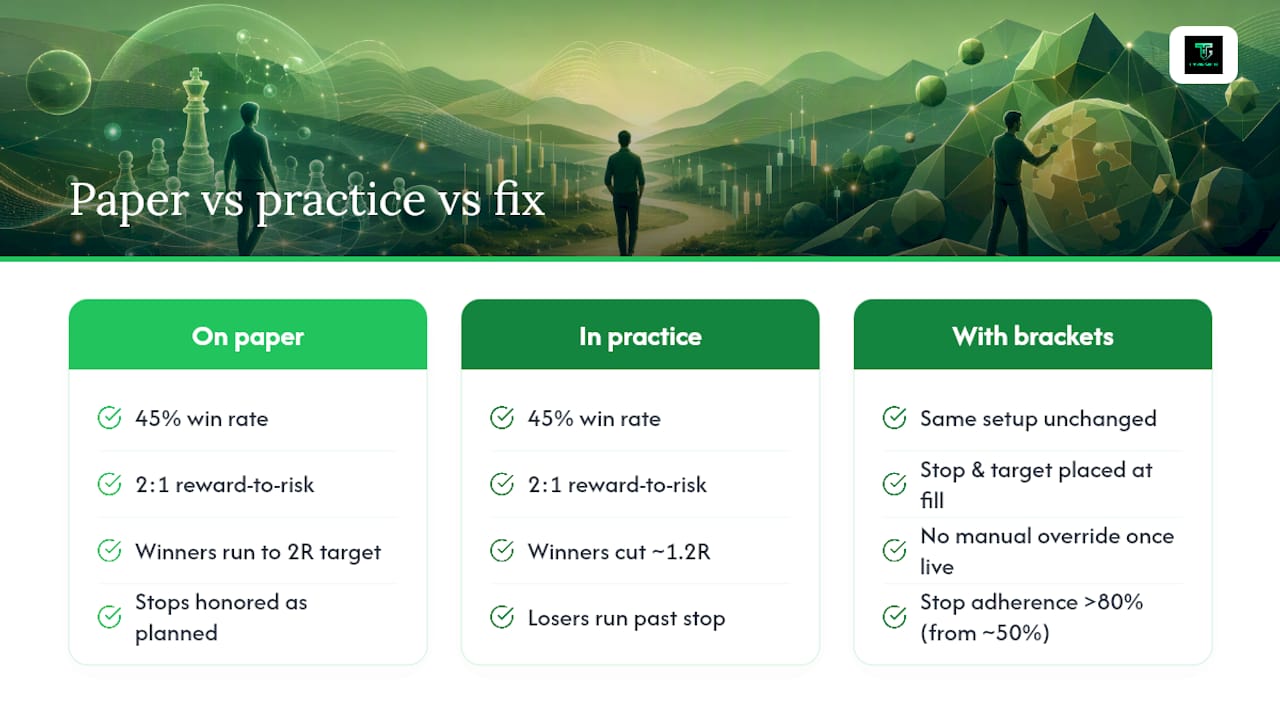
Three months of that pattern turns positive expectancy negative, even though the entry signal never stopped working. The problem was never the setup. It was the two decisions made after the setup triggered.
The fix that actually moved the needle: this trader stopped managing exits by feel and started using bracket orders exclusively, with the stop and target placed the instant the trade filled. No exceptions, no manual override once the order was live. Within six weeks of enforcing that single rule, stop adherence climbed from around 50% to over 80%, and the average MFE gap on winners, the money left on the table by exiting early, dropped toward the target range of under 25% of realized profit.
Nothing about the trading strategy changed. Only the enforcement mechanism did. That’s the pattern worth noticing: the traders who successfully manage loss aversion rarely report a breakthrough in mindset. They report a boring, mechanical change in how orders get placed, and the mindset improvement follows the results rather than causing them.
Which Tools Help You Track and Reduce Loss Aversion?
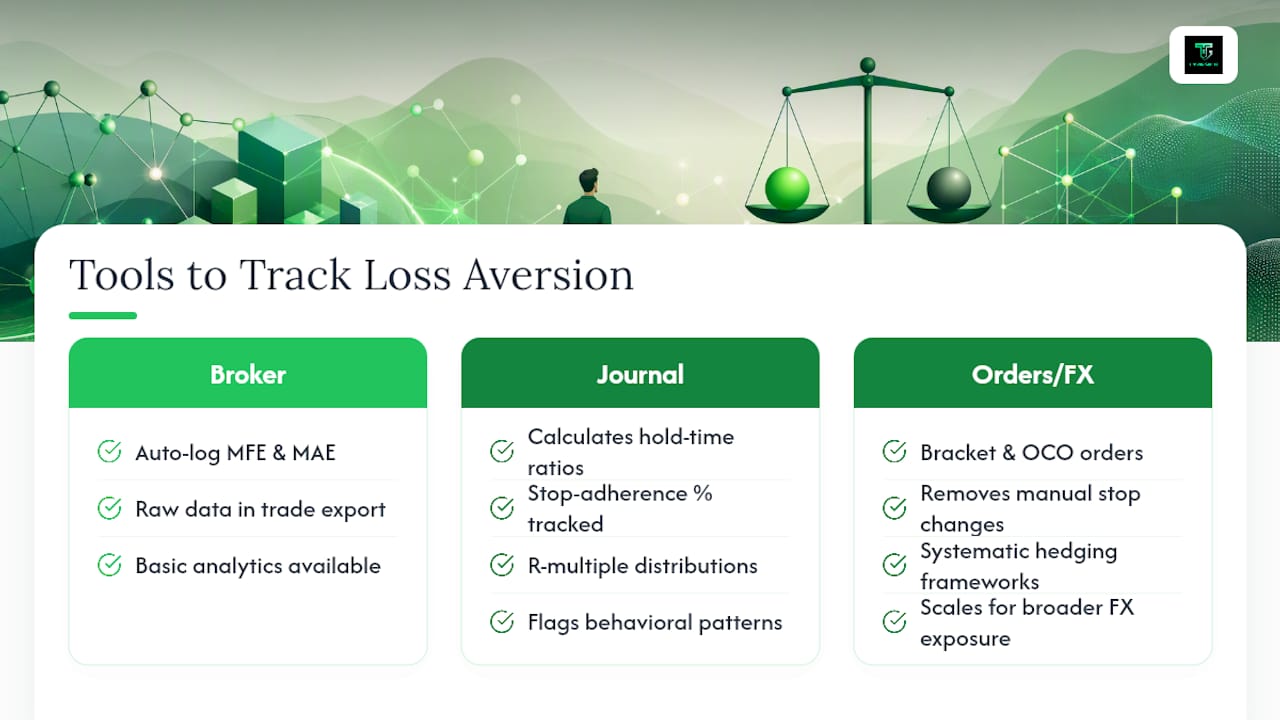
You can’t fix what you don’t measure, and manually calculating hold-time ratios and MFE gaps across dozens of trades gets old fast. This is where trade journaling software and broker analytics earn their keep.
Most modern trading platforms log MFE and MAE automatically on closed positions, which means the raw data for your diagnostics is often sitting in your trade history export already, unused. Dedicated trade-journaling tools go a step further, calculating hold-time ratios, stop adherence percentages, and R-multiple distributions automatically, and flagging patterns like “you’ve cut your last 8 winners short” before you’d notice it yourself scrolling through a spreadsheet.
Bracket and OCO order functionality, available on most retail trading platforms, remains the single most direct technological intervention, because it removes the manual click required to widen a stop or move a target under stress. If the order is already live with both exits attached, breaking the rule requires an active decision to cancel and replace, not a passive drift.
For traders managing broader FX exposure, particularly on the corporate or larger-position side, dedicated currency hedging frameworks apply the same logic at scale: systematic rules replace ad hoc emotional reactions to currency swings. The tool matters less than the discipline it enforces. A $10 spreadsheet with a hold-time ratio formula beats a $200 platform nobody actually checks weekly.
What Actually Changes Trader Behavior
Here’s the uncomfortable truth about loss aversion: most traders already know the textbook advice. Cut losers short, let winners run. They’ve read it a hundred times. Knowing the rule and living by it under real financial pressure are entirely different skills, and almost every piece of content on this topic stops at the knowing part.
What actually moves the needle is turning the bias into a number you check weekly, because a feeling is easy to override and a spreadsheet cell is not. The traders Trader Gibkey works with who make real progress aren’t the ones who read the most about trading psychology. They’re the ones who calculate their stop adherence rate every Sunday night and treat a bad number as a system bug to fix, not a character flaw to feel guilty about.
Expect measurable improvement in your numbers within 2 to 6 weeks of genuinely enforcing bracket orders and a weekly MFE review, not because your emotions changed, but because your process stopped giving emotion a vote. Systems beat willpower every time willpower is tested at the worst possible moment, which, with loss aversion, is always.
— Gabriel
Structured Training for Traders Who Are Done Fighting Their Own Exits
Reading about loss aversion gets you halfway there. Closing the gap between knowing the rule and following it under pressure is where most traders stall out, and mentorship structures built to solve this provide practical price-action strategies, live trading sessions, and trade review templates that hold traders accountable to the exit rules they write down, not the ones they feel like following in the moment.
The daily market analysis and community access give you a second set of eyes on your journal, which functions the same way an institutional risk desk does: friction between the emotion and the action. Visit the Tradergibkey landing page to see current mentorship options and find the path that fits where your trading stands today.
This article is general information, not a substitute for advice from a qualified financial advisor. Consult a qualified financial professional about your own circumstances before acting on anything here.
Sources
- Stress hormones in financial traders may trigger risk aversion and contribute to market crises — University of Cambridge research news
- Loss Aversion in Trading: The Disposition Effect Explained | TradesViz
- Understanding loss aversion in trading — Investopedia
- Trading psychology: Recovering from big losses — Charles Schwab
FAQ
Is It True That 90% of Traders Lose Money?
Widely cited retail-trading failure rates vary by market and broker, but the underlying driver behind consistent losers is well documented: the disposition effect alone cuts annual returns by an estimated 3 to 5 percent for the average retail trader.
What Is an Example of Loss Aversion in Trading?
Closing a winning trade at a small profit out of fear it will reverse, while holding a losing trade far past your stop because you’re hoping it recovers, is the classic disposition effect in action.
How Do You Cope With a Big Trading Loss?
Step away from the screen, journal the emotional state honestly, and return through paper trading before risking real size again. Schwab’s recovery framework outlines this staged re-entry process in detail.