
Revenge trading is entering a trade to recover a loss instead of following your plan, and it’s the fastest way to turn a bad day into a blown account. The single most important fix isn’t a mindset shift. It’s a hard rule: stop trading the moment a pre-set limit is hit, no exceptions. Rules and measurement beat willpower every time discipline is tested.
TL;DR:
- Revenge trading often involves increasing position sizes and re-entering trades shortly after a stop-out, typically within 15 to 30 minutes.
- It is driven by loss aversion and stress-induced physiological responses that impair risk assessment and override disciplined decision-making.
- Data analysis shows revenge trades correlate with larger, more frequent trades on days with prior losses, indicating a habitual pattern that can be measured and addressed.
- Effective short-term rules include mandatory cool-down periods, setting a daily loss limit, and a two-loss stop for the day, enforced by platform locks or account closures.
- Long-term success relies on structured systems like pre-market checklists, trade quotas based on past performance, and regular journal reviews tracking revenge trade patterns.
Table of Contents
- What Revenge Trading Looks Like in Practice
- The Psychology Behind the Trading Revenge Mindset
- Spotting the Data Signature of a Revenge Trade
- Short-Term Rules That Stop Revenge Trading Now
- Long-Term Fixes: Systems, Habits, and Measurement
- A Concise 5-Step Prevention System
- What Practitioner Experience Adds to the System
- Why I Think Rules Beat Willpower Every Time
- How Structured Mentorship Helps You Stop Revenge Trading for Good
- Sources
What Revenge Trading Looks Like in Practice
Revenge trading rarely announces itself. It shows up as a series of small, familiar decisions that feel justified in the moment.
You’ll recognize the pattern by watching for these behaviors:
- Re-entering a position within minutes of a stop-out, before your original setup even reforms
- Increasing size on the next trade “to make it back faster”
- Switching to a higher-leverage instrument you don’t normally trade
- Taking a setup that doesn’t meet your own criteria, just to stay in the action
Here’s a simple filter: would you take this exact trade on a clean, no-loss day? If the honest answer is no, you’re not trading the chart anymore. You’re trading the pain. One trader stops out on EUR/USD, doubles size on the next entry, and loses twice as fast. Another closes a losing crypto position and immediately opens a 5x leveraged trade on an asset they’ve never studied. Neither decision came from analysis. Both came from the need to feel okay again.
The Psychology Behind the Trading Revenge Mindset
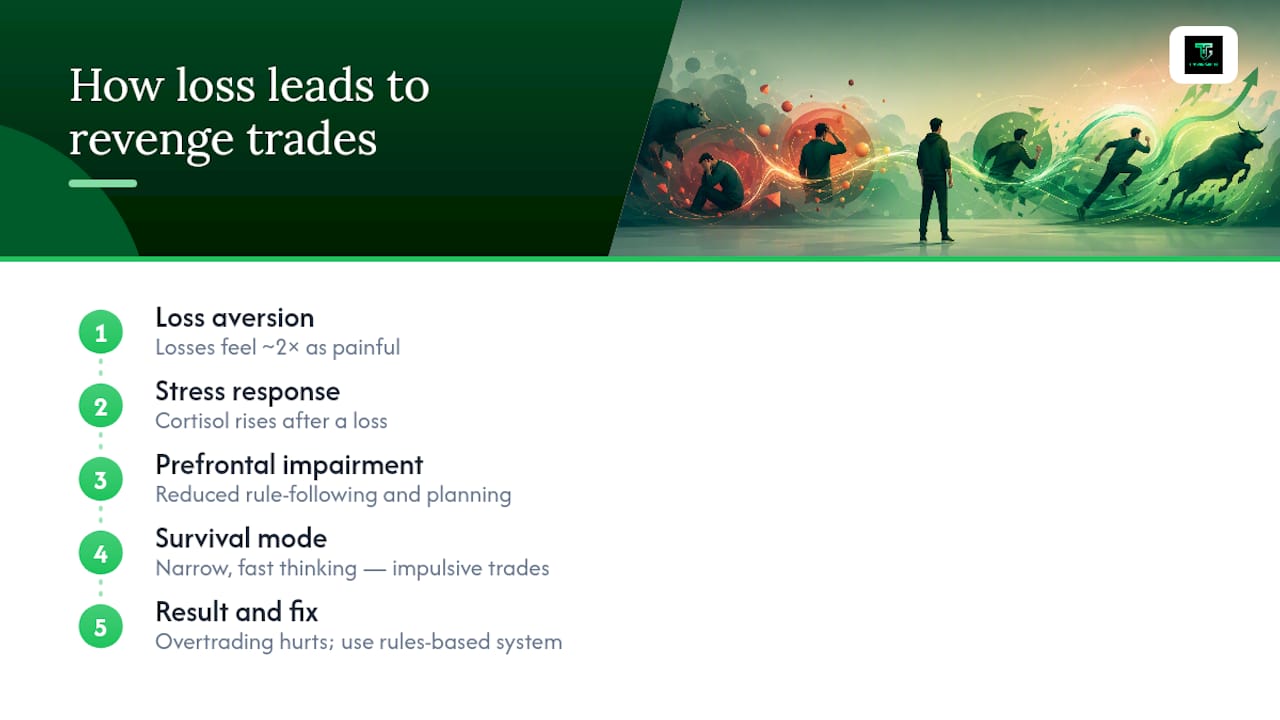
Loss aversion explains a lot of this. Prospect theory, developed by Daniel Kahneman and Amos Tversky, found that losses feel roughly twice as painful as equivalent gains feel good. That imbalance pushes traders toward high-risk bets specifically when they’re trying to erase a loss rather than lock in a smaller, safer gain.
There’s a physiological layer too. A losing trade triggers a stress response, and elevated cortisol impairs activity in the prefrontal cortex, the part of the brain responsible for weighing risk, following rules, and thinking a few steps ahead. Under that chemical load, the brain shifts into a narrower, faster mode built for immediate threats, not for patient analysis of price action.
This is why “get-even” thinking so easily overrides process. The trader isn’t ignoring their plan. Their brain is temporarily running on a different operating system, one built for survival, not strategy. Overtrading driven by this emotional state consistently produces worse outcomes and higher costs than trading on a plan, according to Investopedia’s analysis of the behavior. Understanding this mechanism matters because it explains why “just be disciplined” advice fails. You can’t out-think a stress response. You have to remove the decision from the moment entirely, which is exactly what a rules-based system does.
Spotting the Data Signature of a Revenge Trade
Revenge trades leave fingerprints in your trading journal, and they’re easy to spot once you know where to look. TradesViz’s analysis identifies a clear pattern: entries clustered within 15 to 30 minutes of a loss, position sizes that spike above your normal average, and a noticeably higher trade count on days that started with a loss.
Run this three-step check on your last month of trades:
- Tag every trade with a “time since last loss” value and a simple post-loss flag.
- Compare position size on flagged trades against your typical size for that instrument.
- Count trades per losing day versus trades per winning day. A meaningful gap points straight at the pattern.
If your post-loss trades are consistently larger and more frequent than everything else in your journal, you’re not looking at bad luck. You’re looking at a habit with a clear data trail, and that trail is exactly what makes it fixable.
Short-Term Rules That Stop Revenge Trading Now
You don’t need a personality overhaul to stop revenge trading this week. You need enforceable rules that don’t ask you to make a good decision under stress, because that’s precisely when your judgment is worse.
Start with these three:
- Mandatory cool-down. After any loss, step away from the platform for 15 to 30 minutes, no charts, no watchlist, nothing.
- Daily max-loss limit. Set a dollar or percentage figure before the session starts, and treat it as non-negotiable once it’s hit.
- Two-loss rule. After two losing trades in one session, you’re done trading for the day. Not “probably done.” Done.
Enforcement matters more than the rule itself. Some platforms let you set a hard daily-loss lockout that blocks new orders once you hit your limit, which removes the temptation entirely. If your platform doesn’t support that, close it. Log out. Put your phone in another room. The goal is to make the next trade physically harder to place, not just emotionally discouraged.
Pro Tip: Set your cool-down timer before you start trading, not after a loss. Deciding the rule in advance, while you’re calm, is what makes you actually follow it when you’re not.

Our guide on risk management rules new traders must know breaks down how to size these limits around your account, not a generic percentage pulled from a forum post.
Long-Term Fixes: Systems, Habits, and Measurement
Short-term rules stop the bleeding. Long-term fixes prevent the wound from reopening. That means building structure into your trading before the market ever tests your discipline.
- Build a pre-market gatekeeper checklist. Before you’re allowed to place a single trade, confirm your setup meets defined entry criteria, your bias matches the higher timeframe, and you’re not trading within your cool-down window from a prior loss.
- Set a trade quota from your own data. TradersSecondBrain’s approach uses 60-plus days of journal history to calculate a personal daily trade limit, which tends to be lower than most traders assume. Fewer, higher-quality trades usually outperform a high trade count padded with emotional entries.
- Review weekly, not just after big losses. Tag every revenge trade in your journal and track the tag’s frequency over time. A shrinking count is proof the system is working; a stalled one tells you it’s time for a change.
If the pattern persists despite rules and honest journaling, that’s a signal worth taking seriously, not a personal failure. Persistent revenge trading despite structural fixes often points to something worth working through with a mentor or coach rather than another rule tweak. Our post on trading psychology for beginners covers the mistakes that tend to precede this pattern in newer traders.
A Concise 5-Step Prevention System
Here’s the entire system compressed into something you can actually check off during a live session:
- Step 1: Define entry criteria before the session starts. No setup, no trade.
- Step 2: Enforce a 15 to 30-minute cool-down after every loss, no exceptions.
- Step 3: Set a daily max-loss limit and a hard two-loss stop-for-day rule.
- Step 4: Tag every trade with post-loss status, time-since-last-trade, and position size.
- Step 5: Review tagged trades weekly and track whether the revenge-trade count is falling.
| Step | Enforcement Method | Metric to Track |
|---|---|---|
| Pre-session rules | Written checklist, checked before first trade | Entries taken without a checklist match |
| Cool-down | Timer, platform lock, or closing the app | Trades placed inside the cool-down window |
| Daily loss cap | Platform lockout or manual account closure | Days limit was hit vs. days it was ignored |
| Trade tagging | Journal fields for post-loss and size delta | Post-loss trades as a percent of total trades |
| Weekly review | Fixed calendar slot, no skipping | Trend in tagged revenge trades over time |
A detailed trading journal is what makes step four possible. Without tagging, you’re guessing at the pattern instead of measuring it.
What Practitioner Experience Adds to the System
Rules on paper are one thing. Watching traders actually follow them under pressure is another. Trader Gibkey’s mentorship approach comes out of 18 years of live market trading, built around price action rather than indicator-heavy systems that tend to fall apart the moment a trader gets emotional.

In practice, mentorship works because it adds outside accountability to rules a trader would otherwise abandon alone. A cool-down timer means little if no one checks whether you honored it. Live session reviews and community check-ins close that gap.
[Client case studies and student results to be added.]
If you’ve tried tagging trades and setting limits on your own for a few weeks with no improvement, that’s usually the point where outside structure, not another rule, makes the difference.
Why I Think Rules Beat Willpower Every Time
One student I’ve seen described in our community had a habit of doubling size after every stop-out, convinced the next trade would “fix” the last one. It never did. What actually changed things wasn’t motivation. It was a hard two-loss rule and a mandatory 20-minute walk away from the screen, tracked in a journal every single day.
If you want to see where you stand, export your last 30 days of trades and tag anything placed within 30 minutes of a loss. The pattern will either confirm you’re clean or hand you exactly what needs fixing. Either way, run the five-step checklist above this week. It works whether you’re managing a small account or a funded one.
— Gabriel
How Structured Mentorship Helps You Stop Revenge Trading for Good
Reading about rules is one thing. Having someone check whether you actually followed them is what makes the rules stick. Tradergibkey’s mentorship gives you the accountability layer that solo traders usually skip, structured entry criteria, journaling templates built for tagging post-loss trades, and live sessions where your trades get reviewed by someone who isn’t you.
That external check matters more than most traders expect. A cool-down rule you set for yourself is easy to break in private. A cool-down rule you report on in a live community session is a different commitment entirely. Members also get daily market analysis and price action training built around the same discipline this article describes, so the psychology work and the strategy work reinforce each other instead of running separately.
If you’re ready to put a real system around your trading instead of relying on willpower after a bad session, start with the Trader Gibkey mentorship program and see which package fits where you are right now.
Sources
Three sources back the core claims in this guide, each useful for a different reason. Investopedia’s overtrading entry frames revenge trading as a subtype of a broader problem, emotional overtrading, and explains why it consistently produces worse outcomes and higher costs. Binance Academy’s glossary definition gives a clean, concise definition of the behavior that matches how it shows up in real trading records. TradesViz’s practitioner analysis goes further, showing how journal tagging and cooldown enforcement produce measurable reductions in the behavior, which is the evidence base behind the five-step system above.
This article is general information, not a substitute for advice from a qualified financial advisor. Consult a qualified financial professional about your own circumstances before acting on anything here.