
Smart Money Concepts (SMC) is a price-action trading framework that reveals how large institutions move markets by analyzing price structure, liquidity pools, and order imbalances without relying on traditional indicators. Banks, hedge funds, and pension funds control the majority of market volume. Their footprints show up in price behavior, and SMC teaches you to read those footprints. Mastering market structure is the mandatory first step before you touch any advanced concept like order blocks or fair value gaps. This guide breaks down Smart Money Concepts SMC for beginners in a clear, structured sequence so you build real skill instead of guessing.
What are the core components of Smart Money Concepts?
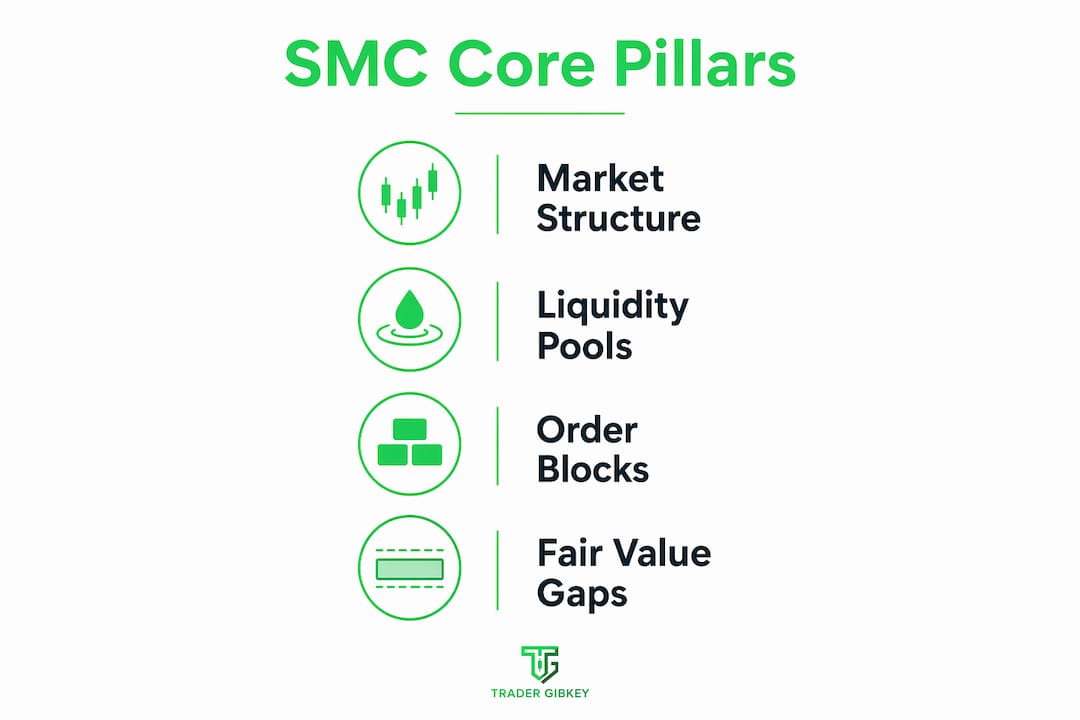
SMC rests on four foundational pillars: market structure, liquidity, order blocks, and fair value gaps. Each one builds on the last. Skip one, and the whole framework falls apart.
Market structure
Market structure is the backbone of every SMC trade. A bullish market structure shows a series of higher highs and higher lows, while a bearish structure shows lower highs and lower lows. Two signals mark structural shifts:
- Break of Structure (BOS): Price breaks a previous swing high or low in the direction of the current trend. This confirms trend continuation.
- Change of Character (CHoCH): Price breaks a swing point against the current trend. This signals a potential reversal and is the earliest warning that control is shifting.
Beginners often confuse BOS with CHoCH. The difference matters because one tells you to stay in the trend and the other tells you to prepare for a reversal.
Liquidity pools
Liquidity is the market’s engine. Retail traders cluster their stop-losses just above swing highs and just below swing lows. Institutions know this. They push price into those clusters to fill their large orders, then reverse. These clusters are called liquidity pools. Your job as an SMC trader is not to copy institutions. Your job is to spot where retail stops are sitting and avoid being the one who gets taken out.

Pro Tip: Mark the most obvious swing highs and lows on your chart. Those are the liquidity pools institutions will target before making their real move.
Order blocks and fair value gaps
An order block is the last bearish candle before a strong bullish move, or the last bullish candle before a strong bearish move. It marks the zone where institutional orders were placed. Price frequently returns to these zones before continuing in the original direction.
A fair value gap (FVG) is a three-candle imbalance where the middle candle moves so fast that price leaves a gap between the wicks of the first and third candles. Institutions tend to fill these gaps before resuming the trend. Both order blocks and FVGs give you high-probability entry zones when the broader market structure supports the trade.
How do beginners learn and implement SMC trading strategies?
The biggest mistake new traders make is jumping straight to order blocks without understanding the structure behind them. Beginners must master market structure concepts like BOS and CHoCH before trading advanced zones. Here is a practical sequence that works:
- Set your bias on the daily or 4-hour chart. Higher timeframes filter out noise and show you the dominant trend. A bullish bias means you only look for long setups. A bearish bias means you only look for shorts.
- Drop to the 1-hour chart to identify key zones. Mark order blocks and fair value gaps that align with your higher timeframe bias. Ignore anything that conflicts with it.
- Use the 15-minute chart for entry. Industry standards recommend the 15-minute timeframe for intraday SMC execution, anchored to daily or 4-hour bias. This is where you watch for liquidity sweeps and CHoCH signals before entering.
- Wait for a liquidity sweep. Do not enter an order block until price has swept the liquidity above or below it. The sweep confirms institutional activity.
- Confirm with CHoCH on the lower timeframe. After the sweep, a CHoCH on the 15-minute chart signals that the institutional move is beginning.
- Apply a minimum 2:1 reward-to-risk ratio. Professional SMC strategies target at least 2:1, with stops placed beyond the structural invalidation point. Anything less and the math does not work in your favor over time.
Pro Tip: Multi-timeframe analysis is non-negotiable. Daily and 4-hour charts set your direction, 1-hour charts identify your zones, and 15-minute charts give you your entry. Never skip a timeframe in this sequence.
Patience is the skill that separates profitable SMC traders from the rest. You are not looking for trades every hour. You are waiting for price to reach your zone, sweep liquidity, and confirm a shift. That process can take days. That is normal.
What are common beginner mistakes when trading with Smart Money Concepts?
Most beginners repeat the same errors. Knowing them in advance saves you months of losses.
- Trading against the higher timeframe bias. SMC is a framework for reading institutional intent. Trading against the dominant trend puts you on the wrong side of institutional flow and leads to frequent stop-outs. Always confirm your bias on the daily or 4-hour chart first.
- Entering order blocks before liquidity sweeps. Most beginners fail by entering order blocks too early. A sweep that clears retail stop-losses is necessary to confirm that institutional order flow has activated. Without the sweep, the order block is just a zone on a chart.
- Misreading BOS signals. Not every break of a swing point is a true BOS. Minor price fluctuations create false signals, especially on lower timeframes. Confirm BOS on the 1-hour chart or higher before acting on it.
- Overloading charts with indicators. SMC is a clean, price-based method. Adding RSI, MACD, and Bollinger Bands on top of it creates confusion, not clarity. Learn to avoid overcomplicated systems that dilute your read of raw price action.
- Ignoring risk management. No setup is guaranteed. Solid risk management rules protect your account when trades go wrong. A 1% risk per trade rule keeps you in the game long enough to develop real skill.
The pattern is consistent: beginners rush the process. SMC rewards traders who wait for full confirmation, not those who act on partial signals.
How do you build a practical SMC trading plan for lasting success?
A trading plan turns SMC from a set of concepts into a repeatable process. Without one, you will second-guess every setup and trade on emotion instead of structure.
The foundation of any SMC plan is session timing. Institutional activity concentrates during specific windows called kill zones. The London kill zone runs from 2:00 AM to 5:00 AM EST, and the New York kill zone runs from 7:00 AM to 10:00 AM EST. Waiting for setups in kill zones increases trade probability by filtering out the low-volume noise that dominates off-peak hours. Understanding global market hours is a practical skill every SMC trader needs.
Premium and discount zones add another filter. In a bullish market, price in the lower 50% of a swing range (the discount zone) offers better long entries. In a bearish market, price in the upper 50% (the premium zone) offers better short entries. Combining this filter with order blocks and FVGs dramatically reduces low-quality setups.
| SMC Plan Element | Purpose |
|---|---|
| Higher timeframe bias (Daily/4H) | Sets trade direction and filters counter-trend setups |
| Kill zone timing (London/New York) | Focuses entries during peak institutional activity |
| Premium and discount zones | Filters entry quality within the swing range |
| Liquidity sweep confirmation | Validates institutional order flow before entry |
| 2:1 minimum reward-to-risk | Protects profitability over a series of trades |
Journaling every trade is not optional. Write down your bias, your zone, your entry trigger, and your outcome. Patterns in your journal reveal whether you are following your plan or trading on impulse. A beginner forex trading plan gives you the structure to make journaling a habit from day one.
Pro Tip: Review your journal weekly, not daily. Daily reviews create emotional reactions to short-term results. Weekly reviews show you patterns in your decision-making.
Key Takeaways
Smart Money Concepts works because it aligns your trades with institutional order flow through market structure, liquidity sweeps, and confirmed entry zones.
| Point | Details |
|---|---|
| Master structure first | Learn BOS and CHoCH before attempting order blocks or fair value gaps. |
| Use multi-timeframe analysis | Set bias on Daily/4H, identify zones on 1H, and execute on 15M charts. |
| Wait for liquidity sweeps | Enter order blocks only after a sweep confirms institutional activation. |
| Apply a 2:1 reward-to-risk minimum | Place stops beyond structural invalidation to keep the math in your favor. |
| Trade kill zones only | Focus on London and New York sessions to filter low-probability setups. |
What I’ve learned after years of watching beginners trade SMC
The most common thing I see is traders who understand SMC intellectually but cannot execute it consistently. They can explain order blocks perfectly in a forum post, then blow their account chasing a setup that never confirmed. The gap between knowing and doing is where most beginners get stuck.
The fix is not more content. It is deliberate practice on a single concept at a time. Spend two weeks doing nothing but marking BOS and CHoCH on historical charts. Do not trade. Just mark. After that, add liquidity pools. Then add order blocks. Build the skill layer by layer, the same way you would learn any technical craft.
I also see traders who treat SMC as a magic system that removes all uncertainty. It does not. What it does is give you a structured way to read retail trading traps and position yourself on the right side of institutional flow more often than not. “More often than not” is the goal. Not perfection.
The traders who stick with SMC long enough to profit from it share one trait: they protect their capital aggressively while they are still learning. A 1% risk per trade feels conservative until you realize it gives you 100 trades to develop your edge before you run out of money. That runway is everything at the beginning.
— Gabriel
How Tradergibkey can accelerate your SMC learning
Knowing the concepts is one thing. Applying them under real market conditions is another challenge entirely.

Tradergibkey offers structured courses and live mentorship built specifically for traders who want to move from theory to consistent execution. With over 18 years of live market experience, the Tradergibkey approach focuses on practical price action skills, not recycled theory. You get a clear learning roadmap, real trade setups explained in detail, and a community of traders working through the same process. If you are ready to build a real edge with SMC, start with Tradergibkey and follow a path that has already worked for hundreds of traders before you.
FAQ
What is the first thing to learn in SMC?
Market structure is the mandatory starting point. Master BOS and CHoCH before moving to order blocks or fair value gaps.
What timeframe works best for SMC beginners?
Use the daily or 4-hour chart to set your bias, then drop to the 15-minute chart for entries. This multi-timeframe approach filters noise and aligns you with institutional flow.
How much risk should a beginner take per SMC trade?
Risk no more than 1% of your account per trade, and target a minimum 2:1 reward-to-risk ratio on every setup.