
Market hours are the designated times when stock exchanges accept trading orders, defining when traders can actively buy and sell securities. Every major exchange operates on a fixed schedule tied to local business hours, regional customs, and regulatory frameworks. Miss that window, and you miss the liquidity. Get it right, and you trade with the market’s full force behind you. This guide covers the core trading hours for NYSE, Nasdaq, the London Stock Exchange, and the Tokyo Stock Exchange, plus extended sessions, holiday closures, and the regional quirks that catch traders off guard.
What are the regular market hours for major global exchanges?
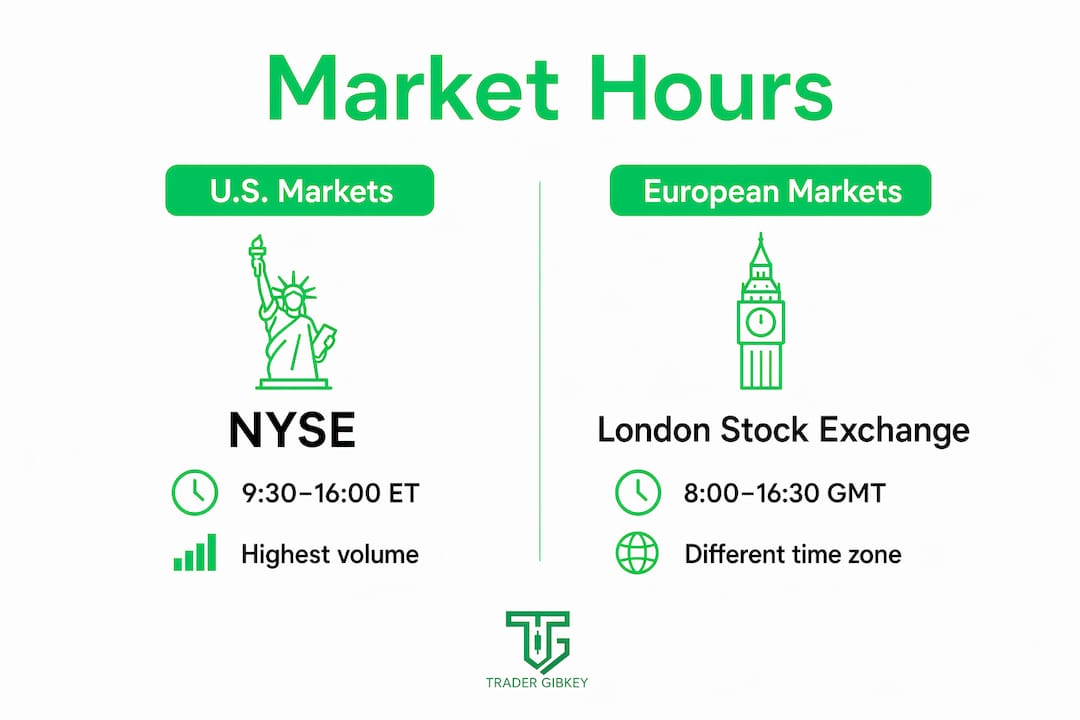
The NYSE and Nasdaq both run their core trading sessions from 9:30 a.m. to 4:00 p.m. ET, Monday through Friday. That six-and-a-half-hour window is when volume is highest, spreads are tightest, and price discovery is most reliable. For most traders, this is the only window worth focusing on.
European markets follow a different clock. The London Stock Exchange operates from 8:00 a.m. to 4:30 p.m. GMT, giving it an overlap with U.S. hours that creates some of the most liquid conditions of the trading day. That overlap, roughly 8:30 a.m. to 11:30 a.m. ET, is when Forex pairs involving the British pound and euro see their sharpest moves.

Asian markets run on a completely separate schedule. The Tokyo Stock Exchange opens at 9:00 a.m. JST and closes at 3:00 p.m. JST, but it includes a one-hour lunch break from 11:30 a.m. to 12:30 p.m. That break is not symbolic. It interrupts momentum strategies and forces traders to reset their read on the session.
| Exchange | Open (Local) | Close (Local) | Time Zone | Lunch Break |
|---|---|---|---|---|
| NYSE | 9:30 a.m. | 4:00 p.m. | ET | None |
| Nasdaq | 9:30 a.m. | 4:00 p.m. | ET | None |
| London Stock Exchange | 8:00 a.m. | 4:30 p.m. | GMT | None |
| Tokyo Stock Exchange | 9:00 a.m. | 3:00 p.m. | JST | 11:30 a.m. to 12:30 p.m. |
Understanding this table is not just an academic exercise. If you trade multiple markets, you need to know exactly when each one is live and when it goes quiet.
How do extended trading hours and off-hours sessions work?
Extended trading hours refer to the pre-market and after-hours sessions that run outside the standard stock market open and close. Pre-market on U.S. exchanges typically starts as early as 4:00 a.m. ET and runs until 9:30 a.m. ET. After-hours trading runs from 4:00 p.m. to 8:00 p.m. ET. Some brokerages offer access to the full window; others restrict it.
The appeal is obvious. Earnings reports, Federal Reserve announcements, and geopolitical news often drop outside regular hours. Traders want to react before the opening bell. The problem is that extended-hours trading features lower liquidity, wider bid-ask spreads, and sharper price swings. A stock that moves cleanly during the regular session can gap violently in pre-market with almost no volume behind it.
Here is what you need to know before trading extended sessions:
- Liquidity is thin. Fewer participants means larger spreads and less reliable fills.
- Order types are restricted. Many brokerages only allow limit orders during extended hours, not market orders.
- Price can be misleading. A pre-market spike does not always hold once the regular session opens.
- Volatility is amplified. News-driven moves in thin markets can reverse fast and hard.
- Not all securities trade. ETFs and some stocks have limited or no extended-hours activity.
Understanding liquidity sweeps becomes especially relevant here. Thin pre-market conditions are exactly where stop hunts and false breakouts happen most often.
Pro Tip: Treat extended-hours price action as information, not a signal. Use it to gauge sentiment before the open, but wait for confirmed volume before entering a position.
What regional nuances affect trading schedules globally?
Market hours reflect local working customs and regional regulations. Ignoring these when trading across borders causes missed opportunities and mispriced trades. The differences go deeper than just time zones.
U.S. markets observe federal holidays that most traders outside America do not track automatically. The NYSE and Nasdaq close on Juneteenth, and they close early at 1:00 p.m. ET on the day after Thanksgiving and on Christmas Eve. If you are running an open position into one of those days expecting normal volume, you will be disappointed.
The Middle East adds another layer of complexity. Markets in the UAE operate on a Friday-Saturday weekend rather than the Saturday-Sunday standard used in Western markets. That means the Dubai Financial Market is open on Sunday when European and American traders are still in their weekend. Cross-border traders who miss this detail end up with gaps in their coverage.
Daylight saving time creates a recurring headache for traders who work across time zones. The U.S. and Europe do not change their clocks on the same date. For a few weeks each spring and fall, the offset between New York and London shifts by an hour. That changes when the overlap window starts and ends, which matters if your strategy depends on that overlap for liquidity.
Asian markets add their own wrinkle with scheduled midday breaks. The Tokyo Stock Exchange’s lunch break from 11:30 a.m. to 12:30 p.m. JST interrupts momentum strategies and forces a reset. Traders running trend-following systems on Japanese equities need to account for that gap or risk getting caught in a false continuation.
How can traders use market hours to sharpen their strategy?
Timing is not everything in trading, but it is close. The opening and closing bells mark the periods of highest liquidity and volatility in any session. These are the moments when institutional orders flood the market, spreads tighten, and price moves with conviction. Trading during these windows gives you the best chance of clean execution.
Here is a practical framework for building your schedule around the market:
- Map your primary market. Identify which exchange you trade most and build your day around its core hours. For Forex traders, this means knowing when the London and New York sessions overlap.
- Mark holiday closures in advance. Use a resource like the Forex Factory economic calendar to track U.S. and international market holidays before they sneak up on you.
- Avoid the dead zones. The hour before the U.S. open and the mid-afternoon lull between 1:00 p.m. and 2:30 p.m. ET are low-volume periods. Spreads widen and setups fail more often.
- Use extended hours for research, not execution. Pre-market price action tells you where sentiment is leaning. It rarely tells you where price will actually go once volume arrives.
- Adjust for DST transitions. Every spring and fall, double-check your time zone conversions. A one-hour shift in the London-New York overlap can change your entire session plan.
Understanding what a trading session is at a structural level helps you apply these steps with more precision. Sessions are not just time blocks. They carry distinct liquidity profiles, participant types, and behavioral patterns.
Pro Tip: The first 30 minutes after the NYSE open and the last 30 minutes before the close are the highest-volume windows of the day. If you are new to timing your entries, start by studying price behavior in those two windows before adding complexity.
Cryptocurrency markets offer a useful contrast here. Unlike traditional exchanges, crypto trades 24/7/365 with no scheduled pauses. That sounds like freedom, but it also means there is no natural liquidity anchor. Traditional traders who move into crypto often underestimate how disorienting the absence of a market schedule feels.
Key Takeaways
Knowing your market schedule is not optional. It is the foundation every other trading decision sits on.
| Point | Details |
|---|---|
| U.S. core hours | NYSE and Nasdaq run 9:30 a.m. to 4:00 p.m. ET with the highest liquidity of the day. |
| Extended sessions carry risk | Pre-market and after-hours trading feature thin liquidity, wider spreads, and unreliable fills. |
| Regional nuances matter | Holiday closures, DST shifts, and Middle Eastern weekend differences affect your market schedule. |
| Asian lunch breaks disrupt momentum | Tokyo Stock Exchange pauses from 11:30 a.m. to 12:30 p.m. JST, interrupting trend strategies. |
| Open and close are your best windows | The first and last 30 minutes of any session carry the most volume and the cleanest setups. |
Why market timing changed how I trade
I spent years treating market hours as background information. I knew the NYSE opened at 9:30 a.m. and closed at 4:00 p.m. Beyond that, I did not think much about it. That was a mistake.
The shift happened when I started trading across the London and New York overlap. I realized I was not just trading a chart. I was trading a specific window of time when two of the world’s largest financial centers were both active. The behavior of price during that overlap was fundamentally different from what I saw at 2:00 p.m. ET when London had closed and New York was drifting. Same instrument, completely different character.
Extended hours taught me a harder lesson. I chased a few earnings moves in pre-market and got burned by spreads I did not account for. The price looked great on the screen. The fill was a different story. After that, I made a hard rule: extended hours are for reading, not trading, unless there is a very specific reason to act.
The regional nuances caught me off guard too. DST transitions cost me a week of confusion one spring when the London-New York overlap shifted and I did not update my schedule. It sounds like a small thing. When your strategy depends on that overlap for liquidity, it is not small at all.
My advice is simple. Build a market calendar. Know every holiday, every DST transition, and every session overlap that affects the instruments you trade. Review your trading performance by session, not just by trade. You will find patterns you never noticed before.
— Gabriel
How Tradergibkey helps traders master market timing
Knowing when markets open and close is the starting point. Knowing how to read price action within those windows is where real edge comes from.
Tradergibkey brings over 18 years of live market experience to traders who want more than theory. The courses and mentorship programs cover session-based trading, price action strategy, and the kind of timing discipline that separates consistent traders from those who grind and wonder why results do not improve. The community is active, the feedback is direct, and the focus is always on what actually works in live conditions. If you are ready to build a trading approach grounded in real market structure, Tradergibkey’s courses and mentorship are the next step worth taking.
FAQ
What time does the U.S. stock market open and close?
The NYSE and Nasdaq open at 9:30 a.m. ET and close at 4:00 p.m. ET, Monday through Friday, excluding federal holidays.
What are extended trading hours?
Extended hours include pre-market sessions from 4:00 a.m. to 9:30 a.m. ET and after-hours sessions from 4:00 p.m. to 8:00 p.m. ET, with lower liquidity and wider spreads than regular sessions.
Do all global markets follow the same schedule?
No. The London Stock Exchange closes at 4:30 p.m. GMT, the Tokyo Stock Exchange includes a midday lunch break, and Middle Eastern markets use a Friday-Saturday weekend instead of Saturday-Sunday.