
For most UK retail traders, spread betting profits are exempt from Income Tax and Capital Gains Tax under current HMRC guidance. However, if HMRC decides your activity resembles a business or trade, it can tax those profits. If that sounds like your situation, get advice from a qualified accountant before you file anything.
TL;DR:
- HMRC typically does not consider spread betting activity as a trade unless it is systematic, frequent, with professional tools, or presented commercially.
- Profits from spread betting are exempt from both Income Tax and Capital Gains Tax because there is no actual transfer of underlying assets involved.
- Spread betting losses are not deductible, and activities that resemble a business can be subject to income tax at HMRC’s discretion.
- Proper record-keeping of trades, prices, and account activity is essential for compliance in case HMRC questions your activity years later.
- Regulatory oversight by the FCA provides protections such as segregated client accounts and conduct rules, but does not cover trading strategy or outcomes.
Table of Contents
- What This Means for Your Tax Return
- Why Is Spread Betting Tax Free in the UK?
- When Does HMRC Tax Spread Betting as a Business?
- Spread Betting vs. CFDs: Which Wins on Tax?
- What Records Should You Keep for HMRC?
- Is Spread Betting Regulated by the FCA?
- Practical Tax Planning: Staying on the Right Side of HMRC
- Does Spread Betting Affect Benefits or Other Allowances?
- What Triggers an HMRC Inquiry Into Spread Betting?
- Casual Bettor or Professional Trader: Does HMRC Treat You Differently?
- A Note From the Trading Side
- Better Trading Habits Start With Better Structure
- Where to Check the Official Rules Yourself
- Quick Answers on Spread Betting Tax
- Sources
What This Means for Your Tax Return
Here’s the practical version, stripped of legal jargon:
- You generally do not declare spread betting winnings on your self-assessment tax return.
- Losses from spread betting are not deductible and cannot be offset against other capital gains or income.
- If spread betting is your main source of income, or you’re running it in a systematic, businesslike way, seek advice from a tax professional.
That third point matters more than most guides admit. The exemption is generous, but it isn’t unconditional.
Why Is Spread Betting Tax Free in the UK?
Spread betting sits outside the Capital Gains Tax regime due to how it’s structured legally, not because HMRC is being generous. When you spread bet, you never actually buy or sell an underlying asset. You’re betting on the direction and size of a price move, and no asset changes hands. HMRC’s own Capital Gains Manual makes this explicit: CG56105 confirms that no chargeable gain or allowable loss arises from spread betting, because there’s no acquisition or disposal of a chargeable asset to tax.
That single structural fact is why spread betting escapes both CGT and Stamp Duty. There’s no share certificate, no contract for an underlying instrument, nothing for Stamp Duty to attach to.
Pro Tip: Don’t confuse “no CGT” with “no scrutiny.” HMRC’s exemption applies to the mechanics of the product, not automatically to every person who uses it. Keep that distinction in mind before you assume you’re untouchable.
Spread betting is also fairly unusual in that it’s largely a UK and Ireland phenomenon, and the tax treatment reflects that specific regulatory history rather than any universal principle about betting or trading. Rules can shift, so treat the exemption as current fact, not permanent guarantee.
When Does HMRC Tax Spread Betting as a Business?
HMRC’s Business Income Manual draws the line between recreational betting and taxable trading. BIM22015 sets out that spread betting is not normally treated as a trade, but it also lists exceptions where systematic, businesslike activity crosses into taxable territory.
What actually triggers reclassification? HMRC looks at a cluster of indicators, not one single test:
- How frequently you trade, and whether it looks continuous rather than occasional
- Whether you use professional-grade systems, automation, or formal strategies
- Whether spread betting functions as your primary income rather than a side activity
- Whether you present the activity commercially, such as advertising signals or a trading service
If HMRC reclassifies your activity as a trade, ordinary Income Tax rates apply to the profits, and in some cases the assessment can be applied retrospectively. Corporate entities face different treatment altogether, since a company running a trading operation is judged under separate rules from an individual placing personal bets.
Pro Tip: The tests hinge on “trade” as defined case by case, not a fixed threshold of trades per month. There’s no magic number that keeps you safe. Consistency of behavior, not volume alone, is what HMRC examines.
Spread Betting vs. CFDs: Which Wins on Tax?
CFDs and spread betting look similar on the surface. Both let you speculate on price movement without owning the underlying asset. Their tax treatment diverges sharply.
| Feature | Spread Betting | CFDs |
|---|---|---|
| CGT status | Normally exempt | Subject to CGT |
| Stamp Duty | Not charged | Not charged |
| Loss offsetting | Not deductible | Can offset against other capital gains |
| Annual allowance | Not applicable | £3,000 CGT allowance applies |
Broker guidance from CMC Markets confirms this split: spread betting sits outside CGT and Stamp Duty, while CFDs fall inside the standard capital gains framework, with gains taxed at 18% or 24% depending on your income band after the £3,000 allowance is used. Accountant analysis of the 2026/27 tax year backs this up, and it flags something worth remembering: because spread betting losses aren’t deductible, a bad losing streak gives you nothing to offset later, whereas a CFD loss can reduce a future tax bill. Non-UK residents should also check availability separately, since spread betting access and treatment can differ outside the UK market.
What Records Should You Keep for HMRC?
Most spread bettors never need to declare anything. But HMRC can ask questions years after the fact, and “I think I made some money” isn’t a defense. Build a simple record habit now, before you need it.
- Log the trade date, instrument, stake size, and direction for every position you open.
- Record opening and closing prices, plus the resulting profit or loss on each trade.
- Save monthly P&L summaries from your broker rather than relying on memory.
- Keep bank and broker statements showing deposits, withdrawals, and account balances.
- Retain everything for at least five years after the relevant tax year, since that’s the window HMRC typically uses for enquiries.
If HMRC ever queries your position, this is exactly the evidence you hand over. Nothing exotic, just a clean paper trail.
Is Spread Betting Regulated by the FCA?
Yes. Spread betting is regulated under the Financial Services and Markets Act (FSMA), and the Financial Conduct Authority (FCA) oversees the firms offering it. That’s a deliberate legal choice: legislative notes on the Gambling Act 2005 confirm that spread bets regulated under FSMA are excluded from the Gambling Act’s definition of betting, which is why the Gambling Commission doesn’t set the conduct rules here. The FCA does.
That regulatory status brings real protections:
- Client money must be held in segregated accounts, separate from the firm’s own funds.
- Providers must run appropriateness and affordability checks before letting you trade.
- Disputes can go to the Financial Ombudsman Service if a provider mishandles your account or breaches conduct rules.
None of that protects you from market losses or a bad trading decision. FCA regulation covers how the firm treats you, not whether your strategy works.
Practical Tax Planning: Staying on the Right Side of HMRC
If your income depends on spread betting, a few habits reduce your reclassification risk. Keep trading funds in a dedicated account, separate from other business dealings, and avoid presenting yourself commercially, such as selling signals or running a paid trading service alongside your own betting.
Incorporation changes everything. A company placing spread bets is assessed under corporate tax rules, not the personal exemption individuals rely on, so profits inside a company structure are typically taxed differently.
Pro Tip: If your trading volume or income has grown to the point where you’re unsure which side of the line you’re on, get a written opinion from a tax advisor before HMRC forms its own view. A proactive query costs far less than a retrospective assessment.
Does Spread Betting Affect Benefits or Other Allowances?
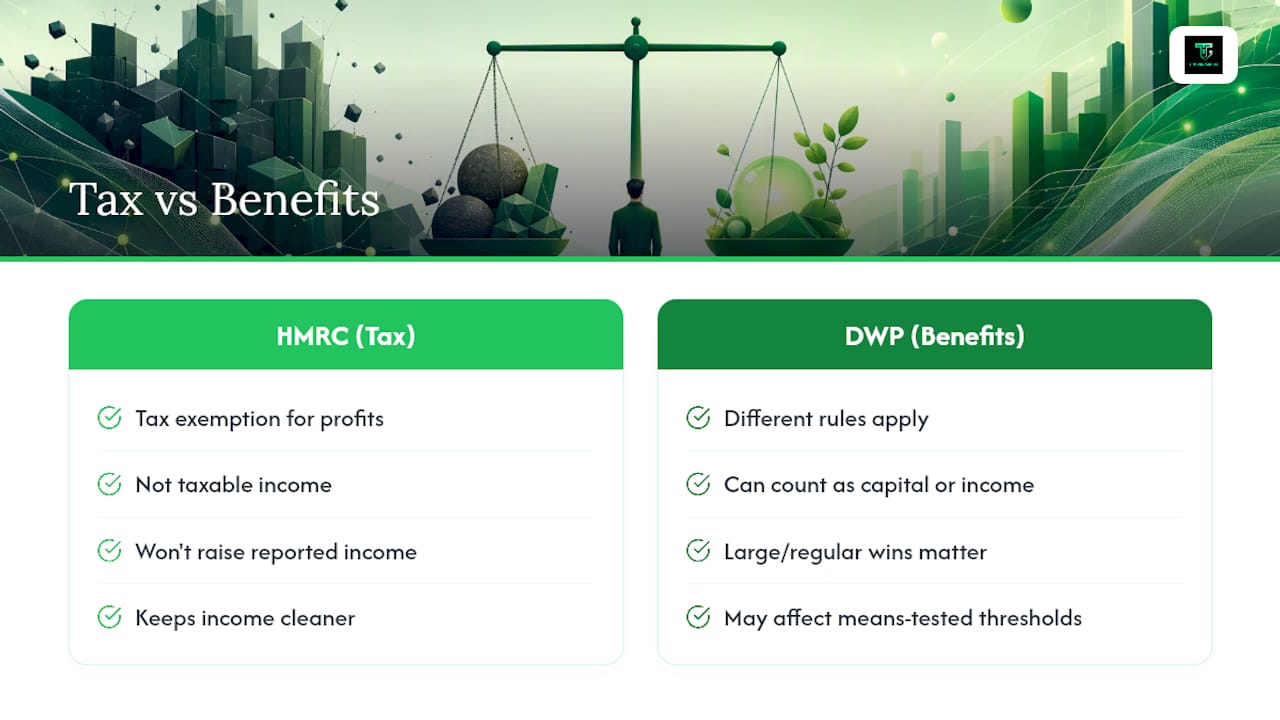
Spread betting profits sitting outside Income Tax doesn’t mean they’re invisible everywhere else. Means-tested benefits, such as Universal Credit, assess your financial resources more broadly than HMRC’s income definitions, and large or regular winnings can affect how your capital and income are treated in those calculations.
The distinction that trips people up: HMRC’s tax exemption and the Department for Work and Pensions’ benefits assessment run on separate rules. A profit that HMRC doesn’t tax can still count as capital or income for benefits purposes if it’s substantial or regular enough to look like a resource you rely on. If you’re claiming any means-tested support, treat large spread betting wins the same way you’d treat an unexpected inheritance or gift, something worth checking against the specific benefit’s rules rather than assuming tax-free automatically means benefit-neutral.
This also touches other allowances tied to income thresholds, such as the tapering of the Personal Allowance for higher earners or eligibility for certain tax credits. Because spread betting profits generally don’t count as taxable income, they typically don’t push you across those income-based thresholds the way employment income or CFD gains might. That’s actually one of the quieter advantages of the exemption: it keeps your reported income figure cleaner for anything else that’s assessed against it.
If you’re combining spread betting with other income streams, forex trading, dividends, or a salary, it’s worth checking how each interacts with your overall position rather than assuming the spread betting portion is a total non-factor.
What Triggers an HMRC Inquiry Into Spread Betting?
HMRC doesn’t routinely investigate spread bettors, because the default assumption is that the activity is gambling, not trading. Certain patterns raise flags. A sudden, large influx of funds into a bank account with no obvious explanation can prompt a query, especially if it coincides with known spread betting withdrawals. HMRC’s data sharing arrangements with financial institutions mean unusual account activity doesn’t go unnoticed indefinitely.
The bigger trigger is public-facing behavior. If you run a website, social media account, or paid signal service that references your spread betting results, you’ve created a paper trail suggesting commercial activity. HMRC’s own guidance in BIM22015 points directly at this kind of businesslike presentation as a factor pushing activity toward taxable trading status.
If HMRC does open an inquiry, the burden falls on you to demonstrate your activity was recreational rather than commercial. This is where contemporaneous records earn their keep. A consistent trade journal, unremarkable account behavior, and no public commercial presentation together build a strong case that you were simply betting, not running a business. Professionals facing this kind of scrutiny typically preserve every relevant record from day one rather than trying to reconstruct history after HMRC asks questions, and many seek a written opinion from a tax advisor to settle the point before it becomes a dispute.
Prepare by treating your account like it might be reviewed someday, even if it never is. That mindset costs you nothing and saves considerable stress later.
Casual Bettor or Professional Trader: Does HMRC Treat You Differently?
The exemption was built with the casual bettor in mind. Someone placing occasional spread bets alongside a regular job, with no systematic strategy and no reliance on the winnings for daily living, sits comfortably within HMRC’s normal, non-taxable treatment. The activity looks exactly like what the exemption was designed to cover.
Full-time or professional-level traders face a fuzzier picture. Volume alone doesn’t flip the switch, but volume combined with structure, dedicated systems, consistent daily activity, dependence on the income, often does. The distinction HMRC draws isn’t really about how much money you make. It’s about whether the activity has the character of a business: repeatable, systematic, income-replacing.
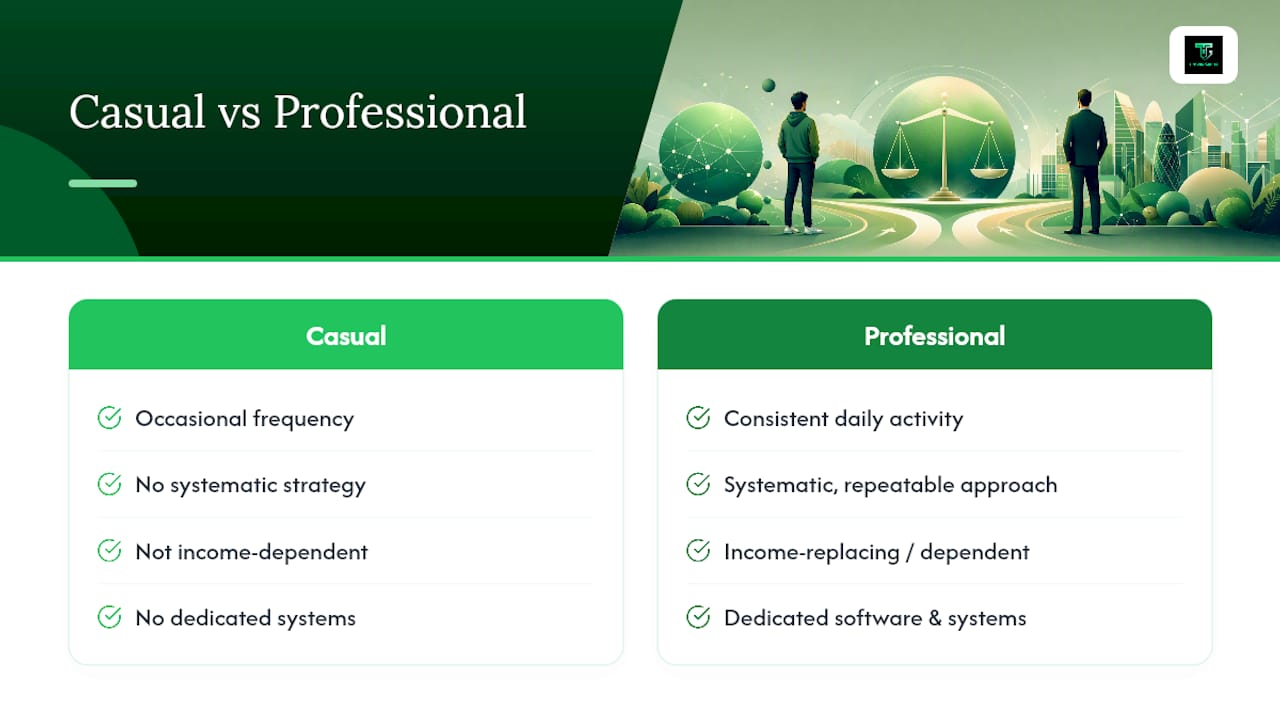
This creates an odd asymmetry worth understanding. Two people can generate identical profits from spread betting, and one pays nothing while the other faces Income Tax, purely based on how organized and dependent their activity looks from the outside. If spread betting has become your main income and you’re running it with real structure, daily routines, formal risk rules, dedicated software, it’s worth having a frank conversation with a tax professional rather than assuming the exemption automatically covers you just because it covered you last year.
A Note From the Trading Side
Tax exemptions don’t fix bad trading habits, and record-keeping isn’t just a tax defense. It’s how you actually improve. I recommend traders log every position with entry price, exit price, stake, reasoning, and outcome, updated the same day, not reconstructed weeks later. That habit builds the discipline behind consistent results, and it happens to double as exactly the paper trail HMRC would want to see. None of this replaces a real conversation with a qualified tax advisor when your situation gets complicated.
— Gabriel
Better Trading Habits Start With Better Structure
Staying on the right side of HMRC’s exemption often comes down to the same discipline that makes traders profitable in the first place: consistent records, clear risk rules, and a strategy you actually follow rather than improvise. Some mentorship programs build that structure directly into their offerings, with trade journal templates, risk management training, and daily market analysis drawn from extensive experience, so you’re not guessing at what “systematic” looks like from the outside.

This isn’t tax advice, and it never claims to be. What structured mentorship and a real trading community give you is the habit of trading with a plan instead of on impulse, the kind of behavior that keeps your activity looking, and functioning, like disciplined trading rather than reckless guessing that leads to both losses and tax headaches. If you’re serious about tightening your process, explore Tradergibkey’s mentorship and course options and see which structured path fits where you are right now.
Where to Check the Official Rules Yourself
Tax rules shift, so verify anything time-sensitive directly on GOV.UK rather than relying on secondhand summaries. Start with BIM22015 for HMRC’s trading tests, CG56105 for the Capital Gains Tax position, and the FCA’s regulatory framework under the Gambling Act 2005 notes for the legal basis behind FCA oversight. If your situation involves large sums, business-like activity, or cross-border residency, a qualified UK tax advisor should review your specific facts before you rely on any general guidance, including this article.
Quick Answers on Spread Betting Tax
Do I need to pay tax on spread betting profits in the UK? Most individuals don’t. Profits are normally exempt from Income Tax and Capital Gains Tax unless HMRC treats your activity as a trade.
Can I deduct spread betting losses from my taxes? No. Losses from spread betting are not deductible and cannot offset gains from other investments.
Does spread betting count as taxable income for benefits? It can. HMRC’s tax exemption doesn’t automatically apply to means-tested benefit assessments, so large or regular winnings may still need reporting there.
This article is general information, not a substitute for advice from a qualified financial advisor. Consult a qualified financial professional about your own circumstances before acting on anything here.
Sources
- CG56105 - Futures: financial futures: financial spread betting
- Legislation
- Spread betting tax in the UK: what you need to know - CMC Markets
- Spread betting, CFDs and forex: How HMRC taxes each one in 2026/27 - Stewart Accounting