
Spread betting is typically tax-free for retail traders in the UK, while CFD and spot forex profits usually face Capital Gains Tax once they clear your annual allowance. The regime you fall under isn’t always your choice, though. HMRC can reclassify frequent, well-organized trading as a business, which pulls your profits into income tax and National Insurance instead.
That single distinction, spread bet versus CFD or spot, versus how HMRC reads your trading pattern, decides almost everything else in this guide. Get the classification wrong on your self-assessment and you either overpay or invite a compliance headache.
Here’s what determines which bucket you’re in:
- Spread betting is generally treated as gambling, so profits sit outside Capital Gains Tax for most retail traders.
- CFDs and spot forex normally attract Capital Gains Tax above your annual exempt amount.
- High-frequency or business-like trading can be reclassified by HMRC as a trade, shifting you to income tax rates.
- Accurate records and the correct self-assessment form (SA108 or SA103F) are non-negotiable once you’re liable.
This guide reflects the 2026 tax year rules, with worked examples further down so you can match your own trading pattern to the right form.
Key Takeaways
Forex tax treatment in the UK depends primarily on instrument type and HMRC’s classification of your trading activity as investment or business.
| Point | Details |
|---|---|
| Instrument decides your default regime | Spread bets are usually tax-free; CFDs and spot forex normally face CGT above the annual exempt amount. |
| HMRC can override the default | Frequent, organized, income-reliant trading risks reclassification as a trade, shifting you to income tax and possible National Insurance. |
| Losses behave differently by regime | CGT losses offset other capital gains; income tax losses follow self-employment loss relief rules; spread betting losses offset nothing. |
| Reporting has strict forms and deadlines | Use SA108 for CGT or SA103F for trade income, filing and paying by January 31 following the tax year. |
| Structured support reduces reporting risk | Tradergibkey’s mentorship builds trade journaling and monthly P&L reconciliation into your trading routine from day one. |
This article is general information, not a substitute for advice from a qualified financial advisor. Consult a qualified financial professional about your own circumstances before acting on anything here.
Table of Contents
- Taxes on Forex Trading by Instrument: Spread Bets, CFDs, and Spot
- When HMRC Treats Your Forex Trading as a Business
- CGT Allowances, Income Tax Bands, and Loss Offsetting Rules
- Reporting Forex Income: Forms, Deadlines, and What HMRC Wants
- Record-Keeping: How to Calculate Your Gains and Losses
- Three Trader Profiles and How Each Gets Taxed
- Overseas Forex Accounts and Currency Conversion Tax Rules
- Does Trading Frequency Change How You’re Taxed?
- Registered Businesses and Professional Forex Traders
- Building Tax-Ready Habits Into Your Trading Routine
- Get Hands-On Support for Tax-Ready Trading Habits
- Sources
Taxes on Forex Trading by Instrument: Spread Bets, CFDs, and Spot
The instrument you trade determines your default tax treatment before HMRC even looks at your behavior. Get this part right and half your tax planning is already done.
Spread betting is a derivative product where you bet on price direction without owning the underlying currency pair. Because HMRC treats spread betting as gambling for most retail traders, profits typically fall outside Capital Gains Tax entirely. That’s the main reason so many UK retail traders gravitate toward spread bet accounts over other forex products. The exception: if HMRC decides your spread betting is actually a business (more on badges of trade below). That shelter disappears.
CFDs (contracts for difference) work differently. You’re entering a contract to exchange the difference in an asset’s price from open to close, and profits from CFD trading are generally subject to Capital Gains Tax for retail traders. The upside: losses on CFDs can offset other capital gains elsewhere in your portfolio, which spread betting losses can’t do.
Spot forex (buying and selling currency pairs directly) sits in the same CGT bracket as CFDs for most individual traders.
A few practical notes on scope:
- Futures and options on currency pairs can carry different treatment depending on contract structure, so check the specific product before assuming CGT applies by default.
- Your account type on your broker’s platform (spread bet vs CFD vs spot) usually determines which bucket you’re in, so check your account terms if you’re unsure.
- Mixed portfolios (some spread bet, some CFD) require separating the two for reporting purposes. Don’t lump them together.
When HMRC Treats Your Forex Trading as a Business
HMRC doesn’t care what you call yourself. It looks at behavior, and it uses a set of criteria known as the badges of trade to decide whether your activity is investment or a trade. CMC Markets outlines these indicators clearly: frequency of transactions, the scale of your operation, whether you’ve built organized systems around it, and your underlying profit motive.
Here’s the practical checklist HMRC actually applies:
- Frequency and volume. Dozens of trades a week looks very different from a handful a year.
- Organization. Dedicated trading software, a business bank account, or a formal setup all point toward “trade” rather than “hobby.”
- Intent. Trading purely to generate a living income weighs more heavily than occasional speculation alongside a day job.
- Use of professional infrastructure. Registered business accounts, accountants on retainer, or trading through a limited company all strengthen the case for business classification.
- Reliance on the income. If forex trading is your sole or primary income source, HMRC is more likely to treat it as a trade.
If HMRC decides you’re trading as a business, profits get taxed as income (not capital gains), and National Insurance contributions may also apply. That can mean a meaningfully higher bill than CGT would have produced.
Pro Tip: Keep your trading separate from any other self-employed income you report. Mixing the two makes it harder to argue your forex activity should sit in a different tax category if HMRC ever asks questions.

CGT Allowances, Income Tax Bands, and Loss Offsetting Rules
Numbers matter here, so let’s get specific. The annual Capital Gains Tax exempt amount applies to your net gains across all CGT-eligible assets, not just forex. Once your net CFD or spot forex gains, combined with any other capital gains, exceed that allowance, you owe CGT on the excess.
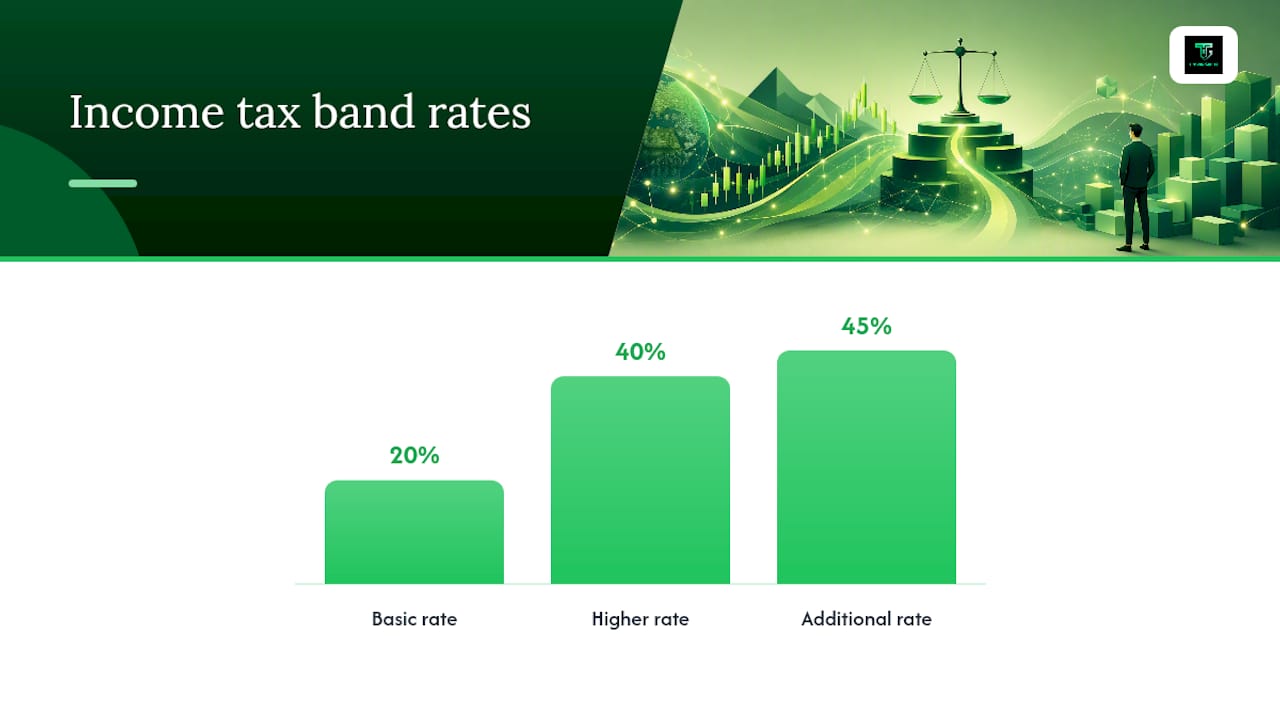
If HMRC classifies your trading as a business instead, the standard income tax bands apply: 20% basic rate, 40% higher rate, and 45% additional rate, layered on top of your other income. National Insurance can also be due on top of that, which is a real difference from the CGT route.
Loss treatment diverges sharply depending on which regime you’re in:
- Under CGT, losses from CFDs or spot forex can offset gains from other capital assets, shares included, in the same tax year or carried forward.
- Under income tax classification, trading losses may offset other income in some circumstances, following the usual self-employment loss relief rules.
- Spread betting losses generally can’t be offset against anything, since the activity sits outside the tax system altogether.
Stamp duty typically doesn’t apply to spread bets, CFDs, or spot forex trades, since you’re not acquiring a UK share or property interest through these products.
An annual CGT exempt amount is important to know if you trade CFDs or spot forex, since it determines whether you owe anything at all in a given year.
Reporting Forex Income: Forms, Deadlines, and What HMRC Wants
Once you know which regime applies, reporting is mechanical, but the deadlines are strict and the penalties for missing them add up fast.
- Identify your form. CGT-liable CFD and spot forex gains go on SA108 (Capital Gains Tax summary), filed alongside your main self-assessment return. If HMRC classes you as trading a business, you’ll instead use SA103F (self-employment, full version) to report income and expenses.
- Know your tax year. The UK tax year runs from April 6 to April 5. Everything you earned or lost within that window belongs on that year’s return.
- File and pay on time. Online self-assessment returns are due by January 31 following the end of the tax year, and that’s also the payment deadline for any tax owed.
- Attach the right records. Include trade-by-trade gain/loss summaries, broker statements, and any worksheets that support your figures, since HMRC can request them later.
- Get help when the numbers get complex. If you’re straddling both CGT and income tax treatment in the same year (a mixed spread bet and CFD portfolio, for example), a tax professional familiar with forex trading tax rules can save you from costly missteps.
Missing the January 31 deadline triggers an automatic penalty, and it compounds the longer the return stays outstanding.
Record-Keeping: How to Calculate Your Gains and Losses
Sloppy records are the number one reason traders overpay tax or panic during an HMRC inquiry. Fix this early and everything downstream gets easier.
For every trade, log:
- Date and time of entry and exit
- Instrument traded (currency pair, CFD, or spread bet)
- Entry and exit rates
- Position size
- Profit or loss converted to British pounds
- Any fees, spreads, or commissions paid
Multi-currency trades need converting into your base currency at the exchange rate on the trade date. Many brokers do this for you. Interactive Brokers, for example, provides a Forex Income Worksheet listing closed transactions with date acquired, proceeds, cost, and income or loss already calculated, which removes most of the manual conversion work.
Once you have every trade logged, aggregate them for the full tax year: total gains, total losses, and a net figure. That net figure (after netting losses against gains) is what feeds into SA108 or your income tax calculation, depending on your classification.
Pro Tip: Reconcile your trading log against your broker statement monthly, not once a year. Catching a data entry error in March beats discovering it in January when your return is due.
Keep supporting records for at least five years after the filing deadline. HMRC can go back that far if it opens an inquiry, and a missing worksheet from three years ago is a hard problem to solve retroactively.
Three Trader Profiles and How Each Gets Taxed
Matching your own activity to a real scenario clears up more confusion than any abstract rule can.
- The casual spread better. Trades occasionally for entertainment, no organized system, no reliance on the income. Profits are typically not reportable since spread betting sits outside CGT for most retail traders. Checklist: keep basic records anyway, in case your activity scales up later.
- The retail CFD or spot trader. Nets £15,000 in gains for the year, no other capital gains. After applying the CGT annual exempt amount, the trader owes CGT on net gains above that threshold, reported on SA108 alongside their main self-assessment return.
- The high-volume trader. Trades daily, uses dedicated software, relies on trading as primary income. HMRC’s badges of trade point toward business classification, so profits get taxed as income at the trader’s marginal rate, reported via SA103F, with National Insurance potentially due.
| Trader profile | Likely tax treatment | Reporting form |
|---|---|---|
| Casual spread better | Outside CGT (gambling treatment) | None typically required |
| Retail CFD/spot trader | CGT above annual exempt amount | SA108 |
| High-volume/business trader | Income tax (plus possible NI) | SA103F |
After matching yourself to a profile, the immediate next step is the same either way: build your record-keeping habit now, before you’re forced into it by an HMRC letter.
Overseas Forex Accounts and Currency Conversion Tax Rules
Trading through an offshore broker doesn’t exempt you from UK tax obligations. If you’re a UK tax resident, HMRC taxes your worldwide income and gains, which includes profits earned through an overseas forex account. The instrument rules from earlier in this guide (spread bet versus CFD versus spot) still apply regardless of where the broker is regulated.
Currency conversion adds a layer of complexity that purely domestic trading avoids. Every trade needs converting into British pounds at the exchange rate applicable on the transaction date, since HMRC calculates gains and losses in sterling, not in whatever currency your account is denominated. If your broker reports in US dollars, for example, you’ll need to convert both your cost basis and your proceeds separately, since exchange rate movements between those two dates can themselves create a gain or loss.
There’s also a reporting angle specific to overseas accounts. Foreign bank and brokerage accounts sometimes carry information exchange obligations between tax authorities, meaning HMRC can already have visibility into an offshore trading account before you file. Assuming an account outside the UK is invisible to HMRC is a costly misread.
Practical takeaway: treat an overseas forex account exactly like a UK one for record-keeping purposes. Log the same fields, convert to sterling consistently using the same methodology throughout the year, and disclose the account’s existence if your self-assessment return asks about foreign income or gains.
Does Trading Frequency Change How You’re Taxed?
Frequency is one of the strongest signals HMRC uses when deciding whether you’re an investor or running a trade, and it directly affects which tax regime applies to you.
A trader who opens a handful of positions a year and holds them for weeks or months looks like an investor from HMRC’s perspective. Gains sit comfortably under Capital Gains Tax, with the annual exempt amount doing real work to reduce or eliminate liability in a modest year.
Contrast that with a trader placing dozens of trades weekly, using automated systems, and treating the activity as a full-time occupation. That pattern echoes the badges of trade discussed earlier, frequency, organization, reliance on the income, and it’s exactly the profile HMRC is more likely to reclassify as a business. Once that happens, the tax treatment shifts from CGT to income tax, and the annual exempt amount no longer applies at all.
There’s a middle ground worth flagging: a trader who trades moderately, say a few times a week, without other business markers. This is where individual circumstances matter more than any bright-line rule, and where HMRC’s fact-specific approach to classification genuinely means two traders with similar profit levels can land in different tax regimes based on how they operate.
The practical lesson: if you’re scaling up your trading frequency, revisit your tax classification assumptions every year rather than assuming last year’s treatment still applies.
Registered Businesses and Professional Forex Traders
Some traders take the classification question out of HMRC’s hands entirely by operating through a formal business structure. If you’ve built a track record, developed a system worth teaching or scaling, or simply want the tax and liability clarity that comes with formal status, operating through a limited company changes the calculation meaningfully.
Company profits face corporation tax rather than personal income tax or CGT, and the rate structure differs from the personal bands discussed earlier. Extracting money from the company (through salary, dividends, or a combination) then creates a second layer of personal tax to plan around. This structure suits traders with substantial, consistent profits where the compliance overhead of running a company is worth the potential tax efficiency.
Professional traders operating this way also take on obligations that casual retail traders don’t face: proper company accounts, corporation tax returns, and often payroll if they draw a salary. Verifying your broker’s regulatory standing through the FCA register becomes more relevant here too, since a registered trading business has more exposure if it’s dealing with an unregulated counterparty.
The badges of trade discussed earlier apply with extra force to anyone who’s registered a company for trading. If you’ve gone to the trouble of incorporating, HMRC will almost certainly treat the activity as a trade rather than revisit the investor classification. That’s usually the point. If you’re weighing whether your trading has reached this stage, our guide on becoming a professional FX trader walks through the practical markers worth watching.
Building Tax-Ready Habits Into Your Trading Routine
I journal every trade the day it closes, tag it by instrument type, and reconcile my monthly P&L against broker statements before the numbers get stale. That habit didn’t start as a tax strategy. It started because mentorship pushed me to standardize records for performance review, and the tax clarity came as a side benefit. If your trade logs are inconsistent, our trading performance review guide is a solid place to tighten that discipline.
— Gabriel
Get Hands-On Support for Tax-Ready Trading Habits
Reading the rules is one thing. Building the discipline to log every trade, tag it correctly, and reconcile your numbers monthly is another, and that’s where most traders fall short even when they know exactly what HMRC expects. Tradergibkey’s mentorship program pairs live trading sessions with structured record-keeping practices, so the habits that keep your tax reporting clean become part of how you trade, not an afterthought you scramble to fix in January.

Our community gives you access to trade journaling templates, monthly performance reviews, and direct mentor feedback on the same price action strategies we use ourselves, all built around the kind of consistent documentation that makes self-assessment straightforward instead of stressful. This is a paid mentorship service, not a free add-on, and it’s built for traders who want hands-on guidance rather than another course that sits unfinished.
If you want to see how the mentorship and community structure work in practice, visit Tradergibkey and check the current course and mentorship options available.
Sources
- Forex tax UK: how trading profits are taxed - CMC Markets
- The 2026 Essential Guide to Forex Trading Tax in the UK - QAccounting
- Tax Information and Reporting - FX P&L | Interactive Brokers LLC