
For beginners focused on price-action system-building, Tradergibkey is the clearest starting point. It pairs 18+ years of live-market experience with structured modules, scheduled live sessions, journaling systems, and a demo-to-live validation path — everything a novice needs to build a rule-based Forex setup that actually holds up under pressure. If you’re ready to stop guessing and start trading with a system, visit Tradergibkey to review the current course and mentorship options.
Table of Contents
- What must every top structured trading program for beginners include?
- What do the core curriculum modules actually teach you?
- How does mentorship and community affect your progress?
- What should you expect to spend and how long does competency take?
- How do you validate a program before paying?
- What does real student progress actually look like?
- What’s the verdict and what should you do next?
- Key Takeaways
- What experienced traders know that most beginners don’t
- Tradergibkey gives you the structure to build a real trading system
- Useful sources
- FAQ
What must every top structured trading program for beginners include?
Not all beginner trading programs are equal. Before you spend a dollar, run any program against this checklist:
- Rule-based price-action entries and exits — clear, written conditions you can test and repeat
- Testing methodology — backtesting, walk-forward testing, and out-of-sample validation before any live capital
- Structured risk management — defined risk-per-trade limits, position sizing rules, and maximum drawdown thresholds
- Live mentorship and scheduled sessions — real-time feedback, not just recorded videos
- Execution psychology and journaling — trade logs, weekly review routines, and a process for learning from mistakes
- Platform and software support — charting tools (TradingView, NinjaTrader), demo accounts, and a clear path to automation if needed
- Refund or trial policy — a money-back guarantee or free trial period with measurable time-to-competency milestones
Pro Tip: Ask any program rep for a sample backtest report before you enroll. If they can’t produce one, the curriculum likely skips the testing phase entirely — and that’s where most beginners blow up their accounts.
What do the core curriculum modules actually teach you?
A complete structured trading education covers system design, rule-based entry and exit logic, backtesting, risk management, and execution psychology. Here’s what each module delivers in practice.
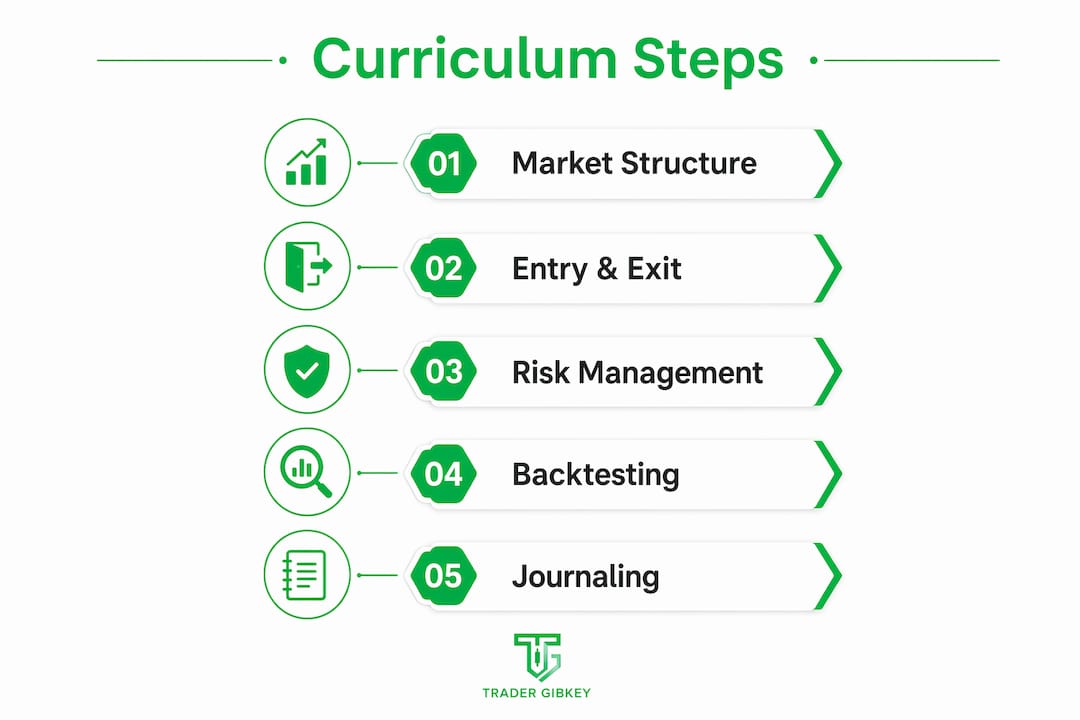
Market structure and price-action foundations
You learn to read swing highs, swing lows, support and resistance, and trend context before touching a single entry. The goal is shifting from “predicting” where price goes to “participating” when structure confirms a move. Deliverable: a written market-context checklist you apply before every session.
Entry and exit rules
Entries typically use a trend filter plus a trigger — for example, a moving average or structure break as context, then a momentum signal or candlestick pattern as execution. Exits follow predefined stop-loss and take-profit levels, not gut feel. Deliverable: a one-page rule set with exact conditions.

Position sizing and risk management
This module covers risk-per-trade limits, account-level drawdown rules, and how to scale position size as your account grows. Position sizing and account risk rules are standard in quality programs because they’re what keeps a bad week from becoming a blown account.
Testing methodology
A trading strategy requires regular backtesting and adaptation to stay valid. You backtest your rule set on historical data, run a walk-forward test on out-of-sample data, then forward-test in a demo account for at least two to four weeks. Deliverable: a backtest report with win rate, average risk-to-reward, and maximum drawdown.
Psychology, journaling, and review
This is the module most self-paced courses skip. You build a trade journal, log every entry with a pre-trade rationale and post-trade review, and run a weekly performance audit. The brain stops trading the chart and starts trading the pain the moment you skip this step.
Learning flow: Market structure → single rule-based setup → backtest → walk-forward → demo with journaling → live scaling with position sizing.
Mentor-led sessions typically cover live execution and trade review. Self-study covers backtesting mechanics and journal templates.
How does mentorship and community affect your progress?
Live mentorship compresses the learning curve in ways that recorded video simply cannot. Seeing a mentor execute a trade in real time, under actual market pressure, teaches decision quality faster than any textbook.
When evaluating a program, ask these specific questions:
- How often are live sessions scheduled, and are recordings archived?
- What is the mentor-to-student ratio?
- How is performance feedback delivered — group review, one-on-one, or written critique?
- Can you attend a guest session before committing?
Red flags to walk away from:
- No live sessions at all — only pre-recorded content
- Vague or unverifiable instructor credentials
- No trade review or journaling requirement built into the program
- Unclear or absent refund and trial policy
- No session archives for students who miss a live call
A well-structured session schedule looks like this: pre-market setup review (15–20 minutes), live trade execution window (30–60 minutes), post-session debrief and journaling assignment (15 minutes). Cohort-based live mentorship consistently outperforms self-paced formats for beginners who need accountability and real-time feedback.
Understanding community learning formats — cohort, self-paced, or hybrid — helps you pick the structure that matches how you actually learn.
What should you expect to spend and how long does competency take?
Realistic timelines and costs vary, but here’s a practical framework for U.S. beginners.
Time-to-competency: Most structured beginner paths require several months from foundations to consistent demo performance, assuming a regular weekly commitment of study and practice. Moving to live trading responsibly requires additional forward-testing time.
Some programs note suitability for traders with around $50,000 or more in trading capital for faster progression, though many Forex-focused programs work with significantly smaller starting balances.
| Pricing model | Typical range | What’s included |
|---|---|---|
| Monthly subscription | $50/month | Course access, community, live sessions |
| One-time lifetime access | — | Full curriculum, no recurring fee |
| Mentorship package | — | Direct coaching sessions, personalized feedback |
| Funded-challenge entry | — | Simulated evaluation leading to a funded account |
Funded-account programs like Topstep’s Trading Combine use a simulated evaluation to verify consistency under risk rules, with live funded starting balances up to $150,000 and monthly bonus pools for qualifying traders. These are useful validation tools, not substitutes for a structured education program.
Refund policies vary widely. A credible program offers at least a 7–14 day money-back window or a free trial session. If the policy is buried or absent, treat it as a red flag.
How do you validate a program before paying?
Run this five-step check before committing to any beginner trading program:
- Review sample lessons. Ask for a free module or preview. Check whether the content is rule-based and testable, not vague theory.
- Request demo or trial access. A reputable program lets you explore the platform and community before charging you.
- Attend a live session as a guest. Watch how the mentor handles a losing trade or an unclear setup — that tells you more than any sales page.
- Ask for a sample backtest report. It should include entry/exit rules, test period, win rate, and drawdown. No report means no testing culture.
- Verify refund terms in writing. Confirm exactly what triggers a refund and the deadline.
For your own demo test, run the program’s core setup in a demo account for 2–4 weeks. Track adherence to system rules, journaling consistency, and how quickly the mentor responds to questions. Knowing how to recognize ineffective trading systems early saves you months of wasted time and capital.
What does real student progress actually look like?
Outcomes vary based on capital, weekly time commitment, and how strictly students follow the program. That said, the most consistent pattern across credible beginner programs is a skills-based progression, not a returns-based one.
Students who complete structured programs typically report:
Verified progress signals include improved demo-account adherence to system rules, a completed backtest report, consistent journaling over four or more weeks, and growing confidence in reading market structure. Testimonials from Tradergibkey students consistently highlight the transition from reactive, emotional trading to disciplined, system-driven execution.
Results depend on individual capital, time commitment, and adherence to the program’s system and journaling requirements.
What’s the verdict and what should you do next?
For beginners who want a structured, price-action-focused path with real mentorship, Tradergibkey is the recommended starting point. It fits best for traders who are serious about building a rule-based system, want live feedback rather than just videos, and are willing to journal and test before going live.
Here are your next steps:
- Review the syllabus. Check that price-action entries, risk management, and testing methodology are all covered.
- Join a trial or watch a live session. See the teaching style before committing.
- Run a 2–4 week demo test with journaling. Apply the core setup and log every trade.
- Enroll or book a mentorship session once your demo results show consistent rule adherence.
To measure whether the program is working in the first 90 days, track three things: journaling consistency (are you logging every trade?), rule adherence in demo (are you following the system?), and mentor response quality (are you getting specific, useful feedback?). If all three are solid, you’re on the right path.
Key Takeaways
A structured, price-action-focused program with live mentorship and a clear testing methodology gives beginners the fastest, most reliable path from zero to consistent demo performance.
| Point | Details |
|---|---|
| Rule-based system first | Every top program teaches testable entry/exit rules before any live capital is risked. |
| Testing is non-negotiable | Backtest, walk-forward test, and demo-validate before going live — skip this and you’re gambling. |
| Live mentorship accelerates progress | Cohort and mentor-led formats outperform self-paced video for beginners who need real-time feedback. |
| Realistic timeline | Expect 3–6 months from foundations to consistent demo performance at 8–12 hours per week. |
| Tradergibkey | Recommended for beginners who want structured price-action modules, live sessions, and demo-to-live validation. |
What experienced traders know that most beginners don’t
Most beginners arrive looking for a strategy. What they actually need is a system — and those are very different things. A strategy is a setup. A system is a setup plus rules for testing it, sizing it, journaling it, and knowing when to stop trading it.
The programs that produce consistent beginners all share one trait: they force students to slow down before going live. Not because the markets are too complex, but because execution discipline is a skill that only develops through repetition with feedback. You can’t shortcut it with more screen time alone.
The practical tip I’d give any beginner: before you trade a single live dollar, run your setup in demo for a full month and grade yourself on rule adherence, not profit. If you can’t follow your own rules in a zero-pressure environment, live capital will make it worse, not better. Journaling is what makes that feedback loop real. It’s the difference between practicing and actually improving.
Tradergibkey gives you the structure to build a real trading system
Most beginners waste months cycling through random strategies because no one ever showed them how to build and test a system from scratch. Tradergibkey solves that directly. The program covers structured price-action modules, risk management rules every new trader needs, live trading sessions with real-time feedback, and a journaling framework that turns screen time into actual skill-building.
You get a community of serious traders, daily market analysis, and a demo-to-live validation path that keeps you from risking capital before you’re ready. Subscription options include monthly access, annual plans, and lifetime packages, so you can start at the level that fits your budget. Head to Tradergibkey to review the current course options and find out how to get started.
Useful sources
- Systematic Trading Course — Enlightened Stock Trading: supports curriculum module structure, staged learning journey, and capital guidance
- Building a Trading Strategy — NinjaTrader: supports entry/exit filter-and-trigger logic, position sizing, and testing methodology
- Trading Strategy Definition — Investopedia: supports backtesting and strategy adaptation requirements
- Best Online Trading Classes — Investopedia: supports format comparison (cohort vs. self-paced) and mentorship recommendations
- Topstep Funded Trading Program: supports funded-account validation model, starting balance figures, and bonus pool examples
FAQ
What is a structured trading program for beginners? A structured trading program teaches rule-based entry and exit logic, risk management, and testing methodology in a defined sequence — so beginners build a repeatable system rather than trading randomly.
How long does it take to become competent with a structured program? Most beginners reach consistent demo performance in 3–6 months at 8–12 hours per week, followed by 4–8 weeks of forward-testing before trading live capital.
Does Tradergibkey offer a trial or refund option? Tradergibkey offers multiple pricing models including monthly subscriptions, so you can start with a lower commitment before moving to a lifetime package. Check the current terms at tradergibkey.eu.