
A structured trading program is a systematic, rule-based framework that combines defined entry and exit criteria, risk management controls, and performance tracking into a single repeatable process. Unlike random market participation, this approach replaces gut instinct with documented rules that govern every trade decision. The industry term for this methodology is a “systematic trading program,” though traders and educators commonly use both phrases interchangeably. Tradergibkey has built its entire teaching model around this principle, drawing on over 18 years of live market experience to show traders exactly how a structured system produces consistent results where improvised approaches fail.
What is a structured trading program and its core components?
A structured trading program is defined by five interlocking elements: a written trading plan, clear entry and exit rules, position sizing guidelines, a risk management framework, and a performance review process. Remove any one of these and the system loses its integrity. Think of it like a flight checklist. Pilots do not skip steps because they feel confident. The checklist exists precisely because confidence is not a reliable safety mechanism.
Here is what each component does in practice:
- Written trading plan. This document states your preferred markets, time frames, and profit targets. It answers the question “why am I in this trade?” before you place a single order.
- Entry and exit rules. These are hard criteria, not suggestions. A price action signal, a specific candlestick pattern, or a moving average crossover triggers entry. A predefined level triggers exit. No exceptions.
- Position sizing. Every trade carries a fixed percentage of account risk, typically 1%–2% per position. This prevents a single bad trade from destroying weeks of gains.
- Risk management framework. Systematic programs embed stop-loss levels and drawdown circuit breakers directly into the execution process, with no discretionary override permitted during losing periods.
- Performance review. A trading journal records every trade, including the reasoning, the outcome, and the emotional state at entry. This is where real learning happens.
Pro Tip: Set a weekly review appointment with your journal the same way you schedule a meeting. Traders who treat performance review as optional rarely improve their decision quality.
The NYSE defines program trading as the simultaneous execution of baskets containing 15 or more stocks worth $1 million or more, completed in milliseconds. That institutional definition matters because it shows the same principle at work: rules execute automatically, without hesitation or second-guessing.

What are the behavioral and performance benefits of structured trading education?
Structured trading education replaces costly trial-and-error with a systematic roadmap connecting strategy, risk, and performance for consistent results. That is not a marketing claim. It is the core reason most self-taught traders plateau while program-trained traders continue to improve.
The behavioral benefits are specific and measurable:
- Reduced revenge trading. When your rules say “no trade after two consecutive losses today,” you cannot rationalize a third entry. The rule removes the decision from your emotional state.
- Elimination of overtrading. A structured learning environment enforces behavior frameworks that prevent the compulsive entry patterns that drain accounts.
- Faster skill development. You are not reinventing the wheel on every losing streak. You follow a documented process, identify where it broke down, and correct one variable at a time.
- Greater confidence. Confidence built on process adherence is durable. Confidence built on a recent winning streak is fragile.
“Successful trading is behavior modification, not intuition. Structured education forces you to build decision frameworks that prevent the most common pitfalls, including overtrading and emotional exits. The brain stops trading the chart and starts trading the pain the moment structure disappears.”
Structured trading education builds consistent habits including clear strategy, goal setting, discipline, and self-assessment for steady results. These are not personality traits you either have or lack. They are skills you build through repetition inside a defined system. That is the real promise of structured trading education: it gives you a process to practice, not just concepts to memorize.
How does a structured trading program differ from unstructured trading?
The difference between structured and unstructured trading is not style. It is outcome reliability. Unstructured trading relies on gut instinct, pattern recognition without defined criteria, and position sizing based on how confident you feel in the moment. Structured programs run on hard rules that execute the same way regardless of your emotional state.
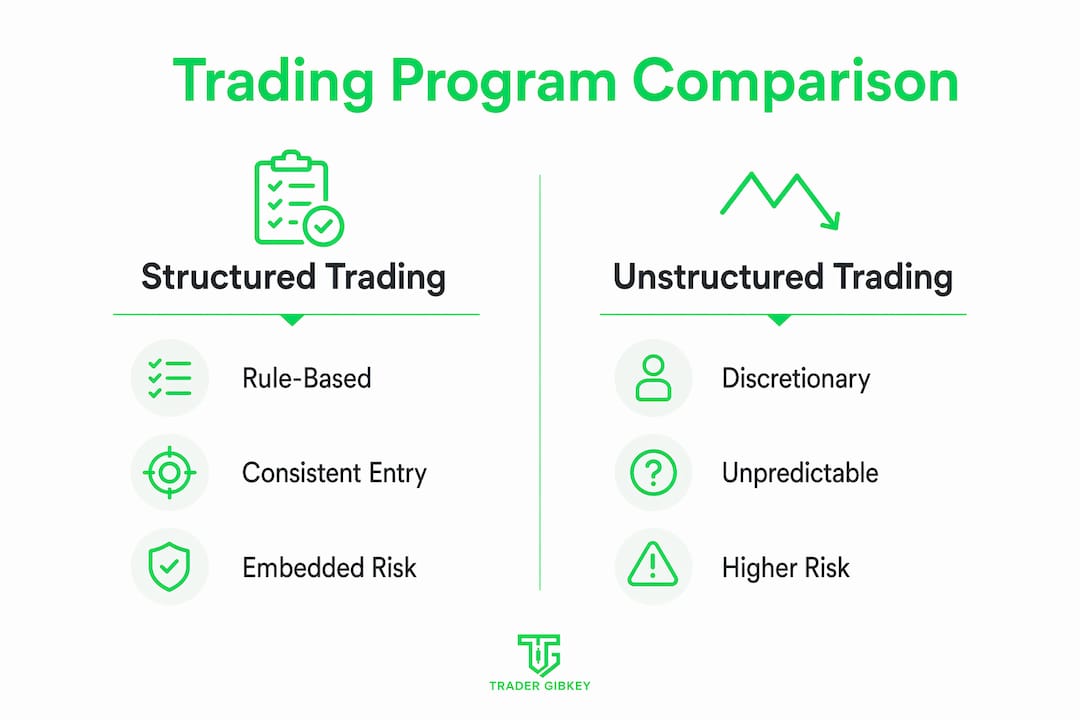
| Feature | Structured program | Unstructured trading |
|---|---|---|
| Entry criteria | Predefined, rule-based | Discretionary, feel-based |
| Exit rules | Hard stop-loss and target levels | Variable, often moved under pressure |
| Position sizing | Fixed percentage per trade | Based on conviction or recent results |
| Risk controls | Hard-coded drawdown limits, no override | Manual, subject to emotional override |
| Performance review | Mandatory journal and metrics | Occasional or absent |
| Holding periods | Minutes to days, defined in advance | Open-ended, decided in the moment |
The most dangerous habit in unstructured trading is the discretionary override. You set a stop-loss, the price approaches it, and you move the stop because you “believe in the trade.” That single action erases the entire purpose of risk management. Structured programs make this physically or procedurally impossible. The rule executes. You do not get a vote in the moment.
Drawdowns are also significantly shallower in structured programs because risk controls are embedded in the execution process itself. When a drawdown circuit breaker triggers, trading stops. There is no “just one more trade to get it back.” That discipline is what separates traders who survive bad months from those who blow up accounts.
How can traders implement a structured trading program effectively?
Implementation follows a clear sequence. Skipping steps does not save time. It creates gaps that show up as losses later.
-
Define your trading objectives. Write down your target monthly return, your maximum acceptable drawdown, and the markets you will trade. Forex pairs, futures, and equities each have different liquidity profiles and session hours. Pick one market and learn it deeply before adding others.
-
Build or adopt a documented trading plan. A written trading plan is not optional. It is the foundation everything else rests on. Your plan should specify the setups you trade, the time frames you use, and the conditions that disqualify a setup.
-
Set hard risk rules. Decide your maximum risk per trade and your daily loss limit before you open a platform. Write these numbers down. Treat them as non-negotiable.
-
Build a daily routine. Structured trading routines include pre-market preparation, defined trading hours, and post-market review. Pre-market prep means checking economic calendars, marking key levels, and confirming your bias. Post-market review means logging every trade and grading your execution against your rules.
-
Maintain a trading journal. Record entry price, exit price, setup type, emotional state, and outcome for every trade. Review it weekly. Experienced traders use structured performance journals to objectively measure and refine trades rather than relying on memory or gut feeling.
-
Seek mentorship or structured courses. Self-study is slow and expensive. A mentor who has traded live markets for years compresses your learning curve by showing you what to avoid, not just what to do. Tradergibkey’s approach is built on this principle: practical experience over theory.
-
Refine based on data, not emotion. After 30–50 trades, review your journal for patterns. If your win rate on one setup is consistently lower, cut it. If another setup outperforms, scale it. Let the data drive the decision, not how you feel about a recent loss.
Pro Tip: Start your performance review practice with a simple grading system. Score each trade A, B, or C based on how well you followed your rules, not on whether it was profitable. A profitable C-grade trade is more dangerous than a losing A-grade trade.
Why structure changed everything I thought I knew about trading
When I started trading, I believed skill meant reading the market better than everyone else. I spent years chasing that edge, switching setups, changing time frames, and blaming bad luck for losing streaks. The honest truth is that I was not trading the market. I was trading my own emotional state.
The shift happened when I committed to a documented process and stopped treating my rules as suggestions. Live trading without structured preparation amplifies costly behavioral errors. I saw this firsthand. The traders I watched blow up accounts were not less intelligent than the ones who succeeded. They were less disciplined about following a defined process.
One thing most articles will not tell you: overfitting is as dangerous as having no system at all. Traders who back-test obsessively and build rules around historical data often create systems that look perfect on paper and fail in live conditions. The antidote is a simple, rule-based framework tested in real time, reviewed objectively, and refined slowly. Complexity is not a sign of sophistication. Consistency is.
If you are struggling with trading psychology or finding that your results are inconsistent despite knowing the theory, the gap is almost always structural, not intellectual. You do not need more information. You need a better process.
— Gabriel
How Tradergibkey can help you build your trading program
Tradergibkey offers courses, mentorship, and a trader community built specifically for individuals who want to move from inconsistent results to a repeatable, rule-based process.
Every program is grounded in 18 years of live Forex trading experience, not textbook theory. You get direct access to price action strategies, risk management frameworks, and a community of traders working through the same challenges you face. Whether you are building your first trading plan or refining an existing system, the courses and mentorship at Tradergibkey give you the structure, feedback, and accountability that self-study cannot replicate. The goal is simple: fewer emotional mistakes, clearer rules, and results you can actually measure.
Key takeaways
A structured trading program is the single most reliable way to replace emotional decision-making with consistent, rule-based execution that survives both winning and losing streaks.
| Point | Details |
|---|---|
| Definition matters | A structured program combines a trading plan, risk controls, and performance review into one repeatable system. |
| Rules prevent emotional errors | Hard entry and exit criteria stop revenge trading and overtrading before they damage your account. |
| Review drives improvement | A weekly journal review identifies execution gaps and refines your system based on data, not feeling. |
| Structure beats discretion | Hard-coded risk controls and defined exits produce shallower drawdowns than gut-based trading. |
| Mentorship accelerates progress | Guided learning with expert feedback compresses the learning curve that self-study stretches over years. |
FAQ
What is a structured trading program in simple terms?
A structured trading program is a documented, rule-based system that defines how you enter trades, manage risk, and review performance. It removes guesswork and emotional decision-making from the trading process.
What are the main benefits of structured trading education?
Structured trading education reduces emotional mistakes like revenge trading and overtrading, builds consistent habits, and accelerates skill development by replacing trial-and-error with a defined learning roadmap.
How do I start building a structured trading program?
Start by writing a trading plan that defines your markets, entry and exit rules, and maximum risk per trade, then add a daily routine with pre-market preparation and post-trade journaling to track and refine your results.