
A trading fad strategy, more precisely known as a fade strategy, is defined as a contrarian trading approach that takes positions directly against prevailing market trends to profit from short-term reversals after overextended price moves. Fade trading exploits two powerful psychological flaws in markets: herd mentality and recency bias, where traders pile into moves that have already gone too far. The result is a temporary mispricing that a disciplined contrarian can trade back toward fair value. This guide breaks down how fade strategies work, how to execute them safely, and where they fit inside a complete trading plan.
What is a trading fad strategy and how does it work?
A fade strategy is a contrarian approach that takes positions against prevailing market trends, expecting quick reversals after overextensions. Trades are typically short-term, held minutes to hours, and target mean reversion following event-driven spikes or drops. The core bet is simple: the crowd overreacted, and the price will snap back.

The psychology driving price overextensions
Markets overshoot because of two repeating behavioral patterns. First, herd mentality pushes traders to follow the crowd without questioning whether the move is justified. Second, recency bias causes traders to assume that whatever just happened will keep happening. Together, these psychological flaws create mispricings that fade traders specifically target.
A practical example: a company reports earnings slightly above expectations. The stock gaps up 8% in the first five minutes. A fade trader reads that move as an overreaction driven by excitement, not fundamentals, and takes a short position expecting the price to retrace toward its pre-announcement level within the hour.
How market makers use fading differently
Market makers also use a fade tactic, but with a different purpose. A market maker fades a quote by refusing to honor a previously published price when a better price is available elsewhere. This protects them from stale pricing and manages inventory risk. That behavior is structurally similar to trader fade strategies but serves a completely different function inside dealer markets.
Key characteristics of fade trades
- Short time horizon. Most fade trades close within minutes to a few hours.
- Event-driven entry. Price spikes or drops after news, data releases, or sentiment shifts create the setup.
- Mean reversion target. The trade aims for a return to a recent average or support/resistance level, not a trend reversal.
- Tactical, not structural. Fade trading is a tool within a broader system, not a standalone long-term strategy.
- Forex application. In forex, fading after economic data releases means trading against the initial price reaction, often waiting for volatility to settle before entering.
What techniques and risk management practices make fade trading work?
Execution discipline separates profitable fade traders from those who blow up on the first strong trend. The entry signal matters, but the risk controls matter more.
-
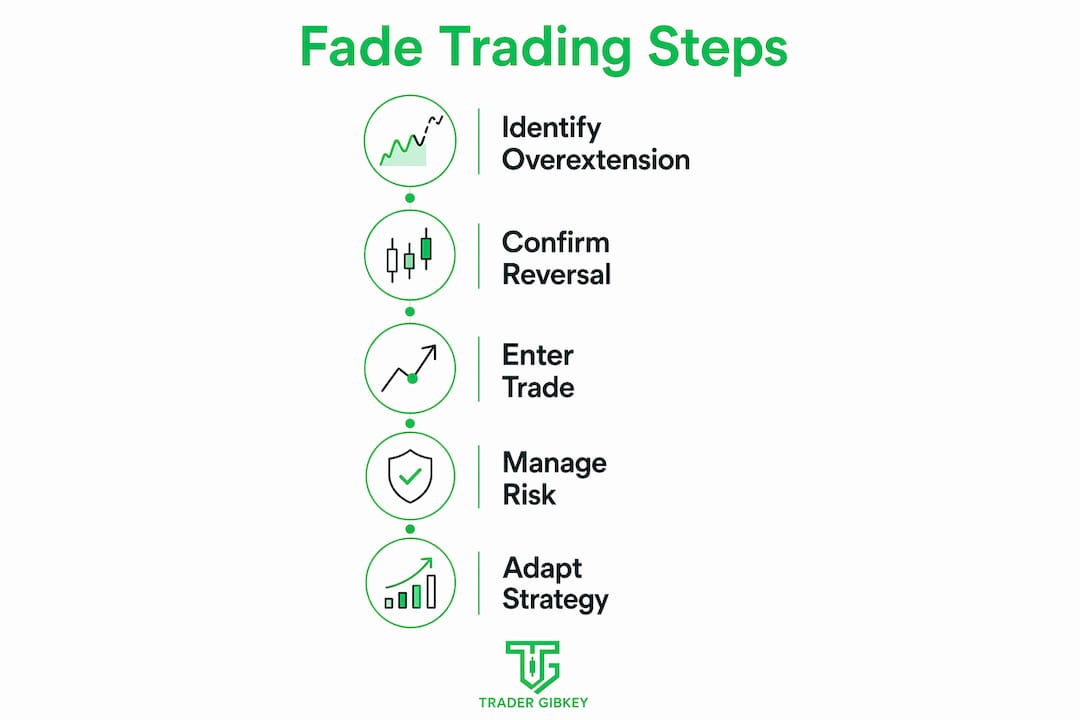
Identify the overextension. Look for price moves that are statistically large relative to recent average ranges. A spike that is two to three times the normal candle size on elevated volume is a candidate.
-
Confirm with technical indicators. The Relative Strength Index (RSI) reading above 70 or below 30 signals overbought or oversold conditions. Volume spikes that are not sustained confirm exhaustion. Neither signal alone is enough. Use both together.
-
Place your stop-loss correctly. Stop-loss placement should sit 5–10% beyond the recent swing high or low, adjusted for current volatility. A tighter stop gets hit by noise. A wider stop risks too much capital.
-
Size your position conservatively. Risk management rules for fade trades are strict: never risk more than 1% of your total capital on a single trade. That limit keeps one bad call from damaging your account.
-
Use time stops. If the expected reversal does not materialize within 1–4 hours, exit the trade regardless of where price sits. Holding a fade trade through a developing trend is how small losses become large ones.
-
Respect liquidity. Avoid fading in illiquid markets or during low-volatility regimes. Thin markets produce wide spreads and slippage that eat into any edge the setup offers.
-
Avoid structural trends. A fade entry against a genuine, sustained trend is not a contrarian trade. It is a mistake. Confirm that the move is an overextension, not the beginning of a new directional phase.
Pro Tip: Wait for a confirmed reversal candlestick pattern, such as a pin bar or engulfing candle, before entering a fade trade. Entering on the spike itself is premature. The pattern gives you evidence the reversal has started, not just that the move was large.
What are the risks of fade trading, and how do traders adapt?
Fade trading carries real, specific risks that beginners often underestimate. Understanding them before you trade is not optional.
- Trend continuation losses. The biggest risk is that the “overextension” is actually the start of a genuine trend. Strong momentum can push price far beyond any reasonable stop-loss before reversing.
- Slippage and wide spreads. Volatile markets, which produce the best fade setups, also produce the worst execution conditions. You may enter at a worse price than planned and exit at an even worse one.
- Structural breaks. Fade signals can fail abruptly when market dynamics evolve. A setup that worked consistently for months can stop working overnight as participant behavior changes or new data becomes widely available.
- Crowding effects. When too many traders recognize the same fade setup, the edge disappears. The reversal gets front-run, the entry becomes crowded, and the risk-reward collapses.
- Discretionary complexity. Fade trading requires judgment, not just rules. Knowing when not to take a setup is as important as knowing when to take one.
“Structural breaks, where previously effective fade signals cease working abruptly due to changes in market participant behavior and data availability, highlight why strategy adaptability and discretionary filtering are not optional. They are the difference between a trader who survives and one who does not.”
The practical response to these risks is continuous adaptation. A break of structure in your fade strategy’s performance is a signal to pause, reassess, and adjust your filters. Traders who treat their fade rules as permanent and unchangeable will eventually find the market has moved on without them.
How does fade trading compare to other trading strategies?
Fade trading sits in a specific tactical position relative to other common approaches. Knowing where it fits helps you use it correctly.
| Strategy | Core Principle | Best Market Condition | Time Horizon |
|---|---|---|---|
| Fade (contrarian) | Trade against overextensions | High volatility, post-news | Minutes to hours |
| Momentum trading | Follow strong directional moves | Trending markets | Hours to days |
| Breakout trading | Enter when price clears key levels | Range-bound to trending | Hours to days |
| Pullback trading | Buy dips within an existing trend | Established trends | Hours to days |
Fade trading and momentum trading are near opposites. What is momentum trading? It is the practice of buying strength and selling weakness, betting that trends continue. Fade trading bets they reverse. The two approaches work in different market conditions, which is exactly why combining them inside one trading plan makes sense.
Breakout and pullback strategies occupy middle ground. Breakout traders enter when price moves through a level with conviction. Fade traders enter when price moves away from a level with too much speed. In post-news environments with high volatility, fading the initial reaction often outperforms chasing the breakout.
Fade trading is a tactical tool best combined with other approaches like trend following. It assumes market inefficiency and capitalizes on psychology-driven overextensions. It is not designed as a standalone, long-term strategy. Traders who use it as their only method tend to struggle in trending markets where the crowd is actually right.
Key Takeaways
A fade strategy is the most direct way to profit from crowd overreaction, but it demands strict risk controls and continuous adaptation to remain effective.
| Point | Details |
|---|---|
| Core definition | Fade trading takes positions against overextended price moves expecting short-term mean reversion. |
| Psychology edge | Herd mentality and recency bias create the mispricings that fade trades target. |
| Risk controls | Never risk more than 1% per trade; place stops 5–10% beyond recent swing levels. |
| Time stops | Exit any fade trade within 1–4 hours if the expected reversal does not appear. |
| Strategy context | Fade trading works best as a complement to trend-following, not as a standalone method. |
What 18 years of watching fades taught me
Fade trading attracts traders for the wrong reason. The idea of being the smart contrarian who fades the crowd feels good. The reality is more demanding than the concept suggests.
The traders I have seen succeed with fading share one trait: they are more disciplined about not trading than they are eager to trade. They pass on setups that look right but feel wrong. They exit on time stops without hesitation, even when the trade looks like it might still work. They treat overtrading as the primary enemy of their edge, not bad setups.
The hardest lesson is accepting that fade signals degrade. A setup that produced consistent results for a year can stop working as market structure shifts. The traders who adapt survive. The ones who keep fading the same pattern into a new market regime take serious damage before they realize what happened.
My honest advice: learn fade trading slowly. Paper trade it first. Watch how often your “obvious” reversal just keeps going. That humility is what keeps your account intact long enough to develop real skill.
— Gabriel
Tradergibkey can help you trade with more confidence
Fade trading is one piece of a complete trading education. Understanding when to go against the crowd, how to size your risk, and when to step aside entirely are skills that take time and the right guidance to build.

Tradergibkey has spent over 18 years in live market conditions developing and teaching price action strategies that work in real trading environments. The resources at Tradergibkey cover risk management, trading psychology, and practical strategy application across forex and other markets. If you are serious about building a trading approach that holds up under pressure, that is the place to start.
FAQ
What is a fade strategy in simple terms?
A fade strategy is a contrarian trading method where you take a position against a recent sharp price move, betting it will reverse. Trades are typically held for minutes to a few hours.
Is fade trading suitable for beginners?
Fade trading carries high risk and requires strong discretionary judgment, making it better suited to traders with some experience in reading price action and managing risk.
How do I know when a price move is worth fading?
Look for RSI readings above 70 or below 30 combined with a volume spike that is not sustained. A confirming reversal candlestick pattern, such as a pin bar, adds further evidence before entry.