
Forex trading is the simultaneous buying of one currency and selling of another to profit from changes in exchange rates. Known formally as foreign exchange trading, it takes place in the largest financial market on earth, with daily trading volume around $7.5 trillion. That number dwarfs the New York Stock Exchange by a factor of more than 20, which tells you everything about the liquidity and opportunity this market holds. Individual retail traders, multinational corporations, central banks, and hedge funds all participate. If you are new to trading, understanding how this market works is the most important first step you can take.
What is forex trading and how does it work?
Forex trading is built around currency pairs. Every trade involves two currencies: the base currency and the quote currency. In the pair EUR/USD, the euro is the base and the U.S. dollar is the quote. When you buy EUR/USD, you are buying euros and simultaneously selling dollars. When you sell EUR/USD, you do the opposite.

This is a key distinction from stock trading. Forex focuses on relative value between two currencies, not ownership of an asset. You are not buying a share of a company. You are speculating on whether one currency will strengthen or weaken against another.
Here are the core mechanics you need to know:
- Currency pairs: Major pairs like EUR/USD and GBP/USD are the most traded and most liquid. Minor and exotic pairs carry wider spreads and more volatility.
- Going long vs. short: Buying a pair (going long) means you expect the base currency to rise. Selling a pair (going short) means you expect it to fall.
- Pips: A pip measures price movement and is typically the fourth decimal place in a currency pair. If EUR/USD moves from 1.1050 to 1.1060, that is a 10-pip move. Pip value directly determines your profit or loss on any trade.
- Bid and ask prices: The bid is what the market will pay you for a currency. The ask is what you pay to buy it. The difference between the two is the spread, which is your primary cost of trading.
- Trade direction example: If you believe the U.S. economy will outperform the eurozone, you sell EUR/USD. If EUR/USD drops from 1.1050 to 1.0950, you captured 100 pips of profit.
Pro Tip: Focus on understanding pairs rather than individual currencies. A currency can be weak overall but still rise against a specific counterpart. Always think in relative terms.
How does leverage and margin affect your trades?
Leverage is the tool that makes forex accessible to retail traders with limited capital. It lets you control a large position with a small deposit. A broker offering 50:1 leverage means a $1,000 deposit controls a $50,000 position. That sounds powerful, and it is. But leverage magnifies both gains and losses, which is why it demands respect from day one.
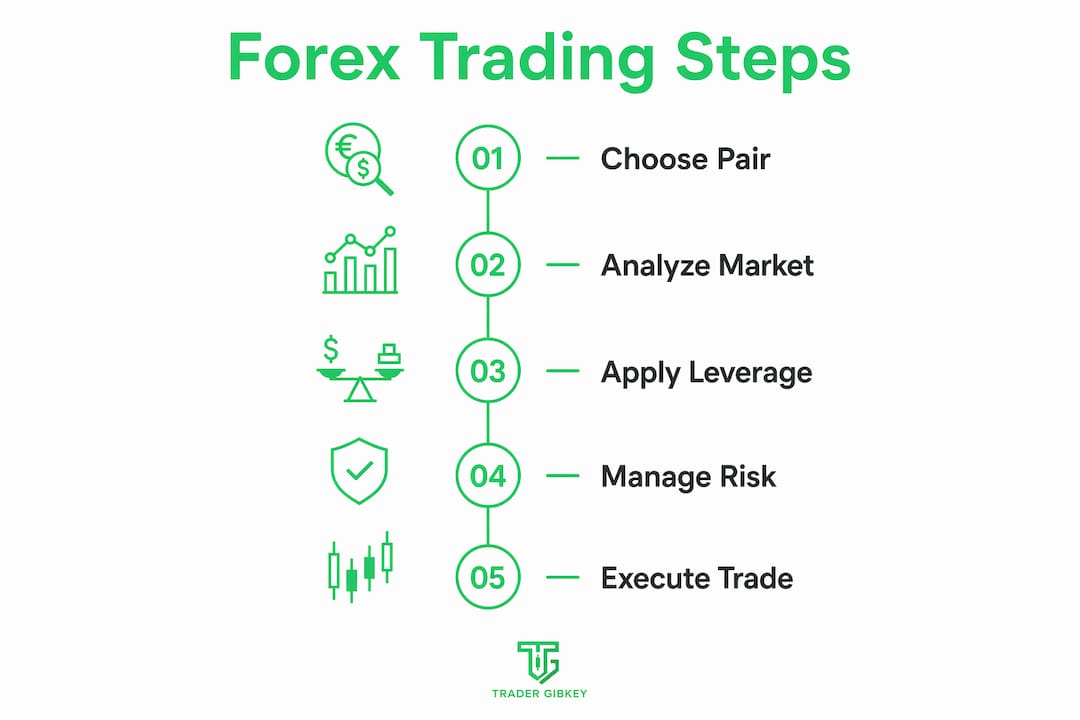
Margin is the collateral your broker holds to keep your trade open. It is not a fee. It is a portion of your account set aside to cover potential losses. If the market moves against you and your account balance falls below the required margin level, your broker will close your position automatically. This is called a margin call, and it is one of the most painful experiences a new trader can face.
Risk controls exist precisely to prevent that scenario. The two most common tools are:
- Stop-loss orders: A stop-loss automatically closes your trade at a predetermined price, capping your loss before it spirals.
- Take-profit orders: These lock in your gains by closing the trade once price hits your target. You do not need to watch the screen every second.
- Position sizing: This is how you control how much of your account is at risk per trade. Most experienced traders risk no more than 1% to 2% of their capital on a single setup.
The most common beginner mistake is treating margin as free money. Your available margin does not equal your total risk. True risk depends on position size, pip value, and where your stop-loss sits. Understanding that relationship is what separates traders who survive from those who blow up their accounts in the first month.
Pro Tip: Before you place any live trade, calculate your exact dollar risk per trade. Write it down. If the number makes you uncomfortable, reduce your position size until it does not.
For a deeper look at protecting your capital, the risk management rules every new trader should know are worth reading before you open your first position.
What does the forex market structure look like?
Forex is an over-the-counter market. There is no centralized exchange like the NYSE or the Chicago Mercantile Exchange. Trades happen directly between participants through electronic networks, which is why the market can operate 24 hours a day, five days a week.
The market runs across three major sessions, and each one has a distinct character:
| Session | Hours (EST) | Key pairs | Liquidity level |
|---|---|---|---|
| Asian (Tokyo) | 7:00 PM to 4:00 AM | USD/JPY, AUD/USD | Moderate |
| European (London) | 3:00 AM to 12:00 PM | EUR/USD, GBP/USD | High |
| U.S. (New York) | 8:00 AM to 5:00 PM | EUR/USD, USD/CAD | Highest |
The London and New York overlap, from 8:00 AM to 12:00 PM EST, is the most active window of the trading day. Spreads tighten, volume surges, and price moves with more conviction. For beginners, trading during high-liquidity windows reduces slippage and improves execution quality.
Most retail traders access the forex market through a broker and trade derivatives like CFDs (contracts for difference) rather than exchanging physical currencies. Retail traders rarely exchange actual cash. You are speculating on price movement, and your broker handles the execution electronically. Platforms like MetaTrader 4 and MetaTrader 5 are the industry standard for retail access, offering charting tools, order management, and real-time price feeds.
Session liquidity directly impacts execution quality and strategy performance. A setup that works cleanly during the London session may behave very differently during the quiet Asian hours. Knowing when to trade is just as important as knowing what to trade.
Pro Tip: Check session overlap times before you plan your trading day. Trying to scalp EUR/USD at 2:00 AM EST is like fishing in an empty pond. The fish are there, but they are not biting.
What are the benefits and risks of forex trading?
Forex trading offers real advantages, especially for retail traders who cannot afford to buy 100 shares of a high-priced stock. But those advantages come with trade-offs that you need to understand before risking a single dollar.
Benefits:
- High liquidity means you can enter and exit positions quickly without significant price impact.
- Low transaction costs compared to stock trading. Most brokers earn through spreads rather than commissions.
- The ability to trade small amounts. Micro lots let you trade as little as 1,000 units of currency.
- 24/5 availability means you can trade around your schedule, whether that is early morning or late evening.
- The ability to profit in both rising and falling markets by going long or short.
Risks:
- Market volatility can move prices sharply and unexpectedly, especially around major economic news releases.
- Leverage misuse is the leading cause of retail trader losses. The same tool that amplifies gains amplifies losses with equal force.
- The decentralized structure means regulation varies by country and broker. Choosing an unregulated broker is a serious risk.
- Emotional decision-making, revenge trading after a loss, and overtrading are behavioral traps that destroy accounts faster than bad strategy.
Education and a disciplined approach are what separate traders who grow their accounts from those who drain them. The market does not care about your feelings or your rent payment. It rewards preparation and punishes impulsiveness.
Pro Tip: Start with a demo account for at least 30 days before trading real money. Use it seriously. Treat every demo trade as if real capital is on the line, because the habits you build in demo carry directly into live trading.
Key takeaways
Forex trading rewards preparation, discipline, and a clear understanding of mechanics before any real money changes hands.
| Point | Details |
|---|---|
| Forex defined | Forex trading is the simultaneous buying and selling of currency pairs to profit from exchange rate changes. |
| Leverage is a double-edged tool | Leverage amplifies both gains and losses; always calculate your exact dollar risk before entering a trade. |
| Market runs 24/5 | The forex market operates across Asian, European, and U.S. sessions with peak liquidity during the London-New York overlap. |
| Risk controls are non-negotiable | Stop-loss orders, take-profit orders, and position sizing are the foundation of long-term trading survival. |
| Start with a demo account | Practice with virtual money for at least 30 days to build habits and test strategies without financial risk. |
My honest take on starting forex the right way
I have spent 18 years watching new traders make the same mistakes. They read about forex, get excited about the leverage numbers, and open a live account before they understand what a pip is worth on their position size. The market takes their money quickly, and they walk away thinking forex is a scam. It is not. The process was just backwards.
Forex is speculation, not investing. You are not buying something that compounds over decades. You are making short-term directional bets on currency relationships. That requires a completely different skill set than buying index funds. Treating it like passive investing is one of the fastest ways to lose capital.
The traders I have seen succeed all share one habit: they understood the mechanics cold before they risked real money. They knew exactly how much they were risking per trade, where their stop was, and why they were in the trade. Not because someone told them to, but because they had practiced it enough that it became automatic.
Demo trading gets dismissed as “not real” because there is no emotional pressure. That is exactly why it is valuable at the start. You are building the mechanical habits before the emotions arrive. Once real money is on the line, your brain runs a different operating system. The habits you built in demo are what keep you rational when a trade goes against you.
Start small. Review your trades. Build a process. The structured roadmap for learning trading I recommend follows exactly this progression, and it works because it respects the learning curve instead of skipping it.
— Gabriel
Start learning forex with structure and support
If you are serious about understanding forex trading beyond the basics, the right environment makes a significant difference. Tradergibkey offers structured courses built specifically for traders who want to move from confusion to confidence without wasting months on generic advice.
With over 18 years of live market experience, Tradergibkey’s approach focuses on price action strategies that actually work in real conditions, not just in backtests. You get mentorship, a supportive community of traders at every level, and a clear progression path from beginner mechanics to live trading. If you are ready to build real skills, explore the courses and community at Tradergibkey and take the first real step toward trading with confidence.
FAQ
What is forex trading in simple terms?
Forex trading is the act of buying one currency while simultaneously selling another to profit from changes in their exchange rate. It is the largest financial market in the world, with around $7.5 trillion traded daily.
How much money do I need to start forex trading?
Many brokers allow you to open an account with as little as $100, though starting with more capital gives you better control over position sizing and risk management.
Is forex trading risky for beginners?
Yes, forex carries significant risk, especially when leverage is involved. Starting with a demo account, learning risk management, and using stop-loss orders are the most effective ways to reduce that risk before trading real money.