
Why beginner traders need community from day one
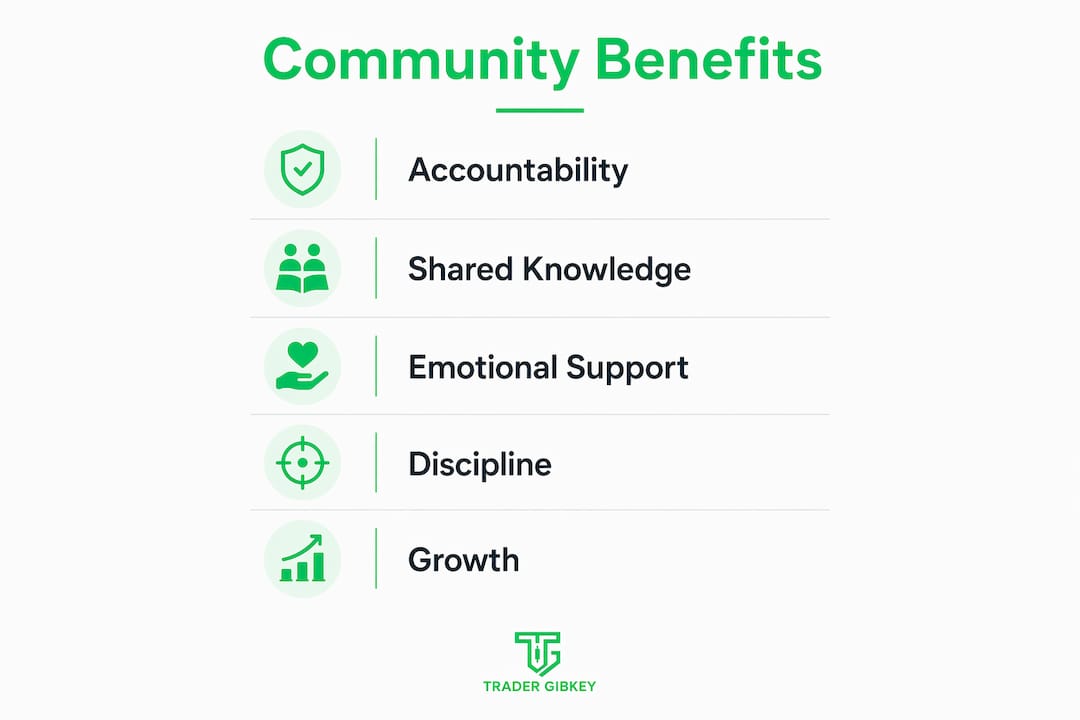
Trading alone is harder than it looks. You can read every book, watch every chart, and still blow up your account because nobody was there to tell you that you were revenge trading. A trading community fixes that. Here is the short version of why it matters:
- Accountability keeps you honest. When you post your trade plan publicly, deviating from it carries a real social cost.
- Shared knowledge cuts your learning curve. Real-time answers from experienced peers beat hours of solo research.
- Emotional support reduces the kind of stress that leads to impulsive, costly decisions.
- Behavioral guidance helps you spot and correct biases like the disposition effect before they drain your account.
- Purpose beyond profit keeps you in the game long enough to actually get good.
None of these benefits show up when you trade in isolation. Together, they change the trajectory for a beginner.
How accountability in communities enforces trading discipline for beginners
Publicly sharing your trade plan in a group makes it harder to ignore. When you post your entries and exits in a community chat, the social cost of abandoning that plan goes up immediately. You can not quietly brush off a bad decision the way you can when you are sitting alone at your desk.
- Visible trade plans create a record you feel responsible for.
- Group members notice when you deviate, which prompts honest reflection.
- Consistent posting builds a habit of pre-trade planning, not post-trade rationalization.
- Reviewing your own public record over time reveals behavioral patterns you would otherwise miss.
Pro Tip: Ask a community member to call you out specifically when your entries do not match your stated plan. That one hard rule, enforced by a peer, is worth more than a month of solo journaling.
How shared knowledge in a trading community accelerates your learning
Solo learning in trading means staring at a blank screen, making a mistake, and having no one to ask why it happened. A community eliminates that. Beginners get questions answered in real time, which prevents the same error from repeating across weeks of costly trial and error.
- Members share live alerts on tickers you may have missed entirely.
- Diverse perspectives on the same setup sharpen your market reading.
- Watching experienced traders explain their reasoning builds pattern recognition faster than charts alone.
- Collaborative discussion turns a losing trade into a learning session rather than just a loss.
The community learning formats that work best for beginners combine live analysis with open Q&A, so you are not just absorbing information but actually processing it with others.
Emotional and behavioral benefits offered by trading communities

Research confirms that social interaction reduces the disposition effect, the common bias where traders hold losers too long and sell winners too soon. Peer review and public scrutiny correct that bias faster than solo journaling ever could. When your trades are visible to others, self-consciousness kicks in and you adjust more actively.
The emotional side is just as concrete. Emotions expressed online by day traders predict actual trading behavior, and traders with moderated emotional activation make fewer errors. Both extremes, too little engagement and too much anxiety, correlate with poorer decisions.
| Emotional state | Decision quality | Community role |
|---|---|---|
| Low activation (boredom, disengagement) | Increased errors, missed setups | Peer discussion re-engages focus |
| Moderate activation (calm, alert) | Best decision quality | Community reinforces this state |
| High activation (anxiety, overconfidence) | Costly impulsive trades | Peer feedback slows the reaction |
Open dialogue about emotions in a group setting normalizes the stress that every beginner feels. That normalization alone reduces the shame spiral that turns one bad trade into three.

What a trading community gives you beyond the profit motive
The traders who stick around long enough to become profitable are rarely the ones who were only chasing money. Communities offer encouragement and shared purpose during the stretches where nothing is working, and those stretches are guaranteed for every beginner.
- Shared struggles build resilience that pure self-study cannot replicate.
- Mentorship from more experienced members gives you a model to follow, not just rules to memorize.
- Celebrating small wins together reinforces the discipline that produces big ones later.
- A group identity creates motivation to show up consistently, even on losing days.
Purpose-driven communities also tend to attract better members. When the group is about growth and learning rather than just signals and tips, the quality of conversation goes up and so does your development as a trader.
Tradergibkey’s perspective on community in trader development
Gabriel at Tradergibkey has spent over 18 years in live market conditions, and one pattern shows up repeatedly: traders who learn inside a structured community progress faster and stay in the game longer. That observation is not anecdotal. Students who go through Tradergibkey’s community-backed program consistently report the transition from uncertain beginner to confident, disciplined trader, crediting peer support and mentorship as the turning point.
The benefits of forex trading mentorship compound when they happen inside a community rather than in a one-on-one vacuum. You get the mentor’s framework and the group’s lived experience at the same time.
How to find and choose the right trading community for beginners
Not every group is worth your time. Some communities are little more than signal services dressed up as education, and joining one of those will slow you down rather than speed you up.
Look for these qualities when evaluating a group:
- Transparency. The best communities show their reasoning, not just their results. If members only post winning trades, leave.
- Active moderation. A well-run group filters out noise, hype, and bad advice before it reaches you.
- Beginner-friendly structure. You need a place where asking basic questions is encouraged, not mocked.
- Focus on process over tips. Communities that teach you how to think about a trade are worth far more than ones that just tell you what to buy.
- Aligned time zone and market. A community built around markets or hours that do not match your schedule will not help you in practice.
Start by observing before committing. Most quality communities offer a trial period or free access to a portion of their content. Use that window to assess the culture, not just the content.
Potential challenges of trading communities and how to navigate them
Communities carry real risks alongside their benefits. Strong social interaction can reinforce herding behavior and overconfidence if the group lacks discipline education. A beginner who follows the crowd without understanding the reasoning behind a trade is not learning. They are just copying.
A few challenges to watch for:
- Groupthink. When everyone agrees, that is often the moment to think independently. Seek communities that encourage dissent and debate.
- Information overload. Too many alerts, too many opinions, and too many setups will paralyze you. Set boundaries on how much you consume daily.
- Overconfidence from early wins. A hot streak in a supportive group can make a beginner feel more skilled than they are. Track your process, not just your results.
- Dependency. The goal is to develop your own judgment, not to rely on the group forever. Use community input as a check, not a crutch.
The fix for most of these is simple: choose a community that explicitly teaches you to think, not just to follow.
Examples of successful beginner trading communities and their impact
The most effective beginner communities share a common structure: transparent education, daily market analysis, and a culture where questions are welcomed at every level. Groups built around price action education, for example, tend to produce traders who understand why a setup works rather than just when to enter it.
Tradergibkey’s own community exemplifies this model. Beginners enter with no framework and exit with repeatable processes, largely because the group combines Gabriel’s 18-plus years of live market experience with peer accountability and open discussion. The trading psychology resources embedded in that community address the emotional side of trading directly, which most signal-based groups ignore entirely.
Study groups built around specific instruments, like forex pairs or futures contracts, also show strong outcomes for beginners because the shared focus keeps conversations relevant and the learning density high.
Key Takeaways
Beginner traders who join a structured, discipline-focused community learn faster, make fewer emotional errors, and build the resilience needed to trade consistently over time.
| Point | Details |
|---|---|
| Accountability accelerates discipline | Posting trade plans publicly raises the social cost of deviating from your strategy. |
| Social interaction reduces bias | Peer review corrects the disposition effect faster than solo journaling. |
| Emotional moderation improves decisions | Moderate emotional activation produces the best trading outcomes; community feedback helps you stay there. |
| Purpose sustains long-term engagement | Groups focused on growth and mentorship keep beginners in the game through inevitable losing periods. |
| Community quality determines outcome | Seek transparent, process-focused groups that teach reasoning, not just signals. |
FAQ
Do beginner traders really need a community, or can they learn solo? Solo learning is possible but much slower. A community provides real-time feedback, accountability, and emotional support that self-study cannot replicate.
What should I look for in a beginner trading community? Prioritize transparency, active moderation, and a focus on teaching process over tips. Avoid groups that only share winning trades.
Can a trading community hurt my development? Yes, if it promotes groupthink or overconfidence. Choose communities that encourage independent thinking and discipline education.