
Trade the reaction, not the rumor. Pre-positioning ahead of a release is a different, higher-risk game reserved for traders who already have positioning and options data on their screen. For everyone else, patience plus a hard size cap is the edge.
TL;DR:
- Reaction trading is safer for most traders, as it involves waiting for market certainty after the initial volatility spike, rather than pre-positioning based on predictions.
- Setting risk limits at 0.5% to 1% of equity per trade and using confirmation signals such as range breaks or technical filters significantly reduces false entries caused by noise.
- High-impact releases like central bank rate decisions and Nonfarm Payrolls are crucial, but market moves are driven by the gap between actual and consensus figures, not the headline number.
- Preparation 48 hours in advance and strict adherence to a trade checklist enhances discipline, minimizes impulsive reactions, and improves overall trade consistency.
- Proper sizing, slippage planning, and filtering via RSI, VWAP, and liquidity checks are essential to avoid common pitfalls like chasing spikes or oversizing during volatile moments.
Table of Contents
- What Is an Economic News Trading Strategy?
- Step-by-Step News-Trading Playbook
- Tactics That Cut Through False Signals
- How the Playbook Changes Across Forex, Equities, and Commodities
- Risk Rules for Trading Around Economic Events
- Rehearsing the Playbook Before You Risk Real Money
- Two Releases That Show the Rules in Action
- What Actually Trips Up News Traders
- Learn the Playbook With Trader Gibkey
- Where to Track the Numbers That Move Markets
- Sources
- FAQ
What Is an Economic News Trading Strategy?
An economic news trading strategy is a rules-based method for entering and exiting trades around scheduled data releases, like Nonfarm Payrolls, CPI, or a central bank rate decision, instead of relying purely on chart patterns. There are really only two ways to play it: pre-positioning and reaction trading.
Pre-positioning means opening a trade before the release based on your read of the outcome. It can pay off huge, but it also means eating full, uncushioned volatility if you are wrong. Reaction trading means waiting for the number to print, letting the initial chaos settle, then entering once price shows its hand. Most traders, especially anyone without deep institutional order flow, are better served by the second approach.
Not every event deserves your attention. Prioritize by impact and relevance to what you actually trade:
- High impact: central bank rate decisions, Nonfarm Payrolls, CPI, GDP revisions
- Medium impact: retail sales, PMI readings, employment claims
- Low impact: regional surveys, minor housing data
The number that moves markets is rarely the actual print. It’s the gap between actual and consensus. Markets price in the expected outcome ahead of time, so a strong report that merely matches forecasts can produce almost no movement, while a modest miss against expectations can trigger a real spike. That’s why every serious playbook starts with a consensus feed, not just a headline number, and a reliable economic calendar that flags impact level and session timing side by side.
Step-by-Step News-Trading Playbook
Trading around a release without a checklist is how disciplined traders turn into gamblers for fifteen minutes. Here’s the sequence that keeps you in control before, during, and after the print.
- Prep 48 hours out. Mark the prior session’s high and low, note consensus and the previous reading, and check positioning commentary for clues on which way the crowd is leaning.
- Define your pre-event range. Draw the tightest consolidation zone in the hours before the release. This becomes your reference for what counts as a genuine breakout versus noise.
- Set size before you need it. Commit to 0.5% to 1% of equity per leg on any high-impact event. Decide the number now, not while your adrenaline is spiking.
- Skip the first 15 minutes. The initial spike is where spreads widen, liquidity thins, and stop-hunting happens. Let it pass.
- Enter on confirmation. Either a break of the 15-minute post-release range with volume behind it, or a disciplined fade back toward the pre-event mean if price overextends and stalls.
- Manage the trade. Trail your stop as the move develops, scale out partial size into strength, and never widen a stop to “give it room” once you’re in.
- Log it immediately. Entry, size, stop distance, slippage, and outcome. Do this before you trade the next setup, not at the end of the week.
Pro Tip: Set a recurring calendar alert 48 hours before every high-impact release you plan to trade. Waiting until the morning of leaves you reacting instead of preparing, and reaction under time pressure is where sizing discipline quietly falls apart.
This sequence isn’t about being clever. It’s about removing decisions from the moment when your judgment is worse, which is exactly when the market is moving fastest.
Tactics That Cut Through False Signals
Volatility spikes generate a lot of noise that looks like a signal. A few tactical filters separate a real move from a trap.
- RSI on the lower timeframe helps flag when the initial spike is already overbought or oversold, warning you against chasing a move that’s about to snap back.
- VWAP gives you a running read on whether price is trading above or below the average transaction price of the session, useful for judging whether a breakout has real participation behind it.
- 15-minute range break remains the simplest and most reliable confirmation: no entry until price closes decisively outside that first range.
- Spread and liquidity checks: widen your mental stop buffer during the release window, since spreads on major pairs can balloon several times their normal size in the first few minutes.
Combining a calendar surprise with a technical trigger like RSI meaningfully reduces false entries compared to trading the headline number alone, according to practitioner discussion on pairing calendar data with RSI confirmation. The surprise tells you direction has conviction behind it. The technical filter tells you the market has actually committed to that direction rather than just flinching.
Automation has a role here too. Platforms built around the MQL5 economic calendar let you build expert advisors that watch for specific event types and react automatically, opening, closing, or adjusting stops the instant a number crosses the wire. That speed is valuable. It also means any bug in your logic executes at full speed too, so backtest with realistic spread and slippage assumptions before you let an EA anywhere near a live account, and build in a kill switch for illiquid windows.
How the Playbook Changes Across Forex, Equities, and Commodities
The core rules hold everywhere. What changes is which releases matter and how the reaction typically unfolds.
Forex is the most news-sensitive asset class because currency pairs sit directly on top of central bank policy. Watch:
- Rate decisions from the Fed, ECB, BoE, and BoJ, especially when forward guidance shifts alongside the headline rate
- Nonfarm Payrolls and CPI, both of which routinely move USD pairs within seconds of release
- Session overlaps (London/New York) where liquidity is deepest and slippage is the lowest
Equities react less to single data points and more to how a release shifts sector-wide expectations. A hot CPI print doesn’t move one stock, it repositions rate-sensitive sectors like real estate and tech all at once. Index volatility around a release tends to run smoother than single-stock volatility, where earnings surprises can gap price well outside any technical range you drew the day before.
Commodities trade on their own release calendar: inventory data for oil, crop reports for agricultural futures, and geopolitical headlines that don’t appear on any calendar at all. Currency correlation matters here too. Gold, for instance, often moves inversely to the dollar around US data, so a CPI surprise can hit gold and USD/JPY through two different mechanisms at the same time.
Risk Rules for Trading Around Economic Events
Position sizing is the one variable that determines whether a bad trade around a release is a rough day or an account-damaging event.
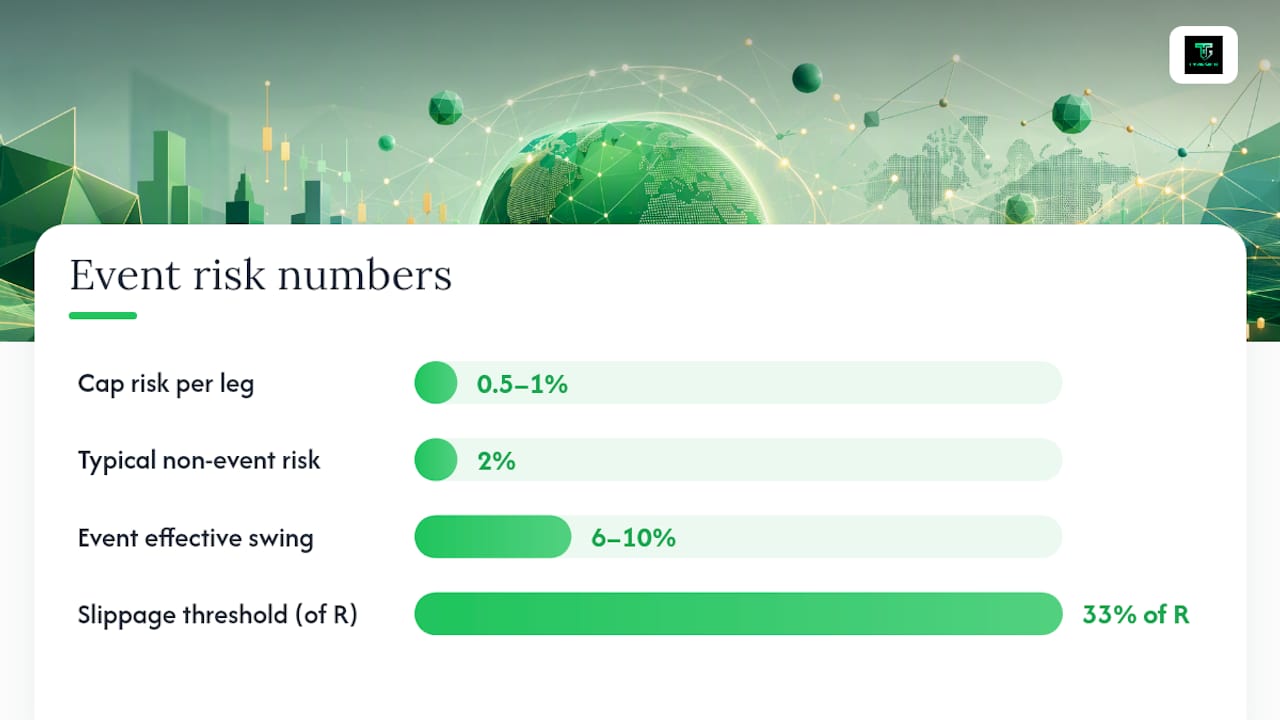
- Cap risk at 0.5% to 1% of equity per leg on any high-impact release. Volatility during these windows commonly runs several multiples of normal, so a standard 2% risk position can swing like a 6% to 10% position once the spread widens and price gaps through your stop.
- Anchor stops to pre-event ATR or the 15-minute range, not to a round number or gut feeling. Trail the stop only after price confirms direction, never before.
- Plan for slippage. Assume your stop will fill worse than the price you set, especially on the first few minutes after release, and size accordingly rather than hoping for a clean fill.
- Stay out when liquidity is compromised. Thin holiday sessions, back-to-back high-impact releases within minutes of each other, or a market already running on fumes from a prior shock are all valid reasons to skip the trade entirely.
Track three numbers after every event trade to know if your rules are working: win rate, average R multiple per trade, and slippage as a percentage of intended entry. If slippage regularly eats more than a third of your expected R, your sizing or entry timing needs adjustment, not your stop-loss placement. Full risk-management fundamentals apply here with extra weight given to event-day volatility.
Pro Tip: *Review your event-day trades separately from your regular trading journal.
Rehearsing the Playbook Before You Risk Real Money
Confidence in a news strategy comes from repetition, not conviction. Build scenario variants for any release you plan to trade: a beat, an in-line print, and a miss, each rehearsed separately in a demo account so you see how your rules behave under different outcomes before real capital is on the line.
A workable validation loop looks like this:
- Replay 50 simulated trades using your fixed entry, stop, and sizing rules
- Track average R per trade, stop-hit rate, and slippage percentage across the batch
- Only move to live trading once expectancy and drawdown numbers meet the thresholds you set going in, an approach detailed in this backtesting framework
Treat major past events, like the Bank of Japan’s 1.25% rate decision and the yen volatility that followed, as free case studies. Rebuild them, run your rules against the recorded price action, and see where your stop would have landed. This is the same rehearsal method behind Gabriel’s 18-plus years of live-market testing at Trader Gibkey: structured practice against real historical events, not theory, is what separates traders who survive news volatility from those who get chopped up by it. For a deeper walkthrough of this validation process, see how to validate a forex strategy in live markets.
Two Releases That Show the Rules in Action
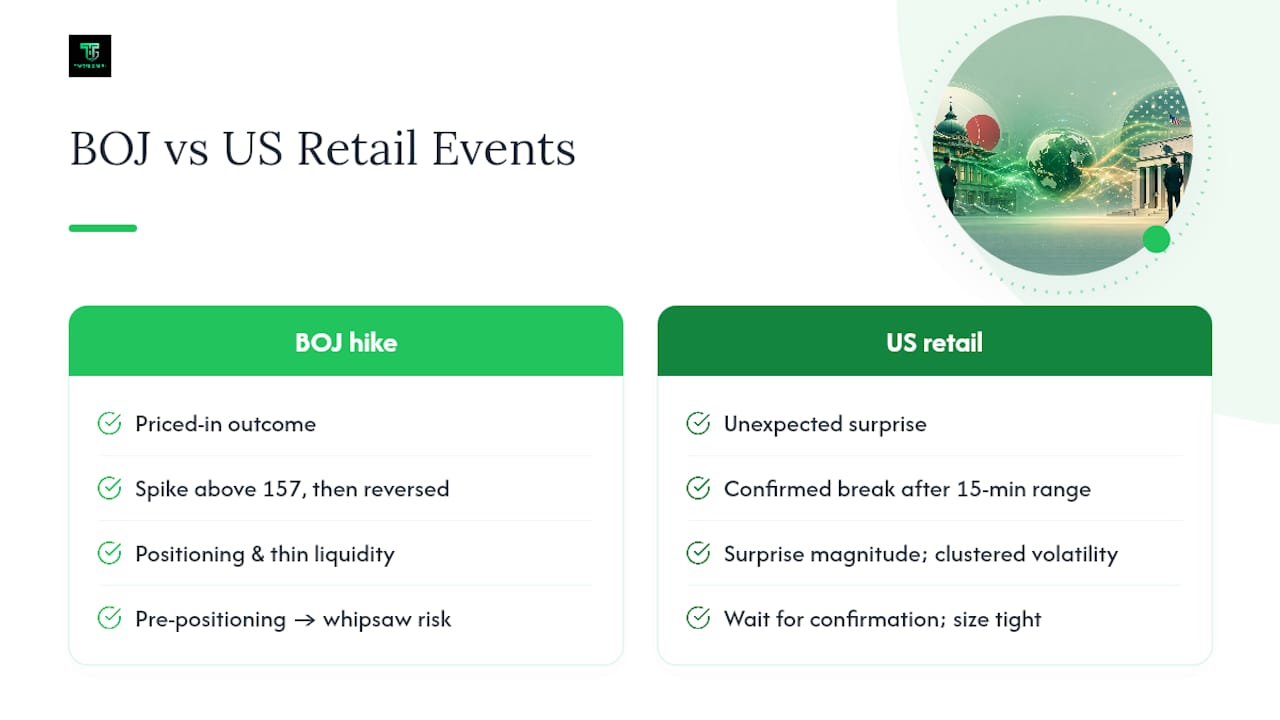
When the Bank of Japan hiked rates to 1.25%, the move was largely expected, yet USD/JPY still spiked above 157 before reversing hard. The lesson: a priced-in outcome can still whipsaw traders who pre-positioned on the headline alone, because positioning and thin liquidity, not the number itself, drove the second leg of the move.
A US retail sales surprise offers the opposite lesson. Traders who waited for the 15-minute range to settle avoided the initial fake-out entirely, entering only once the confirmed break held. Surprise magnitude matters, volatility clusters around these events, and sizing discipline is what separates a manageable loss from a damaging one.
What Actually Trips Up News Traders
Chasing the first spike is the most common mistake we see, followed closely by oversizing because “this one feels obvious” and ignoring how thin liquidity gets in that opening minute. The fix is boring but it works: cut size, wait for confirmation, and log every trade honestly. Structured mentorship shortens this learning curve considerably, because someone who’s already made these mistakes can flag them before they cost you.
— Gabriel
Learn the Playbook With Trader Gibkey
Reading a checklist and executing it under pressure are two different skills, and the gap between them is where most news trades go wrong. Tradergibkey closes that gap with structured courses and live mentorship built around real price action, not signal-following.
The Price Action (Core) plan covers the setups and confirmation rules used throughout this playbook. Traders who want a deeper edge around liquidity-driven moves can access extended learning options, including long-term access packages. If you want direct feedback on your own event-day trades, mentorship sessions are available, where live reviews replace guesswork with a second set of experienced eyes. For daily market context around scheduled releases, a weekly Telegram channel keeps you briefed without committing to a full course. Head to Trader Gibkey to see current enrollment options and pick the format that fits how you trade.
Where to Track the Numbers That Move Markets
For consensus figures and real-time surprise tracking, Investing publishes forecast, actual, and previous values on a live table. TradingEconomics offers deep historical series for building replay scenarios and checking how a country’s data has trended over time.
Sources
- BoJ’s 1.25% hike: yen volatility, carry trades, and what traders should learn
- Mastering MQL5: A Comprehensive Guide to the MQL5 Calendar and its Applications?
- Investing
FAQ
What Is the Best Strategy for Trading the News?
Pre-positioning ahead of the release carries far more risk and suits only traders with deep positioning data.
What Is the 3-5-7 Rule in Trading?
It’s a general risk guideline suggesting you risk no more than 3% on any single trade, cap total exposure across open trades around 5%, and target a 7% profit ceiling before reassessing. Definitions vary by source, so treat it as a rough sizing reference rather than a fixed rule, especially around high-impact events where volatility multiples call for smaller size than 3%.
Can You Make $1,000 a Day Day Trading?
It’s possible on a strong day with sufficient capital and a working edge, but it’s not a reliable expectation and isn’t tied to any specific account size or win rate. Consistent results come from disciplined sizing and rule-following over many trades, not from targeting a fixed dollar figure per session.